
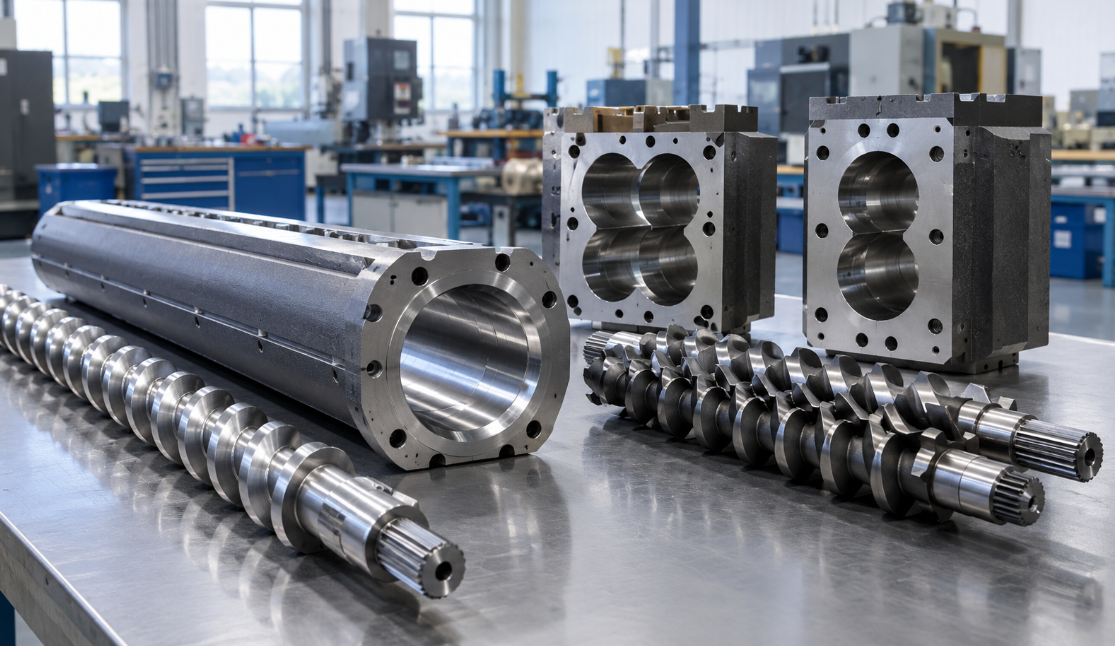
BLOOM is a screw barrel manufacturer in Zhangjiagang, Jiangsu, China. We make extruder barrels — segmented twin screw barrels, figure-8 barrel liners, conical barrels and single-screw barrels — together with the screws and screw elements that run inside them. We also make the wear alloys ourselves: our nickel-based alloy powder and HIP powder-metallurgy materials are produced in-house, on our own smelting and heat-treatment furnaces. Every part we ship comes with a material certificate, a hardness and case-depth report, a dimensional inspection record and a straightness (TIR) record.
By the BLOOM Engineering Team
This page covers the barrel side of our work and the screw and barrel as a matched pair: what we make, the alloys behind it, how a screw and barrel should be matched over their service life, and how to check any screw barrel manufacturer’s barrel capability — including ours. If you only need screws, with sizes, lead times and payment terms, our extruder screw manufacturer page covers those commercial details, and we will not repeat them here.
What We Make as a Screw Barrel Manufacturer
Our first factory, OuZi, opened in 2000 to make twin screw extruder parts, which is why twin screw barrels and liners are the deepest part of our range. Bloom (Suzhou) Materials Co., Ltd. was set up in 2017 to serve overseas customers, a newer plant in Anhui followed in 2021, and in 2023 we completed development of a bimetallic liner for parallel twin screw extruders. The full timeline is on our about us page.
| Product line | Machine type | What we supply | Product page |
|---|---|---|---|
| Twin screw barrel sections | Co-rotating parallel twin screw | Segmented barrels, solid or lined; standard models BLM-20 to BLM-135, or built to your drawing | Barrel body |
| Barrel liners | Parallel twin screw | Replaceable figure-8 liners, spray-welded or bimetallic | Liner sleeve |
| Screw elements and shafts | Parallel twin screw | Conveying, kneading and mixing elements from 20 mm to over 200 mm; splined shafts | Screw elements · Shafts |
| Conical barrels and screws | Conical counter-rotating twin screw | Matched conical barrel-and-screw sets for PVC pipe and profile | Conical barrel · Conical screw |
| Single screw and barrel sets | Single-screw extruders | General-purpose, barrier, pin-mixing and vented screw designs with matching barrels | Other screw and barrel |
We make twin screw elements as replacement parts for most major co-rotating extruder brands, and barrels and liners either to our standard models or to your drawings. For a machine we have not supplied before, we measure your existing parts, send a drawing for your approval, and start machining only after you sign it off.
Why Our Screw Barrel Work Starts With the Alloy
Most of what separates a long-lived barrel from a short-lived one cannot be seen on the finished part: the chemistry of the wear layer, its carbide content, how well it is bonded to the base steel, and how evenly it was heat-treated. Many screw barrel manufacturers buy their wear alloys ready-made; we make ours. Our core team comes from about 20 years of alloy material research, and that background shapes how we build barrels:
- We make our own wear-alloy raw materials. Our nickel-based alloy powder and HIP (hot isostatic pressing) powder-metallurgy materials are produced in-house. The chemistry of a liner or element is set by us, not by whichever powder lot happened to be bought that month.
- We heat-treat in our own plant. Our own smelting and heat-treatment furnaces mean base hardness and case depth are controlled by the same team that machines the part.
- We changed how liners are made. We moved liner production from sintering to spray welding, and we rate our spray-welded liners at 3 to 5 times the service life of conventional sintered liners.
The barrel materials below cover most of the orders we see. Hardness values are the figures we work to for each grade.
| Material | What it is | Hardness | Where it fits |
|---|---|---|---|
| BLM01 | Solid barrel steel, equivalent to grade 45 | 55–58 HRC | Low-abrasion, cost-sensitive barrels |
| BLM02 | Solid barrel steel, equivalent to 42CrMo | 60–62 HRC | General compounding barrels |
| BLM03 | Nitriding steel, equivalent to 38CrMoAlA | Nitrided case, HV 950–1,000 | Unfilled polymers, mild corrosion |
| Spray-welded liner | Wear alloy spray-welded into a replaceable liner | Depends on the alloy chosen | Filled compounds; the liner is replaced while the barrel body is kept |
| BLM60 | Nickel-based alloy | HRC 62–64 | Wear plus corrosion: glass fibre, mineral and flame-retardant compounds |
| BLM6 | Cobalt alloy 6 | HRC 40–45 | Strong-acid and other corrosive service |
For the two most common barrel constructions side by side, see bimetallic vs nitrided barrel, and for how much wear layer a lined barrel really has, see how thick the bimetallic barrel liner is.
Why a Screw and Barrel Should Be Matched as a Pair
A screw and barrel are two parts that share one critical dimension: the flight clearance, the gap between the flight tips and the barrel wall. The usual rule is that clearance per side equals the nominal diameter divided by 1,000 — about 0.10 mm per side on a 100 mm screw. When that gap opens, melt leaks back over the flights, output falls and melt temperature climbs. In one published example, a worn 100 mm screw running polyethylene saw its discharge temperature rise from 236°C toward 246°C, and the line needed a 13% rate reduction to hold quality.
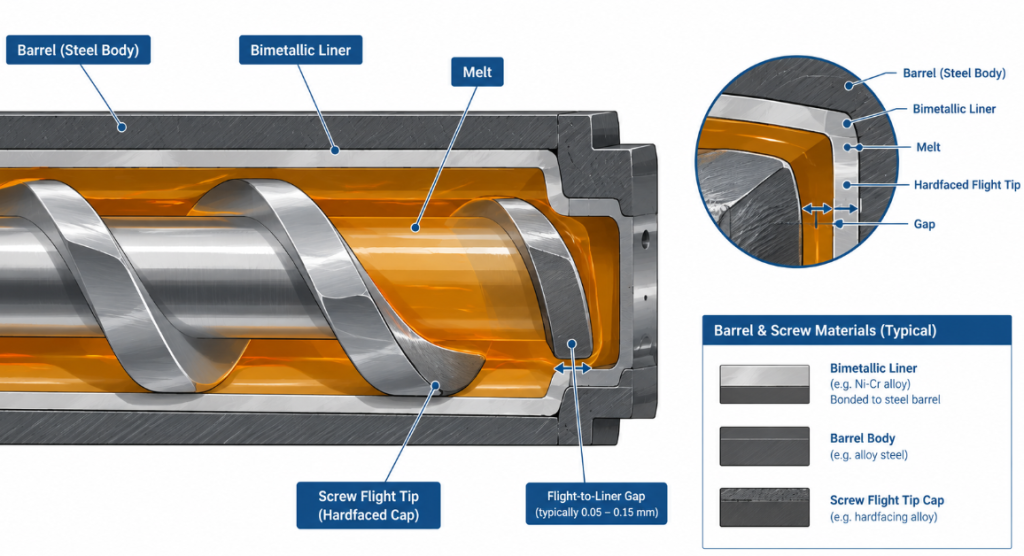
Three facts follow for anyone buying screws and barrels:
- The barrel outlives the screw. A barrel with an iron-based bimetallic liner typically lasts about three times as long as the screw running in it, so over one barrel’s life you will usually buy several screws or rebuilds. We explain why in does the screw or barrel wear out first.
- The barrel’s measured bore should set each new screw’s size. A replacement screw made to the original drawing, for a barrel that has already worn, starts life with too much clearance. Whoever makes your barrel should keep its measured bore on record so that each new screw is machined to the barrel you actually have. Ask any screw barrel manufacturer for this, including us.
- Materials should be paired, not chosen one part at a time. Corrosion-resistant alloys conduct heat less well than ordinary steels, which is one reason published guidance stresses matching the screw and barrel. A hard liner paired with a soft screw — or the reverse — simply moves the wear to the weaker part.
When one part is worn, there are four realistic options:
| Situation | Option | Trade-off |
|---|---|---|
| Screw worn, barrel still within limits | New or rebuilt screw machined to the barrel’s measured bore | Lowest cost; restores the original clearance |
| Barrel bore worn evenly, liner thickness remaining | Hone the barrel oversize and make a matching oversize screw | Thinner liner, and liner hardness drops as it thins; channels get deeper (about 10% deeper metering on a 2.5-in. screw taken 0.030 in. oversize), which reduces pumping, especially with low-viscosity resins |
| Liner worn through, or bore worn unevenly | New barrel, or a new liner in a lined twin screw barrel, plus a new screw set | Highest cost; a complete reset of the clearance |
| Twin screw barrel worn in one zone only | Replace that barrel section or liner and the elements running in it | Only works if wear is measured section by section |
The oversize route has a hard limit. A typical iron-based bimetallic liner is only about 1.5 mm (0.060 in.) thick, and honing a barrel 0.030 in. oversize removes a quarter of that liner from each side. Before choosing it, compare it with the options in extruder barrel repair vs replacement. On twin screw machines, measure each lobe in each section first — the method is in how to measure twin screw barrel wear — and compare the result with the limits in our screw wear limit calculator.
Pairing Screw and Barrel Materials by Application
The compound decides the pairing. This is the starting point we use before looking at filler type and loading, processing temperature and screw speed:
| Application | Barrel or liner | Screw or elements | Why this pairing |
|---|---|---|---|
| Unfilled PE, PP and other low-abrasion resins | Nitrided 38CrMoAlA (BLM03) | Nitrided 38CrMoAlA | Low wear; lowest cost per set |
| Glass-fibre, talc and mineral-filled compounds | Bimetallic or spray-welded liner, e.g. BLM60 | PM-HIP elements (CPM 10V, CPM 9V, SAM-series) or W6Mo5Cr4V2 tool steel; hardfaced flights on single screws | Abrasion is the main mechanism, so both parts need carbide-rich alloys |
| PVC and flame-retardant compounds that release acids | Nickel-based liner | Corrosion-resistant PM-HIP grades (SAM26, SAM39); chrome-plated nitrided steel on single screws | Corrosion first, with some abrasion |
| Fluoropolymers such as PVDF, FEP and PFA | Nickel-based alloy | Nickel- or cobalt-based alloys on every surface that touches the melt | Corrosive at processing temperature; small defects in plating let corrosion through |
| Strong-acid environments | Nickel-based liner | Cobalt alloy 6 (BLM6, HRC 40–45) | Corrosion resistance matters more than peak hardness |
| Severe abrasion plus corrosion | Tungsten carbide or HIP-type liner | Tungsten carbide overlay or PM-HIP elements | Highest material cost; reserved for formulations that wear out everything else |
The upgrade paths are covered in more depth on our bimetallic screw and barrel, nickel-base alloy extruder barrel and tungsten carbide screw and barrel pages. For fluoropolymers specifically, see screw barrel for fluoropolymer extrusion, and for why fibre-filled grades are so hard on both parts, see why glass fiber reinforced plastic wears extruder screws fast.
How We Build a Screw Barrel, Step by Step
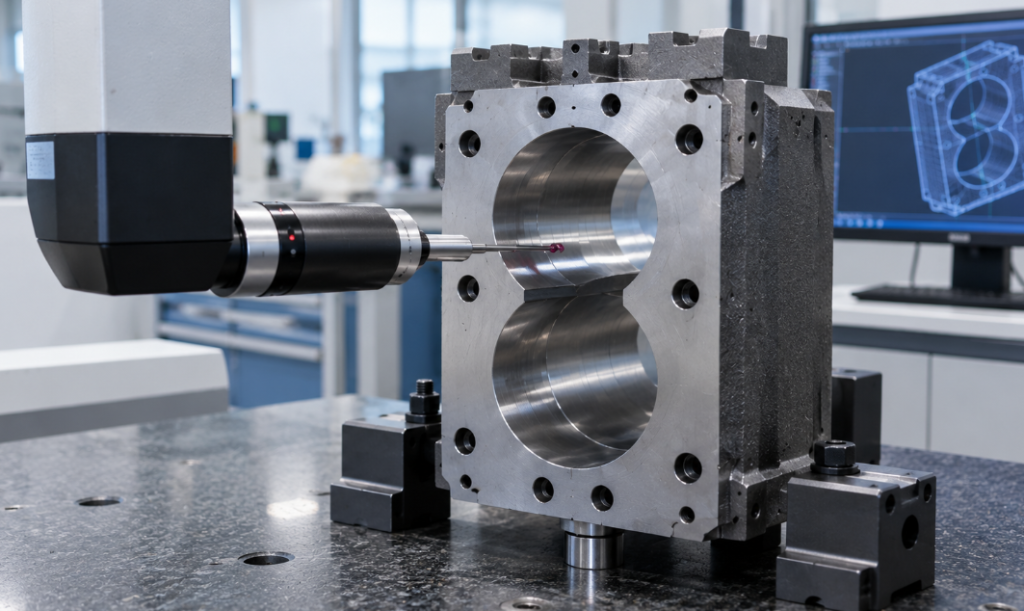
The screw side of the process is described in how are extruder screws made. On the barrel side, a part moves through our plant like this:
- Alloy and chemistry check. Bar stock and powders are checked with a spectral analyzer and a carbon-sulfur analyzer before machining begins. Our nickel-based and HIP powders are made in-house.
- Rough machining and boring. Single-screw barrels are deep-hole drilled; twin screw barrels have their figure-8 bore and center distance roughed out.
- Heat treatment. Quench and temper on our own furnaces — for 38CrMoAlA parts, to a core hardness of about HB 260–320 — so the part stays tough under its hard surface.
- Wear surface. Either nitriding, to a case depth of 0.5–0.7 mm at HV 950–1,000, or a spray-welded or bimetallic liner for abrasive and corrosive service.
- Finish machining. The bore is brought to final size and surface finish; flanges, bolt patterns, heating and cooling channels, and pressure and temperature ports are machined to drawing.
- Inspection. A coordinate measuring machine imported from Germany checks bore geometry and center distance. A precision height gauge, hardness testing, ultrasonic flaw detection, dye-penetrant testing for surface cracks, and metallographic checks of case depth and liner structure follow.
- Traceability. Every part is marked with a code and its processing dates as it moves through production, so its records can be traced after it ships.
More detail on our inspection equipment is on our quality page.
What Ships With Every Screw Barrel We Make
Any screw barrel manufacturer can promise quality; records prove it — if you know what to do with them. This is what comes with each part, and what to check when it arrives:
| Record | What it shows | What to check on arrival |
|---|---|---|
| Material certificate | Chemistry of the steel or alloy | The grade matches your order — 38CrMoAlA, BLM60 or whatever was specified |
| Hardness and case-depth report | Surface hardness, nitride case depth or wear-layer thickness | Hardness and depth meet the agreed specification |
| Dimensional inspection record | Bore, flight or element OD, center distance, flange and port dimensions | Measure bore and OD yourself and calculate the clearance |
| Straightness (TIR) record | Runout along the screw or shaft | Check on V-blocks or between centres before installation |
Bimetallic screws also ship with a metallographic photograph showing the thickness of the alloy layer. Checking a new set on arrival takes little time and catches problems before installation; our guide to inspecting a new extruder screw walks through the measurements step by step.
Screw Barrel Applications We Build For
As a screw barrel manufacturer, we see most of our orders come from a handful of industries, each with its own wear and corrosion pattern. Our application guides go into the details:
- Wire and cable compounds — wire and cable extruder screw guide
- Compounding and masterbatch — compounding and masterbatch extruder screw guide
- PVC pipe and profile — PVC extruder screw and barrel guide
- Polyester fibre spinning — PET filament spinning screws and IV retention
- Lithium battery separator film — screw barrel for battery separator
- Solar encapsulant film — screw barrel for EVA and POE solar encapsulant film
- New-energy vehicle and energy-storage compounds — compounding screws for NEV and energy storage materials
- Medical tubing — medical tubing extruder screw guide
- Recycled plastics — recycled plastic extruder screw guide
- Foam extrusion — foam extrusion tandem cooling screw
How to Check a Screw Barrel Manufacturer’s Barrel Capability
A general supplier audit looks at business licences and workshop photos. For barrels, five questions tell you more:
- How is the bore measured, and on what? A twin screw barrel needs each lobe and the center distance checked, not one diameter. Ask for a real CMM report from a recent barrel.
- How is the bond of the wear layer verified? Ultrasonic testing is the usual way to find unbonded areas in a bimetallic layer. Ask whether every liner is tested or only samples.
- Where does the wear alloy come from? A manufacturer that buys its powder can only certify what its supplier tells it. Ask for the chemistry of the alloy that will actually be in your liner.
- What clearance will you build to — and to whose bore? A good answer refers to your barrel’s measured bore, not only to the original drawing.
- Can I see the four records from a recent order? Material certificate, hardness and case depth, dimensions and straightness — anonymised is fine. A supplier that cannot show them is unlikely to send them with your order.
For the full supplier audit — telling a real factory from a trading company, checking documents, spotting red flags — see how to audit an extruder screw supplier in China and how to choose an extruder parts supplier in China.
When Another Screw Barrel Supplier Is the Better Choice
We would rather lose a quote than win the wrong order. Here are three situations where an overseas screw barrel manufacturer — us included — is not the best answer:
- During your machine’s warranty period, buying wear parts from the extruder’s original builder keeps warranty questions simple.
- When the line is down today, a local shop that can hardface and regrind your screw this week will beat any overseas manufacturer on time — sea freight alone takes weeks.
- When price per part is the only criterion, we are rarely the cheapest. Our premium alloys cost more than plain nitrided steel, and that cost only pays back where wear or corrosion is the real problem. For an unfilled resin on a lightly used line, a standard nitrided set is often the sensible buy — and we will tell you so.
Screw Barrel Manufacturer FAQ
Can you make only a barrel, or only a screw for my existing barrel?
Yes. For a barrel alone we need your drawing or the old barrel’s dimensions, including the flange and bolt pattern. For a screw to run in your existing barrel, send the measured bore — ideally at several points along its length — so the screw can be machined to the barrel you have now rather than the one you started with.
Can a worn twin screw barrel be relined instead of replaced?
If it is a lined barrel, usually yes: the worn liner is removed and a new one is fitted into the barrel body, which is kept. For a solid barrel, whether lining it is worthwhile depends on its size and wall thickness, so send us the dimensions first. See our liner sleeve page for standard liners.
How long does a screw barrel last?
The compound matters far more than the calendar. As a general guide, a barrel with an iron-based bimetallic liner lasts about three times as long as the screw inside it. The reliable approach is to measure clearance at planned intervals and replace parts at a defined limit; see how long a bimetallic barrel lasts.
What do you need to quote a screw and barrel set?
Your extruder make and model; for single-screw machines, the diameter, L/D and barrel drawing; for twin screw machines, the barrel model or section drawings, element OD, center distance and element list; the material you process, including fillers and loading; your output; and the problem you are trying to solve. Our custom extruder screw RFQ guide lists everything in detail.
Are your twin screw parts compatible with my extruder?
Our twin screw elements are made as replacement parts for most major co-rotating extruder brands, and our barrels and liners are built either to our standard models or to your drawings. For a machine we have not supplied before, we measure your parts and send a drawing for your approval before any machining starts.
Where are you located, and do you ship overseas?
Our office is at 2106, Block B, Wanda Center, Zhangjiagang, Jiangsu, China, and we ship to customers in more than 10 countries. If you would like to see the workshop before ordering, ask us for a live video walk-through.
A good screw barrel manufacturer does not just sell you two parts: it sells you a clearance — a barrel built to last, screws made to fit the bore it actually has, and the records to prove both.
If you are looking for a screw barrel manufacturer to replace a worn twin screw barrel, reline one, or make a screw that fits the barrel you already run, send us your machine model, your barrel drawings or bore measurements, and the compound you process on WhatsApp or by email at kara@ttxalloy.com. Our engineers will recommend a barrel and screw pairing and quote both. Standard models are listed on our barrel body, liner sleeve and screw elements pages.
References and Further Reading
- Womer, T., & Spalding, M. (2023). “Troubleshooting Screw and Barrel Wear in Extrusion.” Plastics Technology. https://www.ptonline.com/articles/troubleshooting-screw-and-barrel-wear-in-extrusion
- Womer, T. (2012). “Oversizing Screws and Barrels.” Plastics Technology. https://www.ptonline.com/blog/post/oversizing-screws-and-barrels
- Anderson, R. (2012). “How to Spec’ Screws & Barrels For Running Corrosive Materials.” Plastics Technology. https://www.ptonline.com/articles/how-to-spec-screws-barrels-for-running-corrosive-materials
- Wulbieter et al. (2020). “Influence of Hot Hardness and Microstructure of High-Alloyed Powder Metallurgical Tool Steels on Abrasive Wear Behavior at Elevated Temperatures.” steel research international, Wiley. https://onlinelibrary.wiley.com/doi/full/10.1002/srin.201900461


Pingback: Extruder Screw Manufacturer: Custom and Replacement Screws from Our Own Workshop
Pingback: Conical Twin Screw Barrel Guide: Sizes, Wear and What to Specify for PVC