
We are a Chinese factory that makes extruder screws and barrels — so this guide is unusual: we are going to tell you, the buyer, how to audit a supplier like us. We do this because the buyers who audit properly become our best long-term customers, and the ones who skip it usually get burned by someone else first and arrive distrustful of the whole market. An informed buyer is easier to work with than a nervous one.
By the BLOOM Engineering Team
Sourcing extruder screws from China can save you 40–60% versus OEM parts, but only if you get a real, capable factory — not a trading company reselling unknown workshops, and not the cheapest quote that turns into pitting and premature wear. This guide walks through how to tell a real factory from a middleman, the hard indicators of a capable screw shop, the material and coating verification that generic audit guides miss, and the exact questions to ask before you place an order.
1. Why Auditing Your Extruder Screw Supplier Matters
An extruder screw and barrel is a high-value, long-lead, performance-critical part. If it is made from the wrong steel, heat-treated improperly, or coated with something other than what you ordered, you will not find out for months — until it corrodes, wears out, or fails to hold tolerance. By then the supplier may be unreachable and your line is down.
The financial stakes are real. A wrong screw is not just the cost of the part — it is the downtime, the scrap, the re-order lead time, and the lost production while you wait for a replacement. Auditing the supplier before you commit is cheap insurance against all of that.
There is also a specific China-sourcing risk that auditing addresses: the gap between what a website or B2B-platform profile claims and what the factory can actually do. Glossy Alibaba profiles and AI-translated capability statements are easy to produce; a real machine shop with deep-hole drilling, in-house heat treatment, and inspection equipment is not. The audit is how you close that gap. The rest of this guide is the audit, written from the inside.
2. Four Common Mistakes Buyers Make When Sourcing Extruder Screws
From the factory side, we see the same four buyer mistakes repeatedly — and each one is avoidable.
Mistake 1: Choosing on price alone. The lowest quote is the most dangerous number in sourcing. Extruder screws have enormous hidden quality variation — the same-looking screw can be made from correct 38CrMoAlA or a cheaper substitute, properly nitrided or barely surface-treated, precisely ground or roughly finished. The cheapest quote almost always cut a corner you cannot see in a photo. Price should be one input, never the deciding one.
Mistake 2: Not distinguishing a trading company from a real factory. Many “suppliers” on B2B platforms are trading companies that relay your order to an unknown workshop, add a margin, and have no control over (or knowledge of) the actual manufacturing. You pay more and get less accountability. Telling the two apart is so important it gets its own section (section 3).
Mistake 3: Not verifying material and heat treatment. This is the screw-specific killer. Buyers accept “38CrMoAlA, nitrided” on a quote without ever asking for a material certificate or hardness report — and have no way to know if the delivered screw is actually that steel, actually that hardness, actually that coating. Verification is straightforward to ask for (section 5) and almost never done.
Mistake 4: Not checking after-sales and warranty. Buyers focus on the purchase and ignore what happens if the part fails. A real factory stands behind its work with a warranty and a process for handling problems; a fly-by-night supplier disappears. Asking about warranty up front also tells you how confident the supplier is in its own quality.
3. Trading Company vs Real Factory: How to Tell the Difference
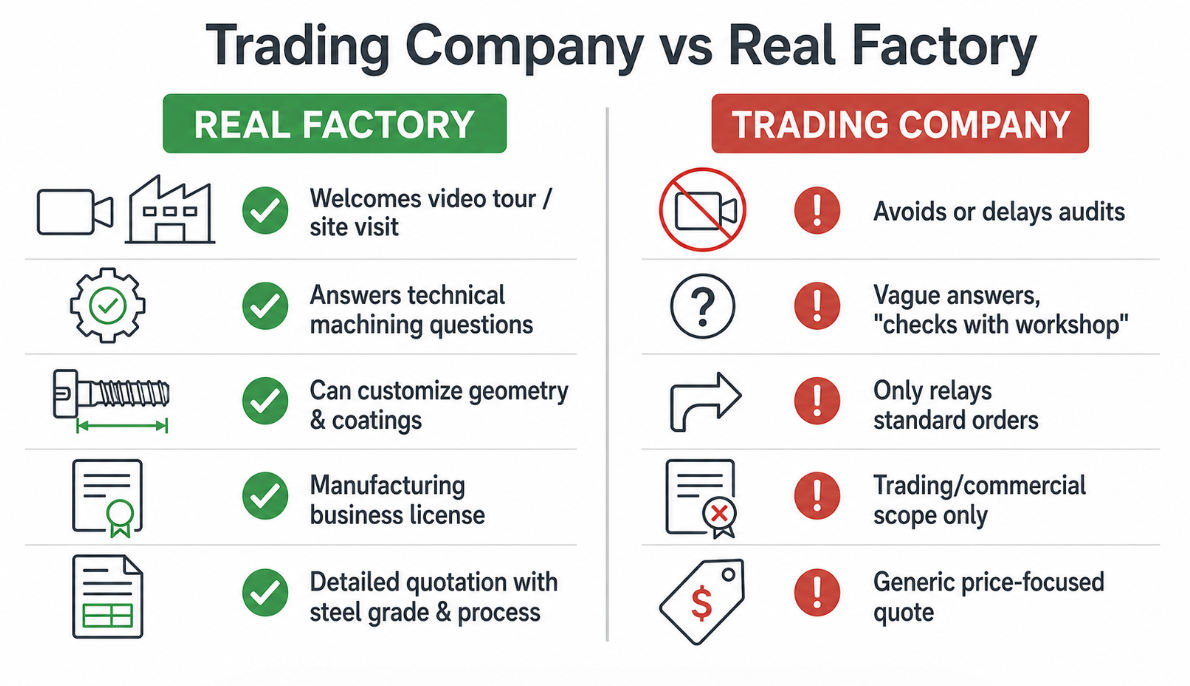
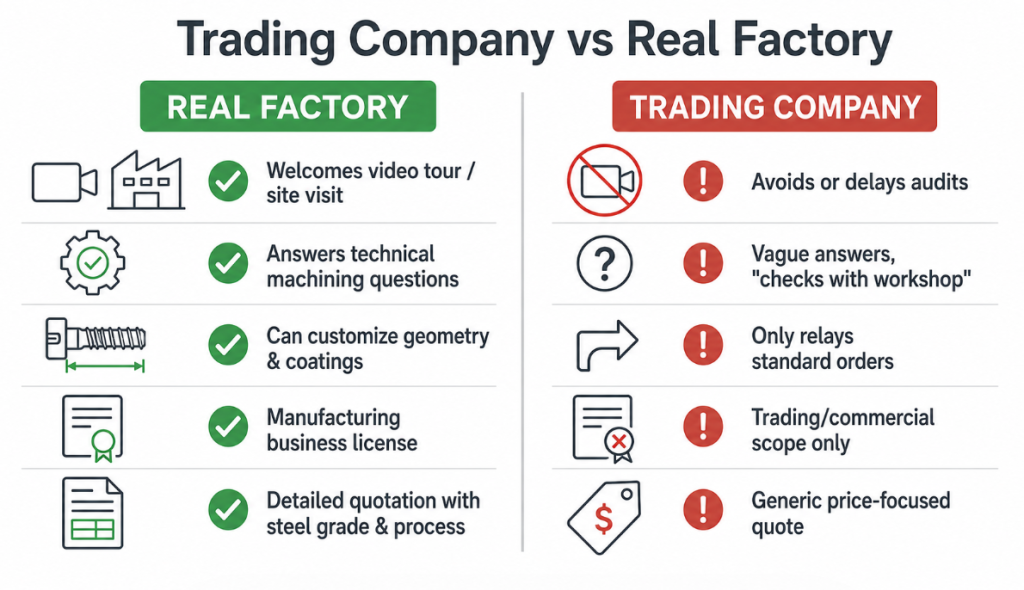
This is the most valuable thing we can teach you as a factory, because we know exactly how to spot a middleman — we deal with the consequences of their work when their customers come to us to fix it. A trading company is not always bad, but you should know which one you are dealing with, because it changes accountability, pricing, and quality control.
Here is how to tell them apart:
| Signal | Real factory | Trading company |
|---|---|---|
| Video tour / site visit | Welcomes it, shows the workshop and machines | Avoids it, makes excuses, or shows a “partner” facility |
| Technical detail questions | Answers specifics on machining, steel, heat treatment | Vague, defers, “checks with the workshop” |
| Customization | Can modify geometry, compression ratio, coatings | Only relays standard orders, can’t engineer changes |
| Business license / scope | Manufacturing scope on the license | Trading/commercial scope only |
| Quotation detail | Specifies steel grade, process, tolerances | Generic, price-focused, light on process detail |
The four most reliable tests, in our experience:
Test 1: Ask for a Video Audit or Site Visit
A real factory will walk you through the workshop on a video call — you should see CNC machines, deep-hole drilling equipment, heat-treatment or coating facilities, and inspection tools. A trading company will avoid this, delay, or show you a facility that is suspiciously generic. Refusing an audit is the single biggest red flag — capable factories have nothing to hide and know that audits win them serious customers.
Test 2: Ask Specific Machining Questions
Ask how they cut the flight, what their deep-hole drilling capacity is, how they control screw straightness, what hardness they achieve after nitriding. A factory engineer answers immediately and in detail. A trading company gives vague answers or says they will “check with the factory” — which tells you they are not the factory.
Test 3: Ask for a Non-Standard Customization
Request a modified compression ratio, a different coating, a specific L/D. A real factory discusses the engineering trade-offs with you. A trading company can only relay standard orders and cannot engineer a change — because they do not make anything.
Test 4: Ask for the Business License and Check the Scope
A manufacturer’s business license shows a manufacturing business scope. Verify the company name matches who you are dealing with, and that the scope includes manufacturing, not just trading or commerce.
4. The Hard Indicators of a Capable Extruder Screw Factory
Beyond “is it a real factory,” the next question is “is it a good factory.” These are the hard, verifiable indicators we would tell any buyer to look for — and the ones we hold ourselves to.
In-house manufacturing equipment, not outsourced. A capable screw factory owns its core production equipment: CNC lathes and milling machines, deep-hole drilling machines for barrels, thread/flight milling, and grinding. If the supplier outsources the actual machining, they cannot control quality or schedule. Ask what they make in-house versus send out — the more outsourced, the more risk.
Material traceability. A serious factory can trace the steel in your screw back to its source and provide a material certificate (mill certificate) and, on request, a spectral analysis confirming the alloy composition. If they cannot tell you where the steel came from or prove what it is, you have no guarantee you are getting what you ordered.
In-house or stable-partner heat treatment and coating. Heat treatment (nitriding) and coatings (chrome, bimetallic, hardfacing) are where screw quality is made or lost. The best factories do these in-house or have a stable, qualified partner — not a different cheap subcontractor each time. Inconsistent heat treatment is a leading cause of screws that wear out early. (For what these treatments are and how to evaluate them, see our extruder screw coating and surface treatment guide.)
A real inspection and QC process. A capable factory inspects dimensions, hardness, and straightness, and can provide an inspection report. Ask what they measure, with what equipment, and whether you will receive a dimensional and hardness report with the parts. No QC process means inconsistent quality, batch to batch.
| Hard indicator | What to ask for | Why it matters |
|---|---|---|
| In-house equipment | Video tour of machine shop, deep-hole drilling | Controls quality and schedule |
| Material traceability | Mill certificate, spectral report | Confirms you get the steel ordered |
| Heat treatment / coating | In-house or named stable partner | Consistency = service life |
| QC process | Inspection report (dimensions, hardness, straightness) | Batch-to-batch consistency |
| Track record | Case examples, references | Proven capability |
5. Verifying Materials, Heat Treatment, and Coatings (the Screw-Specific Step)
This is the section generic factory-audit guides leave out, and it is the most important for extruder screws specifically. You are buying a part whose entire value is in materials and treatments you cannot see. Here is how to verify them.
Verify the base steel. Ask for the mill/material certificate for the steel used. For a higher level of assurance on critical orders, ask whether they can provide a spectral (composition) analysis, or arrange a third-party material test. If a supplier resists providing any material documentation, treat it as a red flag — a real factory buys certified steel and keeps the paperwork.
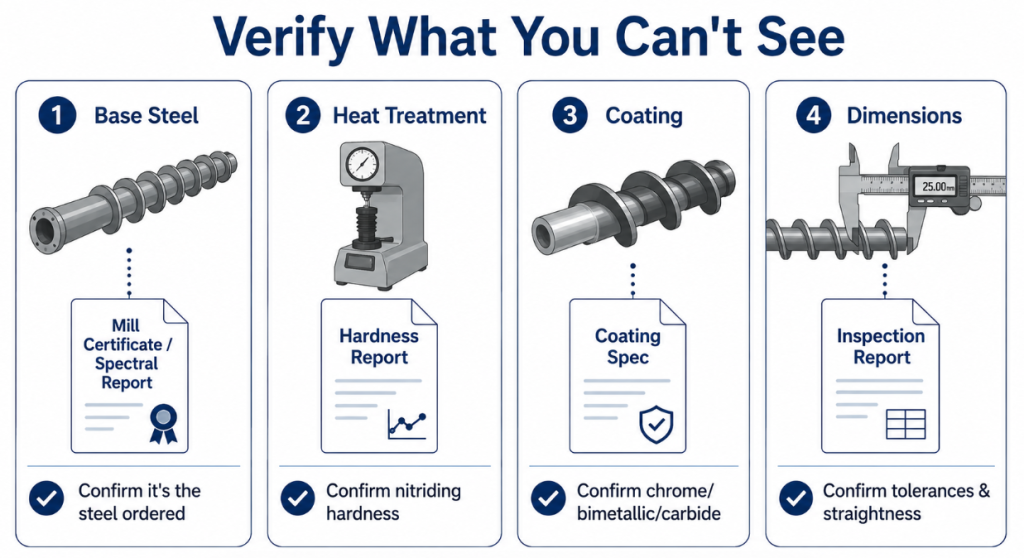
Verify the heat treatment. Nitriding should produce a specified surface hardness. Ask what hardness they achieve and ask for a hardness test report. The nitrided layer is thin, so the hardness and process control matter enormously for service life.
Verify the coating. If you ordered hard chrome, bimetallic, or carbide hardfacing, confirm it is actually applied and to what specification. Coatings are a common place to substitute a cheaper option the buyer cannot detect by eye. Ask how the coating is verified and whether it is done in-house or by a named partner. (Which coating you should even be specifying is covered in our coating and surface treatment guide, and the base-material trade-offs in our 38CrMoAlA vs bimetallic vs tool steel comparison.)
Verify dimensions and tolerances. Ask for a dimensional inspection report against the drawing — outer diameter, flight depth, straightness/runout. For a screw and barrel, the clearance between them is critical, and it depends on both parts being made to tolerance.
The principle across all of these: a capable factory documents what it makes and shares the documentation. The willingness to provide certificates and reports is itself one of the strongest signals of a real, quality-focused supplier.
6. The Pre-Order Questions to Ask Every Extruder Screw Supplier
Before placing an order, put these questions to the supplier. The questions do double duty: they get you the information you need, and the way the supplier answers tells you whether they are a capable factory or a middleman.
| Question | Why you ask | Good answer | Red flag |
|---|---|---|---|
| What steel will you use, and can you provide a material certificate? | Confirms material, tests transparency | Names grade, provides mill cert | Vague, no documentation |
| How is the coating/heat treatment done — in-house or outsourced? | Quality control over critical step | In-house or named stable partner | “Don’t know” / different subcontractor each time |
| What inspection do you do, and will I get a report? | Confirms QC exists | Lists measurements + provides report | No QC, no report |
| What is your lead time and production capacity? | Confirms they can deliver your order | Realistic, specific | Vague, or overpromising on a small shop |
| What warranty do you offer, and how are problems handled? | After-sales accountability | Clear warranty + process | No warranty / evasive |
On capacity specifically: a common failure is a small workshop accepting an order larger than it can deliver, then missing the deadline. Ask about realistic lead time and current capacity, and be wary of a tiny shop promising a huge order fast. (For a structured overview of the whole procurement process, see our 2026 extruder screw and barrel sourcing guide and our guide on choosing an extruder parts supplier in China.)
7. Running the Audit: Remote Video and On-Site
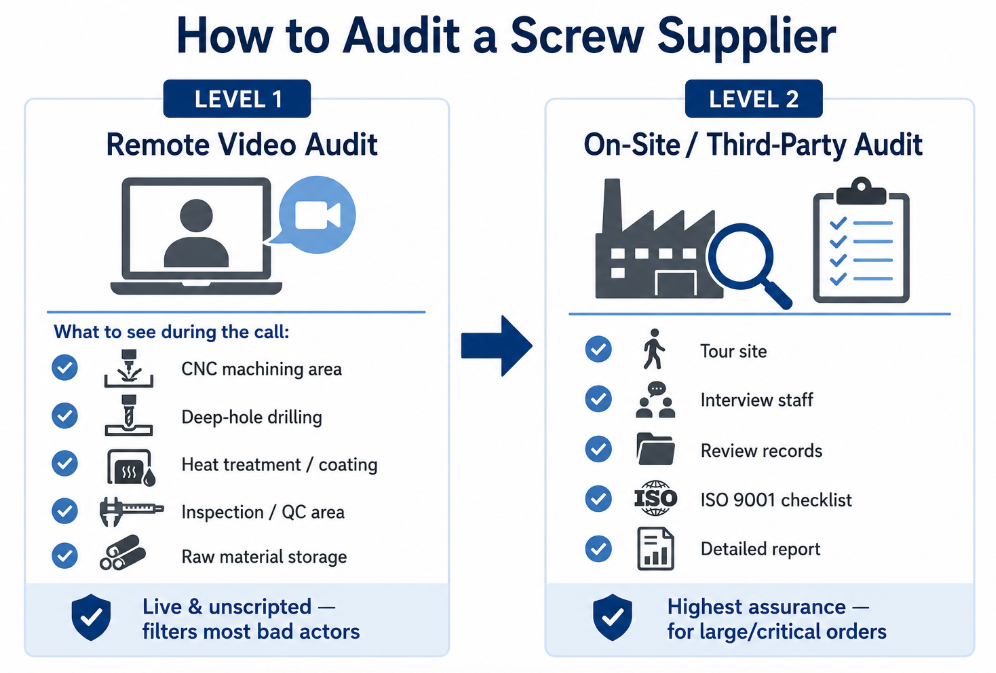
You do not always need to fly to China to audit a supplier. There are two levels, and even the lighter one filters out most bad actors.
Remote video audit. Schedule a live video call and ask the supplier to walk through the factory in real time — not a pre-recorded, edited video. Ask them to show: the CNC machining area, deep-hole drilling for barrels, the heat-treatment/coating area (or explain the partner), the inspection/QC area with measuring equipment, and raw material storage with steel that has identifiable markings. A capable factory does this readily. The live, unscripted nature is what makes it valuable — a trading company cannot fake a real machine shop on a live call.
On-site audit (or third-party). For large or critical orders, an on-site visit — by you, a representative, or a third-party inspection firm — gives the highest assurance. A third-party auditor follows a checklist (often based on ISO 9001), tours the site, interviews staff, and reviews records, then issues a report. This is worth the cost when the order value or the cost of failure is high.
A key behavioral signal: how the supplier reacts to the audit request. Suppliers who welcome audits are confident in their operations; suppliers who refuse, delay, or deflect are signaling they have something to hide. In our experience this reaction is one of the most reliable filters of all.
8. Verifying Certifications and Documents
Documents and certifications are part of the picture — but they must be verified, not just collected, because fake or meaningless certificates circulate widely.
Business license. Confirms the company is a legal entity and shows its business scope (manufacturing vs trading). Verify the company name matches who you are dealing with.
ISO 9001. ISO 9001 is the international standard for quality management systems, and a genuine certification indicates a formal, documented quality process (ISO: ISO 9001 quality management). But two cautions: first, ISO 9001 certifies that a process exists, not that the product is good — it is an indicator, not a guarantee. Second, fake or invalid ISO certificates are common, so verify the certificate is genuine by checking that the issuing certification body is accredited through a recognized accreditation member — the International Accreditation Forum maintains the framework for this (International Accreditation Forum). A certificate from an unaccredited or fictitious body is worthless.
Export license / capability. Confirms the supplier is authorized and able to export. For international buyers, a factory that exports regularly will handle documentation and shipping smoothly; one that does not may create customs and logistics problems.
Material and inspection certificates. As covered in section 5 — mill certificates, hardness reports, dimensional reports. These are the documents that matter most for the actual screw quality.
9. Extruder Screw Supplier Red-Flag Checklist
Pull it together into a quick red-flag list. Any one of these warrants caution; several together mean walk away.
- Refuses or repeatedly deflects a video audit or site visit
- Cannot answer specific machining or material questions (signals a trading company)
- Will not provide material certificates or inspection reports
- Quote is dramatically lower than others (a corner is being cut)
- Business license shows only trading/commercial scope, no manufacturing
- ISO or other certificates cannot be verified through an accredited body
- No clear warranty or after-sales process
- Overpromises a large order on an apparently small operation
- Insists on payment to a personal account or unusual payment terms
- Vague, generic communication that avoids technical specifics
10. Frequently Asked Questions About Auditing Extruder Screw Suppliers
How do I know if a Chinese extruder screw supplier is a real factory or a trading company?
Ask for a live video tour of the workshop, ask specific machining and material questions, request a non-standard customization, and check that the business license shows a manufacturing scope. Real factories show their shop and answer technical questions in detail; trading companies deflect, give vague answers, and can only relay standard orders.
Do I need to physically visit the factory in China?
Not necessarily. A live (unscripted) video audit filters out most bad actors and is enough for many orders. For large or critical orders, an on-site visit — by you or a third-party inspection firm — gives the highest assurance and is worth the cost relative to the risk of failure.
What documents should I ask an extruder screw supplier for?
A business license (with manufacturing scope), material/mill certificates for the steel, a hardness report for heat treatment, a dimensional inspection report, and any quality certifications like ISO 9001 — verified through an accredited body. The willingness to provide these is itself a strong quality signal.
Is ISO 9001 certification enough to trust a supplier?
No. ISO 9001 indicates a quality management process exists, not that the product is good, and fake certificates are common. Treat it as one positive indicator, verify it is genuine through an accredited certification body, and still do the material, coating, and inspection verification specific to screws.
How can I verify the steel and coating are what I ordered?
Ask for the mill certificate for the steel and a hardness report for the heat treatment; for critical orders, arrange a spectral composition analysis or third-party material test. For coatings, confirm the specification and how it is verified. A factory that resists providing any material documentation is a red flag.
Why is the cheapest quote risky for extruder screws?
Because screw quality variation is invisible. The same-looking screw can use correct or substitute steel, proper or minimal heat treatment, the specified or a cheaper coating, and precise or rough finishing. The cheapest quote almost always cut a corner you cannot see in a photo — and it surfaces later as wear, corrosion, or tolerance failure.
What should I ask about warranty and after-sales?
Ask what warranty period they offer and what the process is if a part fails or is out of spec. A real factory stands behind its work with a defined warranty and a clear resolution process. Evasiveness on warranty signals low confidence in their own quality — and no recourse for you.
Auditing Your Supplier: Final Word
Auditing an extruder screw supplier is not about distrust — it is about turning an opaque purchase into a transparent one. The screw’s value is in materials and treatments you cannot see, so the entire game is verification: confirm it is a real factory, confirm it has the equipment and QC, confirm the steel and coating are what you ordered, and confirm someone stands behind the part if it fails. Every step in this guide is something a capable factory can satisfy easily — which is exactly why the suppliers that resist these checks are the ones to avoid.
As a factory, our honest advice is to audit every supplier you are serious about, including us. The good ones will welcome it, and you will end up with a partner you can trust for years rather than a cheap quote you regret in months.
At BLOOM, we manufacture extruder screws and bimetallic barrels in-house, with material certificates, hardness and dimensional reports, and a standing invitation to audit our shop by video or in person. If you are evaluating suppliers — or want to see what a transparent factory looks like — contact our engineering team on WhatsApp with your part requirements, and ask us anything you would ask in an audit. For more on the sourcing process, see our guides on sourcing extruder screws from China and choosing an extruder parts supplier in China.Once you’ve chosen a supplier, see our guide on how to order a custom extruder screw for exactly what to send for an accurate quote.


Pingback: Screw Barrel Manufacturer in China | Barrels & Sets