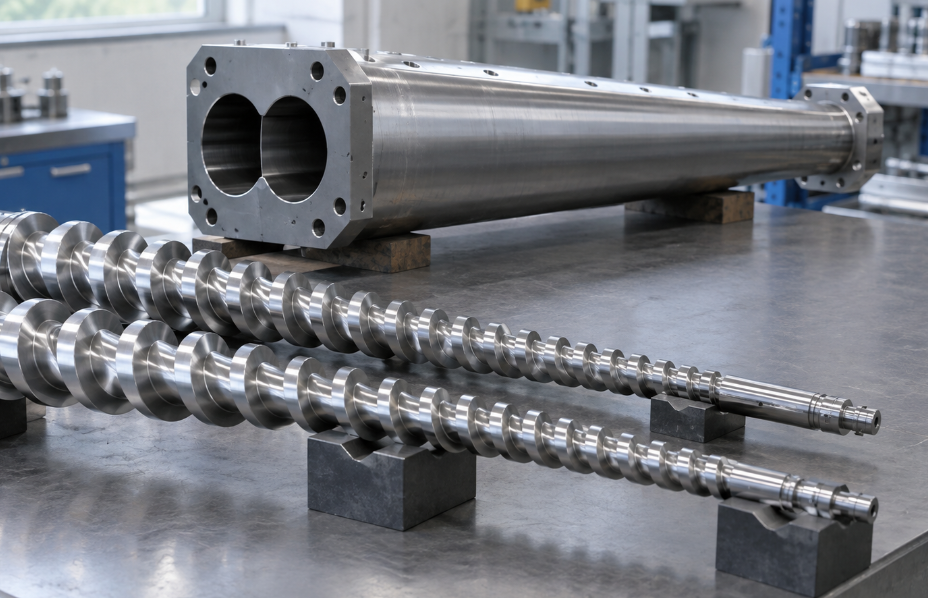
A conical twin screw barrel is the tapered barrel of a counter-rotating conical twin screw extruder, and it is bought, worn and replaced together with its pair of conical screws. Its size is written as two numbers — 65/132, for example — giving the screw diameter at the small (discharge) end and the large (feed) end in millimetres. Because most conical machines run rigid PVC dry blend loaded with calcium carbonate, which is abrasive and turns corrosive when the melt overheats, three things decide whether a replacement set performs: the bore and flight materials, the screw’s internal oil temperature control, and an exact match to your machine — not just the two numbers.
By the BLOOM Engineering Team
This guide explains how to read conical sizes, why the set is always matched, how a conical twin screw barrel wears on PVC, which materials suit which compounds, and what to send your supplier so the new set fits the first time.
How to Read Conical Twin Screw Barrel Sizes
Conical screws taper from a large diameter at the feed end, where the dry blend enters, to a small diameter at the discharge end. The size designation names both ends: in 65/132, the screws are 65 mm in diameter at the discharge end and 132 mm at the feed end. The taper gives the machine a large feed opening for powder and a built-in compression as the channel volume shrinks toward the die.
Choose a size designation to see its working length, output range and screw speed.
Don't know your size? Measure the flight outside diameter at both ends of the flighted section of one screw.
Planning capacity? Enter a target output to see which standard sizes cover it. Replacing parts? Your size is fixed by your extruder — use the other two tabs.
Our conical twin screw barrel range covers the sizes below. The figures are those listed on our product page; actual output depends on the formulation, the die and the downstream line.
| Size (small end / large end, mm) | Working length (mm) | Output (kg/h) | Screw speed (rpm) |
|---|---|---|---|
| 35 / 77 | 810 | 40–70 | 5–50 |
| 45 / 90 | 990 | 50–80 | 5–45 |
| 50 / 105 | 1070 | 100–150 | 4–45 |
| 51 / 105 | 1220 | 100–150 | 4–45 |
| 55 / 110 | 1220 | 120–180 | 4–40 |
| 60 / 125 | 1320 | 150–200 | 4–40 |
| 65 / 120 | 1440 | 200–250 | 4–40 |
| 65 / 132 | 1440 | 200–250 | 4–40 |
| 70 / 140 | 1460 | 220–300 | 4–40 |
| 75 / 150 | 1480 | 250–300 | 4–35 |
| 80 / 143 | 1800 | 300–360 | 4–35 |
| 80 / 156 | 1660 | 300–360 | 4–35 |
| 92 / 188 | 2000 | 400–500 | 4–35 |
Two details in this table matter more than they first appear:
- The two numbers do not define the set on their own. There are two 65 mm designs (65/120 and 65/132) and two 80 mm designs (80/143 at 1,800 mm long and 80/156 at 1,660 mm). Working length, flight design, drive end and barrel features all differ between machines that share a size label.
- Conical screws turn slowly. Speeds of a few tens of rpm are normal. Research on closely intermeshing counter-rotating extruders explains why: the separating force between the screws rises with speed, and large machines are generally limited to under 50 rpm.
Why a Conical Twin Screw Barrel Is Always a Matched Set
A conical bore is two intersecting cones, and the two screws — one left-hand, one right-hand — intermesh along the full length with a narrow calender gap between them. The clearances that matter are set by all three parts at once: flight tip to barrel wall, flight to flight, and flank to flank. That is why conical screws and barrels are made, checked and supplied as a set, and why a screw pair from one maker rarely drops cleanly into another maker’s barrel even when both carry the same size label.
When only part of the set is worn, the replacement still has to be matched. New screws for a used barrel should be machined to the barrel’s measured bore, not to the original drawing, or they will start life with too much clearance. The same logic applies to every screw and barrel pair; we explain it in more detail on our screw barrel manufacturer page.
How a Conical Twin Screw Barrel Wears in PVC
Rigid PVC attacks a conical set in three ways at once:
| Wear mechanism | Where it shows | What resists it |
|---|---|---|
| Abrasion from fillers such as calcium carbonate and titanium dioxide | Flight tips and bore, heaviest where the dry blend is compacted and fused | Bimetallic barrel layer; hardfaced flights |
| Corrosion from HCl when PVC overheats | Pitting on the bore, flights and screw roots | Chrome-plated screws; nickel-based alloys |
| Calender-gap separating forces pushing the screws toward the barrel wall | A wear band at about 30°–60° from vertical — the “ten o’clock and two o’clock” positions | Correct screw speed; hard, well-matched bore |
The third mechanism is specific to counter-rotating machines. As melt is squeezed through the calender gap between the screws, it pushes them apart and toward the barrel wall. A 2021 study of a closely intermeshing counter-rotating extruder running rigid PVC found the resulting wear concentrated in the region between 30° and 60° from the vertical, with the separating force rising as screw speed increases and the gap closes. The study used a parallel machine, but conical counter-rotating screws intermesh the same way.
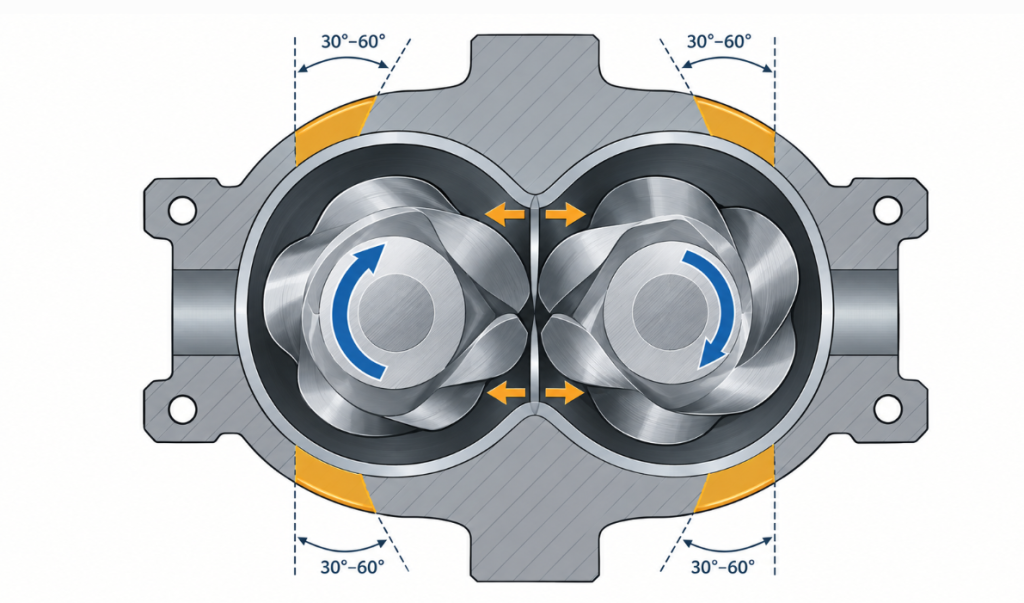
Two practical consequences follow. First, a bore reading taken only top-to-bottom can miss the worst wear, so measure at the 30°–60° positions as well — the method is in how to measure twin screw barrel wear. Second, running a conical machine faster to gain output also raises the separating force, so higher speed costs wear life as well as melt temperature.
Materials and Surface Treatments for a Conical Twin Screw Barrel
Most conical sets start from 38CrMoAlA nitriding steel, quenched and tempered to a core hardness of HB 260–320, with the surface treatment chosen to match the compound. The figures below are the ones we work to:
| Option | Applies to | What it gives | Best for |
|---|---|---|---|
| Nitrided 38CrMoAlA | Barrel bore and screws | HV 950–1,000 case, 0.5–0.7 mm deep, nitride brittleness grade 2 or better | Lightly filled PVC, profiles, cost-sensitive lines |
| Hard chrome plating over nitriding | Screws | Chrome ≥ 950 HV, 0.05–0.10 mm thick; resists HCl and helps the melt release | Most rigid PVC pipe and profile |
| Bimetallic barrel (38CrMoAlA with Ni + WC alloy layer) | Barrel | Wear layer 1.0–2.0 mm deep at HRC 56–65 | High calcium carbonate loading, recycled PVC, WPC |
| Plasma-welded hardfacing on flights | Screws | Cobalt-, nickel- or iron-based alloy on the flight lands | Filled compounds; screw rebuilds |
| Special steels (hot-work, cold-work, high-speed and HIP powder steels such as CPM 9V) | Screws and barrels for severe duty | Higher through-hardness and wear resistance | Very abrasive formulations |
A processing guide from a rigid PVC compound producer recommends bimetallic barrels for twin screw extrusion of rigid dry blend, and corrosion guidance in the trade press points PVC toward nickel-based alloys and corrosion-resistant surfaces. For a broader comparison of the surface options, see the PVC extruder screw and barrel guide, bimetallic vs nitrided barrel and how thick the nitrided layer really is. For wood-plastic composite on conical machines, see our WPC extruder screw guide.
Screw Core Temperature Control in a Conical Twin Screw Barrel
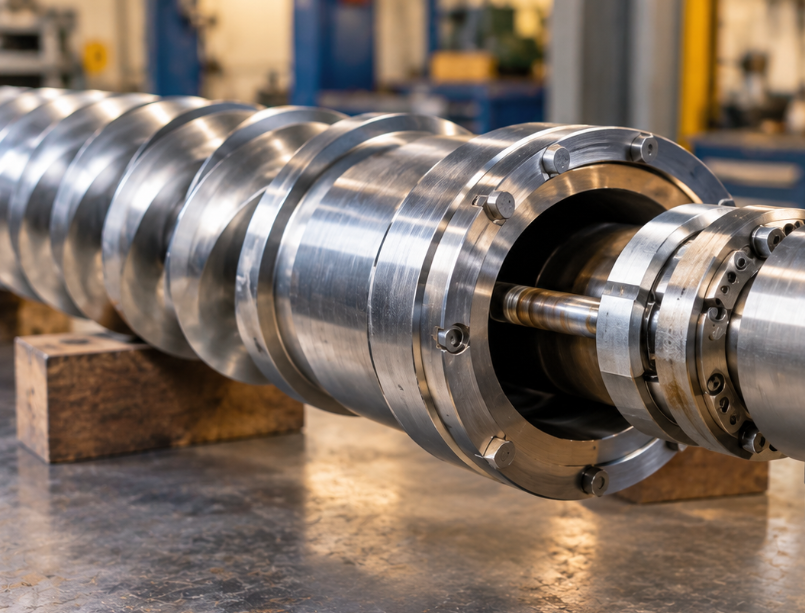
Conical screws for PVC are normally bored through their core and fed with temperature-controlled oil. The same rigid PVC processing guide recommends temperature-controlled, oil-filled screws for screw cooling and heating, alongside vacuum venting. Its typical settings give a sense of how narrow the window is: barrel 325–365°F (about 163–185°C), die 345–365°F (174–185°C) and melt 370–390°F (188–199°C).
The oil does two jobs:
- It keeps the screw surface below the degradation temperature. Rigid PVC often needs screw cooling all the way to the discharge tip, because shear heat builds in the screw and the material has little tolerance for it. When core temperature control fails, the first signs are usually yellowing and black specks — see why PVC turns yellow in the extruder and what causes black specks in PVC extrusion.
- It stabilises feeding. A screw that is too warm in the feed zone lets powder stick instead of conveying; one that is overcooled lets material solidify on the surface and cuts output. Internal cooling is a control, not a setting to max out.
For a buyer, this means the replacement screws must match your machine’s oil system: the core bore diameter and depth, the internal tube length, and the rotary-union connection at the drive end. These are easy to overlook when ordering by size label alone. For the barrel side of temperature control, see extruder barrel temperature control hardware.
Rebuild, Replate or Replace a Worn Conical Twin Screw Barrel Set
As with single-screw extruders, a hard-lined barrel usually outlasts the screws that run in it, so the most common repair is a new or rebuilt screw pair matched to the existing barrel.
| Condition | Option | What to know |
|---|---|---|
| Screw flight tips worn, roots sound, barrel within limits | Rebuild the screws: hardface the flights, regrind, re-plate | Machine to the barrel’s measured bore; see extruder screw rebuilding |
| Chrome worn or peeling, flights in good shape | Strip and re-plate the chrome | See can a chrome-plated screw be replated |
| Barrel bore worn evenly, wear layer still remaining | Hone the barrel and make matched oversize screws | The wear layer gets thinner, and deeper channels reduce pumping |
| Wear layer or nitride case worn through, deep scoring or corrosion pits | Replace the set | A chance to upgrade the material for your compound |
| Output falling and melt temperature rising, cause unclear | Measure before deciding | Check the 30°–60° band; compare with our screw wear limit calculator |
The oversize route has the same limits as on any barrel: every pass of the hone removes wear layer, and a deeper screw channel pumps less, which matters on a pressure-sensitive PVC pipe line. For the single-screw version of these choices, see extruder barrel repair vs replacement.
What to Specify When Ordering a Conical Twin Screw Barrel
| Item | Why it matters |
|---|---|
| Extruder make, model and year | Identifies the screw and barrel generation, not just the size |
| Size designation and working length | 65/132 alone is not enough; lengths differ between machines |
| Screw drawings, or the old screws for measurement | Flight design, compression and mixing sections are machine-specific |
| Drive-end details | Spline or key form, length and fit into the gearbox |
| Screw core oil system | Core bore, internal tube length, rotary-union connection |
| Barrel features | Flange, heating zones, cooling, vent position, feed opening |
| Material and surface treatment | Nitrided, chrome-plated, bimetallic, hardfaced flights |
| Compound and filler loading | Pipe, profile, WPC or foam board; calcium carbonate content |
| Inspection records | Material certificate, hardness and case-depth or wear-layer depth, dimensions, screw straightness |
On straightness, we hold our conical screws to 0.015 mm. When the set arrives, check the records against the order before installation; our guide to inspecting a new extruder screw walks through the measurements.
Conical Twin Screw Barrel FAQ
What does 65/132 mean on a conical twin screw barrel?
The screws are 65 mm in diameter at the small (discharge) end and 132 mm at the large (feed) end. The designation tells you the machine class, but not the working length, flight design or drive end, which you also need for a replacement.
Is a 65/132 set from one maker interchangeable with another?
Not reliably. Working length, flight geometry, drive end, barrel flange and heating layout vary between machines that share a size label — our own size range includes two different 80 mm designs. Send the machine model and, ideally, the old screws or drawings.
Can I replace only the screws?
Yes, if the barrel is still within its wear limits. The new screws should be machined to the barrel’s measured bore so the clearance is restored, not to the original drawing.
Do conical screws need internal oil temperature control?
For rigid PVC, yes in practice: temperature-controlled, oil-filled screws are the recommended setup for twin screw extrusion of rigid dry blend. A replacement screw must match your machine’s oil connection and internal tube.
Which conical sizes do you make?
From 35/77 up to 92/188, including 45/90, 51/105, 55/110, 65/132 and 80/156 — the full list is in the size table above and on our conical screw and conical barrel pages.
Should a new line be conical or parallel?
That is a machine-level choice rather than a parts choice; we compare the two in conical vs parallel twin screw extruders, and the wider family is covered in types of twin screw extruders.
A conical set is only as good as its match: the right two numbers get you in the door, but the working length, the wear-resistant surfaces and the screw’s oil temperature control decide how long it runs.
If you need a replacement conical twin screw barrel or a new screw pair for an existing barrel, send us your extruder model, the size and working length, drawings or photos of the old screws, and your compound on WhatsApp. Our engineers will confirm the match and recommend a surface treatment for your filler loading — see our conical barrel and conical screw pages for the standard range.
References and Further Reading
- Demirci, A., Teke, I., Polychronopoulos, N. D., & Vlachopoulos, J. (2021). “The Role of Calender Gap in Barrel and Screw Wear in Counterrotating Twin Screw Extruders.” Polymers, 13(7), 990. https://www.mdpi.com/2073-4360/13/7/990
- Westlake Compounds (2022). Extrusion Processing Guide — Rigid Dry Blend PVC Compound (Twin-Screw Extruder). https://www.link2westlake.com/resource/1652730681000/ProcessingGuides/RigidDryblendExtrusionProcessingGuide.pdf
- Plastics Technology. “EXTRUSION: When Internal Screw Cooling Makes Sense.” Plastics Technology. https://www.ptonline.com/articles/extrusion-when-internal-screw-cooling-makes-sense
- Anderson, R. (2012). “How to Spec’ Screws & Barrels For Running Corrosive Materials.” Plastics Technology. https://www.ptonline.com/articles/how-to-spec-screws-barrels-for-running-corrosive-materials
- Womer, T., & Spalding, M. (2023). “Troubleshooting Screw and Barrel Wear in Extrusion.” Plastics Technology. https://www.ptonline.com/articles/troubleshooting-screw-and-barrel-wear-in-extrusion
- Womer, T. (2012). “Oversizing Screws and Barrels.” Plastics Technology. https://www.ptonline.com/blog/post/oversizing-screws-and-barrels