
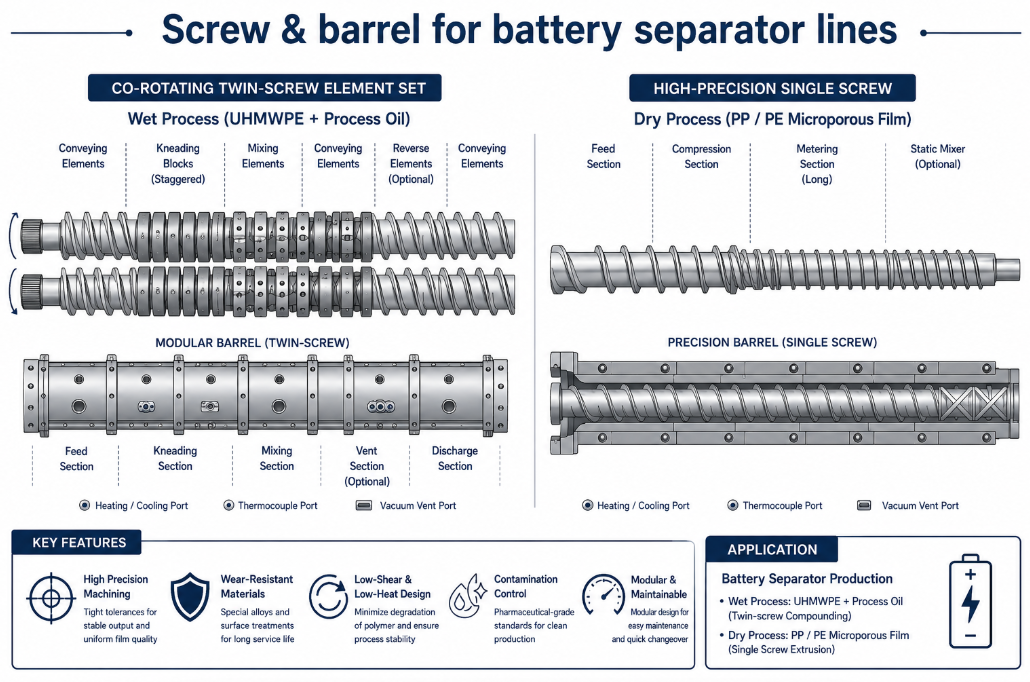
BLOOM manufactures screws, barrels, and twin-screw elements for lithium-battery separator extrusion — the wet-process twin-screw systems that dissolve UHMWPE into paraffin oil, and the high-precision single screws used in dry-process PP/PE lines. Separator extrusion is the least forgiving screw-and-barrel application in polymer processing: the film is 12–30 µm thick, a single carbonized particle bridging it is a potential internal short in a battery cell, and the wet process runs up to 70% oil through the machine. This page covers why separator duty demands different hardware than ordinary extrusion, what we build for it, and how to specify a replacement or upgrade for your line.
By the BLOOM Engineering Team
Why Separator Lines Are Different: Zero Tolerance
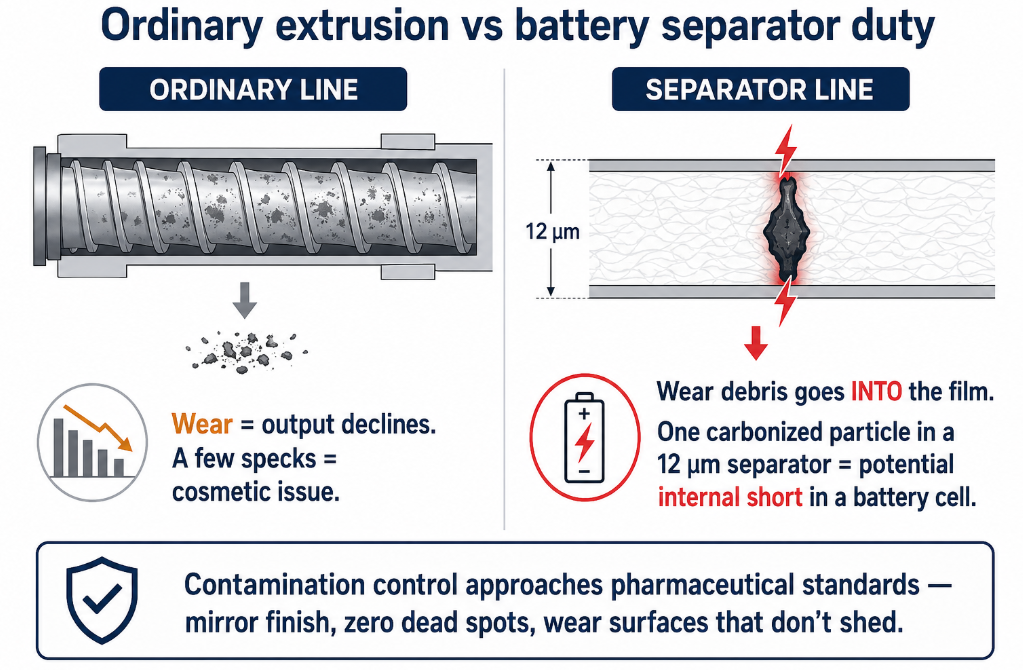
On a commodity line, screw and barrel wear costs you output. On a separator line, it can cost you a battery recall — and that difference drives every specification below.
| Requirement | Ordinary extrusion | Battery separator extrusion |
|---|---|---|
| Contamination | A few dark specks = cosmetic issue | One carbonized particle in a 12 µm film = potential internal short — contamination control approaches pharmaceutical standards |
| Wear consequence | Output declines gradually | Wear debris and metal migration go into the film — a safety defect, not a productivity one |
| Surface finish | Polished is good practice | Mirror finish (Ra ≤ 0.4 µm class) is a specification, because every rough patch is a hang-up point that chars |
| Melt uniformity | Affects quality | Is the yield — thickness tolerance is measured in microns, and melt non-uniformity prints straight into it |
| Dead spots | Cause black specks eventually | Disqualifying — geometry must be fully streamlined |
This is why a separator line’s screw and barrel cannot simply be “a good standard set”: the material system, the geometry discipline, and the wear strategy all change.
Wet Process: Twin-Screw Elements and Barrels for UHMWPE + Oil
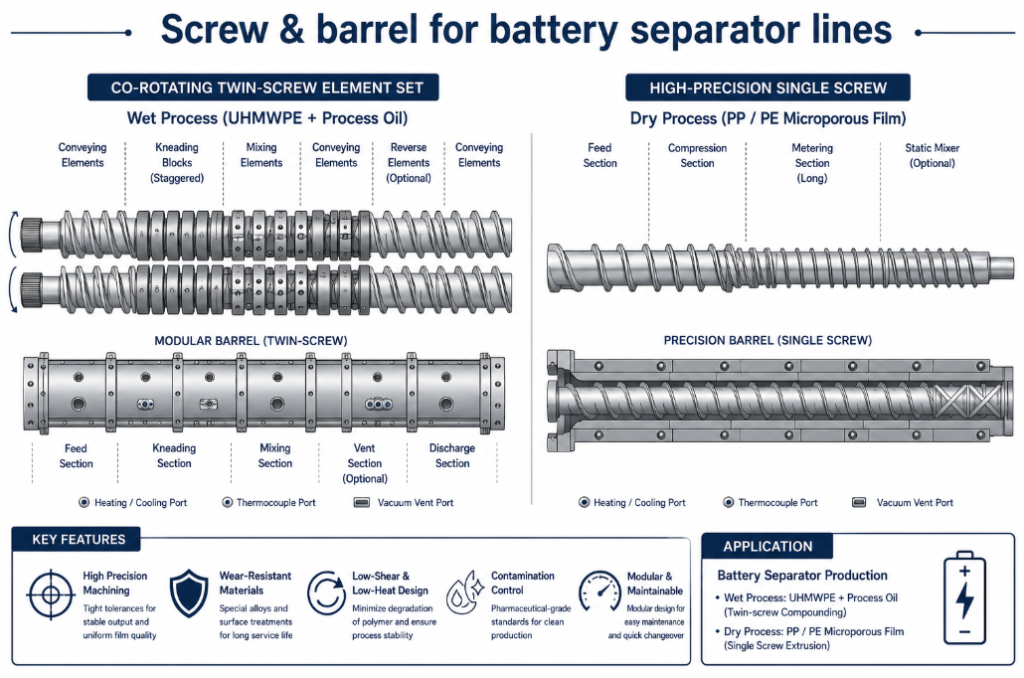
The dominant wet process feeds ultra-high-molecular-weight polyethylene into a co-rotating twin-screw extruder and injects paraffin oil — up to about 70% of the mix. The polymer doesn’t melt in the ordinary sense; it dissolves into the hot oil, which is why these machines run long L/D configurations for thermal soak and phase mixing rather than for melting. That system puts specific demands on the hardware:
- High-torque, wear-resistant screw elements. UHMWPE is extremely viscous before dissolution, and the mixing duty is continuous — elements need tool-steel or powder-metallurgy grades with hard surfaces that wear slowly and, critically, without shedding particles.
- Barrels built for the oil-injection zones. Liner materials must handle the hot oil/polymer system and keep their surface integrity — we build bimetallic and nickel-alloy-lined barrels with the injection ports and configuration matched to your line.
- Streamlined, mirror-finished flow surfaces everywhere. Any groove, corner, or rough patch is a residence-time trap where polymer chars — and on this application, one charred particle is one defect too many.
- Element-by-element replacement. Because twin-screw sets are modular, worn kneading and conveying elements in the high-load zones can be replaced individually — we reverse-measure and match existing element geometry, or supply full sets.
Dry Process: High-Precision Single Screws for PP/PE
Dry-process separator lines extrude PP (or PE, or trilayer PP/PE/PP through coextrusion) on high-precision single-screw extruders, then stretch the film to open its micropores. Here the screw’s whole job is a thermally homogeneous, perfectly stable melt — because melt-temperature variation becomes gauge variation, and gauge variation in a 20 µm film is scrap:
- Barrier-plus-distributive-mixing designs for complete melting and tight melt-temperature uniformity, without the shear heat that dispersive mixing would add.
- Tight manufacturing tolerances and clearances — the running clearance and its consistency along the screw directly affect output stability.
- Matched multi-extruder sets for coextrusion — trilayer dies need the layers’ melt temperatures and viscosities matched, which starts with matched, consistent screws.
What We Supply
| Item | For | Materials / construction |
|---|---|---|
| Twin-screw elements (conveying, kneading, mixing) | Wet-process UHMWPE + oil lines | Tool steel, powder-metallurgy steel, nickel-based hard surfaces |
| Twin-screw barrels with injection ports | Wet-process lines | Bimetallic / nickel-alloy liners, oil-injection and vent configurations |
| High-precision single screws | Dry-process PP/PE, coextrusion | 38CrMoAlA nitrided, hardfaced flights (Colmonoy/Stellite), barrier + mixing geometry |
| Single-screw barrels | Dry-process lines | Bimetallic liners, mirror-honed bores |
| Reverse engineering | Replacements for existing lines | From your worn parts or drawings, with full dimensional reports |
Every part ships with the documentation this application demands: material certificates, hardness and case-depth reports, dimensional and straightness records — the same inspection regime described in our acceptance checklist.
Frequently Asked Questions
Can you replace elements or screws on an existing line (Coperion, Leistritz, or domestic machines)? Yes — we reverse-measure worn elements, screws, and barrels and manufacture dimensionally-matched replacements. Send the machine model, element/screw drawings if you have them, or the worn parts’ measurements.
What makes separator-duty parts more expensive than standard ones? The materials (PM steels, nickel alloys, premium hardfacing), the surface-finish specification, the tighter tolerances, and the inspection regime. On this application those aren’t upgrades — they’re the entry requirement, for the contamination reasons above.
Our film is showing black specks / gels — is it the screw and barrel? Quite possibly: worn or rough flow surfaces and dead spots are the classic origin. The diagnostic logic is the same as in our black specks guide — but on separator film the threshold for action is far lower. Send us photos and your parts’ service history.
Do you supply for both wet and dry process? Yes — twin-screw elements and barrels for wet-process lines, and high-precision single screws and barrels for dry-process and coextrusion lines.
Separator extrusion is the application where screw-and-barrel quality stops being a cost line and becomes a safety specification — the film is microns thick, the tolerance for shed particles is zero, and the hardware either meets that standard or the line’s yield and the cells’ safety pay for it.
If you run a separator line and need replacement elements, screws, or barrels — or want to upgrade wear surfaces before they become a contamination problem — send our engineering team your machine model, the parts you need, and your process (wet or dry) on WhatsApp and we’ll quote with full documentation. For the machine-level engineering decisions behind these lines, see our guide on specifying twin-screw extruders for separator manufacturing, and for the element fundamentals, our twin-screw elements guide.
References and Further Reading
- Battery Separator Films, Coperion — the wet process with up to 70% oil content, and the precision demands of separator-grade twin-screw extrusion: https://coperion.com/en/industries/plastics/battery-separator-films
- Designing Extrusion Dies to Optimize Battery-Separator Film, Converting Quarterly — separator films at 30 µm and thinner, and why exceedingly precise thickness uniformity governs the process: https://convertingquarterly.com/designing-extrusion-dies-to-optimize-battery-separator-film/

Pingback: Extruder Screws and Barrels for Medical Tubing
Pingback: Twin Screw Liquid Injection Barrel: Where to Inject