
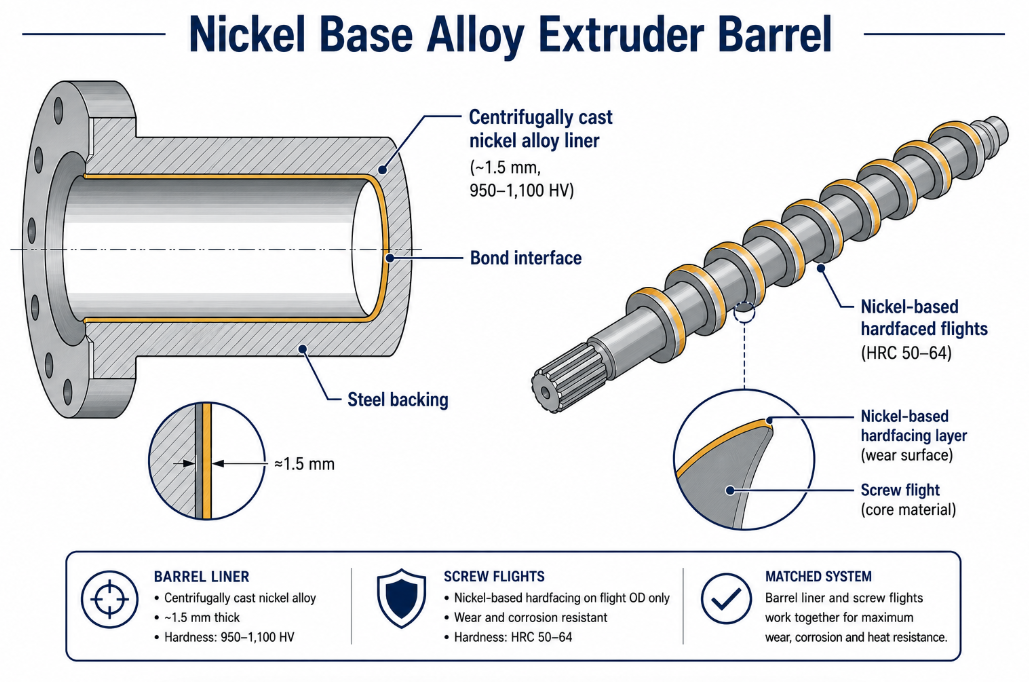
BLOOM manufactures nickel base alloy extruder barrels, liners, and matching nickel-alloy-surfaced screws — the hardware for duties where standard nitrided or iron-based bimetallic parts wear out, corrode, or soften: heavily-filled abrasive compounds, corrosive materials like fluoropolymers and halogenated formulations, and high-temperature engineering resins. Nickel base alloy parts come in three duty grades — anti-wear, anti-corrosion, and anti-high-temperature — and choosing the right grade for the threat is what this page covers, along with what we build, in what forms, and how to specify it.
By the BLOOM Engineering Team
What “Nickel Base Alloy” Means in an Extruder Barrel
In barrel construction, a nickel base alloy is a nickel-chromium alloy system (often with boron, silicon, and optionally tungsten carbide particles) applied as the working surface of the part:
- In a bimetallic barrel, the nickel alloy is centrifugally cast as a liner bonded inside the steel backing — the finished liner is thin (around 1.5 mm), and it is the entire wear-and-corrosion life of the barrel. Nickel-based liners are one of the established bimetallic families, typically finishing in the 950–1,100 HV hardness class, and a good bimetallic barrel outlasts a nitrided one by roughly two to three times.
- On a screw, the same alloy family arrives as hardfacing — nickel-based weld overlays (the Colmonoy family, and Ni60-type self-fluxing alloys reaching about HRC 60 in layers of 2–3 mm) applied to the flight tips, so the screw’s wear surface matches the barrel’s.
- The nickel matrix is what separates these parts from iron-based bimetallics: nickel-chromium resists chemical attack — especially chlorides and halides — far better than iron, and it holds its properties at temperatures where nitrided steel is already softening.
That combination is why nickel base alloy is the default answer to three specific threats.
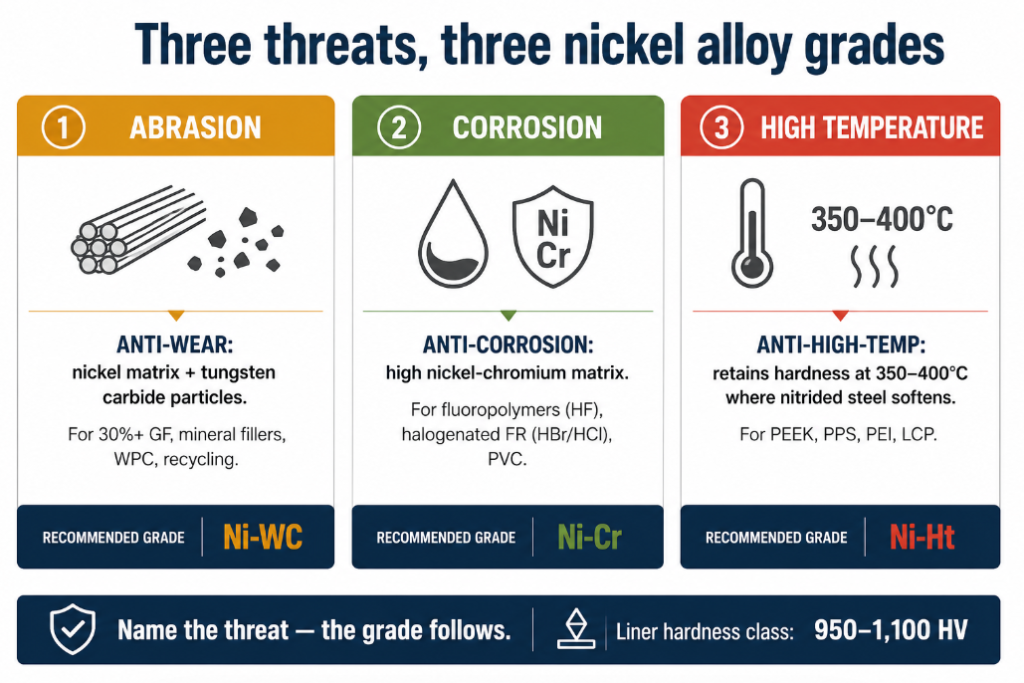
Anti-Wear Nickel Alloy Screw Barrel: For Abrasive Duty
The anti-wear grade pairs the nickel matrix with tungsten carbide particles cast into the liner (and carbide-bearing hardfacing like Colmonoy 83, ~HRC 59–64, on the screw). The carbide does the abrasion resistance; the nickel binds it and adds corrosion protection the filler chemistry often demands anyway. Specify it for:
- Glass-fiber-reinforced compounds (30%+ GF nylon, PP, PBT) — glass fiber wears plain nitrided parts out in months, as covered in why glass fiber wears screws fast
- Mineral-filled and flame-retardant compounds — calcium carbonate, talc, glass beads, ATH
- WPC and natural-fiber composites — abrasive fiber plus moisture
- Recycling lines — unpredictable contamination plus fillers
Anti-Corrosion Nickel Alloy Screw Barrel: For Chemical Attack
The anti-corrosion grade runs a high-nickel, high-chromium matrix chosen for chemical resistance first. Iron-based surfaces corrode in these environments no matter how hard they are — corrosion pits become wear sites and contamination traps. Specify it for:
- Fluoropolymers (PVDF, FEP, PFA) — which can release hydrofluoric acid at melt temperature
- Halogenated flame-retardant compounds — releasing HBr/HCl under heat
- Rigid and flexible PVC at demanding duty — HCl attack, especially where degradation history exists; see the PVC screw and barrel guide
- Corrosive additives and biopolymers — acid-generating formulations
On the screw side, this is where nickel-based hardfacing and plating choices beat cobalt or plain chrome for specific chemistries — the alloy-by-alloy logic is in our Stellite vs Colmonoy guide and the full coating and surface treatment guide.
Anti-High-Temperature Screw Barrel: For 350°C-Class Resins
Nitrided surfaces are produced at around 500°C — run the barrel hot enough for long enough and the case’s hardness advantage erodes, while ordinary steels lose strength. Nickel base alloys are high-temperature materials by nature: they keep their hardness and structure at processing temperatures where standard parts soften. Specify the anti-high-temperature grade for:
- PEEK, PPS, PEI, LCP and other high-performance resins processing in the 350–400°C class
- High-temperature fluoropolymers — which combine the heat threat with the corrosion threat above (these duties often need the corrosion and temperature grades together)
- Battery separator and other precision high-spec lines — where surface integrity at temperature is a contamination requirement, as covered on our battery separator screw and barrel page
Nickel Base Alloy Liner: Barrel, or Just the Liner
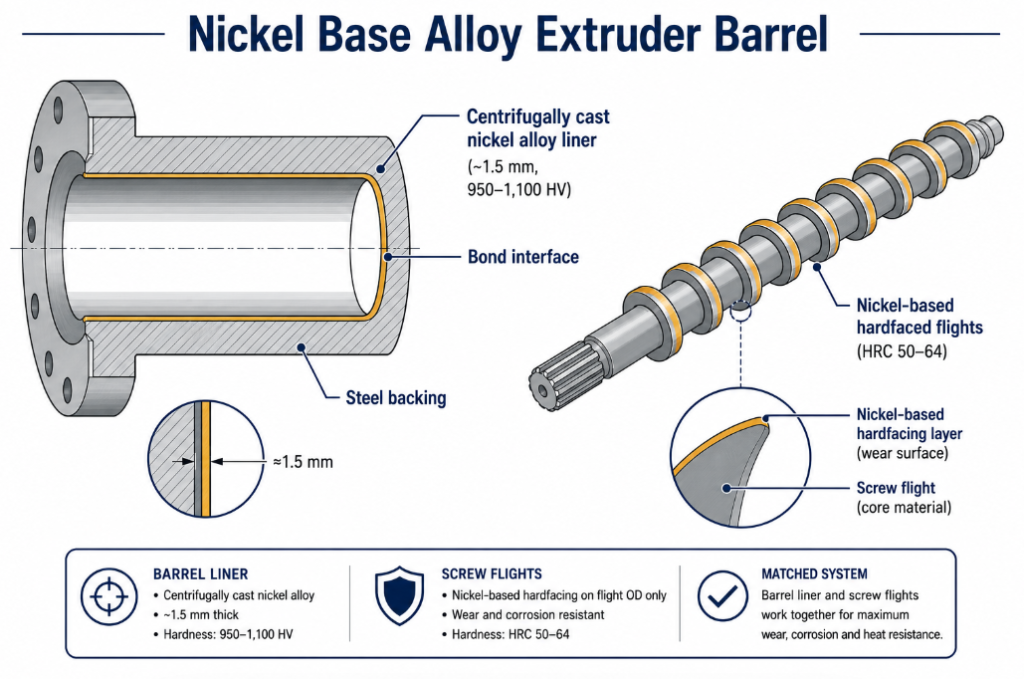
Because the working surface is the liner, nickel base alloy can be supplied two ways:
| Form | What it is | When to choose it |
|---|---|---|
| Complete bimetallic barrel | New steel barrel with the nickel alloy liner centrifugally cast and bonded inside, machined to your drawing | New lines, replacements, or when the old backing is damaged |
| Nickel base alloy liner (re-line) | A new nickel-alloy sleeve installed into your existing barrel backing with a precision interference fit | Large or elaborately-equipped barrels where re-lining saves 25–50% vs new — see barrel repair vs replacement |
Either way, the liner is matched to a screw surface of the same class — a nickel-alloy barrel run against an under-specified screw just moves the wear to the screw, which is why we quote screw and barrel as a pair wherever possible.
What We Supply: Nickel Alloy Extruder Parts
The same three grades apply across the full range of nickel alloy extruder parts we build:
| Part | Construction | Grades available |
|---|---|---|
| Single-screw barrels | Bimetallic, nickel alloy liner, honed and inspected bore | Anti-wear / anti-corrosion / anti-high-temperature |
| Twin-screw barrels & liners | Figure-8 bimetallic liners, injection/vent configurations | All three grades |
| Liners / sleeves for re-lining | Precision-fit into your existing backing | All three grades |
| Screws | 38CrMoAlA base, nickel-based hardfaced flights (Colmonoy / Ni60 class) | Matched to the barrel grade |
| Reverse engineering | From your worn parts or drawings | — |
Every part ships with material certificates, hardness reports, and dimensional and straightness records — the documentation regime in our acceptance inspection checklist.
Frequently Asked Questions
When is nickel base alloy worth it over standard iron-based bimetallic? When the duty includes chemical attack, sustained high temperature, or both on top of abrasion. For plain abrasive duty on neutral materials, iron-based bimetallic is often sufficient and cheaper; the nickel matrix earns its cost where corrosion or heat would defeat iron.
Can you re-line my existing barrel with a nickel base alloy liner? Usually, yes — if the steel backing is sound. Send the barrel drawing or bore measurements and the construction details (plain, jacketed, grooved, vented) and we’ll tell you whether a re-line or a new barrel is the economical path.
What hardness do the surfaces reach? Nickel-based liners finish in the 950–1,100 HV class; carbide-bearing versions higher in effective wear resistance. Nickel-based screw hardfacing runs about HRC 50–55 (Colmonoy 56 class) to HRC 59–64 (carbide-bearing) — all verifiable on the hardness report that ships with the part.
Do you match existing machines? Yes — we reverse-measure worn barrels, liners, and screws from any make and manufacture dimensionally-matched replacements.
Nickel base alloy is the answer when the threat is more than plain wear — carbide-loaded for abrasion, high-nickel-chromium for corrosion, and inherently stable at temperatures that defeat nitrided steel — so the specification starts with naming your threat, and the grade follows from it.
If your line runs filled, corrosive, or high-temperature materials and the current screw and barrel aren’t lasting, send our engineering team your material (and filler content), processing temperature, and part drawings or measurements on WhatsApp and we’ll recommend the right nickel alloy grade — or tell you honestly if standard bimetallic will do. See also our barrels and screws pages.
References and Further Reading
- Troubleshooting Screw and Barrel Wear in Extrusion, Plastics Technology — the bimetallic liner families (iron-, nickel-, and tungsten-carbide-based), the ~1.5 mm finished liner, and bimetallic service life versus nitrided: https://www.ptonline.com/articles/troubleshooting-screw-and-barrel-wear-in-extrusion
- Barrel Repair: When Does It Make Sense?, Plastics Technology — liner replacement economics and the precision interference-fit requirement for re-lining: https://www.ptonline.com/articles/barrel-repair-when-does-it-make-sense

Pingback: Compounding Screws for EV and Energy Storage Materials: Batch Consistency, Dispersion, and Stability