Quick answer: glass fiber is harder than the steel your screw is made of, so it physically cuts and grinds the screw and barrel as it passes through — far faster than unfilled plastic. Glass fiber sits around 5–7 on the Mohs hardness scale, which exceeds the hardness of many tool steels, so the fibers act like millions of tiny cutting tools abrading the flight tips and barrel bore. A standard nitrided screw running 30%+ glass-filled nylon can wear out in a fraction of its normal life. The fix is matching the screw’s surface to the abrasion — bimetallic and tungsten carbide instead of plain nitriding. Here is why, and what to specify.
By the BLOOM Engineering Team
Why Glass Fiber Is So Abrasive
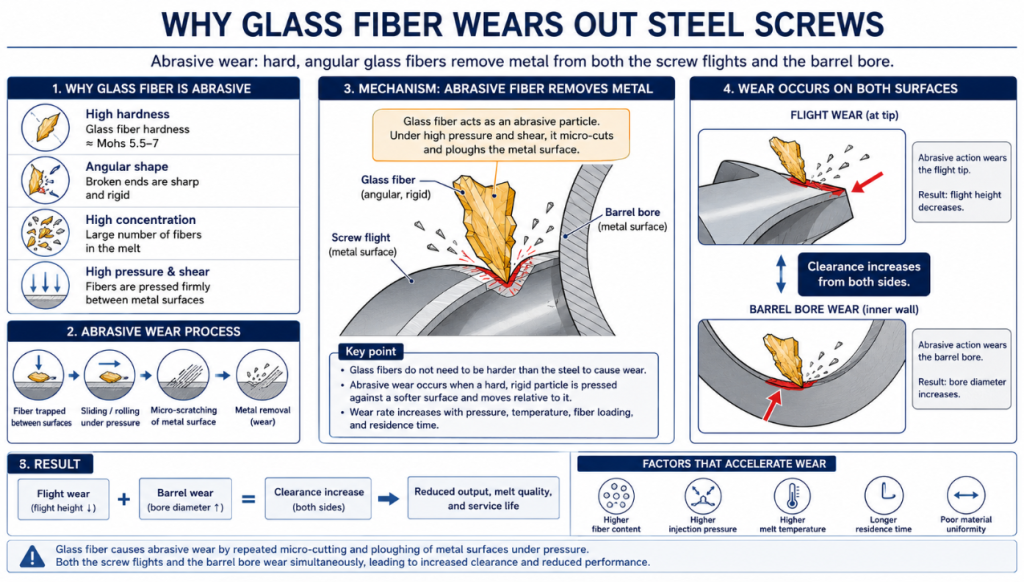
The reason glass-filled compounds destroy screws comes down to a simple hardness mismatch. Wear happens when a harder material grinds against a softer one — and glass fiber is harder than the steel in a normal screw.
Glass fiber rates roughly 5–7 on the Mohs hardness scale, which exceeds the hardness of many tool steels used for screws. So as the compound flows through the extruder, the embedded glass fibers behave like an enormous number of tiny cutting edges, continuously scraping metal off the screw flights and the barrel bore. It is genuine abrasive cutting, not gentle polishing — the fibers are hard enough to remove steel.
Several factors make it worse:
- Higher glass content = faster wear. A 50% glass-filled compound is far more abrasive than a 15% one. The 30% level is a common threshold where wear protection becomes essential.
- Glass fiber is rigid and angular. Unlike soft fillers, glass fibers are stiff and have sharp broken ends that dig into metal.
- Other reinforcements behave similarly. Carbon fiber, mineral fillers, and glass beads abrade by the same mechanism; rice-husk and some natural fibers carry silica that is also hard.
- It attacks both parts. The fibers grind the screw flight tips and the barrel bore, opening the clearance between them from both sides.
What the Wear Actually Does to Your Process
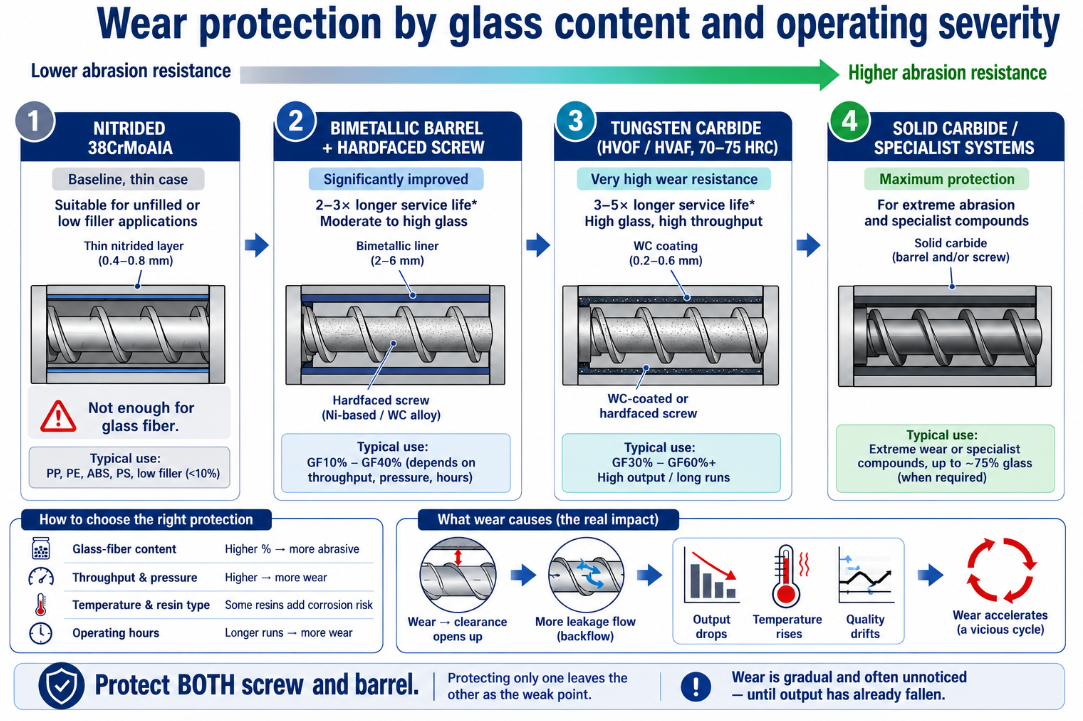
Glass-fiber wear isn’t just cosmetic metal loss — it steals performance. As the flight tips and barrel bore wear, the clearance between them opens up, and once it does:
- Output drops — melt leaks back over the worn flights instead of being pumped forward.
- Melt temperature rises and quality drifts — the leakage and compensating higher speeds add heat and instability.
- The wear accelerates — wider clearances and continued abrasion feed on each other.
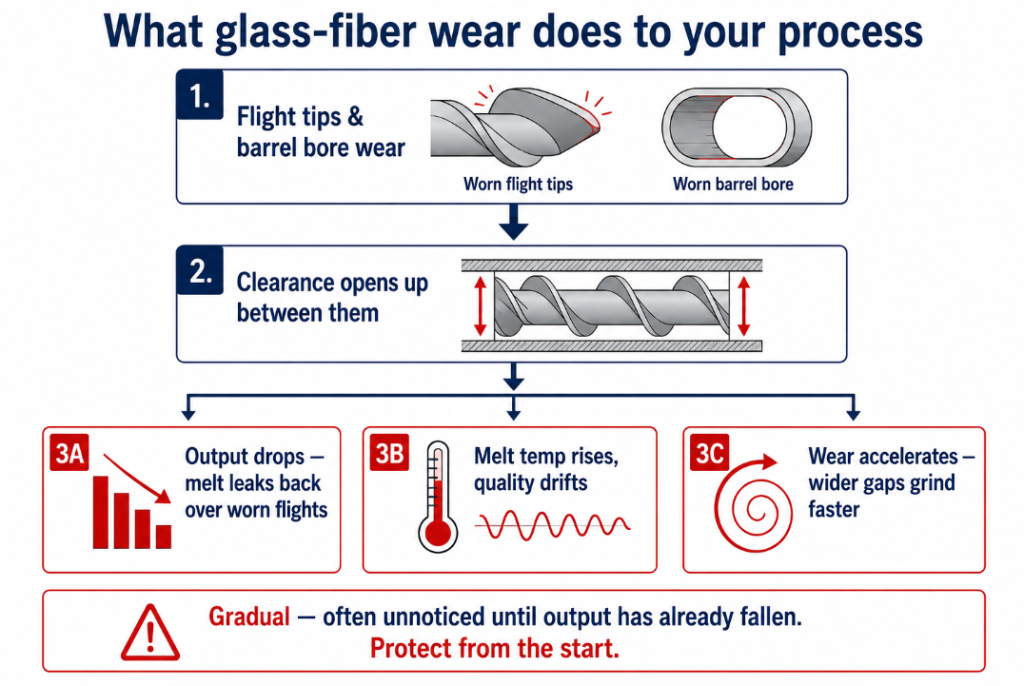
Because the wear is gradual, it often goes unnoticed until output has measurably fallen — by which point a lot of metal is gone. This is why glass-filled lines need wear-resistant construction from the start, not after the screw is ruined. For how to judge when wear has crossed the line, see our guide on how much screw wear is acceptable.
The Fix: Match the Surface to the Abrasion
A standard nitrided screw — with its thin ~0.5–0.8 mm hardened case — simply isn’t built to survive continuous glass-fiber abrasion; the case wears through and the soft core underneath goes quickly. Glass-filled compounds need harder, thicker, tougher wear protection. The options, in increasing order of abrasion resistance:
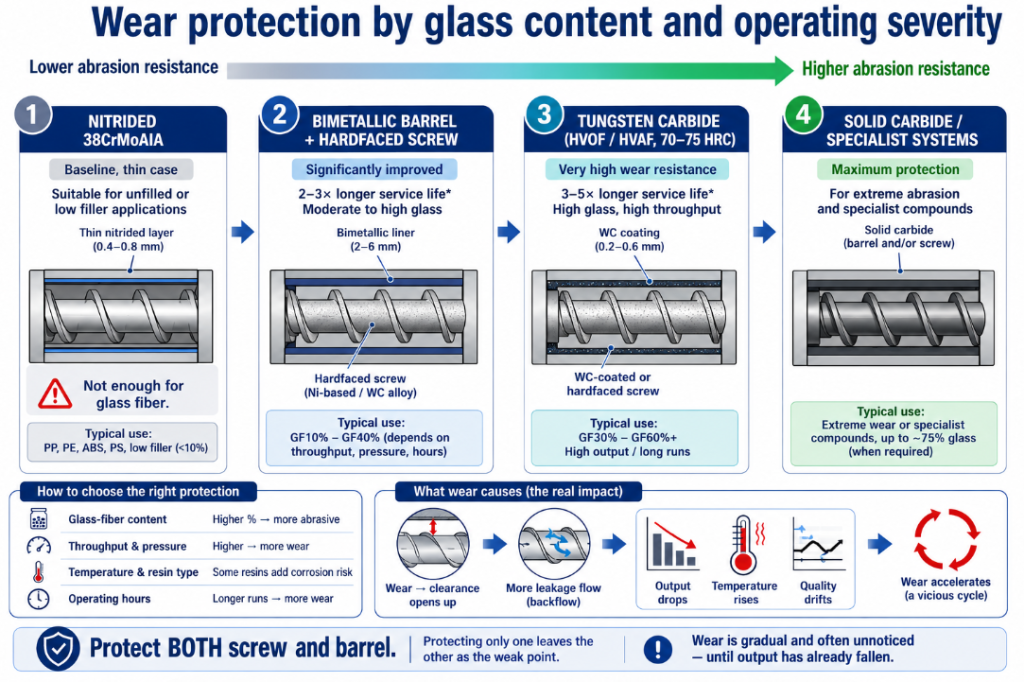
| Surface | Wear resistance vs nitrided | Best for |
|---|---|---|
| Nitrided 38CrMoAlA | Baseline (thin case) | Unfilled / low filler only |
| Bimetallic barrel + hardfaced screw | ~2–3× longer life | Moderate-to-high glass content |
| Tungsten carbide (HVOF, ~70–75 HRC) | ~3–5× longer life | High glass content (30%+), severe abrasion |
| Solid carbide / specialist | Highest | Extreme (up to ~75% glass fiber) |
The practical guidance we give:
- Bimetallic barrel — a thick, hard wear-resistant alloy liner cast or applied into the bore gives 2–3 times the life of a nitrided bore, and is the standard for filled compounds.
- Tungsten carbide hardfacing on the screw flights — applied to the flight crests (often by HVOF), tungsten carbide at 70–75 HRC resists the glass abrasion far better than nitriding, extending life 3–5×.
- Match screw and barrel together — both wear, so protecting only one leaves the other as the weak point; a hardfaced screw in a nitrided barrel still wears the barrel.
The full comparison of these surface treatments and how to choose between them is in our coating and surface treatment guide, and the specific hardfacing alloys (Colmonoy, Stellite, tungsten carbide grades) in our Stellite vs Colmonoy guide.
It’s a Cost-Per-Hour Decision, Not a Price Decision
The temptation with glass-filled work is to buy the cheaper nitrided screw and replace it when it wears. The math usually argues otherwise: a nitrided screw that wears out in months, plus the lost production and quality problems along the way, costs more than a tungsten-carbide-protected screw that runs for years. Wear-resistant construction costs more up front but far less per operating hour on abrasive compounds — which is the number that actually matters. This is the same engineering-plastics wear logic covered in our engineering plastics extruder screw guide.
Glass fiber wearing out screws fast isn’t a sign of a bad screw — it’s the predictable result of running a material harder than steel through a part made of steel, so the answer isn’t a better grade of the same nitrided screw but a different class of wear protection sized to your glass content, which turns a months-long wear problem into a multi-year one.
At BLOOM, we build bimetallic barrels and tungsten-carbide-hardfaced extruder screws specifically for glass-filled and reinforced engineering plastics — matched to your glass content so they last. If your screws are wearing out fast on glass-filled compound and you want the right wear protection for your fiber level, send our engineering team your material, glass percentage, and machine details on WhatsApp and we’ll recommend the right construction. For the broader picture, see our engineering plastics screw guide.