
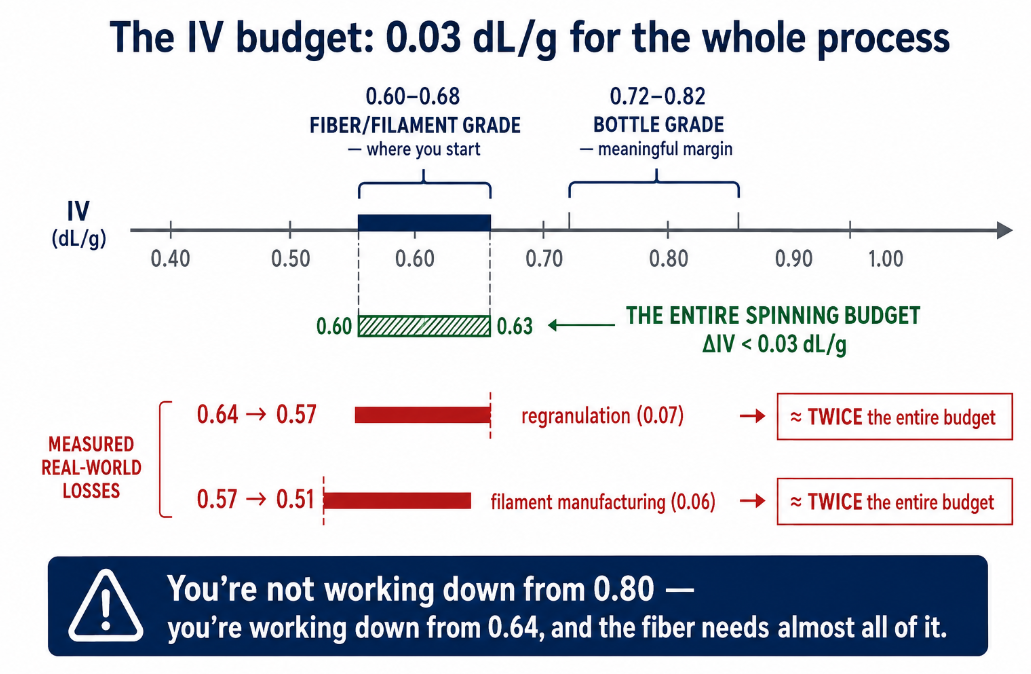
In polyester filament spinning the whole degradation budget is about ΔIV < 0.03 dL/g — that’s the maximum intrinsic-viscosity drop melt spinning can tolerate before fiber integrity is compromised. Fiber-grade chips start around 0.60–0.68 dL/g (lower than bottle grade), so there is very little molecular weight to give away, and every source of loss — moisture, heat, residence time, shear — has to be squeezed into that one number. The screw is the largest controllable variable in that budget: it decides how long the polymer stays hot, how much shear heat it adds on top of the barrel setpoints, and whether any material stagnates long enough to degrade. This guide covers the IV budget, what each loss mechanism costs, and the screw design that protects it.
By the BLOOM Engineering Team
The IV Budget: Why Spinning Is Tighter Than Bottles
| Bottle grade | Fiber/filament grade | |
|---|---|---|
| Typical chip IV | 0.72–0.82 dL/g | 0.60–0.68 dL/g (staple often 0.60–0.65) |
| Moisture spec before melting | <50 ppm | <30 ppm (some processes below 100 ppm after drying at 160–180°C, dew point −40°C) |
| Tolerable IV loss | Meaningful margin | ΔIV < 0.03 dL/g |
| What loss shows up as | Bottle strength, clarity | Filament breaks, low tenacity, denier variation |
Two things follow from that table, and they’re the reason spinning screws are specified differently from bottle or sheet screws.
First, fiber grade starts lower. You’re not working down from 0.80 — you’re working down from 0.64, and the fiber needs almost all of it. There’s no cushion.
Second, the tolerance is a hard number. ΔIV < 0.03 dL/g is the documented control limit for melt spinning; exceed it and fiber integrity suffers. For scale: published studies of recycled PET show IV dropping 0.64 → 0.57 in regranulation and further to 0.51 during filament manufacturing — losses of 0.07 and 0.06, each roughly twice the entire spinning budget. That’s what an uncontrolled process costs.
High-tenacity industrial yarn goes the other way: chips are solid-state polymerized up to 0.85–1.05 dL/g precisely because the strength requirement demands molecular weight the spinning process will partly consume.
Where the IV Goes
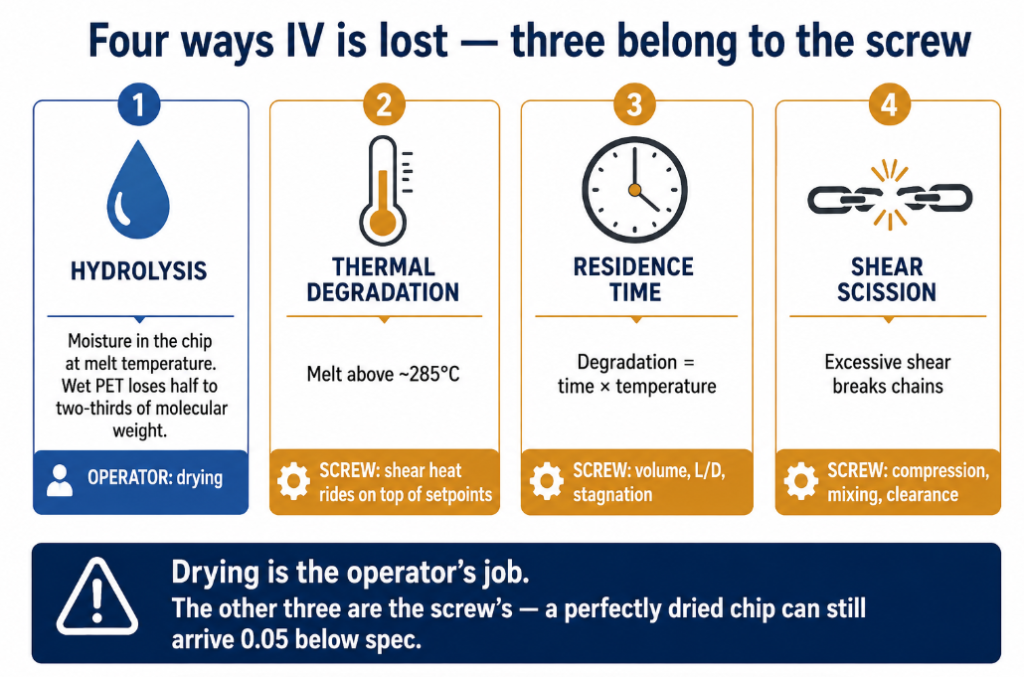
Four mechanisms, and the screw is implicated in three of them:
| Loss mechanism | Cause | Screw’s role |
|---|---|---|
| Hydrolysis | Moisture in the chip at melt temperature — wet PET can lose half to two-thirds of its molecular weight | None directly — this is a drying problem, see drying PET |
| Thermal degradation | Melt above ~285°C, and it accelerates with temperature | Direct — shear heat rides on top of barrel setpoints |
| Residence time | Cumulative time at temperature; degradation is time × temperature | Direct — screw volume, L/D, and any stagnation |
| Shear/mechanical scission | Excessive shear breaking chains | Direct — compression ratio, mixing aggressiveness, clearance |
The full chemistry of each is covered in why PET IV drops during extrusion. What matters here is the allocation: drying is the operator’s job, and the other three are the screw’s. A perfectly dried chip can still arrive at the spinneret 0.05 below spec if the screw is wrong.
The Screw Design That Protects IV
- Melt with the barrel, not with shear. Spinning runs at 280–300°C, and the degradation ceiling sits at roughly 285°C for the melt itself. Since shear heat is invisible on barrel thermocouples, a screw that generates significant shear heat pushes the actual melt past the ceiling while the panel still reads compliant. Moderate compression ratio (around 3:1 for fiber grade), gradual transition, generous channel depths in the metering zone.
- Shortest practical residence time. Degradation integrates over time, so oversized machines and unnecessarily long L/D cost IV. Size the screw to your actual throughput — a screw running at 40% of its capacity holds the melt far longer than one properly matched.
- Distributive mixing only. The homogenizing requirement in spinning is real (±2°C melt uniformity), but it must be met with low-shear distributive elements — pin, pineapple, or a downstream static mixer — never with a high-shear dispersive mixer that converts mixing into heat. See choosing a mixing section.
- Zero stagnation, absolutely. Material caught in a dead spot doesn’t just lose IV — it degrades completely, then releases as a gel that blocks a spinneret capillary or breaks a filament. Streamlined, radiused, mirror-polished flow surfaces everywhere.
- Correct clearance. A worn screw recirculates melt over the flight tips, which increases both shear and effective residence time — so wear is an IV problem before it’s an output problem. Check against the wear limit calculator.
The overall spinning framework — the four-zone temperature scheme, the metering pump’s role, and the ±2°C target — is in our extruder screw for fiber spinning guide.
Recycled PET: The Same Budget, Half the Starting Capital
rPET filament magnifies every point above. Recycled flake arrives with IV already reduced (mechanically recycled material typically needs solid-state polymerization back up to 0.7–0.8 dL/g before it’s spinnable), moisture history is unknown, and contamination adds gels and abrasion. On an rPET line:
- The IV budget is the same 0.03, but the starting IV is lower and less consistent — so the screw’s contribution has to be smaller still.
- Vented/vacuum designs appear on some rPET lines to strip moisture and volatiles in-process; note that this is specialized deep-vacuum territory, not a replacement for drying — see when you need a vented screw.
- Wear rises sharply — contamination plus any filler content, on top of TiO₂ delustrant.
Wear, Delustrant, and the Slow IV Drift
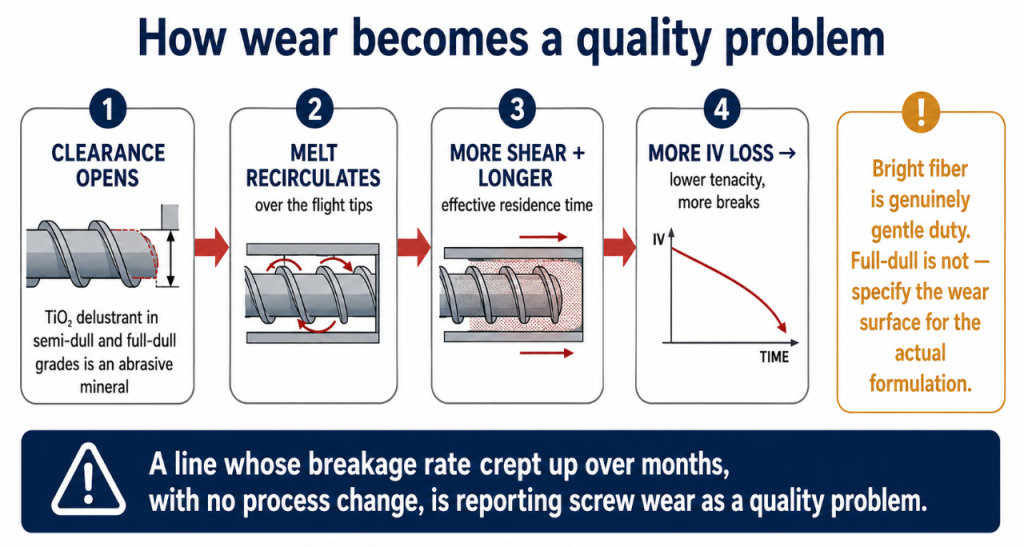
Fiber lines look like clean unfilled duty, but titanium dioxide delustrant (in semi-dull and full-dull grades) is an abrasive mineral, and it wears screws and barrels faster than “unfilled PET” suggests. That matters for IV in a way most plants don’t connect:
Clearance opens → melt recirculates over the flights
   → more shear + longer effective residence time
      → more IV loss → lower tenacity, more breaks
So a line whose breakage rate has crept up over months, with no process change, is often reporting screw wear as a quality problem. Specify the wear surface for the actual formulation — bright fiber is genuinely gentle, full-dull is not — using bimetallic construction or hardfaced flights where the delustrant load justifies it; see our bimetallic screw and barrel page.
Symptoms and What They Point To
| Symptom | Where to look |
|---|---|
| Tenacity below spec, IV test confirms loss | Melt temperature/shear heat, residence time, or drying |
| Filament breaks with clean spinneret | Gels from stagnation, or IV loss weakening the filament |
| Breakage creeping up over months, no process change | Screw and barrel wear — clearance, then IV |
| Rising screen-pack pressure | Degraded material or contamination upstream |
| IV loss worse at low throughput | Residence time — the screw is oversized for the rate |
| Loss appears only after a chip supplier change | Moisture history or starting IV, not the screw |
Filament spinning gives the screw a budget of about three hundredths of a dL/g and asks it to melt, homogenize, and pump inside that — which is why an IV problem on a fiber line is almost never solved at the control panel, and almost always traced back to how long the polymer was hot, how hard it was worked, and whether any of it had somewhere to sit.
At BLOOM, we build extruder screws and barrels for polyester filament and staple lines — low-shear geometry sized to your actual throughput, distributive homogenizing, mirror-polished flow paths, and wear surfaces specified for your delustrant and any recycled content. If your line is losing tenacity, breaking filaments, or seeing breakage rates creep upward, send our engineering team your chip IV, throughput, machine L/D, melt temperatures, and TiO₂ content on WhatsApp and we’ll tell you whether the screw is spending your IV budget.
References and Further Reading
- Polyester Fiber: Molecular Engineering, Performance Optimization and Industrial Applications, PatSnap Eureka — industrial polyester IV of 0.55–0.85 dL/g and the ΔIV < 0.03 dL/g control limit during melt spinning to avoid compromising fiber integrity: https://eureka.patsnap.com/materials/polyester-fiber-engineering
- Polyester Filament Spinning Production Line: FDY, POY & HOY Guide, Shengbang — drying to below 30 ppm moisture, hydrolytic degradation reducing IV, and the resulting filament breakage, poor tenacity and inconsistent denier: https://www.shengbang-machine.com/news/industry-news/polyester.html
- Progress in 3D printing of recycled PET, ScienceDirect — measured IV falling 0.64 → 0.57 during regranulation and further to 0.51 during filament manufacturing, described as average for these processing steps: https://www.sciencedirect.com/science/article/pii/S2589234724000939



Pingback: Filament Breaks and Fluff: When the Screw Is the Root Cause