
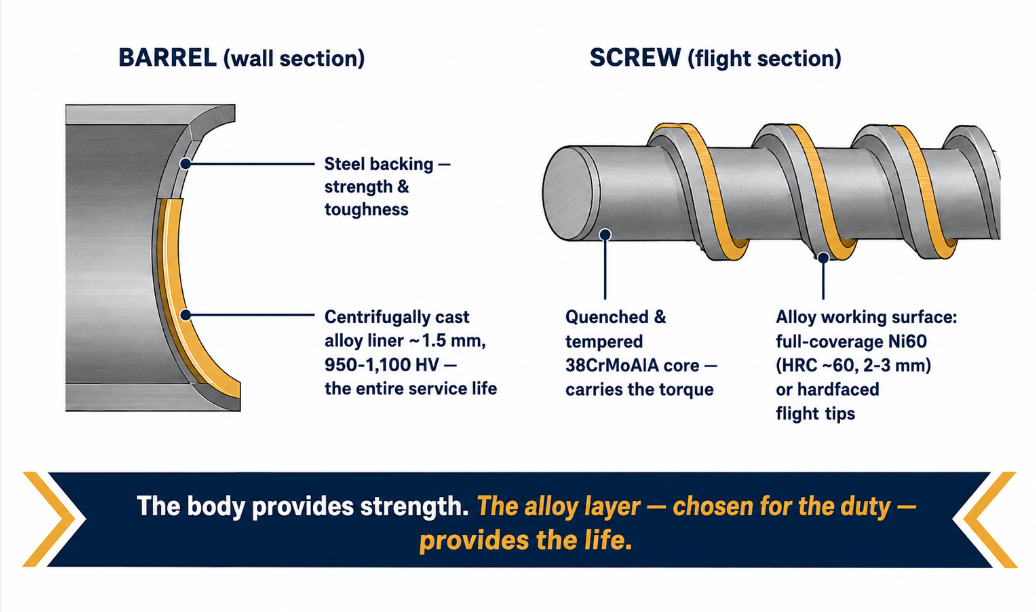
A bimetallic barrel carries a centrifugally-cast alloy liner (about 1.5 mm finished, in the 950–1,100 HV class) that typically lasts two to three times as long as a nitrided barrel; a bimetallic screw carries the matching alloy on its flights, either as full-coverage spray-welded surfacing or as hardfaced flight tips. This page covers how the construction works, the three liner families and how to choose between them, the screw side of the pair, and the honest cases where standard nitrided parts remain the right buy.
By the BLOOM Engineering Team(China BLOOM manufactures bimetallic screws and barrels — parts whose working surface is a dedicated wear alloy bonded onto a tough steel body, rather than a hardened layer of the base steel itself. )
What “Bimetallic” Actually Means
A nitrided part hardens its own steel surface — effective, but the case is thin and its chemistry is fixed by the base steel. A bimetallic part separates the two jobs:
- The steel body (barrel backing, screw core) provides strength, toughness, and machinability.
- The alloy working layer — chosen independently for the duty — provides the wear, corrosion, or temperature resistance.
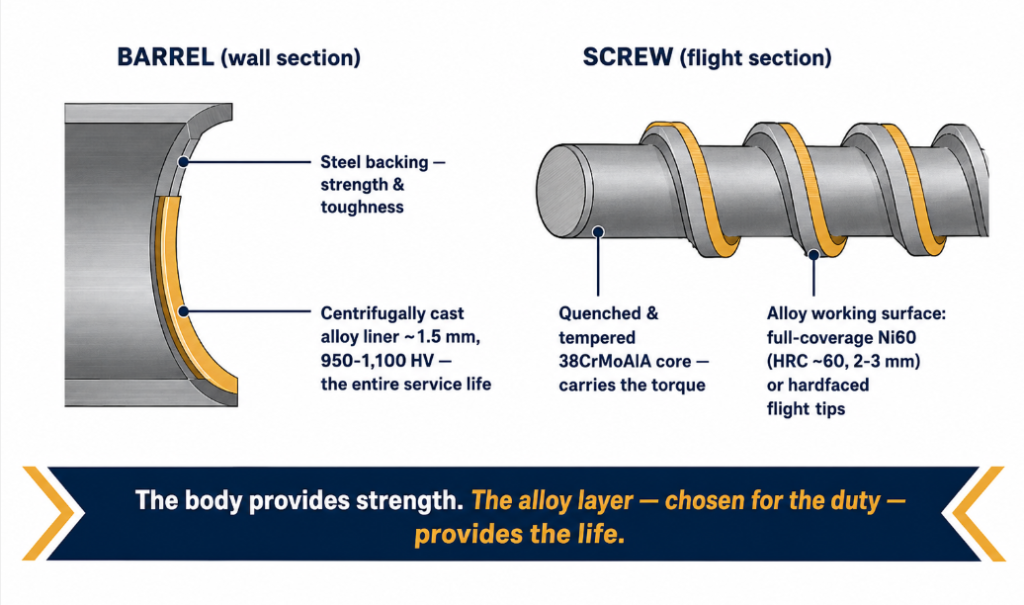
In a bimetallic barrel, the alloy is centrifugally cast inside the bore and metallurgically bonded to the backing, then honed to final dimension: the finished liner is only about 1.5 mm thick, and that thin layer is the barrel’s entire service life. In a bimetallic screw, the same principle puts the alloy where the wear happens — on the flights — over a quenched-and-tempered 38CrMoAlA core that carries the torque.
The Three Liner Families: Choosing the Alloy
The alloy family is the real specification decision, and it follows from the threat:
| Liner family | Hardness class | Best for | Notes |
|---|---|---|---|
| Iron-based (Fe-Cr-B class) | ~950–1,100 HV | General abrasive duty on neutral materials — the economical default | Roughly 3× the life of nitrided at moderate cost |
| Nickel-based (Ni-Cr class) | ~950–1,100 HV, superior chemistry | Corrosive duty (fluoropolymers, halogenated FR, PVC) and high-temperature resins (PEEK/PPS class) | The corrosion-and-heat family — full grades on our nickel base alloy barrel page |
| Tungsten-carbide-bearing | Highest effective wear resistance | Severe abrasion: 30%+ glass fiber, high mineral loading, abrasive recycling | Carbide particles in a metal matrix; the premium anti-wear grade |
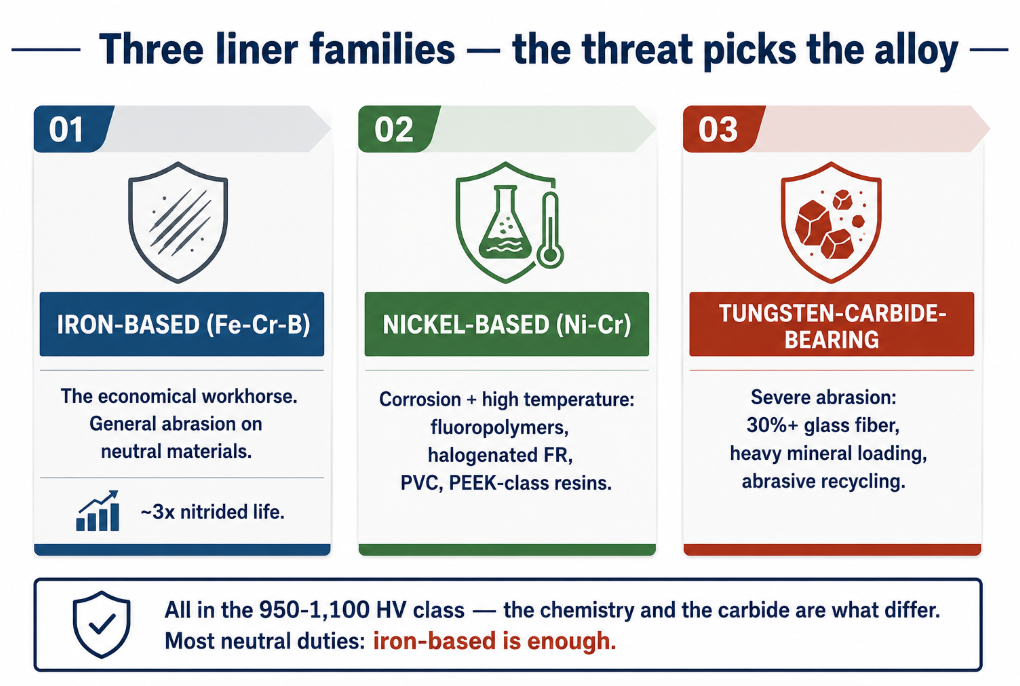
The honest guidance: most neutral, moderately-filled duties are well served by the iron-based family — it’s the workhorse. Nickel earns its premium when chemistry or temperature attacks iron; carbide earns its premium when the filler is grinding everything else away — see why glass fiber wears screws fast.
The Screw Side: Two Ways to Build a Bimetallic Screw
“Bimetallic screw and barrel” is a pair for a reason — the barrel liner and the screw surface wear against each other, and they should be specified as matching classes. On the screw, the alloy arrives one of two ways:
- Full-coverage spray welding (Ni60 class). A self-fluxing nickel alloy is spray-welded over the working length — flights and root — reaching about HRC 60 in a 2–3 mm layer. This is the construction usually meant by “bimetallic screw”: the entire wetted surface is alloy, which also protects the root against corrosion and adhesive wear.
- Flight-tip hardfacing (Colmonoy / Stellite / carbide grades). The wear alloy is PTA-welded onto the flight crests only — the highest-wear surface — over a nitrided body. Economical, rebuildable, and the standard answer for abrasive duty; the alloy choice is covered in Stellite vs Colmonoy.
Which construction to choose follows the threat again: corrosion or full-surface attack points to full coverage; concentrated flight-tip abrasion points to hardfacing. Either way, pairing matters — a carbide-grade barrel run against a plain nitrided screw simply relocates the wear to the cheaper part, and the clearance opens just the same.
When Bimetallic Is Worth It — and When Nitrided Still Wins
| Your duty | Recommendation |
|---|---|
| Unfilled or lightly-filled neutral resins, normal runtimes | Nitrided is fine — bimetallic would be paying for protection you don’t consume |
| Filled compounds, WPC, recycling, high-utilization lines | Bimetallic (iron-based / carbide) — 2–3× life typically beats the price difference on parts that run hard |
| Corrosive or 350°C-class materials | Bimetallic (nickel-based) — nitrided surfaces are defeated by the chemistry or the heat, not the abrasion |
| Frequent screw pulls / product changes on abrasive work | Bimetallic pair — downtime cost multiplies the value of longer intervals |
| A barrel that wore out prematurely | Upgrade the liner family, don’t repeat it — the same logic as barrel repair vs replacement |
The economics are straightforward: a bimetallic barrel costs more up front and lasts two to three times longer — how long that is in years, and what shortens it, is covered in how long a bimetallic barrel lasts. On lines where wear parts are consumed steadily, the bimetallic pair usually wins on cost-per-year; on gentle duty, it never gets the chance to pay back.
What We Supply
| Item | Construction | Grades |
|---|---|---|
| Single-screw bimetallic barrels | Centrifugally-cast liner, honed bore, to your drawing | Iron-based / nickel-based / carbide |
| Twin-screw barrels & liners | Figure-8 liners, vent and injection configurations | All families |
| Bimetallic screws | Full-coverage Ni60-class spray welding, or hardfaced flights over nitrided 38CrMoAlA | Matched to the barrel |
| Liners for re-lining | Precision interference fit into sound backings | All families |
| Reverse engineering | From worn parts or drawings, full documentation | — |
Every pair ships with material certificates, hardness reports, and dimensional records — verifiable against our acceptance inspection checklist.
Frequently Asked Questions
Is a bimetallic barrel really worth 2–3× the nitrided price? On abrasive, corrosive, or high-utilization duty — usually yes, because it lasts 2–3× as long and saves the downtime of extra changeovers. On light neutral duty — usually no, and we’ll tell you so.
Can I run a bimetallic barrel with my existing nitrided screw? You can, but on the duties that justify the barrel, the nitrided screw becomes the sacrificial part and the clearance still opens. Specify the pair together.
Bimetallic screw: full coverage or hardfaced flights? Corrosive or whole-surface attack → full-coverage Ni60-class. Concentrated flight abrasion → hardfaced tips, which are also straightforward to rebuild later.
Can you match my machine? Yes — send the drawing or the worn parts’ measurements and we reverse-engineer dimensionally-matched replacements for any make.
A bimetallic screw and barrel is simply the right alloy in the right place — a thin, purpose-chosen working layer over a strong steel body — so the specification comes down to naming the threat, choosing the liner family it points to, and buying the two parts as the matched pair they wear as.
If you’re weighing the upgrade from nitrided, or replacing a bimetallic pair that wore out too soon, send our engineering team your material (and filler content), temperatures, and part drawings or measurements on WhatsApp and we’ll recommend the family and construction — or tell you honestly that nitrided will do. See also our screws and barrels pages.
References and Further Reading
- Troubleshooting Screw and Barrel Wear in Extrusion, Plastics Technology — the bimetallic liner families (iron-, nickel-, and tungsten-carbide-based), the ~1.5 mm finished liner, hardness class, and service life versus nitrided: https://www.ptonline.com/articles/troubleshooting-screw-and-barrel-wear-in-extrusion
- Essential Feedscrew and Barrel Maintenance, Davis-Standard — screw and barrel wear economics and why the pair is maintained together: https://davis-standard.com/custom_blog/essential-feedscrew-and-barrel-maintenance-part-ii/

Pingback: Spunbond and Meltblown Screws: Opposite Problems