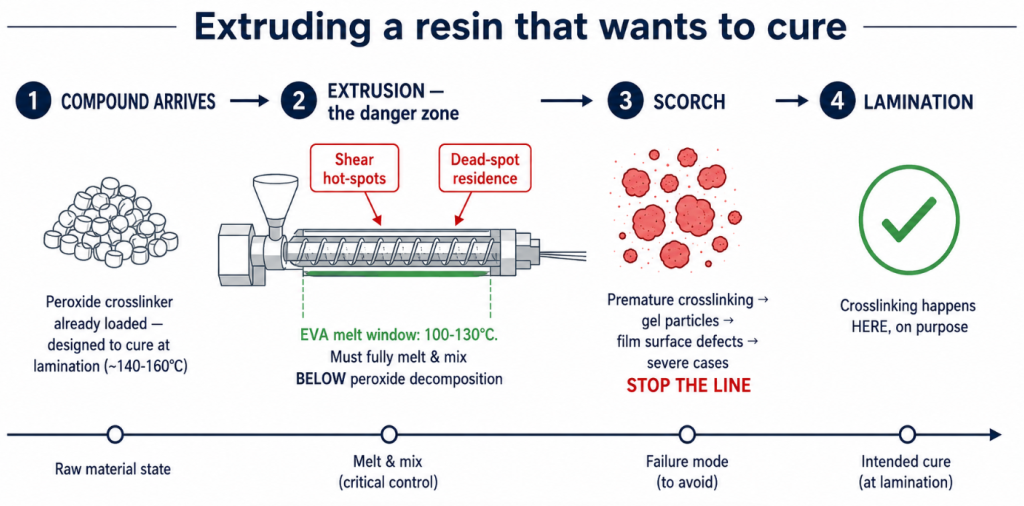
BLOOM manufactures screws and barrels for photovoltaic encapsulant film extrusion — EVA and POE cast-film lines where the resin arrives already loaded with its peroxide crosslinker, and the entire job of the screw is to melt and homogenize it without setting that crosslinker off. Encapsulant extrusion is processing with a built-in time bomb: EVA runs in a narrow low window (barrel 80–120°C, melt 100–130°C) precisely because any overheating — including the shear heat and dead-spot residence the screw itself creates — triggers scorch: premature crosslinking that forms gel particles, ruins film surface quality, and in severe cases stops the extrusion line entirely. This page covers what encapsulant duty demands from the screw and barrel, the EVA-versus-POE differences (including the acetic-acid corrosion problem unique to EVA), and how to specify.
By the BLOOM Engineering Team
The Core Problem: Extruding a Resin That Wants to Cure
Encapsulant film is a thermoset-in-waiting. The compound contains organic peroxides chosen to crosslink during module lamination (~140–160°C) — which means the extruder must fully melt, mix, and pump the resin at temperatures below meaningful peroxide decomposition. The margin is thin, and the failure mode is well documented: premature crosslinking (scorch) creates gel particles in the melt, causing surface irregularities and roughness in the film — and excessive scorch can bring the extrusion process to a complete stop for a teardown and cleaning. Film-quality specs reflect how little tolerance exists: encapsulant-grade resin itself is specified below 0.5 wt% gel content, and the finished film must hold thickness uniformity around ±5% at 0.3–0.5 mm.
Every requirement on the hardware follows from that one constraint.
What the Screw Must Do (and Must Not Do)
- Melt completely at genuinely low temperature. EVA’s window (melt 100–130°C) leaves no room for “run it a little hotter to finish the melting.” The screw geometry — gentle, gradual compression, generous channel depths, moderate speed operation — has to achieve full melting within the window, not by exceeding it.
- Add as little shear heat as possible. The barrel setpoints can be perfect while the melt runs hot anyway, because shear heating is invisible on the controller. A low-shear screw design is the difference between actual melt temperature that matches the setpoint and one that quietly crosses the scorch threshold.
- Distribute the peroxide and additives uniformly — with low-shear mixing. Peroxides, UV stabilizers, and coupling agents must be homogeneous in the film, but dispersive (high-shear) mixing is exactly the wrong tool here. The specification is distributive mixing — pin or pineapple-type elements that divide and recombine the melt without shear spikes, the low-heat option in our mixing section guide.
- Leave the melt nowhere to sit. A dead spot on an encapsulant line isn’t a black-speck problem months away — it’s a scorch source today: material trapped at temperature crosslinks, then sheds gel into the film continuously. Fully streamlined, radiused, mirror-polished geometry, with the same zero-stagnation discipline as our battery separator hardware. If a line produces gels immediately after every restart, the material that sat in the hot barrel through the stop is usually the culprit — a geometry and purge-discipline problem together.
- Pump with absolute stability. At ±5% thickness tolerance on a wide cast web, output pulsation prints straight into gauge — the same logic as gauge variation in film, with less forgiveness.
EVA vs POE: Same Bomb, Different Chemistry
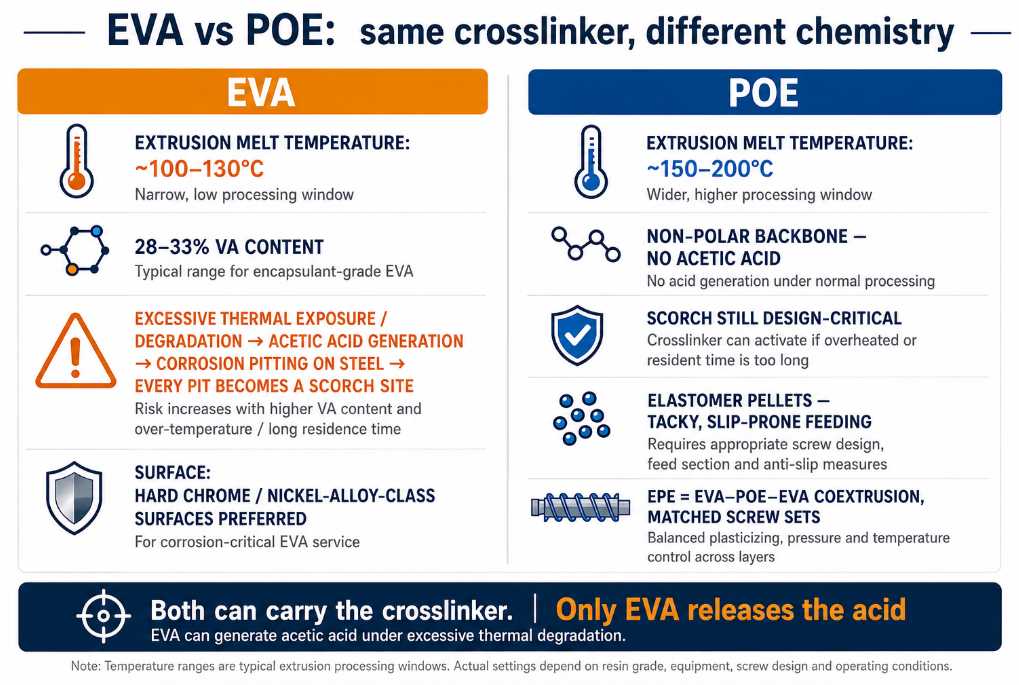
| EVA lines | POE lines | |
|---|---|---|
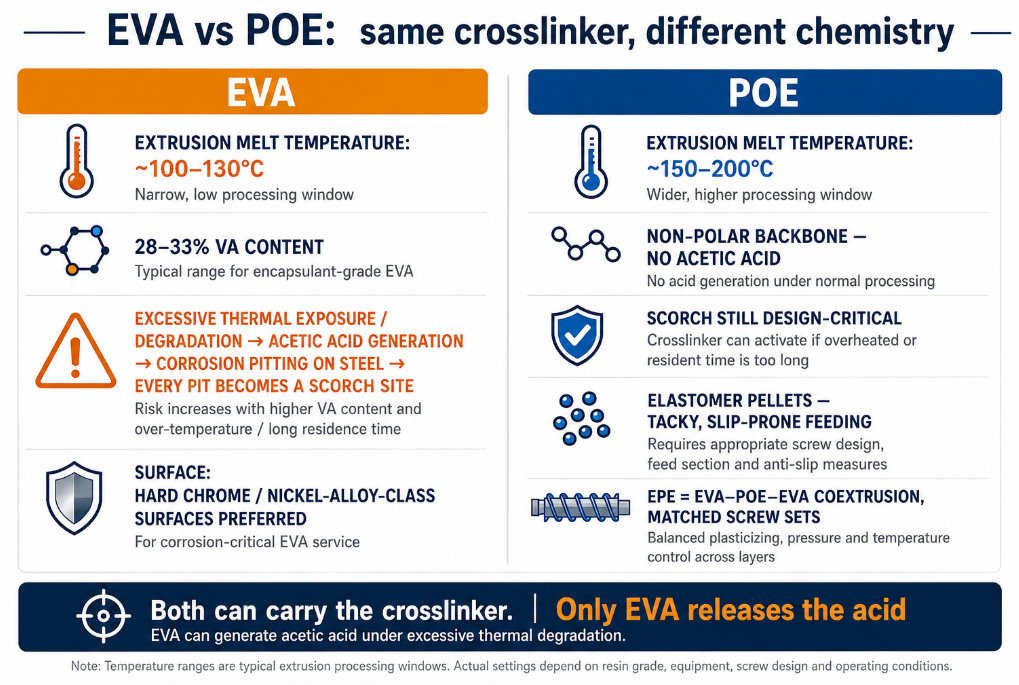
| Melt temperature | ~100–130°C (barrel 80–120°C) | ~150–200°C |
| Scorch risk | High — narrow, low window | Present — managed by peroxide selection, still design-critical |
| Corrosive by-product | Yes — overheated EVA (28–33% VA) splits off acetic acid, which attacks steel surfaces | No — non-polar backbone, no acetic acid |
| Screw/barrel surface | Corrosion-resistant required: hard chrome or nickel-alloy class | Standard wear surfaces generally sufficient |
| Feeding | Conventional | Elastomer pellets — tackier, slip-prone; feed-section design matters |
| Line formats | Single-layer EVA | POE and EPE (EVA-POE-EVA) coextrusion — multiple matched extruders |
Two rows deserve emphasis. First, the acetic-acid problem is real hardware chemistry: EVA that overheats — in a dead spot, during a stop, in a shear hot-spot — releases acetic acid, the same corrosive by-product documented for attacking module metallization. On the screw and barrel it means corrosion pitting over time, and every pit becomes a hang-up point that scorches. EVA-line hardware therefore carries corrosion-resistant surfaces — hard chrome or nickel-alloy class, the anti-corrosion grade on our nickel base alloy page. Second, EPE coextrusion multiplies the specification: three layers means multiple extruders whose melts must arrive matched in temperature and stability — which starts with matched, consistent screws.
What We Supply
| Item | Construction | Notes |
|---|---|---|
| EVA encapsulant screws | Low-shear, gradual-compression geometry, distributive mixing, mirror-polished; hard chrome or nickel-alloy surfaces | Built for the 100–130°C window and acetic-acid duty |
| POE encapsulant screws | Low-shear geometry tuned to the 150–200°C window; feed section designed for elastomer pellets | Scorch-safe melting for POE compounds |
| Barrels | Honed bores; corrosion-resistant or bimetallic liners per duty | Matched to the screw as a pair |
| EPE coextrusion sets | Matched multi-extruder screw sets | Layer-to-layer melt consistency |
| Reverse engineering | From your worn parts or drawings | Full dimensional documentation |
Every part ships with material certificates, hardness reports, and dimensional records — the regime in our acceptance inspection checklist.
Frequently Asked Questions
Our film shows gel specks — is it the screw and barrel? Very possibly. Gels on an encapsulant line mean scorch, and scorch means the melt got too hot somewhere or sat somewhere: shear hot-spots from an aggressive screw design, dead spots in worn or badly-designed geometry, or material left in the barrel through a stop. Send us your gel pattern (continuous vs after-restart), melt temperatures, and the parts’ history.
Do EVA screws really need corrosion protection? Yes. Overheated EVA releases acetic acid, and over months that pits unprotected steel — and every pit becomes a scorch site. Chrome or nickel-alloy surfaces are the standard answer on EVA duty.
Can one screw run both EVA and POE? The windows differ (100–130°C vs 150–200°C) and POE pellets feed differently. A screw designed honestly for one is a compromise on the other — workable for trials, not ideal for dedicated production. For EPE lines the layers run on separate, purpose-specified extruders anyway.
We’re commissioning a new encapsulant line — what should we send you? The resin and compound datasheets (peroxide system matters), target output and film width, machine models and L/D, and whether the line is EVA, POE, or EPE. We’ll specify the geometry, surfaces, and mixing from that.
Encapsulant film extrusion is the discipline of melting a resin that’s trying to cure — so the screw and barrel are specified around one idea: complete, uniform, cool melting with nowhere to sit — low shear, distributive mixing, zero dead spots, corrosion protection where EVA’s acetic acid demands it, and output stable enough to hold ±5% on a product measured in tenths of a millimeter.
If you run or are building an EVA, POE, or EPE encapsulant line — fighting gels, replacing pitted parts, or specifying new extruders — send our engineering team your compound details, temperatures, line format, and machine specs on WhatsApp and we’ll design the screws and barrels for the window your chemistry allows. See also our screws and barrels pages.
References and Further Reading
- US Patent 12,018,139 (USPTO) — scorch (premature crosslinking) during encapsulant extrusion forming gel particles, causing surface irregularities and, in excess, complete stoppage of the extrusion process: https://image-ppubs.uspto.gov/dirsearch-public/print/downloadPdf/12018139
- EVA Solar Encapsulant Film, PatSnap Eureka — extrusion at barrel temperatures of 80–120°C and melt 100–130°C to prevent premature crosslinking, ±5% thickness uniformity, and peroxide masterbatch practice: https://eureka.patsnap.com/materials/eva-solar-encapsulant-film
- PV Encapsulant Materials: EVA, POE & TPO, PatSnap — EVA’s 28–33% VA content and acetic-acid release as a corrosive degradation by-product, versus POE’s non-polar backbone releasing none: https://www.patsnap.com/resources/blog/mse-blog/pv-encapsulant-materials-2026-eva-poe-tpo-patsnap-eureka/