
BLOOM manufactures tungsten carbide screws and barrels — the top wear-resistance grade in extrusion hardware, for the duties that grind everything else away: 30–65% glass fiber, heavy mineral loading, WPC wood flour, and abrasive recycling. The reason it sits at the top is simple arithmetic: tungsten carbide reaches about 2,200 HV (roughly 85 HRC equivalent) — double a nitrided surface — and carbide-based coatings pack up to 80% hard particles by volume, where conventional wear alloys max out around 35% of a softer carbide. This page covers what tungsten carbide construction actually is, the two ways it goes onto a screw, the carbide-reinforced barrel liner, when it’s genuinely required versus overkill, and its honest limitations.
By the BLOOM Engineering Team
Why Tungsten Carbide Is the Ceiling
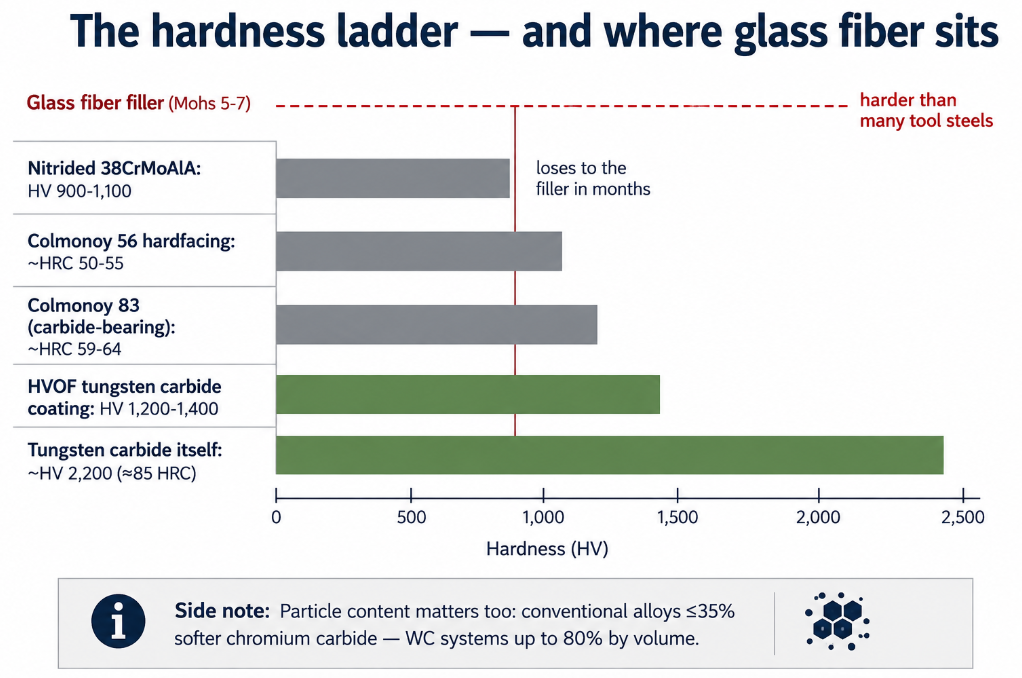
Wear resistance against hard fillers is a hardness contest. Glass fiber sits at Mohs 5–7 — harder than many tool steels — which is why plain nitrided parts (HV 900–1,100) lose to it in months. The carbide answer:
| Surface | Hardness class | Hard-particle content |
|---|---|---|
| Nitrided 38CrMoAlA | HV 900–1,100 | — (hardened steel case) |
| Conventional hardfacing (Colmonoy 56 class) | ~HRC 50–55 | Moderate |
| Carbide-bearing hardfacing (Colmonoy 83 class) | ~HRC 59–64 | High |
| Tungsten carbide (WC-Co / WC-CoCr) | ~HV 1,200–1,400 as HVOF coating; WC itself ~2,200 HV | Up to ~80% by volume |
The particle-content row is the underrated one: most standard wear alloys carry at most about 35% by volume of chromium carbide — a softer carbide — while tungsten carbide systems are mostly carbide with just enough metal binder (cobalt or nickel) to hold it together. Against a melt full of glass fiber, that’s the difference between a surface that resists the filler and one that outranks it.
On the Screw: Two Ways to Apply It
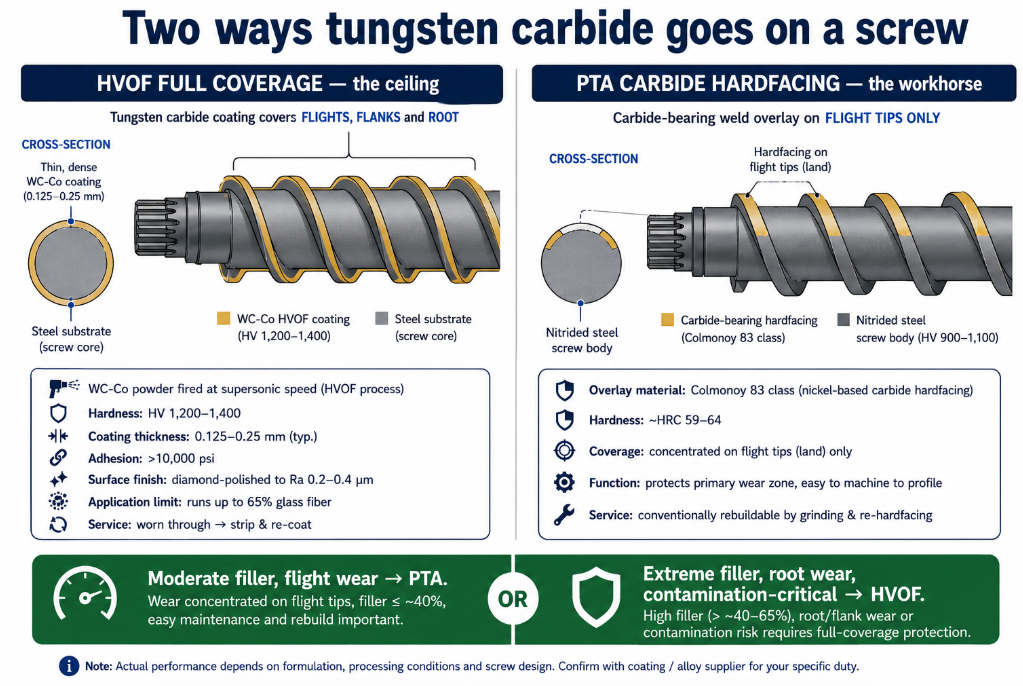
1. HVOF full-coverage coating (the premium route). Tungsten carbide powder (WC-Co or WC-CoCr) is fired onto the screw at supersonic velocity by high-velocity oxy-fuel spraying, building a dense, metallurgically-anchored coating over the flights and the root:
- Hardness HV 1,200–1,400, coating density above 98%, adhesion beyond 10,000 psi — engineered specifically so the coating doesn’t peel or shed, which matters because shed coating is itself contamination.
- Thickness typically 0.125–0.25 mm, diamond-polished afterward to a Ra 0.2–0.4 µm mirror finish — the full-surface protection plus the streamlined polish abrasive duty demands.
- The specification for extreme cases: full-coverage WC screws run compounds up to 65% glass fiber.
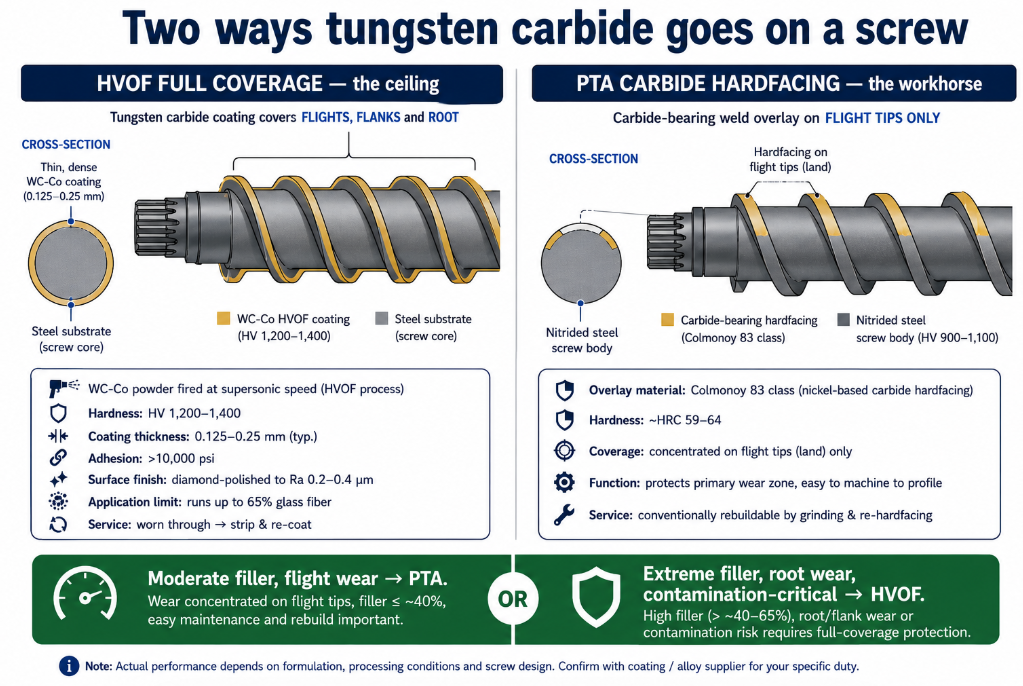
2. Carbide-bearing PTA hardfacing on the flight tips (the workhorse route). The tungsten-carbide-bearing weld alloys (Colmonoy 83 class, ~HRC 59–64) are PTA-welded onto the flight crests — the concentrated-wear surface — over a nitrided body. Less total protection than full coverage, but robust, economical, and straightforwardly rebuildable when it finally wears; the alloy logic is in our Stellite vs Colmonoy guide.
Choosing between them: flight-tip abrasion on moderate filler → PTA hardfacing; extreme filler content, root wear, or contamination-critical product → HVOF full coverage.
On the Barrel: The Carbide-Reinforced Bimetallic Liner
The barrel-side answer is a bimetallic liner with tungsten carbide particles cast into the alloy matrix — a technology originally patented by Xaloy in 1974 (US 3,836,341) and now the industry’s severe-duty standard. The incorporation of carbide into the centrifugally-cast liner extends barrel life by roughly 4–5× versus the earlier plain bimetallic liners — which is what makes highly-filled compounds and high screw speeds economically runnable at all. It slots in as the top grade of the same liner family covered on our bimetallic screw and barrel page, and it should always be paired with a carbide-class screw surface — a WC barrel against a nitrided screw simply transfers all the wear to the screw.
When Tungsten Carbide Is Required — and When It’s Overkill
| Your duty | Verdict |
|---|---|
| Glass or carbon fiber ≥30% (up to 65%) | Required — nothing softer survives economically |
| Calcium carbonate above ~20 phr, talc, mineral-filled compounds | Required / strongly advised |
| WPC — wood flour, rice husk | Strongly advised — abrasive fiber plus moisture |
| Abrasive recycling with unpredictable contamination | Strongly advised |
| High-temperature filled resins (30% CF PEEK class) | Required — carbide holds its hardness hot; see the PEEK specification |
| Unfilled or lightly-filled neutral resins | Overkill — nitrided or standard bimetallic serves at a fraction of the cost |
| Corrosive melt, low abrasion (fluoropolymers, PVC) | Wrong grade — that’s a chemistry problem; see the nickel base alloy page (carbide-in-nickel-matrix exists for combined duty) |
The Honest Limitations
- Cost. The highest-priced surface grade — which is exactly why the table above matters; buy it for the duty that consumes it.
- The HVOF coating is thin. 0.125–0.25 mm is dense and extremely hard, but once abraded through it must be stripped and re-coated — it’s not a grind-and-reweld surface like PTA hardfacing.
- Carbide is brittle. Superb against sliding abrasion, sensitive to impact and bending — a WC-coated screw must be handled, straightened, and installed with more care than a welded one.
- Machining needs diamond. Any post-coating correction is diamond-grinding work, not conventional machining — one more reason the specification and dimensions must be right before coating.
None of these are reasons to avoid it on the right duty; they’re reasons it should be applied by a shop that does it properly — dense, adherent, polished, and documented with the hardness reports our acceptance checklist calls for.
What We Supply
| Item | Construction |
|---|---|
| HVOF tungsten carbide screws | WC-Co / WC-CoCr full coverage, HV 1,200–1,400, mirror-polished |
| Carbide-hardfaced screws | Colmonoy 83-class PTA on flight tips over nitrided 38CrMoAlA |
| Carbide-reinforced bimetallic barrels | WC-particle liner, centrifugally cast, honed |
| Matched screw + barrel pairs | Carbide grade on both sides — specified together |
| Reverse engineering | From worn parts or drawings, full documentation |
Frequently Asked Questions
Tungsten carbide versus Colmonoy 83 — aren’t they the same thing? Related, not the same. Colmonoy 83 is a nickel-based weld alloy bearing tungsten carbide (~HRC 59–64) applied to flight tips by PTA. Full HVOF tungsten carbide is a coating that is mostly carbide (HV 1,200–1,400) over the entire surface. The first is the workhorse; the second is the ceiling.
Will the coating peel off into my product? A properly applied HVOF coating is the opposite of a peel risk — 98%+ density and >10,000 psi adhesion exist precisely so nothing sheds. Peeling is the signature of a badly-applied coating, which is why the process quality and documentation matter more here than anywhere.
Can a WC-coated screw be rebuilt? The PTA-hardfaced route rebuilds conventionally. The HVOF route is re-coated: strip the worn coating, verify the base, re-spray, re-polish. Both are serviceable; they just follow different paths.
We run 50–65% glass fiber — is that really viable? Yes — that’s exactly the duty full-coverage WC screws and carbide-reinforced barrels exist for. Send the compound details and we’ll specify the pair.
Tungsten carbide is the grade you buy when the filler is winning — twice the hardness of a nitrided case, four-to-five times the barrel life of plain bimetallic, and the only surface that outranks glass fiber itself — applied where the duty consumes it and skipped where it doesn’t.
If your compound is grinding through screws and barrels faster than the maintenance budget can stand, send our engineering team your material and filler content, current parts’ service life, and drawings or measurements on WhatsApp and we’ll specify the carbide construction — HVOF, hardfaced, or the matched pair — with full documentation. See also our screws and barrels pages.
References and Further Reading
- Extrusion Screws for Thermoplastic Composites, SpecialChem — tungsten-carbide particles in spin-cast bimetallic liners extending barrel life 4–5× versus earlier bimetallic liners, enabling highly-filled polymers and higher screw speeds: https://www.specialchem.com/plastics/guide/extrusion-screws-for-thermoplastic-composites
- US Patent 3,836,341 (Xaloy Inc., 1974) — the original patent for incorporating tungsten carbide into bimetallic barrel liner material: https://patents.google.com/patent/US3836341A/en


Pingback: Wire and Cable Extruder Screw and Barrel Guide
Pingback: Twin-Screw Extruders for Dry Battery Electrodes
Pingback: The Twin Screw Discharge Barrel: Where Pressure Costs You Heat and Wear
Pingback: Screw Barrel Manufacturer: Barrels, Liners and Matched Screw Sets Built From Our Own Alloys