
Quick answer: black specks in PVC are carbonized, fully-degraded PVC breaking loose into your product — and in most cases you manufactured them inside your own machine. PVC that stagnates in dead spots, hot spots, or worn surfaces degrades all the way past yellowing to black carbon; the carbon builds up on the screw, barrel, and die, then flakes off into the melt as black specks. The remaining cases come in with the raw material. Below are the specific places specks are born, why purging alone rarely cures them, and the diagnostic sequence that finds the real source.
By the BLOOM Engineering Team
Black Specks Are the End Stage of the Same Degradation That Causes Yellowing
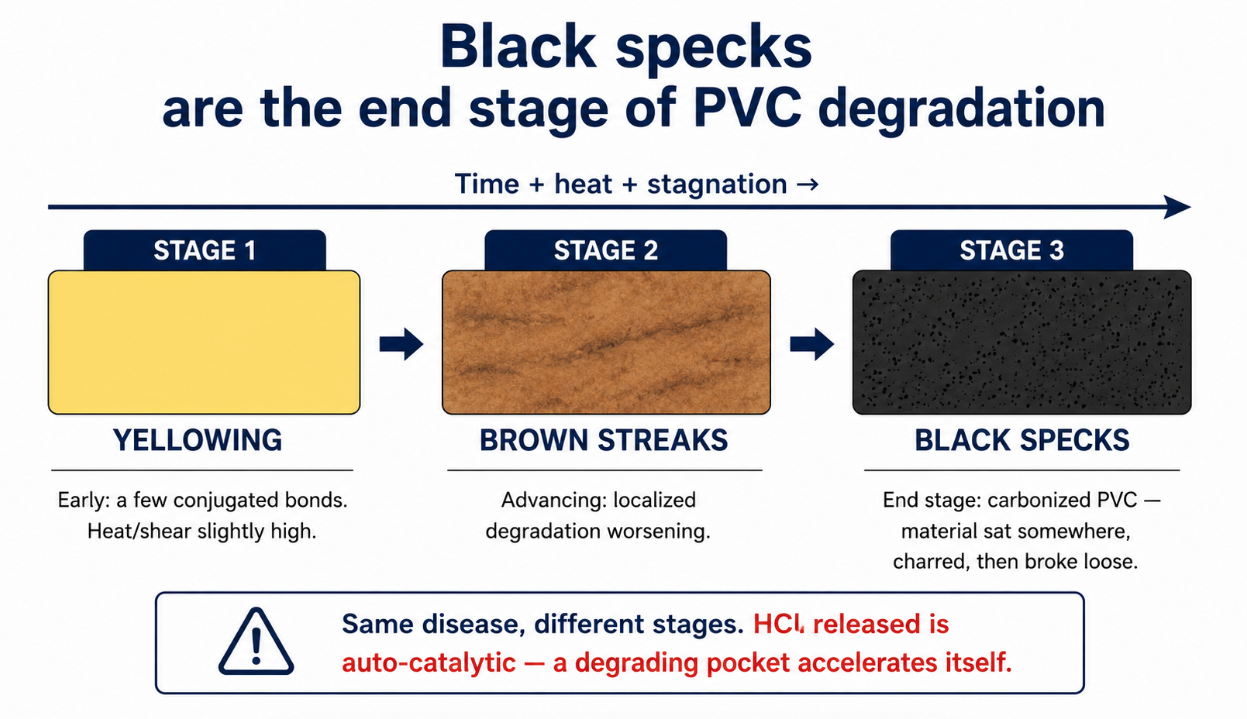
Black specks and yellowing are the same disease at different stages. PVC degrades by dehydrochlorination — it sheds HCl and forms conjugated structures that color the material. A few conjugated bonds show as yellow; keep heating, and the degradation runs all the way to carbonized, black material. And because the HCl released is auto-catalytic, a small pocket of degrading PVC accelerates its own destruction and attacks the stabilizer around it.
| Symptom | Degradation stage | What it tells you |
|---|---|---|
| Yellowing | Early — a few conjugated bonds | Heat/shear slightly too high, or early stagnation |
| Brown streaks | Advancing | Localized degradation worsening |
| Black specks | End stage — carbonized PVC | Material sat somewhere long enough to char, then broke loose |
The distinction matters for diagnosis: uniform yellowing points to overall temperature or stabilizer problems (see our guide on why PVC turns yellow), while black specks almost always mean a specific place in the machine where PVC is stagnating and charring — and your job is to find that place.
Where Black Specks Are Born
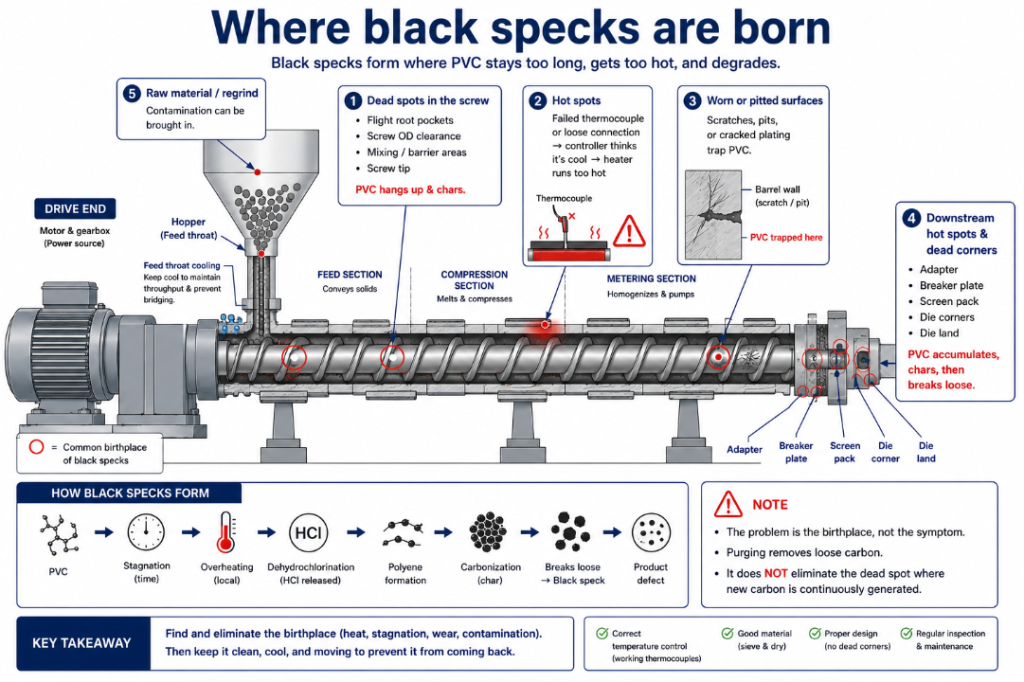
Industry troubleshooting converges on a short list of birthplaces. Work through them in this order:
| Source | What happens | How to check |
|---|---|---|
| Raw material / regrind | Specks or “unmelts” arrive in the compound; contaminated or over-cycled regrind | Inspect representative raw samples first — rule this out before blaming the machine |
| Dead spots behind screw flights | Most general-purpose screws have dead space behind the flights where PVC hangs up and chars | Pull the screw; look for carbon behind flights in the transition and metering zones |
| Hot spots | A failed thermocouple, runaway heater band, or stuck relay overheats one zone | Verify actual zone temperatures against setpoints; check the control hardware |
| Worn or pitted surfaces | Worn screw/barrel, pitted chrome, or cracks in plating trap small amounts of PVC that degrade over time | Inspect surfaces when the screw is out; measure wear |
| Shutdowns & residence time | Stops, die changes, and weekend shutdowns leave PVC cooking in a hot barrel | Review shutdown/purge procedures; systems on 5-day operation often re-speck within weeks of a cleaning |
| Running too cold | Counterintuitive: forcing cold, stiff PVC to flow generates localized shear heating and degradation | Check the low end of the profile, not just the high end |
Two of these deserve emphasis for PVC specifically. Dead spots are the classic source — any groove, scratch, corner, or unswept zone lets PVC sit, shed HCl, and char, and the auto-catalytic HCl makes the pocket worse over time. And worn surfaces are an underrated one: a scratch from a steel cleaning tool or a crack in old chrome plating is a permanent PVC trap. This is one more reason PVC machines need streamlined, polished, corrosion-resistant flow surfaces, and why cleaning is done with brass, never steel.
The Purge Trap: Why the Specks Keep Coming Back
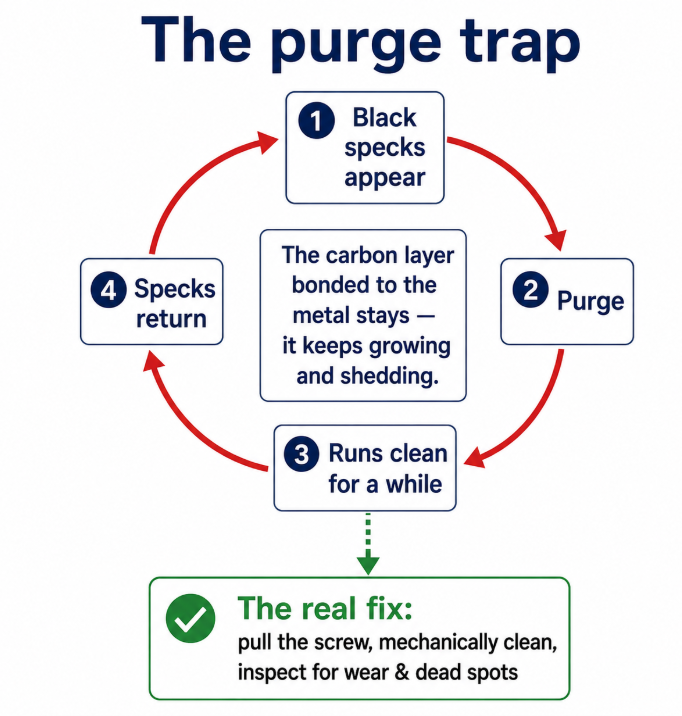
Here is the pattern that frustrates most shops: black specks appear → you purge → the product runs clean for a while → the specks return. The cycle repeats because ordinary purging removes the loose contamination but leaves the carbon layer bonded to the metal — the actual factory making the specks. That layer keeps growing and keeps shedding.
Two practical diagnostics from the troubleshooting literature:
- The backpressure test: if raising backpressure (or screw speed agitation) triggers a burst of specks — a “carbon shower” — the carbon reservoir is on the screw, and it’s usually a screw-design or dead-spot problem, not a material problem.
- The purge-pile check: purge with the barrel completely full and examine the purge pile. Random specks throughout the pile point to the screw and barrel; contamination at the same spot every time points to the die or downstream plumbing.
When the carbon layer is established, the honest fix is mechanical: pull the screw and physically clean screw and barrel (our screw cleaning playbook covers the safe procedure), and while it’s out, inspect for the wear, pitting, and dead spots that let the layer form — see how much screw wear is acceptable.
Eliminating Black Specks for Good
Purging manages the symptom; eliminating specks means removing the birthplace. The sequence that works:
- Rule out the raw material — inspect incoming compound and regrind before touching the machine.
- Verify temperature control hardware — thermocouples, heater bands, relays. One runaway zone chars everything passing through it.
- Pull and inspect the screw — carbon behind the flights, wear, scratches, pitted or cracked plating. Clean mechanically; repair or replace damaged surfaces.
- Fix the geometry — for PVC, the screw should be streamlined and polished with no dead spots, radiused flight roots, and low-shear design; worn parts that trap material need rebuilding or replacement.
- Tighten shutdown discipline — never leave PVC sitting in a hot barrel; purge properly at every stop. Heat-sensitive PVC punishes casual shutdowns more than almost any material.
- Control regrind — over-cycled regrind arrives with depleted stabilizer and degrades far more easily.
Black specks in PVC are not random bad luck — they are carbonized PVC announcing that somewhere in your system, material is stagnating and charring, so the cure is never just another purge but finding and removing that place: a dead spot, a hot zone, a worn or scratched surface, or a shutdown habit, after which the specks stop being manufactured at all.
At BLOOM, we build extruder screws and barrels for PVC with streamlined, polished, low-shear geometry and corrosion-resistant surfaces — designed so PVC flows through without the stagnation points where black specks are born. If you’re fighting recurring specks and suspect worn or badly-designed hardware is the reservoir, send our engineering team photos of your screw and a description of the problem on WhatsApp and we’ll give you an honest read. For the full PVC picture, see our PVC extruder screw and barrel guide.
References and Further Reading
- Stop Black Specks!, Plastics Technology, 2011 — the two sources of specks (raw material vs manufactured in the system), hot spots from failed thermocouples, worn/pitted surfaces and cracked plating as degradation traps, shutdown heat history: https://www.ptonline.com/articles/stop-black-specks
- Minimizing Black Specks, Plastics Technology, 2013 — dead space behind screw flights, the backpressure “carbon shower” diagnostic, residence time as the source of most specks: https://www.ptonline.com/articles/minimizing-black-specks
- Got Streaks or Black Specs? Here’s How to Find and Fix Them, Plastics Technology, 2023 — the purge-pile diagnostic and locating contamination in barrel vs die: https://www.ptonline.com/articles/got-streaks-or-black-specs-heres-how-to-find-and-fix-them


Pingback: Conical Twin Screw Barrel Guide: Sizes, Wear and What to Specify for PVC