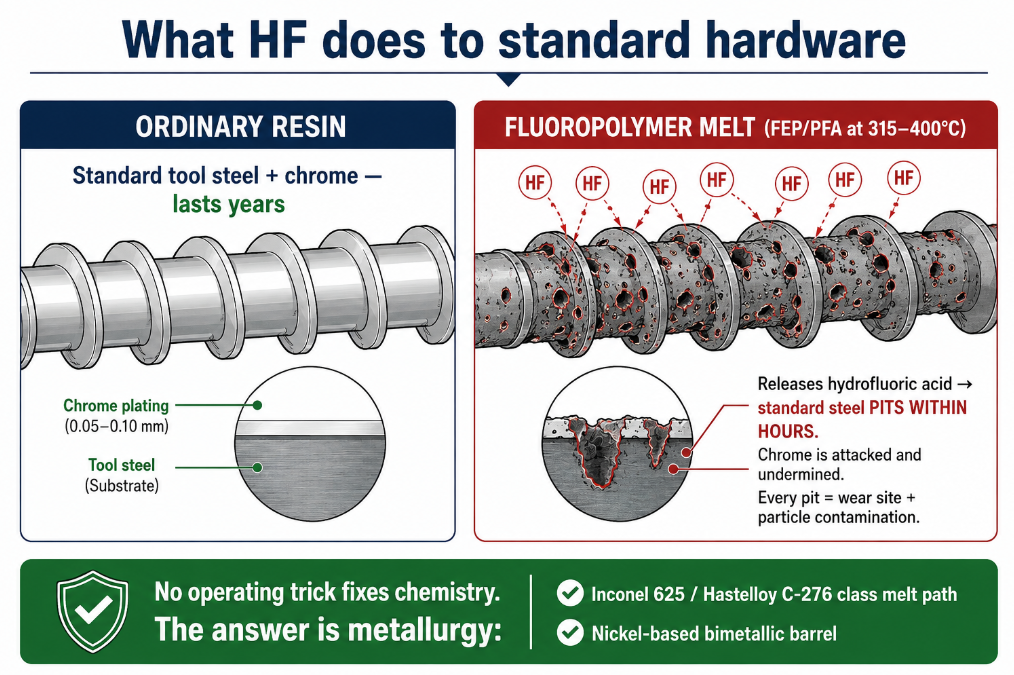
BLOOM manufactures screws and barrels for fluoropolymer extrusion — full nickel-alloy screws in the Inconel 625 / Hastelloy C-276 class for melt-contact duty, and nickel-based or tungsten-carbide bimetallic barrels for the bore. Fluoropolymers are the one material family that chemically destroys standard hardware: at melt temperature they release hydrofluoric acid (HF), which pits ordinary tool steel within hours of operation, attacks chrome plating, and turns every corrosion pit into a wear site and a contamination source. This page covers why fluoropolymer duty defeats standard parts, the alloy solutions by resin grade, the strength trade-off every buyer must understand before running a nickel-alloy screw, and how to specify.
By the BLOOM Engineering Team
Why Fluoropolymers Destroy Standard Screws and Barrels
| Ordinary resins | Fluoropolymers (PVDF, FEP, PFA, ETFE) | |
|---|---|---|
| Chemical attack at melt temp | None to mild | Releases HF — highly acidic, attacks steel and chrome |
| Standard tool steel | Lasts years | Pits within hours to days of molten contact |
| Hard chrome plating | Adequate for mild duty | Attacked and undermined by HF |
| The consequence of pitting | Gradual wear | Pits = wear sites + particle contamination in the melt — fatal for high-purity tubing, semiconductor, and medical products |
| Processing temperature | Typical 180–280°C | FEP/PFA run roughly 315–400°C — corrosion and heat together |
The mechanism is unavoidable chemistry: melt-processable fluoropolymers give off trace HF at normal processing temperature, and much more if they overheat or degrade — non-nickel-alloy surfaces simply cannot survive perfluoropolymer melt contact under normal process conditions. There is no operating trick around it; the answer is metallurgy.
The Alloy Solution: What Each Part Needs
Industry practice for fluoropolymer lines — established in medical-tubing and high-purity extrusion — is specific about the wetted path:
- The screw (and die, adapter, breaker plate — every melt-contact component) is made from a high-nickel corrosion-resistant alloy: Inconel 625 or Hastelloy C-276 class. Hastelloy C-276 offers the highest corrosion resistance; Inconel 625 is slightly stronger with marginally less corrosion resistance — the choice weighs your chemistry against your torque.
- The barrel takes a nickel-based bimetallic liner, or a tungsten-carbide/nickel-based liner where fillers add abrasion to the corrosion — the same nickel-alloy liner family covered on our nickel base alloy barrel page, specified here in its anti-corrosion grade.
- Flow surfaces streamlined and polished throughout. Fluoropolymers are shear- and residence-sensitive: material that hangs up and degrades releases more HF, accelerating the attack on everything downstream. Dead spots aren’t just a quality issue on this duty — they’re a corrosion accelerant.
The Trade-Off Every Buyer Must Know: Half the Strength
Here is the detail that separates suppliers who have actually built fluoropolymer screws from those who haven’t. Nickel alloys in the Inconel 625 / Hastelloy C-276 class have roughly half the yield strength of a standard quenched-and-tempered screw steel (about 359 MPa versus a 4140-class core at 28–32 HRC). That has real consequences:
- Cold starts snap these screws. A nickel-alloy screw turning against unmelted fluoropolymer can exceed its torsional strength easily — a small extruder started cold is very likely to break its Hastelloy screw. Soak discipline isn’t optional on these lines; the full logic is in why extruder screws break.
- The design must be torque-checked. Root diameters, drive-end geometry, and the machine’s torque have to be verified against the alloy’s real strength — a geometry that’s safe in 38CrMoAlA can be marginal in Hastelloy.
- Don’t use these alloys where you don’t need them. For hot but non-corrosive resins (PEEK, PSU, PEI), a nickel-alloy screw gives up strength for corrosion resistance the material never attacks — the wrong specification in the other direction.
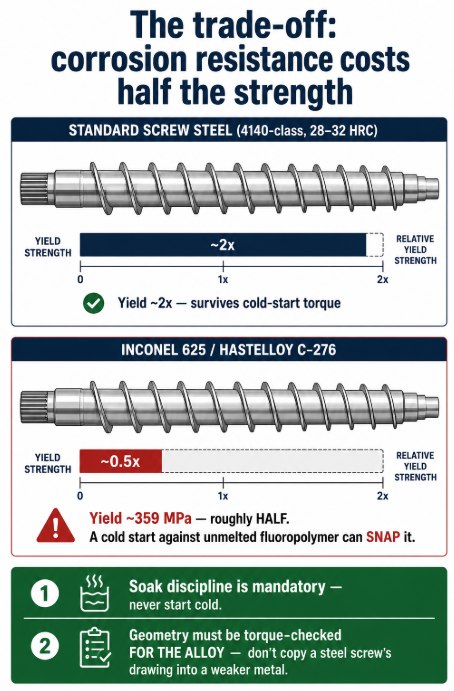
We design fluoropolymer screws around this trade-off — geometry sized to the alloy’s strength and your machine’s torque — rather than copying a steel screw’s drawing into a weaker metal.
Matching the Solution to the Resin: Not All Fluoropolymers Are Equal
| Resin | Processing temp | Corrosion severity | Typical specification |
|---|---|---|---|
| PVDF | ~200–260°C | Milder — lower temp, less aggressive | High-nickel surfaces / nickel-alloy grade — full Hastelloy often not required |
| ETFE | ~300–340°C | Moderate–high | Nickel-alloy melt path recommended |
| FEP | ~315–390°C | High — heat + HF together | Inconel 625 / Hastelloy C-276 class screw + nickel-based bimetallic barrel |
| PFA | ~350–400°C | Highest — near the degradation edge | Full Hastelloy C-276 class wetted path; tight temperature control (overheating releases more HF) |
The honest guidance: PVDF lines often don’t need the full Hastelloy treatment, while FEP and PFA lines always do — specifying by the actual resin saves real money at the mild end and prevents hardware destruction at the severe end.
What We Supply
| Item | Construction | Notes |
|---|---|---|
| Fluoropolymer screws | Inconel 625 / Hastelloy C-276 class, torque-checked geometry | Polished, streamlined, full melt-contact protection |
| High-nickel-surface screws | Nickel-alloy surfacing over steel core | The PVDF-class economical option |
| Barrels | Nickel-based bimetallic liners; carbide/nickel grades for filled compounds | Anti-corrosion grade, honed bores |
| Downstream wetted parts | Adapters, breaker plates to match | Same alloy class as the screw |
| Reverse engineering | From your worn parts or drawings | With full documentation |
Every part ships with material certificates, hardness reports, and dimensional records — the regime in our acceptance inspection checklist.
Frequently Asked Questions
Our chrome-plated screw pitted after switching to FEP — is that normal? Yes — HF attacks chrome and the steel beneath it. Chrome is not a fluoropolymer solution; the melt path needs nickel-alloy metallurgy.
Hastelloy or Inconel? Hastelloy C-276 for maximum corrosion resistance (PFA, aggressive duty); Inconel 625 where you need a little more strength and the chemistry allows. We’ll recommend based on your resin and machine torque.
Why did our nickel-alloy screw snap when steel ones never did? Almost certainly a cold start — these alloys carry about half the torsional strength of screw steel. The fix is soak discipline plus a geometry actually designed for the alloy.
Do you supply for high-purity (medical / semiconductor) lines? Yes — polished, streamlined, fully nickel-alloy wetted paths with documentation, the same contamination logic as our battery separator page.
Fluoropolymer extrusion is the duty where the material fights back — HF chemistry that standard steel and chrome cannot survive — so the hardware is a metallurgy decision first: the right nickel alloy on every wetted surface, in a geometry honestly designed around that alloy’s strength.
If you’re specifying a fluoropolymer line, replacing pitted parts, or upgrading from PVDF-class to FEP/PFA duty, send our engineering team your resin, processing temperatures, machine model and torque, and part drawings on WhatsApp and we’ll specify the alloy class and build the parts with full documentation. See also our nickel base alloy barrels and bimetallic screw and barrel pages.
References and Further Reading
- Processing and Workplace Safety Tips for Fluoropolymer Medical Tubing, Plastics Technology, 2018 — Inconel 625 / Hastelloy C-276 for all melt-contact components, nickel-based bimetallic barrel liners, and the half-strength / cold-start breakage trade-off: https://www.ptonline.com/articles/processing-and-workplace-safety-tips-for-fluoropolymer-medical-tubing
- US Patent 8,318,819 (USPTO) — HF released in fluoropolymer extrusion as highly acidic, corroding barrels, screws, and dies; non-Hastelloy/Inconel surfaces unable to survive perfluoropolymer melt contact under normal conditions: https://image-ppubs.uspto.gov/dirsearch-public/print/downloadPdf/8318819