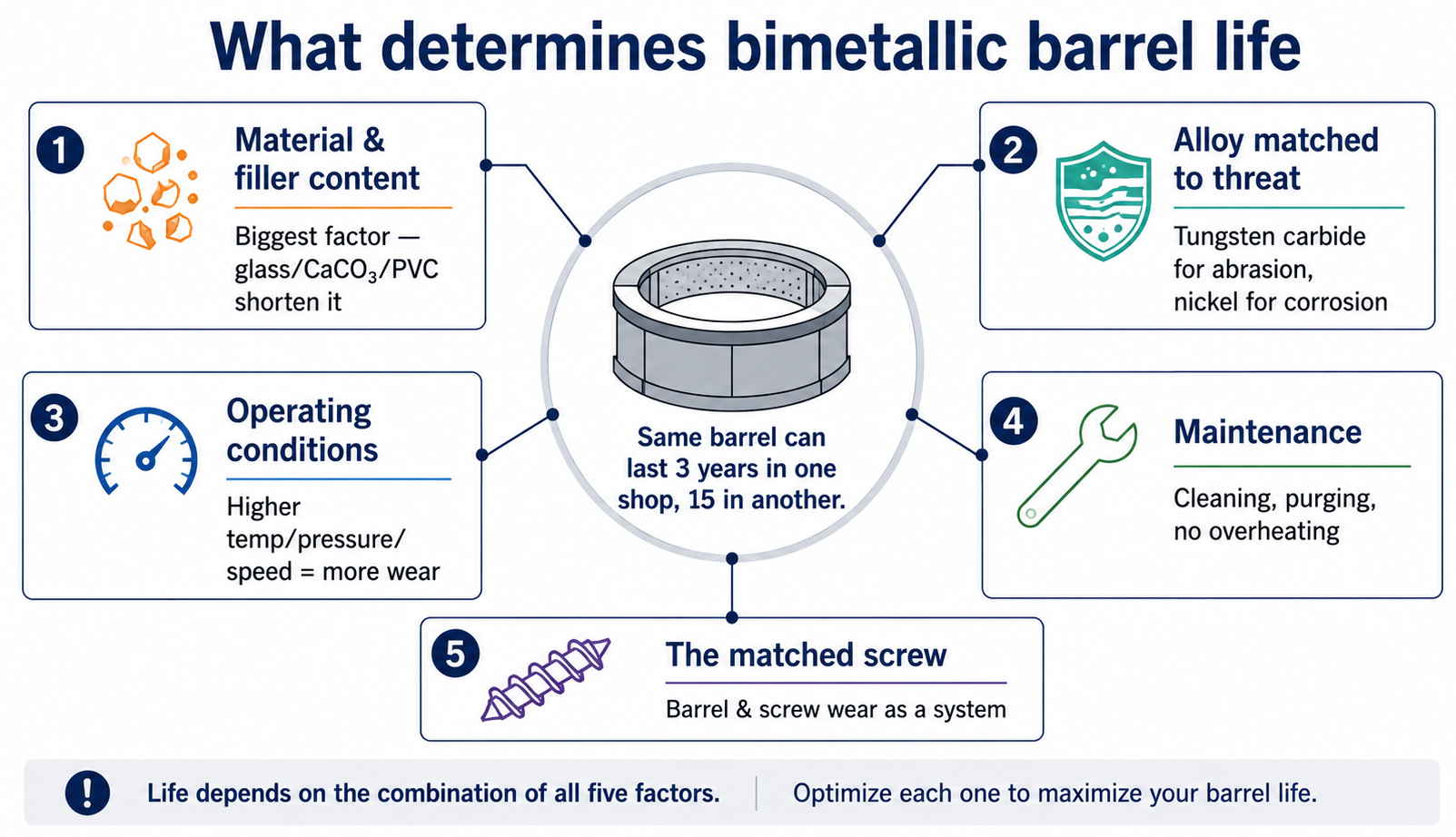
a bimetallic barrel typically lasts 2–3 times longer than a nitrided barrel under the same conditions — often 10–15 years with proper maintenance on moderate-duty work, and 2–5 times longer on highly abrasive materials. The reason is simple: a bimetallic barrel has a thick (2–3 mm) wear-resistant alloy liner, versus the thin (0.3–0.8 mm) hardened case of a nitrided barrel, so there is far more wear-resistant material to grind through. But “how long” depends heavily on what you process — so here is what actually drives bimetallic barrel life, and when it pays for itself.
By the BLOOM Engineering Team
Why Bimetallic Lasts Longer: It’s About Thickness
The whole reason a bimetallic barrel outlives a nitrided one comes down to how much hard material protects the bore:
- Nitrided barrel: a hardened surface case about 0.3–0.8 mm thick (HV 900–1,100). Good wear resistance, low cost — but a thin layer. Once it wears through, the soft core underneath goes quickly, and wear accelerates fast.
- Bimetallic barrel: a wear-resistant alloy liner about 2–3 mm thick (nickel-based, tungsten carbide, or cobalt alloy), metallurgically bonded into a tough steel base. Several times more hard material, engineered specifically for abrasion or corrosion.
That thicker liner is why bimetallic barrels last roughly 2–3 times longer than nitrided in the same service, and why they hold their geometry — and so their output and melt quality — stable for much longer rather than degrading the moment a thin case wears through. On highly abrasive or highly filled materials, the advantage widens to as much as 2–5 times.
So How Many Years Is That?
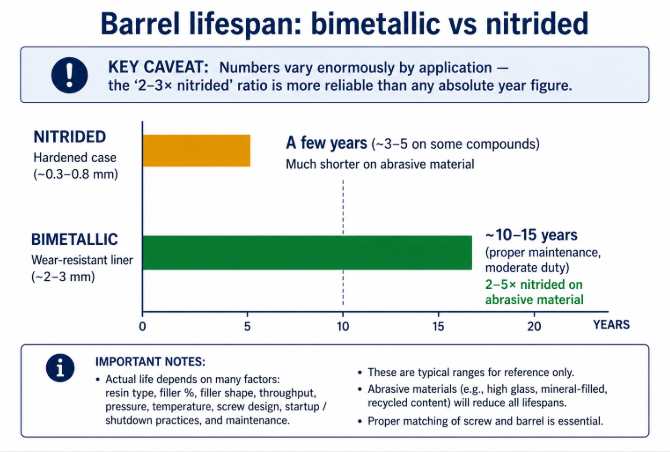
Real numbers, with the important caveat that they vary enormously by application:
| Barrel type | Typical service life (moderate duty) | On abrasive/filled material |
|---|---|---|
| Nitrided | A few years (e.g., ~3–5 years on some compounds) | Much shorter — wears fast |
| Bimetallic | ~10–15 years with proper maintenance | 2–5× a nitrided barrel |
The headline figure of 10–15 years for a bimetallic barrel applies to proper maintenance and moderate duty — running clean, non-abrasive polymer on a well-maintained machine. Running 50% glass-filled compound three shifts a day is a completely different story and will be far shorter for either barrel type. The “2–3× a nitrided barrel” comparison is more useful than any absolute number, because it holds across applications: whatever a nitrided barrel gives you in your specific process, expect meaningfully more from bimetallic.
What Actually Determines the Lifespan
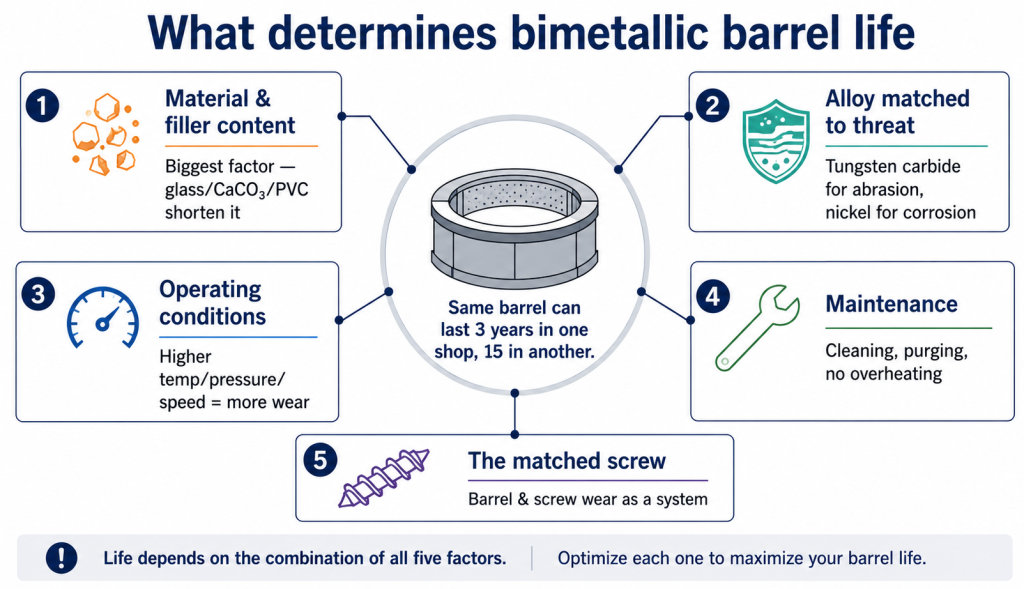
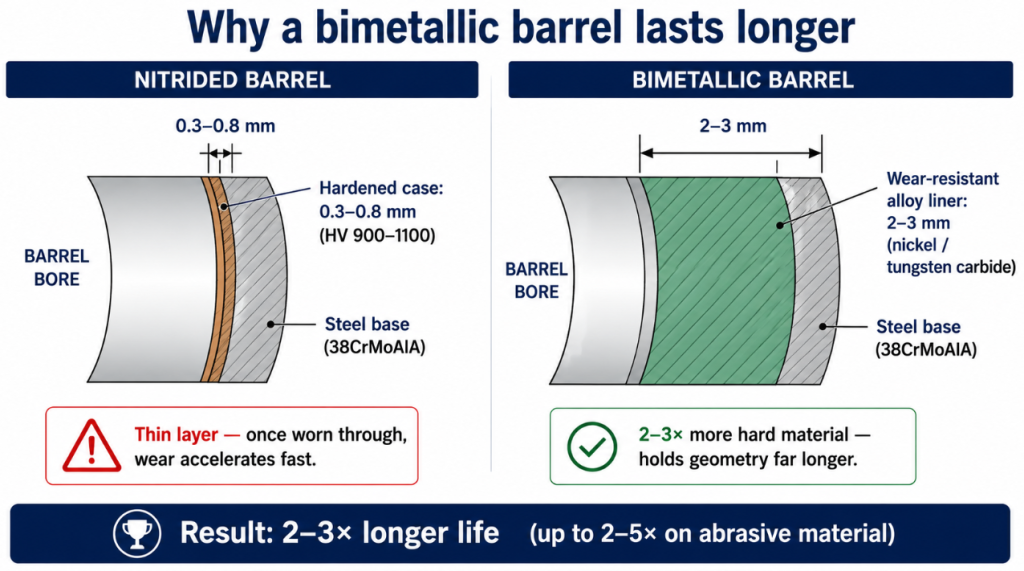
A bimetallic barrel’s life isn’t a fixed number — it’s the result of several factors, and the same barrel can last 3 years in one shop and 15 in another:
- Material and filler content. The biggest factor. Abrasive fillers (glass fiber, calcium carbonate, talc) and corrosive resins (PVC) dramatically shorten life; clean, unfilled polymer extends it. Highly filled or recycled material is the hardest on a barrel — see why in our guide on why glass-fiber-reinforced plastic wears screws fast.
- The alloy matched to the threat. A bimetallic liner only lasts if its alloy fits the duty — tungsten carbide for abrasion, nickel-based for corrosion-plus-wear. The wrong alloy for the application wears faster than its potential. (See our coating and surface treatment guide.)
- Operating conditions. Higher temperatures, pressures, and screw speeds all increase wear.
- Maintenance. Regular cleaning, correct purging, avoiding overheating that degrades the alloy, and scheduled wear inspection all extend life. Bimetallic barrels are low-maintenance, but not no-maintenance.
- The matched screw. A barrel wears against the screw — a worn or poorly-matched screw shortens barrel life and vice versa. They’re a system, which is why we measure and protect both.
How to Tell When It’s Worn Out
Whatever the calendar age, a bimetallic barrel is “done” when its bore has worn enough to open the screw-to-barrel clearance past its limit — the same wear standard as any barrel. The signs are output drop at the same screw speed, rising melt temperature, surging, and quality drift; confirm by measuring the bore against the original dimension. For the specific clearance limits and how to judge them, see our guide on how much screw wear is acceptable, and remember the clearance is the sum of screw and barrel wear, so measure both. A worn bimetallic barrel can sometimes be relined — see barrel relining and replacement signs.
Does It Pay for Itself?
A bimetallic barrel costs more up front than a nitrided one, so the question is whether the longer life is worth it. On abrasive or corrosive work, it usually is: lasting 2–3 times longer (and holding output stable in between) means fewer replacements, less downtime, and less scrap from a worn barrel — so the cost per operating year is lower even though the purchase price is higher. On clean, unfilled, low-duty work, a nitrided barrel may be the more economical choice, since the bimetallic advantage is smaller when there’s little abrasion to resist. It’s the same cost-per-hour logic that governs every wear-protection decision.
How long a bimetallic barrel lasts is really a question about your process, not the barrel — feed it clean polymer with good maintenance and 10–15 years is realistic, feed it heavily filled or corrosive compound and it’ll be less, but in either case it outlasts a nitrided barrel by 2–3 times or more, which is the number that matters when you’re deciding whether the extra cost is worth it.
At BLOOM, we manufacture bimetallic barrels and matched extruder screws with the liner alloy chosen for your material — tungsten carbide for abrasion, nickel-based for corrosion-plus-wear — so they reach their full service life. If you’re weighing bimetallic against nitrided for your process, or want to know what life to expect on your specific material, send our engineering team your material, filler content, and machine details on WhatsApp and we’ll give you a straight answer. For how wear is measured and judged, see our screw and barrel wear analysis.