This is a working glossary of the terms you’ll meet on a screw drawing, in a quote, or in a troubleshooting conversation — organized by topic, with the practical meaning rather than the textbook one. Where a term deserves more than a paragraph, we’ve linked the full guide. If you’re new to specifying screws, start with the geometry section; if you’re diagnosing a problem, jump to process problems at the end.
By the BLOOM Engineering Team
Screw Geometry
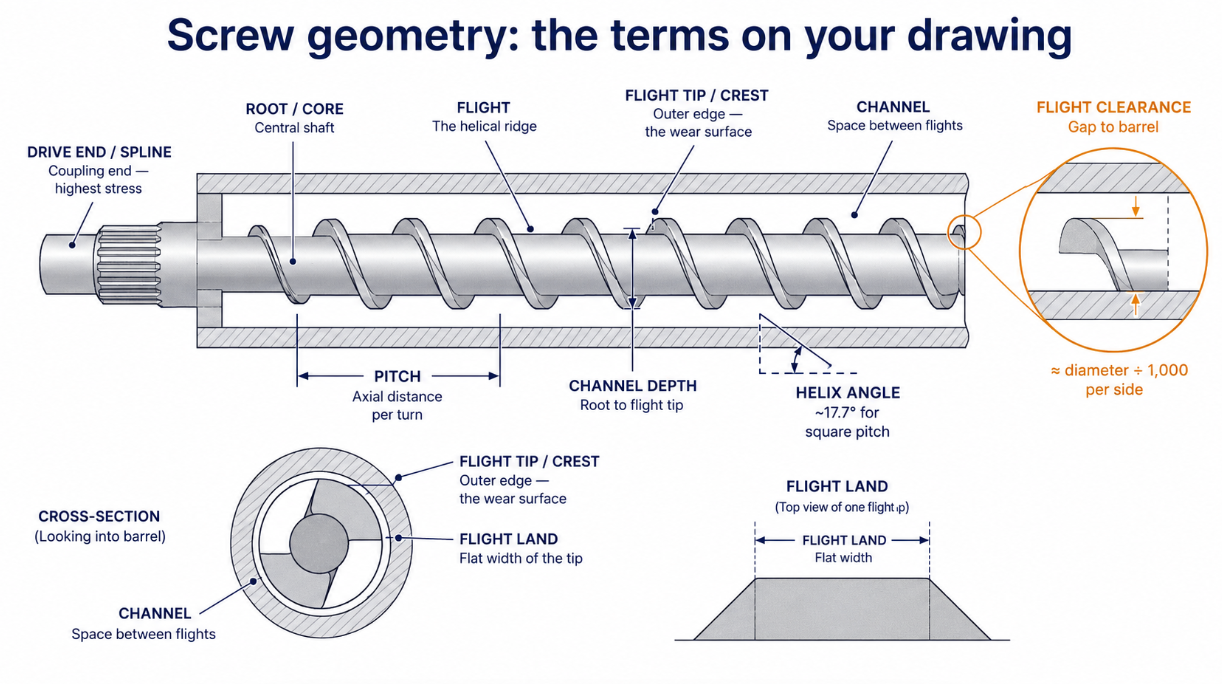
Flight — The helical ridge that spirals along the screw and pushes material forward. The flight’s outer edge is what wears against the barrel.
Flight tip (crest) — The outermost surface of the flight, running with a small clearance against the barrel bore. This is the wear surface, and where hardfacing is applied.
Root (core) — The central shaft the flight spirals around. The root diameter changes along the screw, which is what creates compression.
Channel — The space between adjacent flights where material travels. Its depth is set by the root diameter.
Channel depth (flight depth) — The distance from the root to the flight tip. Deep channels convey more material; shallow channels shear and pump more. Deeper at the feed end, shallower at the metering end.
Pitch (lead) — The axial distance the flight advances in one full turn. “Square pitch” means pitch equals screw diameter — the most common design.
Helix angle — The angle of the flight relative to a plane perpendicular to the screw axis. Square pitch gives roughly 17.7°.
Flight land (land width) — The flat width of the flight tip. Rebuilding a screw grinds the flight sides, so land width narrows over successive rebuilds — the practical limit on how many rebuilds a screw can take.
Flight clearance — The radial gap between flight tip and barrel bore. As-new is roughly screw diameter ÷ 1,000 per side; when it opens to about 2× that, output loss becomes significant. Check yours with our wear limit calculator.
Drive end (shank / spline / keyway) — The end that couples to the gearbox. It’s the highest-stress region on the screw, and a common fatigue-crack origin — see why screws break.
TIR (total indicator reading) — The measure of straightness: the total swing of a dial indicator as the screw is rotated on V-blocks. A bent screw wipes the barrel, so TIR is a critical acceptance check — see the inspection checklist.
Key Parameters
L/D ratio — Flighted length divided by diameter. Sets how much room the screw has to melt and mix. Common range 20:1 to 36:1; longer isn’t automatically better — see the L/D guide and the downsides of too long.
Compression ratio (CR) — Feed channel depth divided by metering channel depth. Typically 2:1 to 4:1 — low (2.0–2.5) for heat-sensitive PVC, standard (3.0–4.0) for polyolefins. See the compression ratio guide and how to measure it.
Pump ratio — On a vented (two-stage) screw, the second-stage metering depth divided by the first-stage. Typically 1.3–2. The second stage must out-pump the first, or melt floods the vent — see vented screws.
Specific output — Kilograms per hour per RPM. A useful health metric: if it drops over time at the same settings, you’re losing melt over worn flights.
Screw Zones
Feed zone (solids conveying) — Deep, constant channels at the hopper end that take in and preheat solid pellets. Typically 15–30% of screw length.
Compression zone (transition / melting zone) — Channels shallow gradually, compressing and melting the polymer. This is where most barrel wear concentrates — roughly two-thirds down the machine.
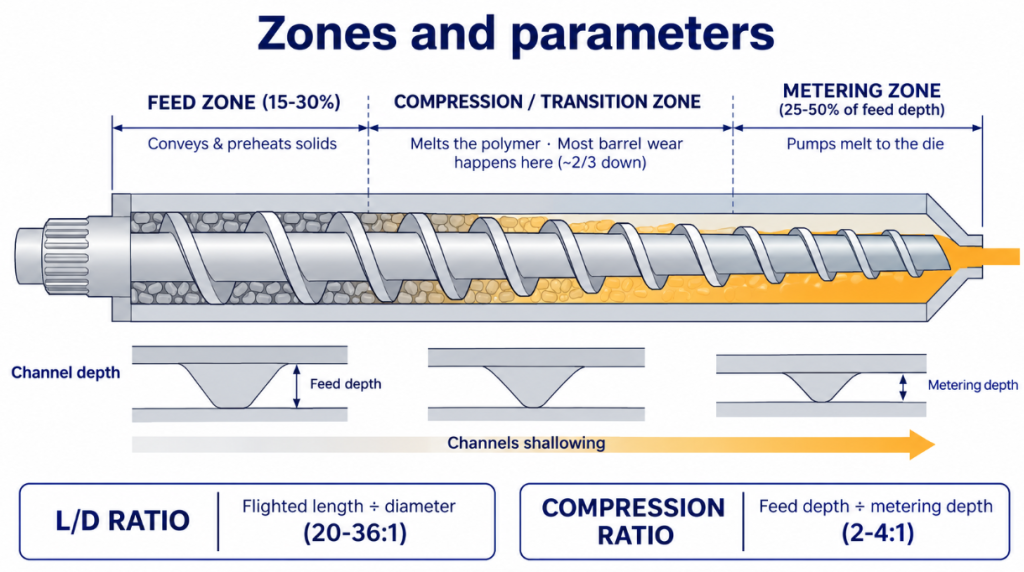
Metering zone (pumping) — Shallow, constant channels that pump the molten polymer at a steady rate and pressure to the die. Typically 25–50% of the feed depth.
Vent zone (decompression) — On a two-stage screw, a deep, partially-filled, zero-pressure section under a vent port where volatiles escape.
Design Features
General-purpose (GP) screw — A conventional three-zone single-flight screw. Simple and versatile, but at higher speeds it lets unmelted particles through, because nothing separates melt from solids.
Barrier screw — A secondary flight in the melting zone separates solids from melt, forcing complete melting. Commonly 20%+ more output and much better melt uniformity — see barrier vs GP.
Barrier flight — The undercut secondary flight that only melt can cross. Its clearance and length are what make or break a barrier design.
Mixing section — An element added (usually in the metering zone) to improve mixing:
- Dispersive mixers (Maddock, Egan, blister ring) use high shear to break up agglomerates — pigment clumps, gels.
- Distributive mixers (pin, pineapple, Dulmage) divide and recombine the melt with low shear to spread additives evenly.
- Choosing wrong is a classic error — see how to choose a mixing section.
Maddock (fluted) mixer — A dispersive mixer with longitudinal grooves; material must pass over barrier flights under high shear. Also acts as a melting check. Drawback: shear heat and output loss — poor for heat-sensitive resins.
Pin mixer / pineapple mixer — Distributive mixers using pins or a slotted diamond pattern on the root. Low shear, good for color and additive distribution.
Blister ring — A cylindrical section with a small radial clearance that all melt must pass through; a shear barrier and melt seal, at the cost of a large pressure drop.
Grooved feed — Longitudinal grooves in the barrel’s feed section that grip the pellets, dramatically improving solids conveying for slippery, hard resins like HDPE. Requires a matched screw geometry.
Vented (two-stage) screw — Effectively two screws in series with a decompression zone between, letting moisture and volatiles escape through a vent port. Standard for recycled material and WPC.
Vent flow — The failure mode of a vented screw: melt backing up and escaping out the vent port, usually caused by an incorrect pump ratio or excessive die pressure.
Screw Types
Single-screw extruder — One screw in one bore. Simple, high-output, ideal for steady extrusion of one material.
Twin-screw extruder — Two intermeshing screws. Superior mixing, used for compounding, devolatilization, and filled materials — see single vs twin.
Co-rotating / counter-rotating — Twin screws turning in the same direction (co-) for intensive distributive mixing, or opposite directions (counter-) for high positive conveying, common in rigid PVC.
Conical twin screw — Twin screws tapering along their length, giving a large feed area and high torque capacity — see conical vs parallel.
Screw elements (kneading blocks, conveying elements) — The modular building blocks assembled on a twin-screw shaft; their arrangement is the design — see the elements guide.
Materials and Surface Treatment
38CrMoAlA — The standard nitriding steel for extruder screws — economical, and it takes a hard nitrided case. See the 38CrMoAlA design guide.
Nitriding — A surface hardening process that diffuses nitrogen into the steel, producing a hard case (typically HV 900–1,100) about 0.5–0.8 mm deep. The default treatment for general work.
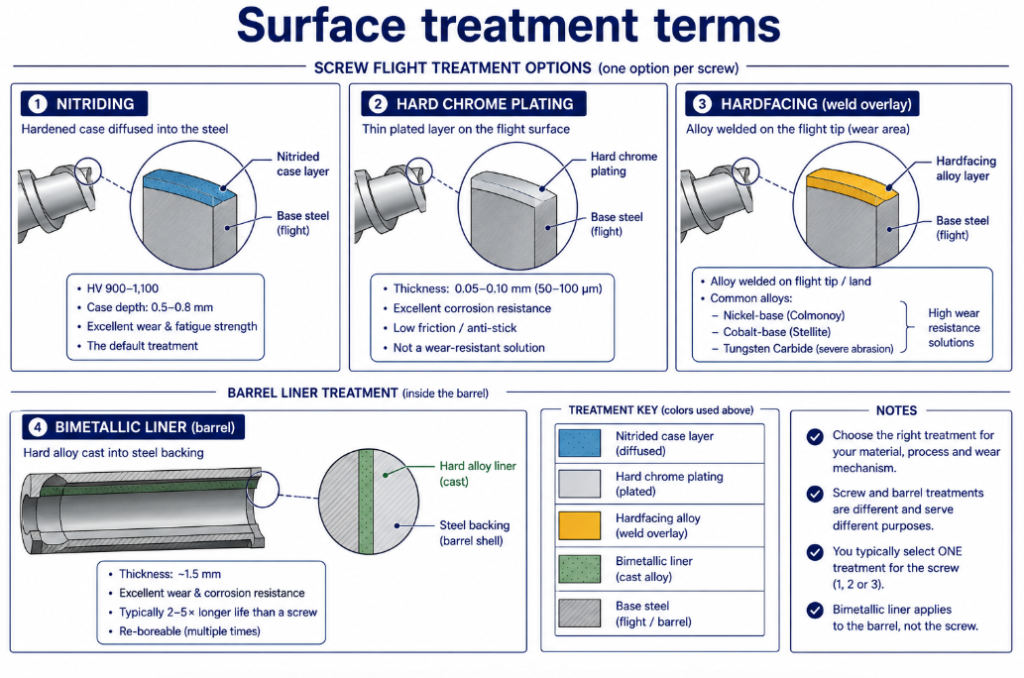
Case depth — How deep the hardened layer extends. A shallow or skipped case is invisible on arrival and shows up as premature wear.
Hardfacing (weld overlay) — Welding a wear-resistant alloy onto the flight tips. The two families:
- Colmonoy — nickel-based, for abrasion and corrosion.
- Stellite — cobalt-based, for high-temperature wear and galling resistance.
- See Stellite vs Colmonoy.
Tungsten carbide — The most abrasion-resistant option, used for heavily glass- or mineral-filled compounds.
Hard chrome plating — A thin (typically 0.05–0.10 mm) plating for corrosion resistance and reduced friction. Can be stripped and re-plated — see re-plating.
Bimetallic barrel — A barrel with a hard alloy liner centrifugally cast and bonded into a steel backing. The finished liner is typically only about 1.5 mm thick — the constraint that governs every barrel repair decision. Typically lasts about 3× a screw — see how long a bimetallic barrel lasts.
Wear, Repair, and Maintenance
Wear limit — The clearance at which a worn screw or barrel should be repaired or replaced — commonly around 2× the as-new clearance. See how much wear is acceptable.
Rebuild (refurbish) — Stripping, re-hardfacing, straightening, and grinding a worn screw back to dimension. Typically 50–75% of a new screw’s cost, and a sound screw takes 3–5 rebuilds — see the rebuilding guide.
Oversize rebuild — Building a screw slightly larger to match a worn (or honed) barrel bore, restoring clearance without replacing the barrel. The trade-off: that screw fits only that barrel.
Honing — Machining a worn barrel bore smooth and round at a slightly larger diameter. Cheap and fast, but requires a matched oversize screw.
Re-lining (re-sleeving) — Boring out a worn bimetallic liner and installing a new sleeve in the original backing — see barrel repair vs replacement.
Galling — Metal-to-metal adhesive wear when screw and barrel contact directly — often at the transition zone where pressure peaks.
Process Problems
Surging — Unstable, pulsing output and pressure. Usually a feeding or melting instability — a screw design problem, or wear.
Gels / fish-eyes — Unmelted or degraded particles visible in film. Points to incomplete melting or degradation — see eliminating gels.
Black specks — Carbonized, fully-degraded material breaking loose from dead spots, hot spots, or worn surfaces — usually manufactured inside your own machine, see what causes black specks.
Dead spot (stagnation zone) — Any corner, groove, or unswept area where material sits, degrades, and eventually breaks loose. The origin of most black specks.
Gauge variation — Uneven film thickness. Bands around the bubble point to the die/air ring; variation along the length points to output instability — see gauge variation.
Degradation — Polymer breaking down from excess heat, shear, residence time, or moisture. Material-specific: PVC dehydrochlorinates (yellow → black), POM depolymerizes to formaldehyde, PET and nylon hydrolyze.
Hydrolysis — Moisture-driven chain scission during melting, which permanently lowers molecular weight. The reason PET and nylon must be dried — see drying PET and drying nylon.
Residence time — How long material stays hot inside the machine. Long residence time degrades heat-sensitive resins — the reason oversized machines and dead spots cause trouble.
Every one of these terms eventually connects back to the same question — is the screw right for the material, and is it still within spec — so if a term sent you here from a quote or a drawing, the linked guides take it from definition to decision.
At BLOOM, we design and manufacture extruder screws and barrels — and we’re happy to explain any term on your drawing or quote in plain language before you commit to anything. Send our engineering team your drawing, your material, and your questions on WhatsApp and we’ll walk you through it. For the full picture, start with our screw design guide or the complete screws and barrels guide.
References and Further Reading
- Extrusion Basics: Screw Design Essentials, PlasticsToday (A. Griff) — three-zone screw fundamentals and the vocabulary of screw geometry: https://www.plasticstoday.com/extrusion-pipe-profile/extrusion-basics-screw-design-essentials-you-learned-a-long-time-ago-but-maybe-forgot
- Extrusion: Barrier Screws and Mixers, Plastics Technology (J. Frankland) — dispersive vs distributive mixing terminology and the common mixer designs: https://www.ptonline.com/articles/extrusion-barrier-screws-and-mixers