By the BLOOM Engineering Team
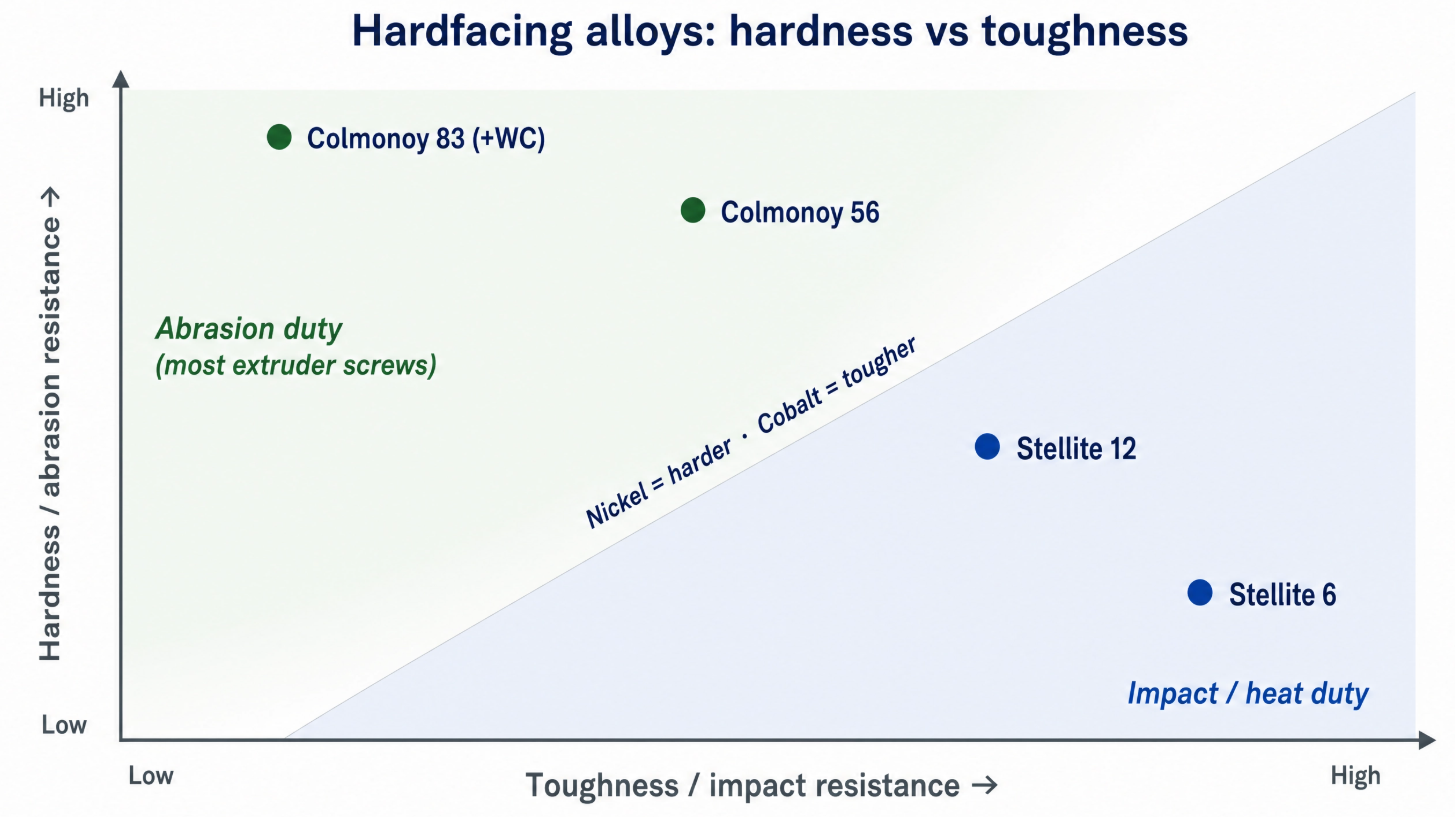
Quick answer: Stellite is a cobalt-based hardfacing family and Colmonoy is nickel-based — and for most extruder screw flights, Colmonoy is the standard choice. Colmonoy 56 is the workhorse for general wear-and-corrosion duty, and Colmonoy 83 (with tungsten carbide) handles extreme abrasion like glass-filled compounds. Stellite earns its place where impact toughness or high-temperature hardness matters more than maximum abrasion resistance. The real decision comes down to one trade-off: nickel-based alloys are harder, cobalt-based alloys are tougher.
What Stellite and Colmonoy Actually Are
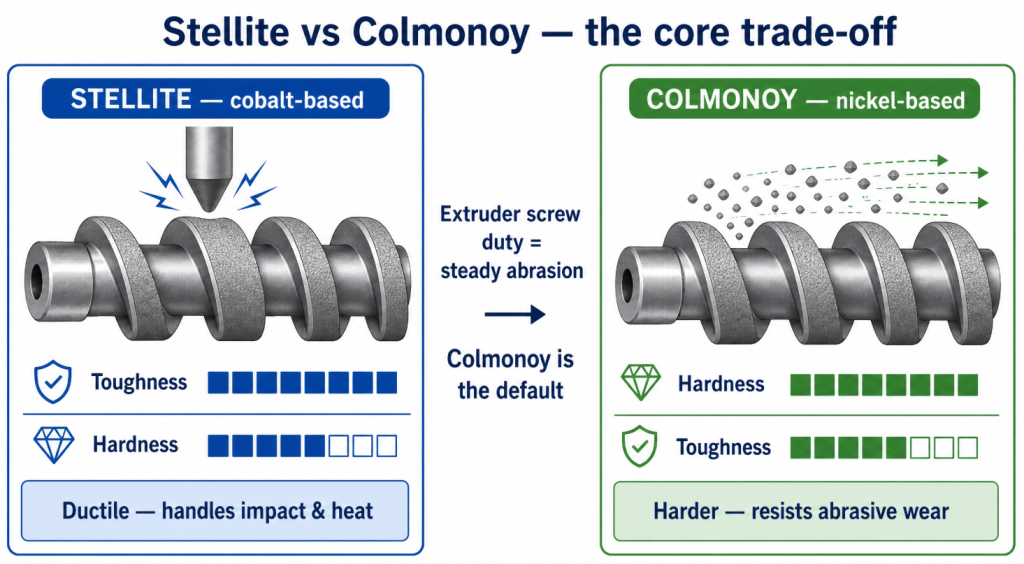
Both are families of hardfacing alloys — welded onto the screw flight tops to create a wear-resistant armor far thicker and tougher than any plating. The names are brands that have become shorthand for their alloy types:
| Stellite® | Colmonoy® | |
|---|---|---|
| Base metal | Cobalt (Co-Cr-W-C) | Nickel (Ni-Cr-B-Si) |
| Character | Tougher, more ductile | Harder, more abrasion-resistant |
| Strength | Impact resistance, hot hardness | Wear resistance, lower cost |
| Weakness | Less abrasion-hard, costlier | Can crack under heavy impact |
| Common extruder grades | Stellite 6, Stellite 12 | Colmonoy 56, Colmonoy 83 |
The fundamental difference is the base metal, and it drives everything else. As neutral coatings specialists summarize it: nickel-based coatings tend to be harder, which handles abrasive wear better but may crack in impact situations, while cobalt-based coatings are more ductile and handle impact wear better (HTS Coatings: Stellite vs Colmonoy hardfacing). Both families take additions of chromium, boron, silicon, carbon — and in the heavy-duty grades, tungsten carbide.
The Core Trade-Off: Hardness vs Toughness
Think of it as a spectrum:
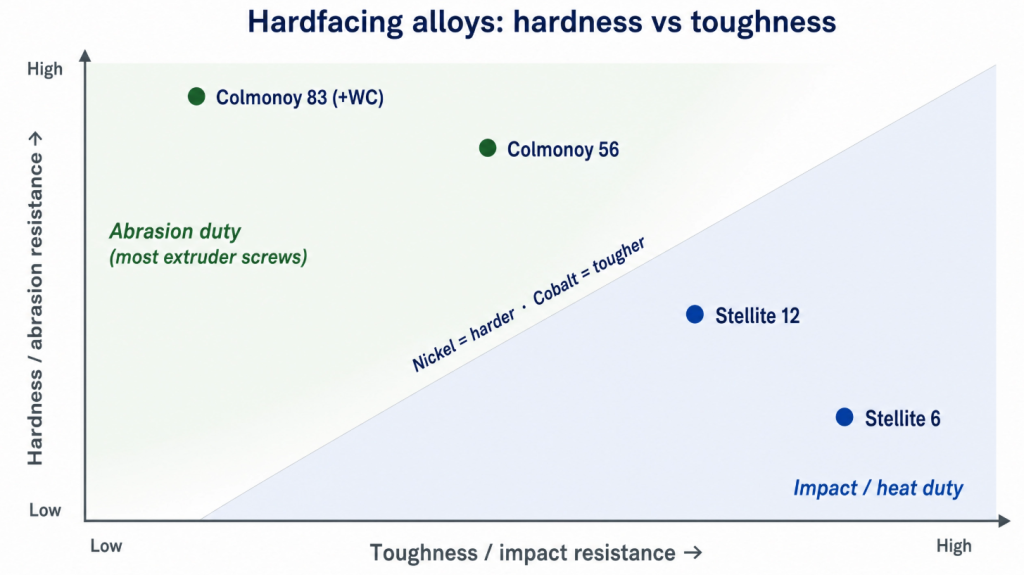
Colmonoy (nickel-based) = harder. The Ni-Cr-B-Si chemistry forms hard boride and carbide phases that resist the grinding action of fillers — exactly the wear mechanism that kills extruder screws running calcium carbonate, glass fiber, or wood flour. This hardness is why Colmonoy dominates screw flight hardfacing.
Stellite (cobalt-based) = tougher. The cobalt matrix is more ductile, absorbing impact without cracking, and famously keeps its hardness at high temperature — Stellite 6 has dominated high-temperature wear overlays for decades, with excellent hot hardness and weldability (ScienceDirect: Stellite overview). Comparative studies of the two families confirm the same picture: Stellite 6 shows low wear loss with a smooth, stable surface in sliding wear, while nickel alloys like Colmonoy trade some of that toughness for higher hardness.
For an extruder screw, the duty is mostly steady abrasion, not impact — the filler grinds continuously, but nothing hammers the flight. That is why the harder nickel family is the default for screws, and the tougher cobalt family is the specialist.
Which Grade for Which Job
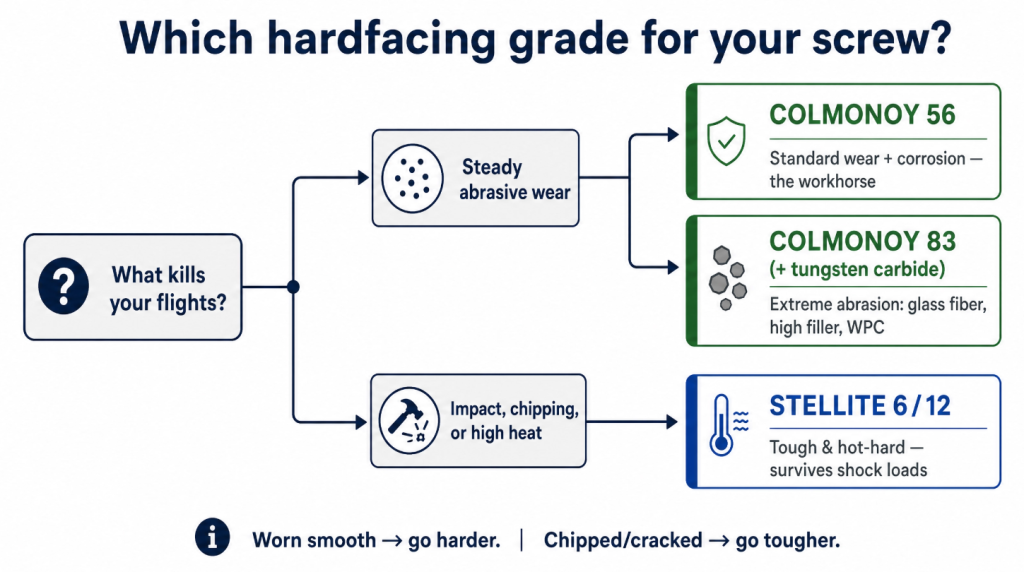
Within each family, the grades matter as much as the family itself:
| Grade | Type | Hardness (HRC, approx.) | Best for on an extruder screw |
|---|---|---|---|
| Colmonoy 56 | Ni-Cr-B-Si | ~50–55 | The workhorse: standard wear + corrosion duty, most filled compounds |
| Colmonoy 83 | Ni + tungsten carbide | ~60+ (matrix; WC particles far harder) | Extreme abrasion: high glass-fiber nylon, heavily filled, WPC |
| Stellite 6 | Co-Cr-W-C | ~35–45 | Impact + heat: where flights see shock loads or high temps |
| Stellite 12 | Co-Cr-W-C (more W) | ~45–50 (harder than 6) | Higher-wear duty that still needs cobalt toughness |
The hardness numbers tell the story directly. Colmonoy 56 runs about 50–55 HRC (Wall Colmonoy, the alloy’s maker), comfortably above Stellite 6’s roughly 35–45 HRC (Valve Magazine: hardfacing) — which is exactly why the nickel grade wins on pure abrasion. The tungsten-carbide grades (Colmonoy 83, and the related Colmonoy 88 at around 850 HV) push higher still, with embedded carbide particles far harder than the matrix number suggests. Importantly, Colmonoy 56 also offers better corrosion resistance than Stellite 6 and 12, because nickel rather than cobalt forms its base — giving it the wear-and-corrosion combination most extruder screws need.
One honest caveat on these figures: hardfacing hardness varies with the application method and dilution (how much base steel mixes into the weld), so as-deposited numbers shift somewhat with how and how thickly the alloy is applied. Treat the ranges as guidance, not guarantees, and ask your supplier for the achieved hardness on the actual screw.
The practical pattern we follow at the factory:
- Default to Colmonoy 56 for most hardfaced screws — it covers the common wear-plus-corrosion duty economically.
- Step up to Colmonoy 83 when the material is severely abrasive — 30%+ glass fiber, high mineral filler, rice-husk WPC. The embedded tungsten carbide particles are what survive that grinding.
- Reach for Stellite when the failure mode is chipping or cracking rather than gradual wear, or when the application combines heat and corrosion in ways nickel handles less well.
A caution from the toughness side: because Colmonoy is harder and less ductile, a flight hardfaced with it should not be subjected to prying, hammering, or impact during handling and screw removal — the same hardness that resists abrasion makes it crack-sensitive. (One more reason never to lever a screw out with steel bars.)
The Decision in Practice
Three questions settle the choice for almost every screw:
- What is grinding the flight? Steady abrasive filler → Colmonoy. The more severe the abrasion, the stronger the case for Colmonoy 83’s tungsten carbide.
- Is there impact or shock in the duty? Yes → Stellite’s ductility earns its premium.
- What killed the last screw? Worn smooth → more hardness (Colmonoy). Chipped or cracked flights → more toughness (Stellite).
Hardfacing is one option among several surface treatments — nitriding, chrome, bimetallic liners — and the right answer depends on whether your enemy is abrasion, corrosion, or both. For that full decision framework, see our extruder screw coating and surface treatment guide. And because hardfacing is welded, it is also re-weldable — a hardfaced screw can be rebuilt at each service cycle, unlike a nitrided case, as covered in our screw repair guide.
The Bottom Line
Stellite is cobalt-based and tough; Colmonoy is nickel-based and hard. For the steady grinding abrasion that defines extruder screw duty, Colmonoy 56 is the standard choice and Colmonoy 83 the heavy-abrasion upgrade, while Stellite 6 or 12 is the answer when impact toughness or hot hardness matters more. Match the alloy to the failure mode — worn versus cracked — and the choice usually makes itself.
At BLOOM, we hardface extruder screws with Colmonoy 56, Colmonoy 83, and Stellite grades, matched to your material and what your last screw failed from. Not sure which your application needs? Tell our engineering team what you process on WhatsApp — material, filler level, and how the old flights look — and we will recommend the right alloy.