
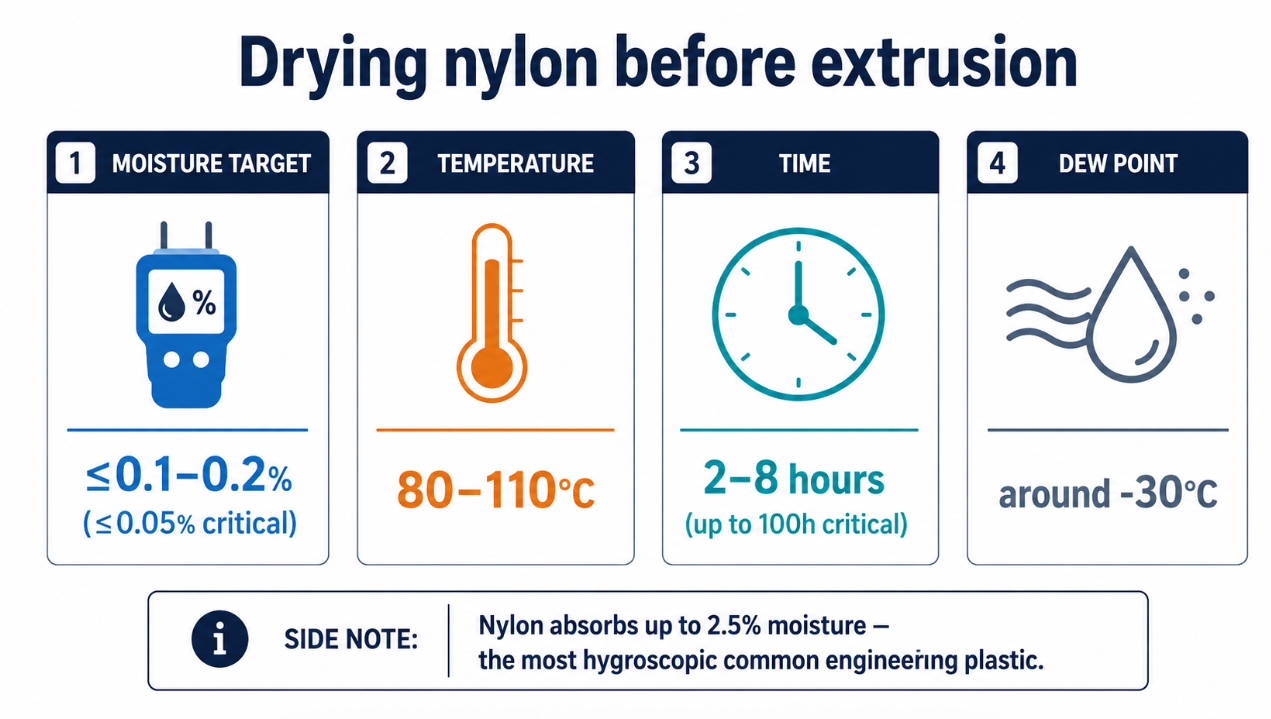
Quick answer: yes — nylon must be dried before extrusion, typically to below 0.1–0.2% moisture (0.05% or less for critical applications), at 80–110°C for 2–8 hours, using desiccant-dried air with a dew point around -30°C. Nylon is the most hygroscopic of the common engineering plastics — it absorbs up to 2.5% moisture by weight, several times more than PET — and that moisture causes the same hydrolytic chain scission that weakens any polyester or polyamide melted wet. Here are the real numbers, how PA’s drying needs differ from PET’s, and what skipping it costs you.
By the BLOOM Engineering Team
The Hard Numbers
| Parameter | Standard processing | Critical applications |
|---|---|---|
| Target moisture | ≤0.1–0.2% | ≤0.05% |
| Drying temperature | 80–110°C (PA6/PA66) | Same, longer time |
| Drying time | 2–8 hours | 24–100 hours (pre-dry) |
| Dew point of drying air | around -30°C | -30°C or lower |
| As-absorbed moisture (humid storage) | up to 2.5% by weight | — |
PA6 and PA66 are typically dried in the 80–110°C range, and PA6 absorbs moisture faster than PA12 (a less hygroscopic nylon grade), so PA6 often needs more frequent drying attention (SpecialChem: polyamide processing guide). The “critical applications” column matters more for nylon than for many plastics — parts with tight mechanical or dimensional tolerances are often pre-dried far longer than the standard cycle to push moisture down toward 0.05%.
The common nylon grades aren’t all equally thirsty, though:
| Grade | Hygroscopicity | Drying temp | Max moisture | Processing temp |
|---|---|---|---|---|
| PA6 | High — absorbs fastest | 80–110°C | ≤0.2% | 240–270°C |
| PA66 | High | 80–110°C | ≤0.2% | 270–290°C |
| PA4-6 | High | ~80°C | ≤0.1% (0.05% critical) | Higher-temp grade |
| PA11 / PA12 | Lower than PA6/66 | 75–90°C | Less stringent | Lower than PA6/66 |
The general principle holds across grades — dry before processing — but the exact target and tolerance for skipping a cycle shifts with which nylon you’re running.
Why Nylon Absorbs So Much More Than PET
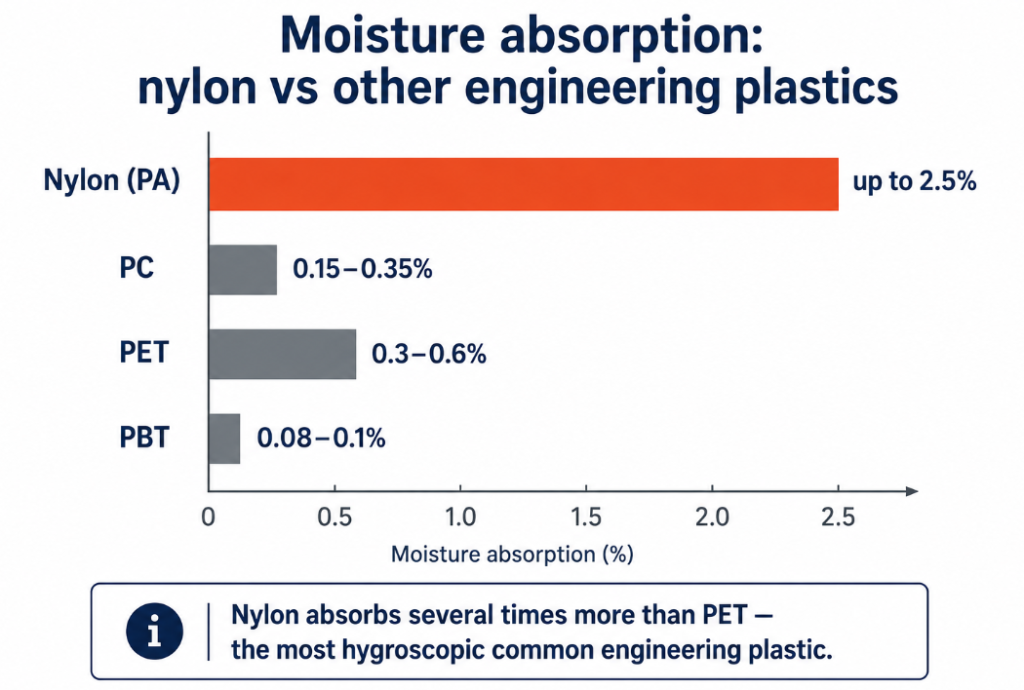
This is the headline difference from PET, and it changes how you think about drying nylon. PET absorbs roughly 0.3–0.6% moisture at equilibrium — already enough to require careful drying, as covered in our PET drying guide. Nylon absorbs up to 2.5% — several times more. It is consistently ranked the most hygroscopic of the common engineering plastics, well ahead of PC (0.15–0.35%), PBT (0.08–0.1%), and PET itself.
The mechanism is the same family of chemistry: moisture in the polymer hydrolyzes at melt temperature, breaking the polymer chains (chain scission) and lowering molecular weight — the nylon equivalent of the IV drop that plagues wet PET. But because nylon’s amide groups bind water more readily and in greater quantity than PET’s ester groups, the practical consequence is that nylon left out in humid air gets wetter, faster, and worse than PET in the same conditions — an open spool or hopper of nylon can approach saturation within hours in humid air.
Interesting Twist: Nylon’s Dew Point Requirement Is Actually Looser Than PET’s
Here’s a detail that surprises people coming from PET drying: despite absorbing far more moisture, nylon’s required drying-air dew point (around -30°C) is less aggressive than PET’s (around -40°C). The reason is the different chemistry and equilibrium behavior of the two polymers — PET needs the extra-dry air to chase its moisture down to the very low ppm levels (often under 50 ppm) that avoid IV loss, while nylon’s standard target (0.1–0.2%, i.e., 1,000–2,000 ppm) is reached with somewhat less aggressive air. For nylon dried specifically to avoid hydrolysis in critical parts, the target tightens toward under 0.02% — and at that level, the dew point requirement converges with PET’s.
Side by side, the two materials’ standard drying specs look like this:
| Nylon (PA) | PET | |
|---|---|---|
| As-absorbed moisture | Up to 2.5% | 0.3–0.6% |
| Standard target moisture | 0.1–0.2% | <50 ppm (0.005%) |
| Drying temperature | 80–110°C | 160–180°C |
| Drying time | 2–8 hours | 4–6 hours |
| Required dew point | ~ -30°C | ~ -40°C |
The practical takeaway: don’t assume nylon and PET use the same dryer settings — check the actual target moisture for your grade and application, because “more hygroscopic” does not automatically mean “needs drier air,” only “needs to come from a wetter starting point and is less forgiving of skipped drying.”
What Happens If You Skip or Shortcut Drying
Running wet nylon doesn’t fail quietly. The visible and mechanical consequences:
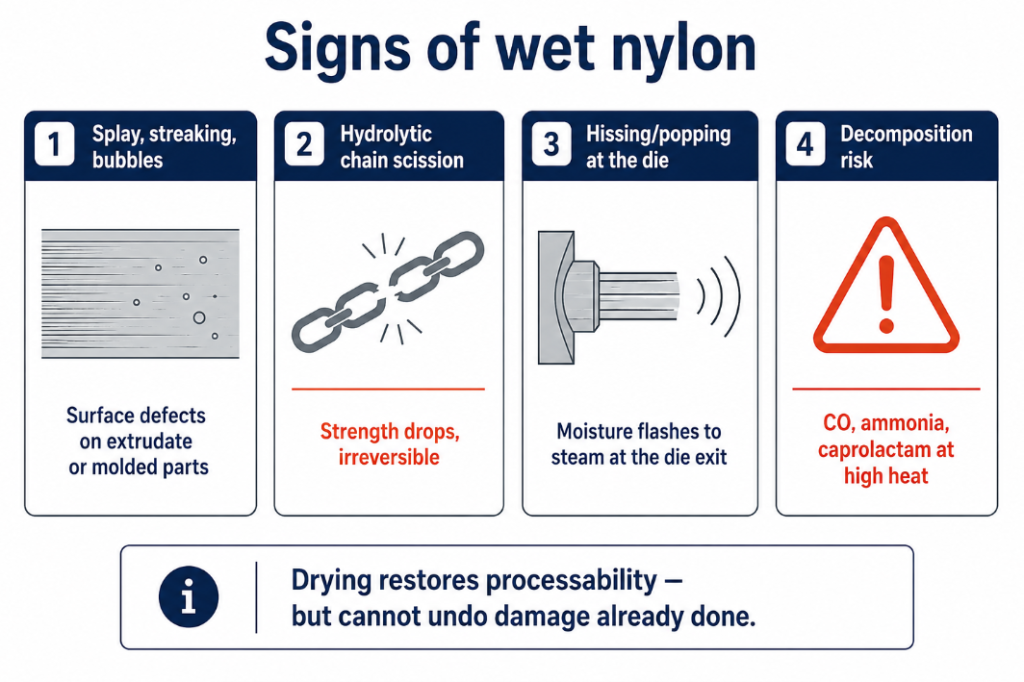
- Splay, surface streaking, and bubbles — trapped moisture flashes to steam at melt temperature (PA processing runs roughly 240–290°C depending on grade), creating visible defects.
- Hydrolytic chain scission — molecular weight drops, and with it impact strength and elongation, the properties nylon is usually chosen for in the first place.
- Audible signs at the die or nozzle — hissing, popping, or crackling as steam escapes, often the first clue a batch is wet.
- Decomposition risk at temperature — push wet or overheated nylon too hard and you risk thermal breakdown products including carbon monoxide, ammonia, and caprolactam (Toray: nylon resin processing guide), on top of the moisture damage.
Unlike a cosmetic defect you can sand away, hydrolytic degradation is not reversible by further drying — once the chains are cut, the material’s molecular weight stays down. Drying restores processability, but it cannot undo damage already done to material that was melted wet.
Practical Drying Setup
A few points that make nylon drying work reliably in practice:
- Use a desiccant (dehumidifying) dryer, not a simple hot-air dryer — ordinary hot air dries the surface but cannot push nylon down to the low moisture levels hydrolysis protection requires.
- Monitor dew point continuously — a dryer that drifts above its target dew point will silently under-dry the batch.
- Don’t trust “sealed bag” pellets indefinitely — factory-sealed nylon needs no pre-drying if used immediately after opening, but once opened, nylon’s high hygroscopicity means it should go straight into a dry hopper or be re-dried, not sit exposed.
- Increase drying time for wetter starting material — pellets that have sat open longer need proportionally more time at temperature to reach target moisture, the same logic that governs most hygroscopic resins.
Nylon’s combination of high moisture uptake and hydrolytic sensitivity means drying isn’t a step you can skip on a humid day or skimp on to save changeover time — get the target moisture, temperature, and time right for your grade and application, and the mechanical properties nylon is chosen for come through intact.
At BLOOM, we design extruder screws and barrels for engineering plastics including nylon, matched to the material’s processing temperature and moisture sensitivity. If you’re processing PA and seeing splay, bubbles, or strength issues and want to rule out the screw alongside your drying setup, send our engineering team your grade, drying parameters, and symptoms on WhatsApp and we’ll help. For the broader engineering plastics picture, see our engineering plastics screw guide.


Pingback: Extruder Screws and Barrels for Medical Tubing