
Quick answer: you need a vented (two-stage) screw when volatiles have to leave the melt during extrusion — the classic cases are recycled material with variable moisture and inks, wood-plastic composites whose fiber releases moisture at melt temperature, formulations that generate gases as they process, and persistent bubbles or voids that survive even proper drying. You don’t need one for well-dried virgin resin with no volatiles — and the vent isn’t free: a vented screw needs a longer machine (typically 30:1 L/D or more), gives up some output for its length, and demands correct design to avoid melt escaping out the vent. Here’s how the two-stage design works, the cases that justify it, and the honest trade-offs.
How a Vented (Two-Stage) Screw Works
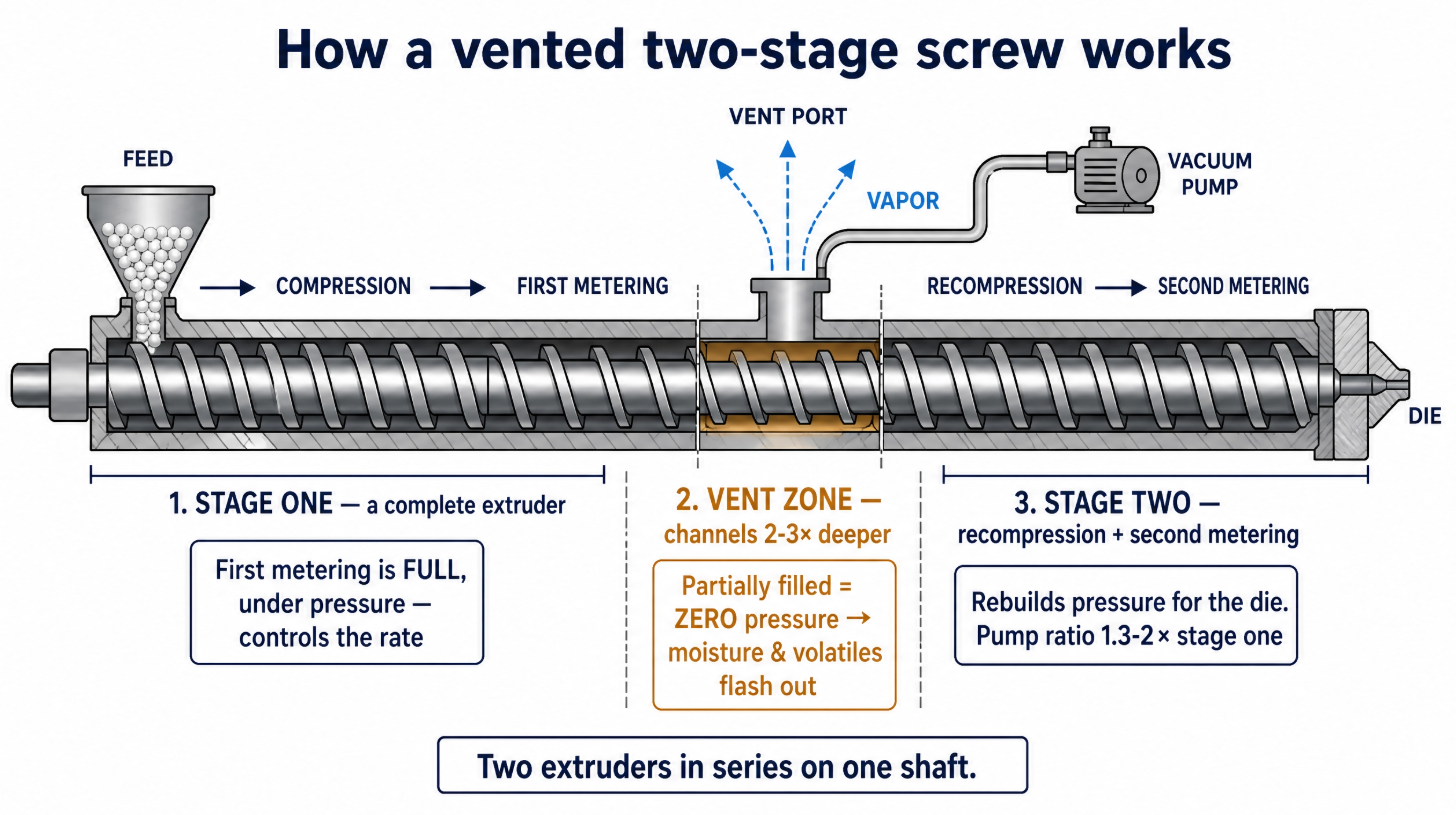
A vented screw is best understood as two extruders in series on one shaft:
- Stage one is a complete conventional screw — feed, compression, and a first metering section. Its metering section is full, under pressure, and controls the output rate of the whole machine.
- The vent zone comes next: the channels suddenly become much deeper (typically 2–3× the first metering depth), so the melt arriving from stage one only partially fills them — and a partially-filled channel is at zero pressure. With no pressure, moisture and volatiles flash out of the melt and escape through the vent port in the barrel, often helped by a vacuum pump for stubborn, low-vapor-pressure volatiles.
- Stage two then shallows the channels again, refills them, and rebuilds the pressure needed to push through the die.
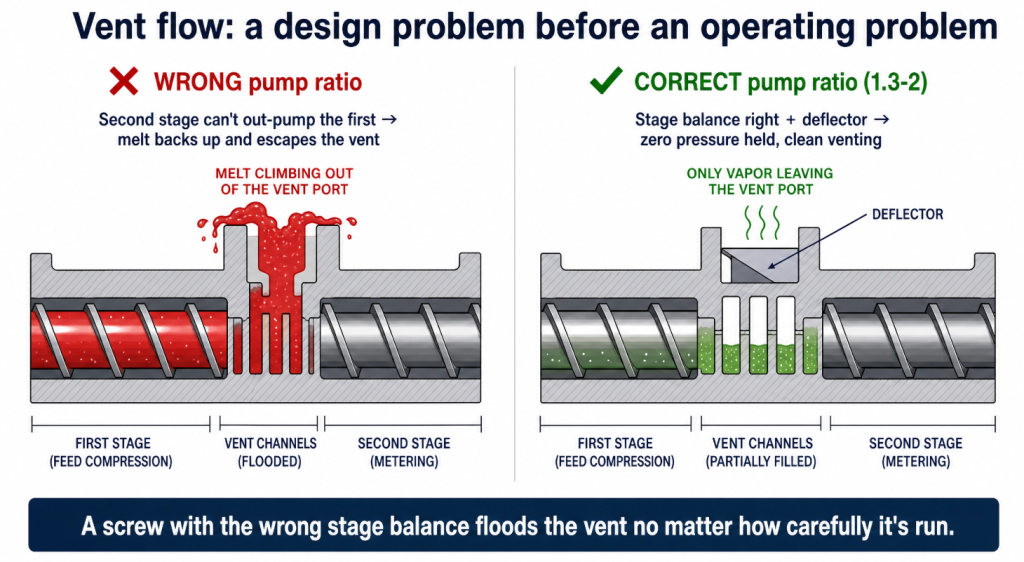
The number that makes or breaks the design is the pump ratio — the second-stage metering depth divided by the first-stage metering depth, usually between 1.3 and 2. The second stage must be able to pump more than the first stage supplies; that’s what keeps the vent zone partially filled and at zero pressure. Get that ratio wrong, or push the die pressure too high, and melt backs up into the vent zone and out the port — the infamous vent flow, the number-one headache of vented extrusion. A properly-shaped deflector in the vent opening is the other essential, scraping off the small amount of melt that passes the port so it can’t climb out.
The Cases That Justify a Vented Screw
| Situation | Why the vent earns its keep |
|---|---|
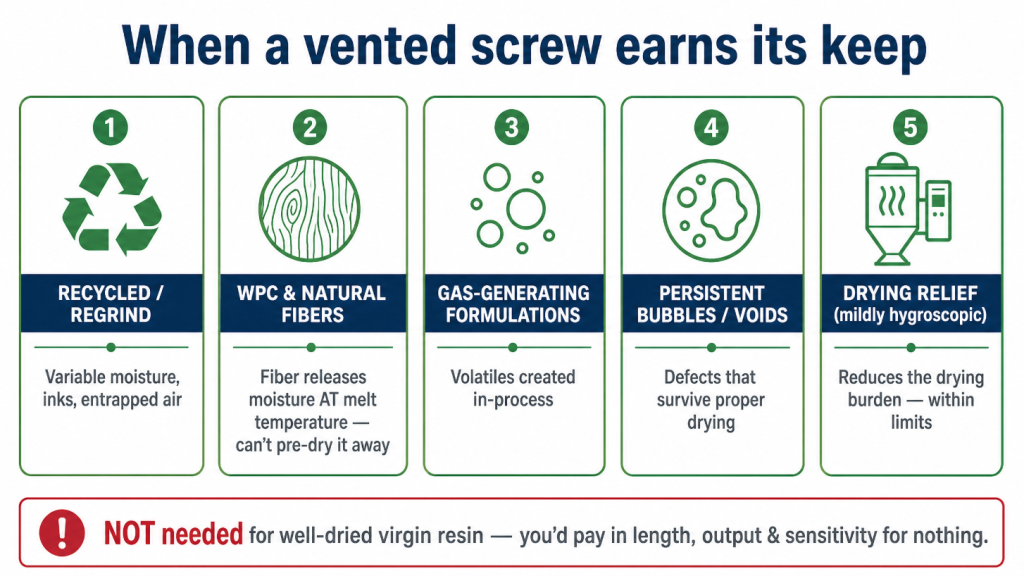
| Recycled material / regrind | Variable moisture, printing inks, contamination volatiles, and entrapped air from low-bulk-density flake — a vent handles what pre-drying can’t predict. See our recycled plastic screw guide |
| Wood-plastic composites & natural fibers | Wood fiber releases moisture at melt temperature — you can’t fully pre-dry away what the fiber gives up inside the barrel. See our WPC screw guide |
| Formulations that generate volatiles | Some compounds, masterbatch carriers, and reclaim from printed film release gases as they melt — the vent removes them before the die |
| Persistent bubbles, voids, or porosity | If defects survive correct drying, the volatiles are being generated or carried in-process — a vent attacks them where they appear |
| Mildly hygroscopic resins, drying relief | For moderately hygroscopic materials, a well-designed vent can reduce the drying burden — with the honest limits below |
What a Vent Can and Can’t Replace
The most common misunderstanding is treating a vent as a dryer substitute. The honest picture:
- A vent removes what’s free to escape at melt temperature and zero pressure — surface moisture, entrapped air, and volatiles generated in-process. For those, it’s the right tool and often the only tool.
- It is not a full replacement for drying strongly hygroscopic resins on a single-screw machine. PET and nylon carry moisture inside the pellet that does its hydrolysis damage during melting — before and while the vent can act. Wet PET loses IV in stage one no matter how good the vent is; see our guides on drying PET and drying nylon. Vacuum-vented systems are used commercially for recycled PET, but that’s specialized multi-vent, deep-vacuum territory — not a standard single vent standing in for a dryer.
- Rule of thumb: the vent is for volatiles you can’t remove beforehand; the dryer is for moisture you can. Demanding materials often justifiably use both.
The Trade-Offs (What the Vent Costs You)
| Standard single-stage screw | Vented two-stage screw | |
|---|---|---|
| Machine length | Standard (24–30:1 typical) | Longer — typically 30:1+ to fit two full stages |
| Output for a given length | All of the L/D works on output | First stage alone sets the rate — less output per unit length |
| Operating sensitivity | Tolerant of die-pressure changes | Die pressure too high → vent flow; needs operating discipline |
| Complexity | Simple | Pump ratio, vent geometry, and deflector must be designed right |
| Volatile removal | None in-process | Its whole reason for existing |
Two of these deserve emphasis. First, the L/D requirement is real: cramming two stages into a short machine shortchanges both, which is why vented designs live on longer extruders — see our L/D ratio guide. Second, vent flow is a design problem before it’s an operating problem: a screw with the wrong pump ratio will flood the vent no matter how carefully it’s run, while a correctly-designed one tolerates normal operating variation. If an existing vented line drools melt from the port whenever the die pressure climbs, the screw’s stage balance — not the operator — is usually the root cause.
The Decision in Short
Run a vented screw when the volatiles are unavoidable in-process: recycled feedstock, moisture-releasing fibers, gas-generating formulations, or defects that outlive proper drying. Skip it when clean, dried virgin resin runs fine on a single-stage screw — you’d pay in machine length, output, and operating sensitivity for a function you don’t need. And if you do need one, the design quality is the product: the pump ratio, vent-zone depth, and deflector determine whether you get clean devolatilization or a port that spits melt.
A vented screw is a specialist’s tool — two extruders in series that trade some length and output for the ability to pull moisture and volatiles out of the melt itself — so the decision is simply whether your material brings volatiles the dryer can’t reach, and if it does, whether the screw’s stage balance is designed well enough to vent without flooding.
At BLOOM, we design and build vented two-stage extruder screws and matching vented barrels — first and second stages balanced to the correct pump ratio for your material, die pressure, and output, so the vent removes volatiles instead of leaking melt. If you’re weighing a vented design for recycled material, WPC, or a stubborn porosity problem, send our engineering team your material, machine L/D, and die pressure on WhatsApp and we’ll tell you honestly whether a vent solves it — and design the stage balance if it does. For where vented designs sit among the options, see our screw types guide and screw design guide.
References and Further Reading
- Troubleshooting Vent Flow Problems in Single-Screw Extruders, Plastics Technology (M. Spalding), 2025 — two-stage mechanics, the zero-pressure vent zone, and the 1.3–2 pump ratio: https://www.ptonline.com/articles/troubleshooting-vent-flow-problems-in-single-screw-extruders
- Extrusion Know-How: The Whys & Hows (& Ifs) of Vented Extruders, Plastics Technology (J. Frankland), 2010 — applications including hygroscopic resins and printed-film reclaim, three-stage double-vent designs, and vacuum assistance: https://www.ptonline.com/articles/extrusion-know-how-the-whys-hows-ifs-of-vented-extruders
- High-Performance Vent Design for Single-Screw Extruders, Bausano — vent-zone depth at 2:1–3:1 of the first metering depth and why the deflector is critical to preventing vent flow: https://www.bausano.com/en/press-and-news/vent-design-single-screw-extruders



Pingback: Screws and Barrels for Tab Sealant and Pouch Film Lines
Pingback: Foam Extrusion Screws: The Extruder That Cools
Pingback: The Twin Screw Vent Barrel: Volatiles Out, Melt In