
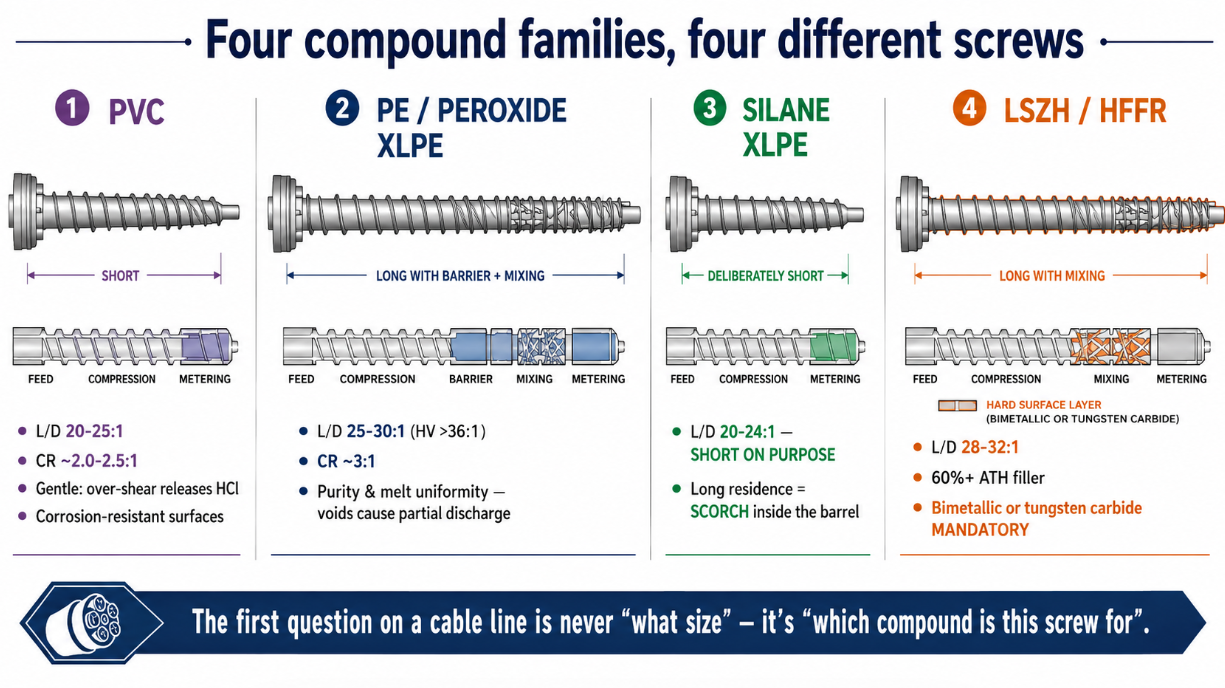
Quick answer: there is no single “cable screw” — the four compound families that dominate wire and cable each demand a different screw, and running the wrong one is the most common hardware mistake in the industry. PVC wants a short, low-compression screw that doesn’t over-shear it into releasing HCl; PE and peroxide XLPE want longer, gentler geometry; silane-crosslinkable XLPE wants a deliberately short screw, because long residence time scorches it in the barrel; and LSZH/HFFR — loaded past 60% with mineral filler — needs a long, strongly-mixing screw on abrasion-proof metallurgy. This guide covers the geometry for each family, the two classic mis-specifications, the metallurgy question filled compounds force, and how to size a screw for a cable line.
By the BLOOM Engineering Team
The Four Compound Families at a Glance
| Compound | Typical L/D | Compression ratio | The governing constraint | Metallurgy |
|---|---|---|---|---|
| PVC (insulation & jacket) | 20–25:1 (up to 28:1 for heavily filled/rigid) | ~2.0–2.5:1 | Over-shear releases HCl → degradation + corrosion | Nitrided minimum; chrome or nickel-alloy for corrosion |
| PE / peroxide XLPE | 25–30:1 (HV power cable can exceed 36:1) | ~3:1 | Melt uniformity and cleanliness — voids cause partial discharge | Nitrided; bimetallic on high-utilization lines |
| Silane XLPE | 20–24:1 — deliberately short | ~3:1 | Residence time → scorch (premature crosslinking) | Nitrided; streamlined, zero dead spots |
| LSZH / HFFR | 28–32:1 | Lower — high-shear-sensitive filler | Dispersing 60%+ ATH/MDH without overheating it | Bimetallic or tungsten carbide — mandatory |
Screw diameters across the industry run from about 30 mm for fine wire insulation to 150 mm and above for heavy cable jacketing, sized from target output (line speed × linear weight of the covering).
PVC: Short and Gentle, Because Shear Makes Acid
PVC is the volume material of the industry and the one most often run on a wrong screw. Its constraint is chemical: PVC degrades by releasing hydrochloric acid, and shear heat drives that reaction. A compression ratio around 2.0–2.5:1 keeps the melting gentle enough to avoid over-shearing, and the L/D stays moderate to limit residence time.
Two consequences follow. First, the degradation cascade — yellowing, then black specks, then acid attack on the hardware — is the same one covered in our PVC screw and barrel guide and why PVC turns yellow. Second, the HCl attacks the screw and barrel themselves over time, which is why PVC cable lines specify corrosion-resistant surfaces — chrome plating or, on demanding duty, the anti-corrosion grade on our nickel base alloy page.
PE and XLPE: The Split That Trips Everyone Up
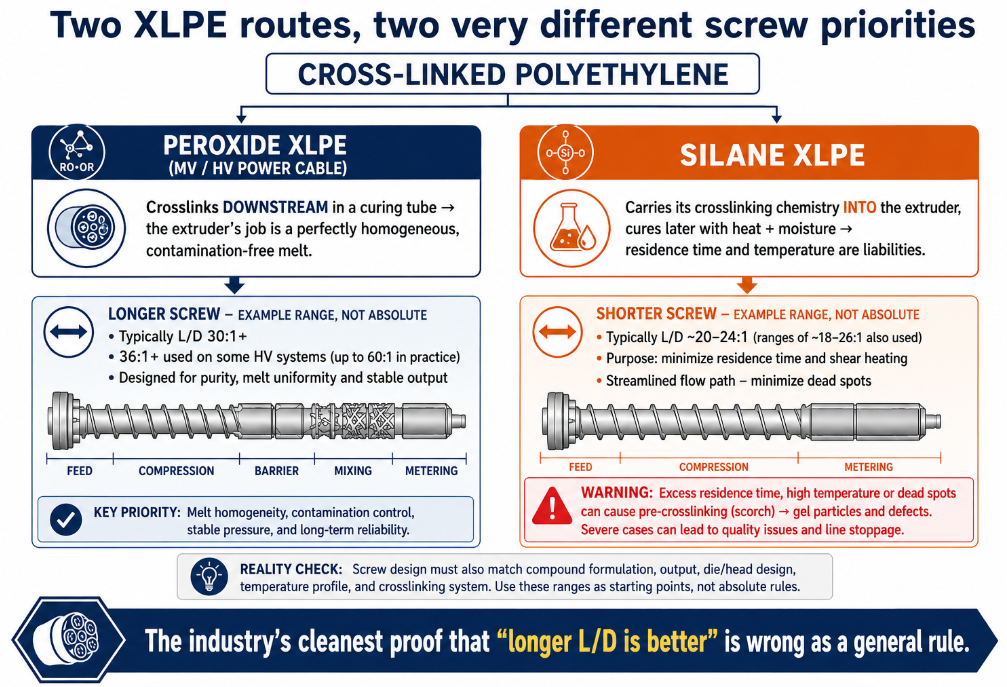
Polyethylene insulation splits into two crosslinking routes, and they want opposite screws:
- Peroxide XLPE (medium/high-voltage power cable) crosslinks downstream in a curing tube, so the extruder’s job is a perfectly homogeneous, contamination-free melt — longer L/D (30:1, and above 36:1 on HV lines where purity and uniformity are everything, because voids and contaminants cause partial discharge). Barrier-plus-mixing geometry is standard, for the same melt-uniformity reasons as in our blown film screw guide.
- Silane-crosslinkable XLPE carries its crosslinking chemistry into the extruder and cures later on exposure to heat and moisture — so extra residence time is a liability, not a benefit. Keep L/D at 20–24:1. A long screw scorches it: premature crosslinking inside the barrel, gel particles in the insulation, and eventually a line stoppage — exactly the scorch mechanism we cover on solar encapsulant film, where the same “resin that wants to cure” problem appears.
This is the industry’s cleanest example of why “longer L/D is better” is wrong as a general rule — see are there disadvantages to a long extruder screw.
LSZH / HFFR: The Abrasion Problem
Halogen-free flame-retardant compounds achieve their fire performance through sheer filler loading — ATH (aluminium trihydrate) or MDH at 60% or more by weight. That creates two problems at once:
- Dispersion. Filler must be uniformly distributed or the compound fails fire-performance testing (EN 60332 class standards) and surface quality suffers — which is why HFFR needs 28–32:1 with real mixing capability, and why heavily-filled compounding often moves to twin-screw entirely (see our compounding guide and mixing section selection).
- Abrasion. Mineral filler at that loading grinds nitrided surfaces down in months. LSZH lines are a textbook case for bimetallic construction, and for heavy loading, tungsten carbide — the same logic as glass-fiber duty.
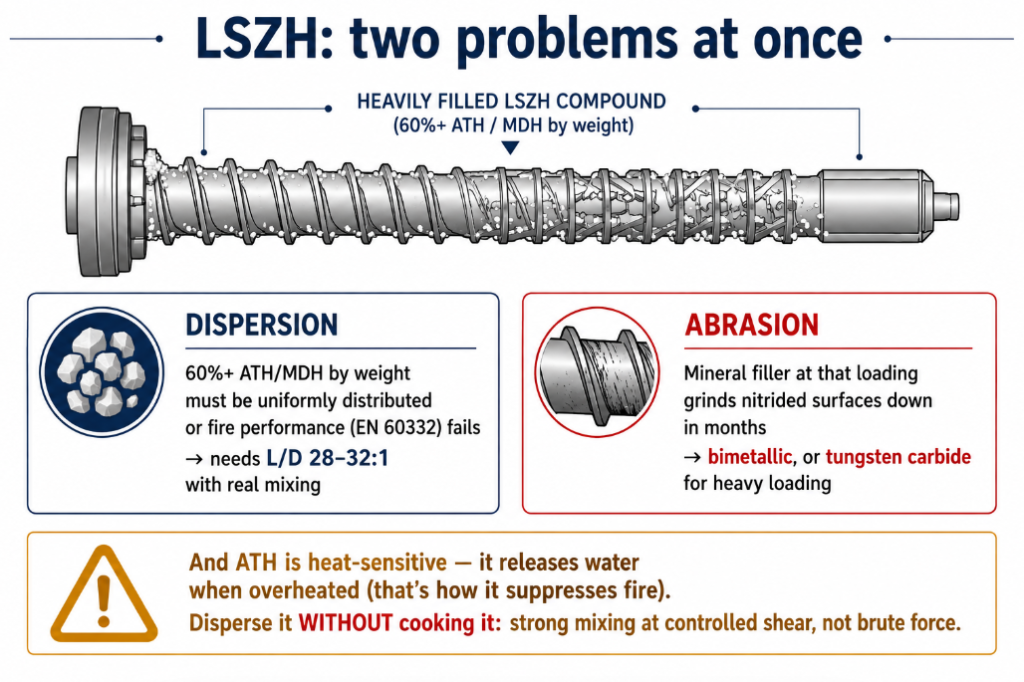
At the same time ATH is heat-sensitive (it releases water when overheated — that’s how it suppresses fire), so the screw must disperse without cooking it: strong mixing at controlled shear, not brute force.
The Two Classic Mis-Specifications
Both are so common they’re worth stating plainly:
| The mistake | What happens | The fix |
|---|---|---|
| Running HFFR/LSZH on a PVC screw (20–24:1) | Not enough length or mixing to disperse 60% filler → poor dispersion, surface defects, inconsistent mechanical and fire performance | Dedicated 28–32:1 screw with mixing, on wear-resistant metallurgy |
| Running silane XLPE on a long screw (30:1+) | Excess residence time → scorch, gels in the insulation, line stops | Keep to 20–24:1, streamlined and dead-spot-free |
The pattern underneath both: a cable plant that runs multiple compound families on one machine ends up compromising on all of them. Where volumes justify it, a dedicated screw per compound family — swapped with the product — outperforms one “universal” screw badly, and it’s why so many cable lines keep two or three screws for the same barrel.
Sizing and Specifying a Cable Screw
What determines the specification, in order:
- The compound family — the table above sets L/D, compression ratio, and mixing needs.
- Target output in kg/h — calculated from line speed × the linear weight of the covering. This sizes the screw diameter and drive power.
- Number of layers — single insulation, insulation + jacket, or triple coextrusion (standard on XLPE MV/HV cable, where hot bonding of the semicon–insulation–semicon interfaces must be void-free). Multi-layer lines need matched screws across extruders, so melt temperatures and stability align.
- Tolerance class — building wire tolerances are achievable with basic control; automotive and aerospace specs demand far tighter output stability, since output pulsation prints straight into wall thickness.
- Filler content — sets the metallurgy, per the LSZH section above.
For the general parameter logic behind L/D and compression ratio, see our screw design guide; for specifying a replacement, our custom screw RFQ guide.
Wire and cable is not one application but four, and the screws that serve them well look nothing alike — short and gentle for PVC, long and homogenizing for peroxide XLPE, deliberately short for silane XLPE, long and abrasion-proof for LSZH — so the first question on any cable line is never “what size screw” but “which compound is this screw for.”
At BLOOM, we build extruder screws and barrels for wire and cable lines across all four compound families — including dedicated screws for plants running more than one — with the metallurgy each duty demands and full inspection documentation. If you’re specifying a new cable line, adding a compound to an existing one, or replacing screws that were never right for the material, send our engineering team your compound, line speed and covering weight, machine model and L/D, and layer count on WhatsApp and we’ll specify the screw the compound actually needs.
References and Further Reading
- What Is Extrusion: How Wire and Cable Extruders Work, Gemwell — PVC at 20–25:1 L/D and ~3:1 compression, XLPE at 30:1 to avoid premature crosslinking, bimetallic barrels for filled LSZH, and output-based screw sizing: https://www.gemwellcmc.com/news/media-information/what-is-extrusion-how-wire-and-cable-extruders-work.html
- What is L/D Ratio in an Extruder?, Sai Extrumech — the two classic mis-specifications: PVC screws on HFFR compounds, and long screws on silane XLPE causing scorch: https://www.saiextrumech.com/what-is-ld-ratio-in-extruder/
- Wire and Cable Explained: Types, Extrusion & Manufacturing Guide, Gemwell — ATH loadings above 60% by weight in LSZH compounds, EN 60332 fire performance, screw diameters from 30 mm to 150 mm+, and triple coextrusion for XLPE cable: https://www.gemwellcmc.com/news/media-information/what-do-you-mean-by-wire-and-cable.html



Pingback: Twin-Screw Extruders for Dry Battery Electrodes