
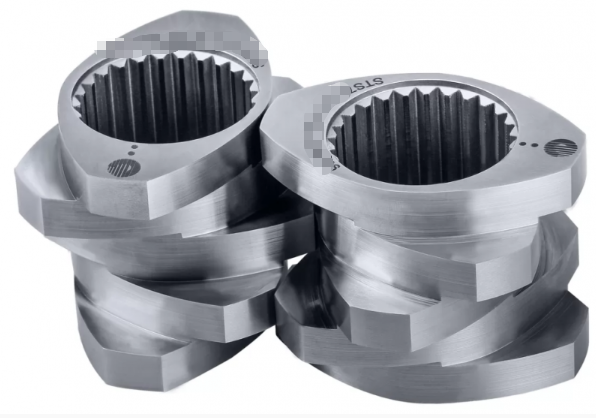
BLOOM manufactures twin-screw elements and barrels for dry battery electrode (DBE) lines — the solvent-free process where active material, conductive additive, and PTFE binder are mixed in a twin-screw extruder, and the screw’s shear fibrillates the PTFE into a fibre network that holds the electrode together. Dry electrode processing is the most demanding twin-screw duty in battery manufacturing, because the screw configuration is the process parameter: too little shear and the PTFE never fibrillates; too much and the fibre network over-refines while the active particles themselves crack. And it happens with 82–95 wt% hard ceramic powder in the barrel, in an environment where a shed metal particle is a cell defect. This page covers what the process demands, why screw configuration decides electrode quality, and what we supply.
By the BLOOM Engineering Team
What the Screw Is Actually Doing
In conventional compounding the screw disperses and distributes. In dry electrode mixing it does something different: it mechanically transforms the binder.
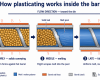
PTFE is uniquely suited to dry coating because it fibrillates under mechanical shear at slightly elevated temperature, drawing out into fibrils that entangle the active material particles and hold the electrode film together without any solvent. The extruder’s kneading zones supply exactly that shear. So the screw isn’t just mixing a formulation — it’s manufacturing the binder network in situ, and the quality of that network is the electrode.
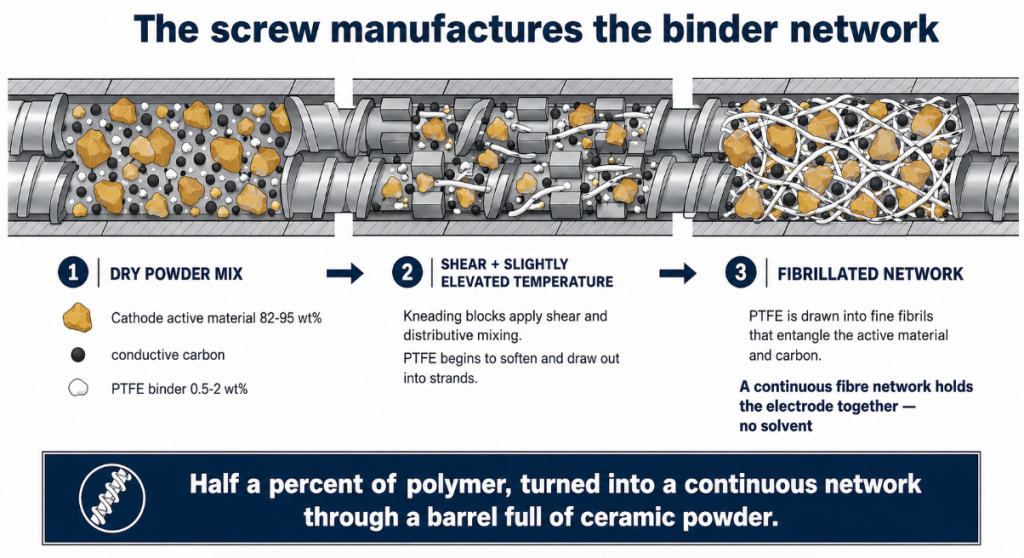
A typical formulation makes the challenge clear: 82–95 wt% cathode active material (NMC, NCA, LFP, LMO), a few percent conductive carbon, and as little as 0.5–2 wt% PTFE. The screw has to take half a percent of polymer and turn it into a continuous network through a barrel full of ceramic powder.
The Shear Window: The Central Trade-Off
Screw configuration — how many kneading blocks, of what type, in what sequence — sets the specific mechanical energy input, and research has mapped what that does:
| Kneading intensity | Effect on the material | Consequence |
|---|---|---|
| Too little | PTFE doesn’t fibrillate adequately; coarse, incomplete network | Electrode film lacks strength and cohesion |
| Intensive (high SME) | More homogeneous, finer PTFE fibril network; more compact, size-reduced granules; higher bulk density and better flowability; broadens the calendering process window | Also raises electrical resistivity, and can crack active particles |
| Excessive | Over-refined network, active material particle cracking | Higher resistivity, reduced C-rate performance |
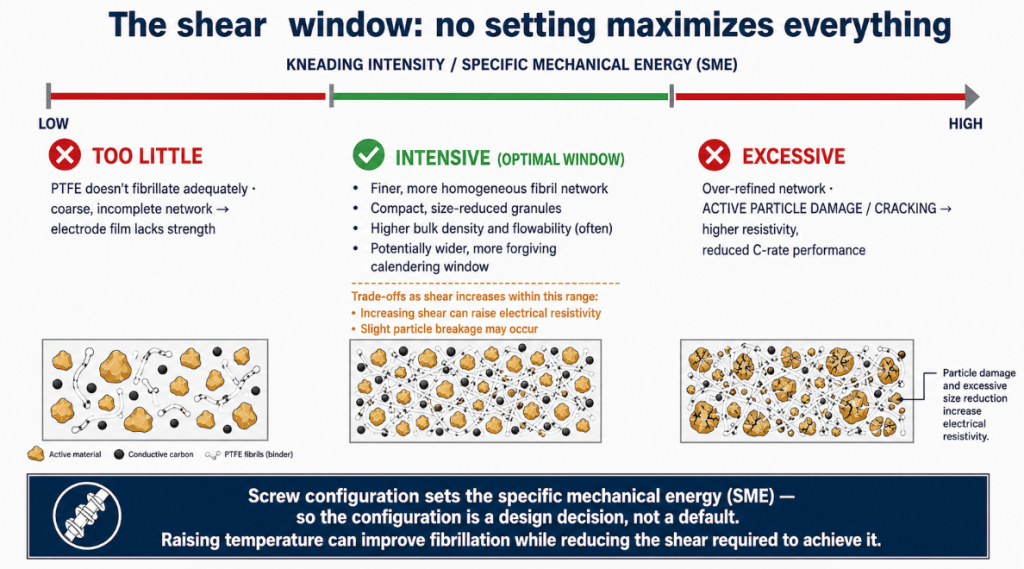
That middle row is the honest picture: intensive kneading is not simply “better.” Fine fibrillation genuinely helps downstream — the calendering window widens, granules flow better, thinner electrodes become achievable — but the same intensity raises resistivity and starts breaking the cathode particles you’re trying to preserve. Documented work on LFP found intensive kneading gave higher adhesion strength and higher electrical resistivity and slight LFP particle breakage and lower C-rate performance, all at once.
There is no setting that maximizes everything. The screw configuration has to land on the compromise your cell design wants — which is exactly why the configuration is a design decision, not a default.
One useful lever from solid-state work: raising process temperature while reducing calender line load enhances PTFE fibrillation and mitigates particle cracking — you can buy fibrillation with heat instead of buying all of it with shear. That trade-off is available to the screw designer too, and it’s why extruder temperature and kneading configuration are specified together.
Material Matters: LFP Fibrillates Differently From NMC
The same screw configuration does not give the same result on different cathode chemistries:
- LFP carries a high fine-particle content, and those fines are intermittently absorbed by the PTFE — which prolongs fibrillation. LFP needs more mixing work to reach the same network quality.
- NMC contains fewer fines and fibrillates faster.
So a line converting between LFP and NMC isn’t just changing a recipe; it’s changing the shear demand. Where both chemistries run regularly, dedicated screw configurations per chemistry outperform a compromise — the same conclusion we reach on multi-compound cable lines, for the same reason.
Scale: From Pilot to Gigafactory
The scale-up path is well documented, and the numbers put the hardware in perspective:
| Scale | Screw diameter | Throughput | Equivalent |
|---|---|---|---|
| Pilot | 20 mm | ~10 kg/h | Development and formulation work |
| Industrial | 125 mm | up to 2,400 kg/h of NMC622 extrudate | ≈ 12 GWh/year of cathode capacity |
That’s the commercial reality of this technology: a single 125 mm twin-screw line underwrites gigawatt-hour-scale cathode output — which means its elements and barrels are not a consumable to be sourced casually. Downtime and quality drift on that screw propagate directly into cell production.
Two Problems the Formulation Creates for the Hardware
Abrasion: 82–95% ceramic powder
Cathode active materials are hard oxide and phosphate ceramics, and they make up the overwhelming majority of the mix by weight. This is a more extreme abrasion duty than heavily-filled plastics compounding — where LSZH cable compounds at 50–70% filler already mandate bimetallic and carbide-grade construction. The same principle applies with less margin: when nearly everything passing the kneading blocks is ceramic, quantity of abrasive contact drives wear regardless of how the individual particles rank on a hardness scale.
The specification follows: wear-resistant element materials (tool-steel and powder-metallurgy grades), and barrels with bimetallic or tungsten-carbide-bearing liners rather than nitrided bores.
Contamination: wear debris is a cell defect
This is the constraint that makes battery duty different from ordinary compounding. Metallic particles in an electrode are a potential internal short circuit — the same logic that governs separator production, applied to the electrode itself. That changes what “wear” means: it isn’t only a maintenance cost, it’s a source of defects entering the product.
Practically:
- Wear surfaces must resist abrasion without shedding. Hard is not enough; the surface must be metallurgically sound so it wears slowly and cleanly.
- Element geometry must be fully swept — dry powder finds every stagnation pocket, and material that sits gets over-worked before it moves on.
- Documentation matters. Material certificates, hardness reports, and dimensional records are how a battery producer qualifies a wear part — the regime in our acceptance inspection checklist.
- Dry room compatibility. These lines run in controlled-humidity environments; parts and packaging need to arrive fit for that environment.
What We Supply
| Item | Construction |
|---|---|
| Twin-screw elements (kneading blocks, conveying, mixing) | Tool-steel and powder-metallurgy grades; wear-resistant surfaces |
| Twin-screw barrels and liners | Bimetallic or tungsten-carbide-bearing liners, segmented configurations |
| Element sets to your configuration | Built to your kneading sequence, or reverse-measured from existing sets |
| Reverse engineering | From worn elements or drawings, with full dimensional reports |
The element fundamentals — how kneading blocks, conveying elements, and their sequence determine mixing behaviour — are covered in our twin-screw elements guide and mixing section selection guide.
Frequently Asked Questions
Can you supply replacement elements for our existing extruder? Yes — we reverse-measure worn kneading blocks and conveying elements and manufacture dimensionally-matched replacements, or build to your specified configuration.
Our electrode resistivity rose after an element change — is that the screw? Quite possibly. Kneading intensity correlates directly with fibril network fineness and with electrical resistivity, so a configuration change alters the electrode’s microstructure. Send us the before/after configurations and we’ll look at what changed in shear terms.
How fast do elements wear on cathode duty? Faster than on most plastics compounding, because the mix is overwhelmingly hard ceramic. Rather than guess, measure: track element dimensions at each teardown, and specify the next set’s material grade against the wear you actually observe.
Do you understand the contamination requirement? Yes — it’s the same standard we build to for battery separator lines: wear surfaces that don’t shed, fully swept geometry, and documentation with every part.
Dry electrode processing puts a twin-screw extruder in an unusual position: the screw configuration doesn’t just mix the formulation, it manufactures the binder network that holds the electrode together — so the elements are a process parameter, a wear part, and a contamination risk all at once, and they deserve to be specified with all three in view.
At BLOOM, we manufacture twin-screw elements and barrels for dry electrode lines — wear-resistant grades matched to your cathode chemistry and loading, built to your kneading configuration, with full inspection documentation. If you’re specifying a DBE line, replacing worn elements, or seeing electrode quality drift you suspect is hardware, send our engineering team your cathode chemistry and loading, extruder model and screw diameter, element configuration, and throughput on WhatsApp and we’ll quote the right construction. See also our battery separator screw and barrel page.
References and Further Reading
- Industrial dry coating of NMC battery electrodes enabled by continuous extrusion mixing, Cell Reports Physical Science, 2026 — PTFE fibrillating under mechanical shear at slightly elevated temperature; pilot 20 mm screw at ~10 kg/h scaling to 125 mm screws at up to 2,400 kg/h of NMC622, equivalent to ~12 GWh/year of cathode capacity: https://www.cell.com/cell-reports-physical-science/fulltext/S2666-3864(26)00056-1
- Process-property relationships in dry powder extrusion and dry electrode manufacturing, Fraunhofer IWS / Powder Technology — kneading intensity and specific mechanical energy controlling PTFE fibril network fineness, granule density and flowability, and the resulting trade-offs in resistivity, particle breakage and C-rate performance: https://publica.fraunhofer.de/bitstreams/4bb165bd-f12d-4ab1-b649-4f1a48ff5bd3/download
- Impact of Extrusion and Direct Calendering on Dry-Coated Cathodes for Sulfidic All-Solid-State Batteries, Advanced Energy Materials (Wiley), 2026 — 82 wt% CAM with 0.5 wt% PTFE mixed and fibrillated in a twin-screw extruder, and higher process temperature with reduced line load enhancing fibrillation while mitigating active-particle cracking: https://advanced.onlinelibrary.wiley.com/doi/full/10.1002/aenm.202506443

Pingback: Extruder Screws for Solid Electrolyte Membrane Production
Pingback: Screws for Tab Sealant and Pouch Film Lines