Quick answer: clean it while it’s still warm, coat it with rust preventive, and support it horizontally at three or more points in a dry place — never standing on end, never resting on just its two ends, and never stacked metal-to-metal against another screw. A spare screw exists to eliminate downtime; a spare that arrives at the machine bent, rusted, or nicked on the flight edges delivers the opposite. The three things that ruin stored screws are corrosion, sag-induced bend, and handling damage — all of them slow, all of them invisible until installation day. Here’s how to prevent each.
By the BLOOM Engineering Team
Step 1: Clean and Protect Before It Cools
A screw comes out of the barrel with polymer on it, and polymer left in place traps moisture against the steel and carbonizes onto the surface. Two rules:
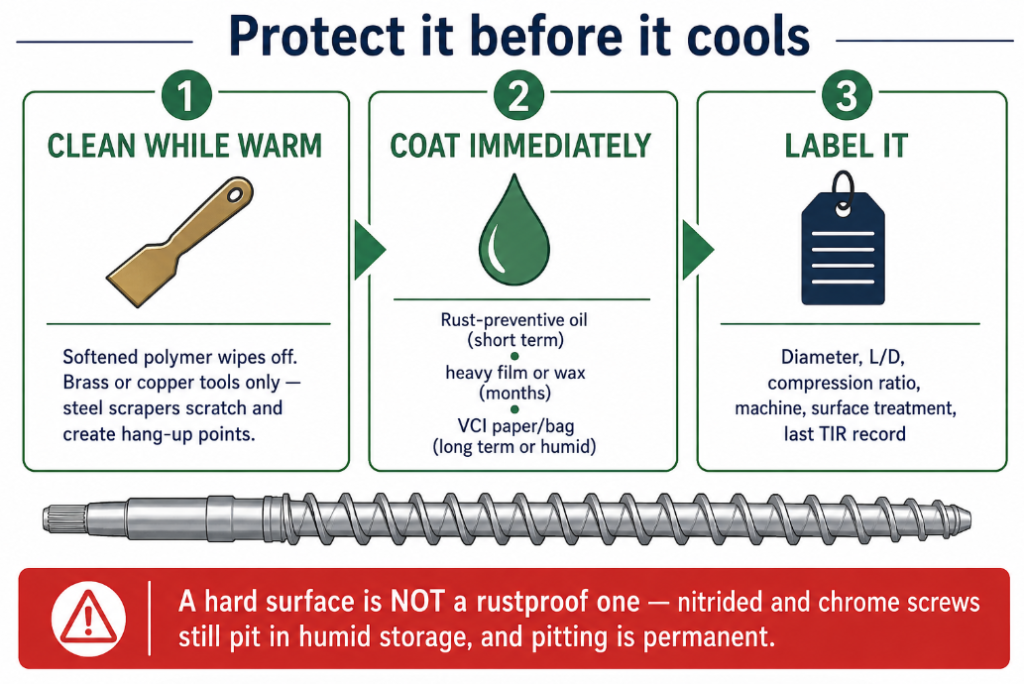
- Clean while warm. Softened polymer wipes off; cooled polymer has to be chipped, and chipping is where flight edges get damaged. Use brass or copper tools — never steel scrapers, which scratch the surface and leave hang-up points that become black specks on the next run. The full procedure is in our screw cleaning playbook.
- Coat it immediately. Bare steel starts oxidizing the moment it’s clean and cool. Options: a rust-preventive oil for short-term indoor storage; a heavier film or wax for months; VCI (vapor-corrosion-inhibitor) paper or bags for long-term or humid environments — the same class of protection used for anti-rust export packing.
⚠️ Do not skip this on nitrided or chrome-plated screws. A hard surface is not a rustproof one — nitriding and chrome resist wear and some corrosion, but stored bare in humid air they still pit, and pitting is permanent.
Step 2: Support It So It Can’t Bend
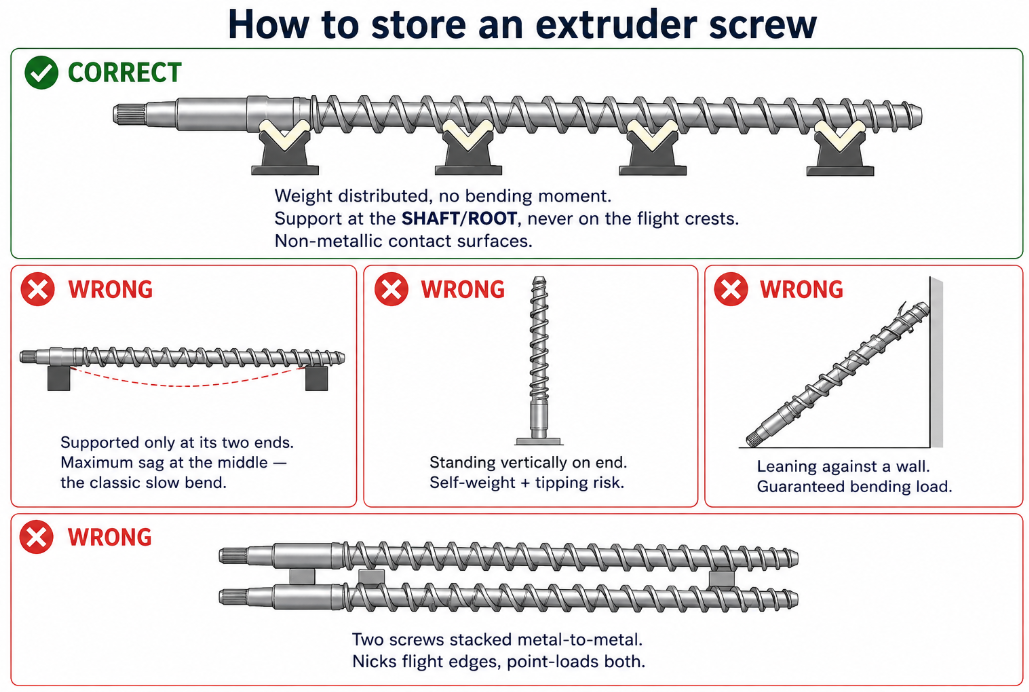
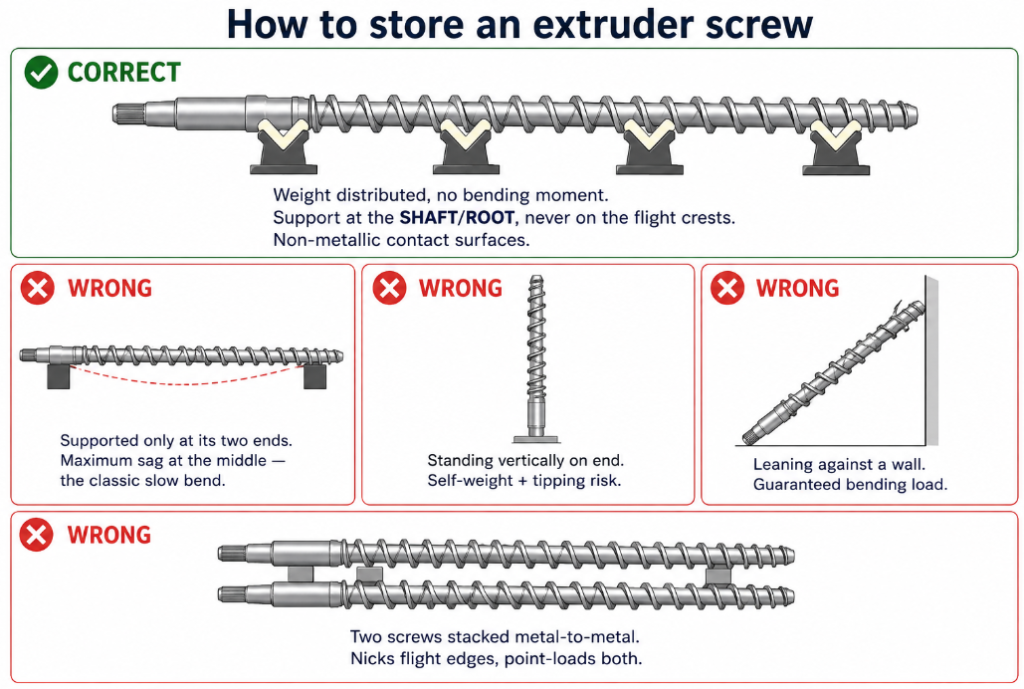
This is the failure mode buyers underestimate. A screw is a long, slender shaft, and its own weight will slowly deflect it if it’s supported wrong for months:
| Storage position | Verdict | Why |
|---|---|---|
| Horizontal, on 3+ evenly spaced supports (V-blocks, padded cradles, a rack) | ✅ Correct | Weight distributed; no sustained bending moment |
| Horizontal, resting on only the two ends | ❌ Wrong | Maximum sag at the middle — the classic slow bend on long screws |
| Standing vertically on end | ❌ Wrong | Self-weight plus a real tipping risk; a screw that falls is scrap |
| Leaning against a wall | ❌ Wrong | Guaranteed bending load, guaranteed eventual fall |
| Stacked directly on another screw | ❌ Wrong | Metal-to-metal contact nicks flight edges — and point loads bend both |
Use non-metallic contact surfaces — wood, hard rubber, or padded V-blocks — and support at the shaft/root, not on the flight crests, so the wear surface never carries the load. Long screws need more supports, not stronger ones.
Why this matters so much: straightness is the acceptance criterion you cannot fix on the shop floor, and a bent screw wipes the barrel as it turns — it is one of the mechanical failure paths in why extruder screws break. The TIR check in our acceptance inspection checklist applies just as much to a screw coming out of storage as to a new one.
Step 3: Store It Somewhere That Won’t Corrode It
- Dry and temperature-stable. Condensation is the real enemy — a shed that swings 15°C between day and night will sweat moisture onto cold steel regardless of how dry the air seems at noon.
- Away from process chemistry. Don’t store screws near PVC, fluoropolymer, or halogenated-compound operations where acidic vapors circulate: HCl and HF attack steel in storage exactly as they do in service, which is the corrosion logic in why fluoropolymers corrode extruder screws.
- Off the floor, away from forklift traffic and washdown.
- Labeled. Diameter, L/D, compression ratio, machine, surface treatment, and the last dimensional/TIR record — a spare nobody can identify is a spare nobody trusts in an emergency.
Step 4: Inspect on a Schedule
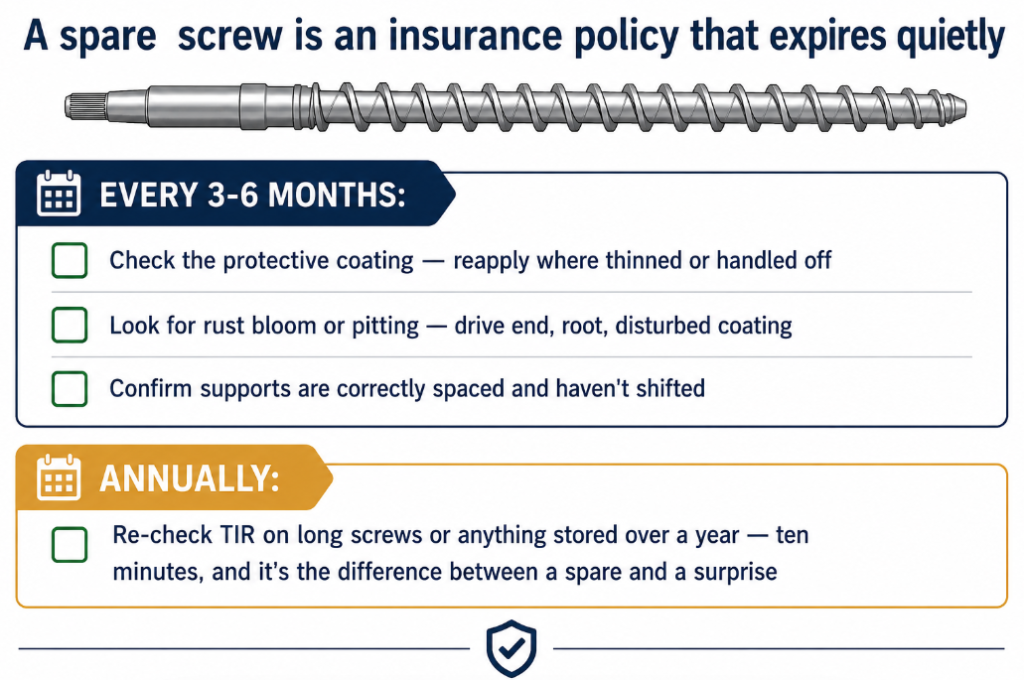
A spare screw is an insurance policy that expires quietly. Every three to six months:
- Check the protective coating — reapply where it’s thinned, wiped, or handled off.
- Look for rust bloom or pitting, especially at the drive end, in the root, and anywhere the coating was disturbed.
- Confirm the supports are still spaced correctly and haven’t shifted or collapsed.
- Re-check TIR once a year on long screws, or any screw that’s been stored more than a year — it takes ten minutes and it’s the difference between a spare and a surprise.
Don’t Forget the Barrel
An idle machine has an empty barrel, and an empty barrel rusts from the inside:
- Purge the barrel clean before an extended shutdown — never leave polymer sitting hot, and never leave degradation-prone material (PVC, POM, fluoropolymers) in there at all.
- Oil or VCI-protect the bore, then plug or cover the openings to keep moisture and debris out.
- Rotate the drive occasionally on long shutdowns per the machine maker’s guidance, to keep bearings and seals from setting.
- Bore corrosion consumes the liner locally — and as covered in how thick a bimetallic liner is, it’s local pitting rather than even wear that ends a liner’s life.
Before You Put a Stored Screw Back In
- Remove all rust preventive — leftover heavy oil or wax contaminates the first production run.
- Inspect the flights for handling nicks and burrs; dress carefully with a stone if needed, never aggressively.
- Check TIR before installation, not after the first bad run.
- Verify it’s the right screw — the label from Step 3 pays for itself here.
- Measure the barrel bore too if it’s been idle — you’re pairing two parts whose condition both changed while nothing was running.
A stored screw is a precision component on pause, not a piece of stock steel — so keep it clean, coated, horizontally supported at several points, dry, labeled, and checked twice a year, and the spare you bought for emergencies will actually be usable when the emergency arrives.
At BLOOM, we manufacture extruder screws and barrels and ship them with rust-preventive treatment and protective crating built for long transit and storage. If a stored or long-idle screw has come out rusted, pitted, or out of straightness and you need to know whether it’s salvageable, send our engineering team photos and your TIR and dimensional readings on WhatsApp and we’ll tell you honestly whether it’s a clean-up, a rebuild, or a replacement.
References and Further Reading
- Essential Feedscrew and Barrel Maintenance, Davis-Standard — feedscrew and barrel handling and maintenance practice, including care of removed screws: https://davis-standard.com/custom_blog/essential-feedscrew-and-barrel-maintenance-part-ii/
- Troubleshooting Screw and Barrel Wear in Extrusion, Plastics Technology — surface condition, corrosion pitting, and the clearance consequences that stored-part damage feeds into: https://www.ptonline.com/articles/troubleshooting-screw-and-barrel-wear-in-extrusion