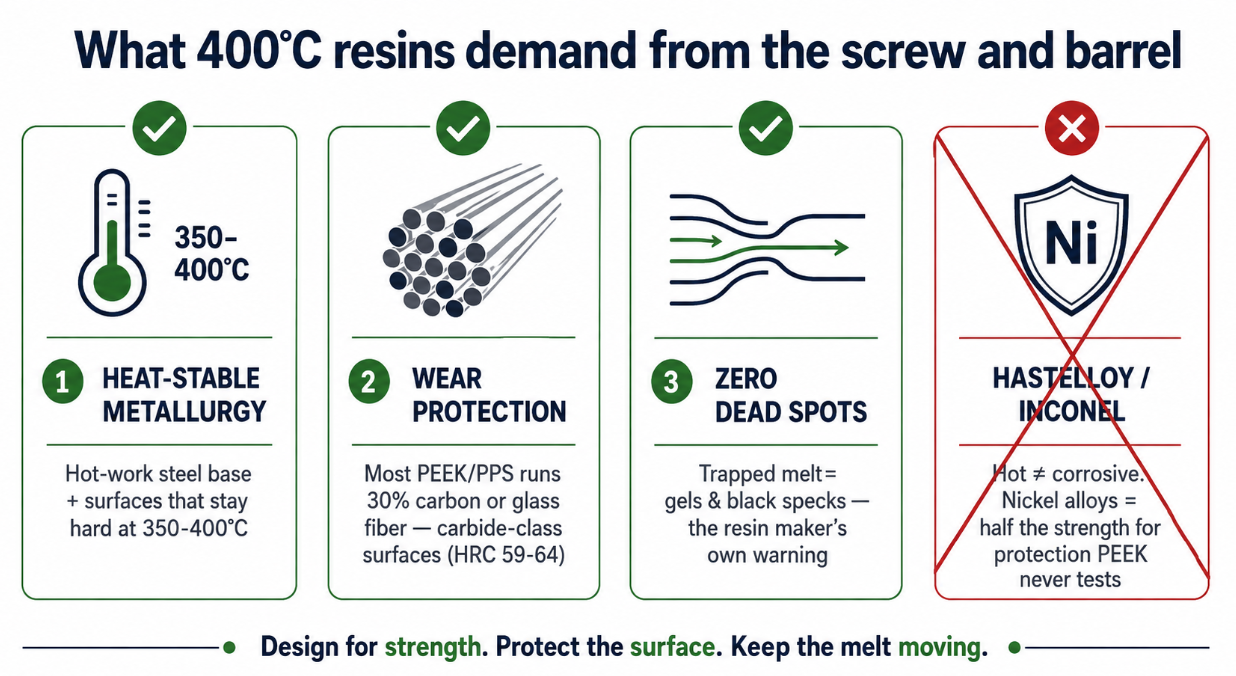
Quick answer: PEEK and the other 400°C-class resins demand three things from the screw and barrel — metallurgy that keeps its properties in sustained 350–400°C service, wear protection for the carbon- and glass-fiber fillers most of these resins carry, and absolutely streamlined, dead-spot-free flow, because at these temperatures any trapped material turns into gels and black specks. And one thing they do NOT need: Hastelloy or Inconel. PEEK is hot but not corrosive — a nickel-alloy screw gives up half its strength for chemical protection the resin never attacks, and becomes a cold-start breakage risk instead. Here are the real requirements, the numbers, and the specification that fits.
By the BLOOM Engineering Team
The Temperature Class We’re Talking About
| Resin | Typical processing temperature | Notes |
|---|---|---|
| PPS | ~300–340°C | The “entry” high-temperature resin |
| LCP | ~300–350°C | Thin-wall, very low viscosity |
| PEI (Ultem) | ~340–400°C | Amorphous, high viscosity |
| PEEK | ~360–400°C | Barrels must operate to 400°C; equipment rated to 450°C |
| PEEK HT / ST grades | up to ~430°C | The extreme end |
Two useful facts from the resin maker’s own processing guidance: despite the extreme temperatures, PEEK’s melt viscosity sits in the normal processing range — and venting is not required. So the machine doesn’t need to be exotic in architecture; it needs to be right in metallurgy and geometry.
Threat 1: What Sustained 400°C Does to Standard Hardware
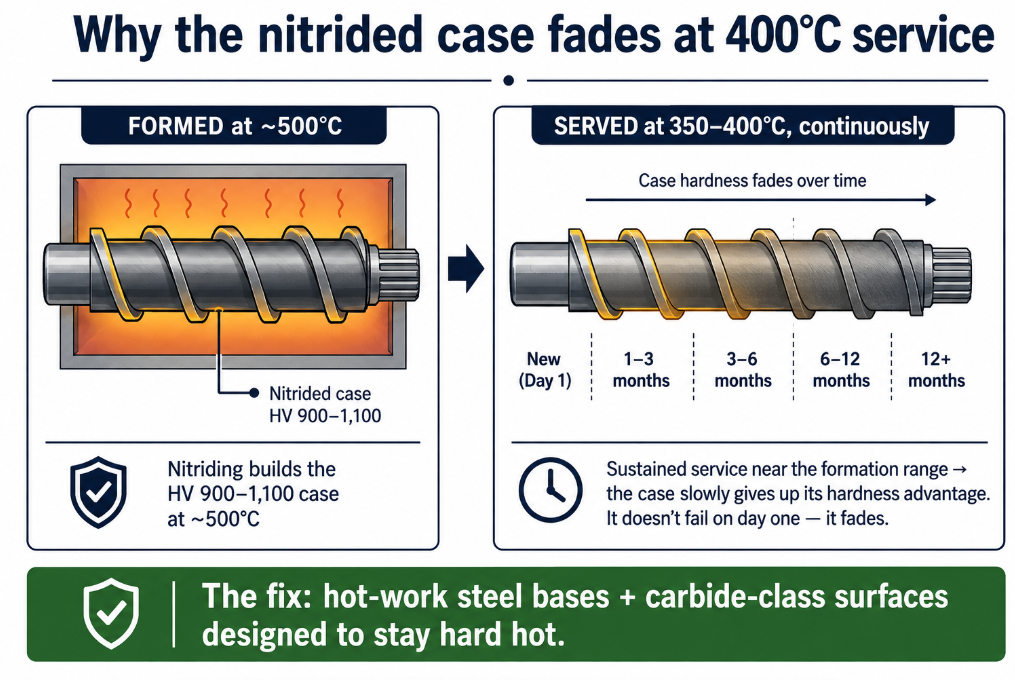
Ordinary screw and barrel construction is qualified by room-temperature numbers — and 400°C service quietly erodes all of them:
- The nitrided case is formed at around 500°C. Run the part continuously at 350–400°C — uncomfortably close to that formation range — and over long service the case slowly gives up the hardness advantage it was built with. It doesn’t fail on day one; it fades over months.
- Steel strength falls with temperature. A base steel chosen for its room-temperature torque capacity carries meaningfully less at 400°C, so high-temperature screws are properly built on hot-work tool-steel-class bases that are designed to keep strength and hardness hot.
- Thermal expansion changes the clearance. A screw-and-barrel pair dimensioned cold doesn’t run at those dimensions at 400°C — the running clearance must be designed for the hot state, or the pair runs either too tight (galling risk) or too loose (leakage) at operating temperature.
None of this is visible in a quote photo — it lives in the material specification and the design calculations, which is the recurring theme of buying for this duty.
Threat 2: The Fillers — Because PEEK Rarely Comes Alone
Most structural PEEK, PPS, and PEI runs 30% carbon or glass fiber, which means the hardware faces severe abrasion at temperature — the combination that kills standard surfaces fastest. Glass and carbon fiber grind down plain nitrided parts in months even at ordinary temperatures, as covered in why glass fiber wears screws fast; at 400°C, with the nitrided case already fading, the timeline shortens further. The answer is the same family that handles abrasion everywhere else, specified in its heat-stable grades:
- Screw flights: carbide-bearing hardfacing (Colmonoy 83 / tungsten-carbide class, ~HRC 59–64) that retains its hardness hot.
- Barrel: a carbide- or nickel-based bimetallic liner — the anti-high-temperature grade on our nickel base alloy barrel page — rather than a nitrided bore.
Unfilled PEEK is far gentler; the filled grades are where the premium surfaces earn their cost.
Threat 3: Zero Dead Spots — the Resin Maker’s Own Warning
The PEEK manufacturer’s processing guide is explicit: any dead spot in the melt path — gaps around flanges, badly fitting blanking plugs — causes gels and black specks. At PEEK’s temperatures, trapped material degrades quickly; at PEEK’s prices and applications (medical, semiconductor, aerospace), one black speck is a scrapped part, the same economics as on a battery separator line. For the screw and barrel, that means:
- Fully streamlined, radiused, polished geometry — no square corners, no unswept zones, the same discipline behind avoiding black specks anywhere, applied with less forgiveness.
- Moderate, gradual compression — PEEK screws are commonly specified around a 2–3:1 compression ratio with a gradual transition, melting the polymer without shear-overheating it (high screw speed is a known shear-degradation risk on PEEK).
- A cooled feed throat — heat conducting back along the screw and barrel toward the hopper hurts feeding; the feed throat is held around 70–100°C, typically water-cooled. A small detail that separates lines that feed steadily from lines that don’t.
The Mistake to Avoid: “Hot” Does Not Mean “Hastelloy”
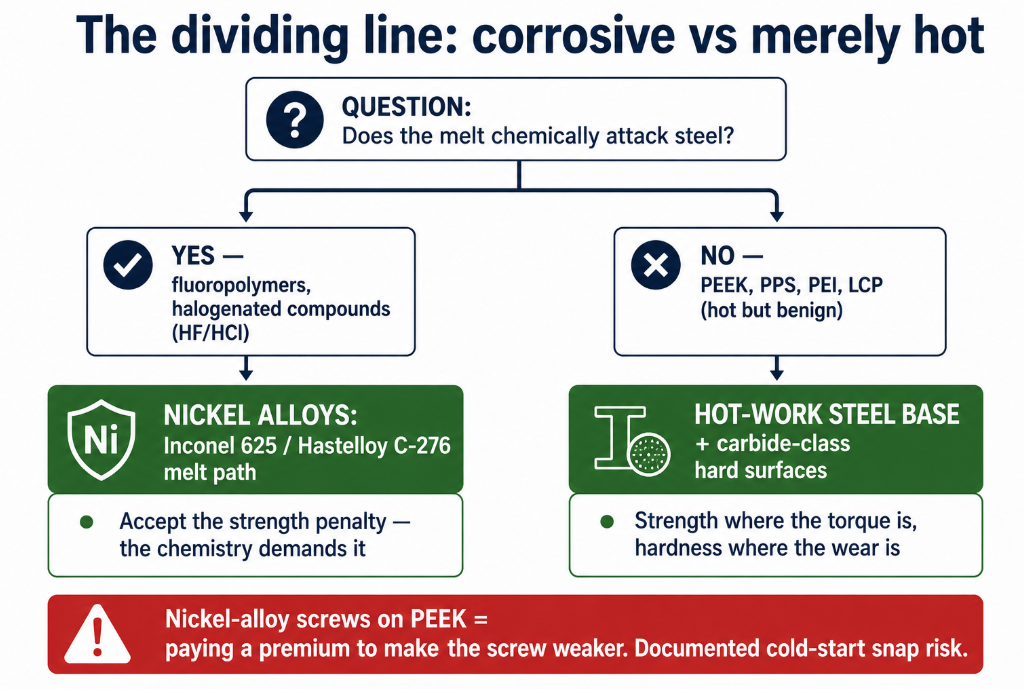
Because 400°C sounds extreme, buyers regularly specify nickel superalloys — Inconel 625, Hastelloy C-276 — for PEEK screws. That’s the fluoropolymer answer applied to the wrong problem. PEEK, PPS, and PEI are hot but chemically benign to steel: there’s no HF, no acid attack, nothing that defeats a properly chosen tool steel. What the nickel alloys bring instead is roughly half the yield strength of screw steel — and nickel-alloy screws running PEEK, PSU, and PEI are exactly the ones documented as prone to snapping on cold starts. You’d be paying a premium to make the screw weaker against a threat that doesn’t exist. The dividing line:
- Corrosive melt (fluoropolymers, halogenated compounds) → nickel-alloy metallurgy — see screw and barrel for fluoropolymer extrusion.
- Hot but non-corrosive (PEEK/PPS/PEI/LCP) → high-strength hot-work steel base + hard, heat-stable surfaces. Strength where the torque is, hardness where the wear is.
(The exception that proves the rule: PEEK compounded with PTFE or halogenated additives reintroduces fluorine chemistry — then the corrosion logic returns. Specify by the compound, not the base resin’s name.)
The Specification That Fits
| Element | For 400°C-class duty | Why |
|---|---|---|
| Base steel | Hot-work tool-steel class, quenched & tempered | Keeps torsional strength and core hardness at temperature |
| Screw surface | Unfilled/light duty: quality nitride may serve · Filled: carbide-class hardfacing (HRC 59–64) | Wear resistance that survives sustained heat |
| Barrel | Bimetallic, carbide- or nickel-based liner | Bore hardness that doesn’t fade at 400°C |
| Geometry | ~2–3:1 gradual compression, streamlined, polished, radiused | Melt without shear damage; zero dead spots |
| Clearance | Designed for the hot running state | Cold dimensions mislead at 400°C |
| Feed section | Cooled feed throat (~70–100°C) | Protects solids feeding from back-conducted heat |
| What to skip | Hastelloy/Inconel screws · vented designs (PEEK needs no vent) | Wrong threat; unnecessary complexity |
And the honest lower bound: unfilled PPS at the bottom of the temperature class, on intermittent runs, can live on quality standard construction — the premium specification earns its cost as the temperature, the filler content, and the utilization climb. A 30% carbon-fiber PEEK line running continuously sits at the top of every column above.
The 400°C resins don’t need exotic machines — they need honest metallurgy: a base that stays strong hot, surfaces that stay hard hot, geometry with nowhere for material to sit and char, and the discipline to spec for heat and abrasion rather than reaching for a corrosion alloy the resin will never test.
At BLOOM, we build screws and barrels for PEEK, PPS, PEI, and LCP duty — hot-work-class bases, carbide-grade surfaces, bimetallic barrels, and streamlined geometry designed for the hot running state. If you’re specifying a high-temperature line or replacing parts that faded early, send our engineering team your resin and filler content, processing temperatures, and machine details on WhatsApp and we’ll spec the right construction — and tell you honestly where standard parts will do. See also our screws and barrels pages.
References and Further Reading
- VICTREX Extrusion Processing Guide, Victrex — equipment rated to 450°C with barrels operating to 400°C (430°C for HT/ST), venting not required, dead spots causing gels and black specks, feed throat held at 70–100°C: https://www.victrex.com/-/media/downloads/technical-guides/victrex_extrusion-brochure_jan2022.pdf
- Processing and Workplace Safety Tips for Fluoropolymer Medical Tubing, Plastics Technology, 2018 — why nickel-alloy (Inconel/Hastelloy) screws are reserved for corrosive duty: roughly half the strength of screw steel and prone to cold-start breakage when run on hot-but-non-corrosive resins like PEEK, PSU, and PEI: https://www.ptonline.com/articles/processing-and-workplace-safety-tips-for-fluoropolymer-medical-tubing