Quick answer: melt-processable fluoropolymers (PVDF, ETFE, FEP, PFA) release small amounts of hydrofluoric acid (HF) at processing temperature — and HF is one of the few acids that attacks not only steel but also the chromium-oxide layer that chrome plating and stainless steel depend on. That’s why a screw that ran ordinary resins for years can pit within hours to days on FEP or PFA, why chrome plating doesn’t save it, and why the only durable answer is nickel-alloy metallurgy. Below: where the HF actually comes from, why it defeats every standard surface, how to recognize the attack early, and what you can and can’t do about it operationally.
By the BLOOM Engineering Team
Where the HF Comes From
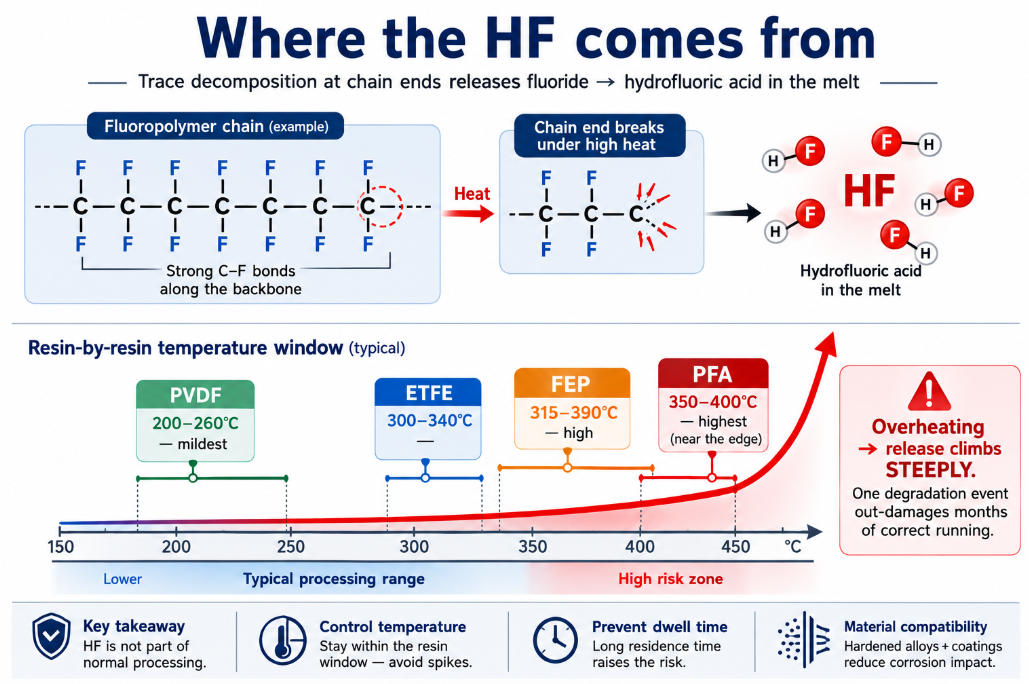
Fluoropolymers are built on the carbon–fluorine bond — the strongest single bond in organic chemistry, which is exactly what makes the finished parts so inert. But at melt-processing temperature, the polymer isn’t perfectly stable: trace decomposition at chain ends and defect sites releases small amounts of fluoride, which with any available hydrogen (moisture, polymer hydrogen) forms hydrofluoric acid in the melt and the vapor above it. Two things control how much:
| Resin | Processing temperature | HF release / corrosion severity |
|---|---|---|
| PVDF | ~200–260°C | Mildest — lowest temperature, partially fluorinated |
| ETFE | ~300–340°C | Moderate |
| FEP | ~315–390°C | High — fully fluorinated at high temperature |
| PFA | ~350–400°C | Highest — runs near its degradation edge |
And critically: release climbs steeply with overheating. A fluoropolymer pushed past its window, or left sitting hot in a dead spot, decomposes and releases far more HF than normal running — which is why one degradation event can do visible damage that months of correct processing wouldn’t.
Why Steel, Chrome, and Even Stainless Lose
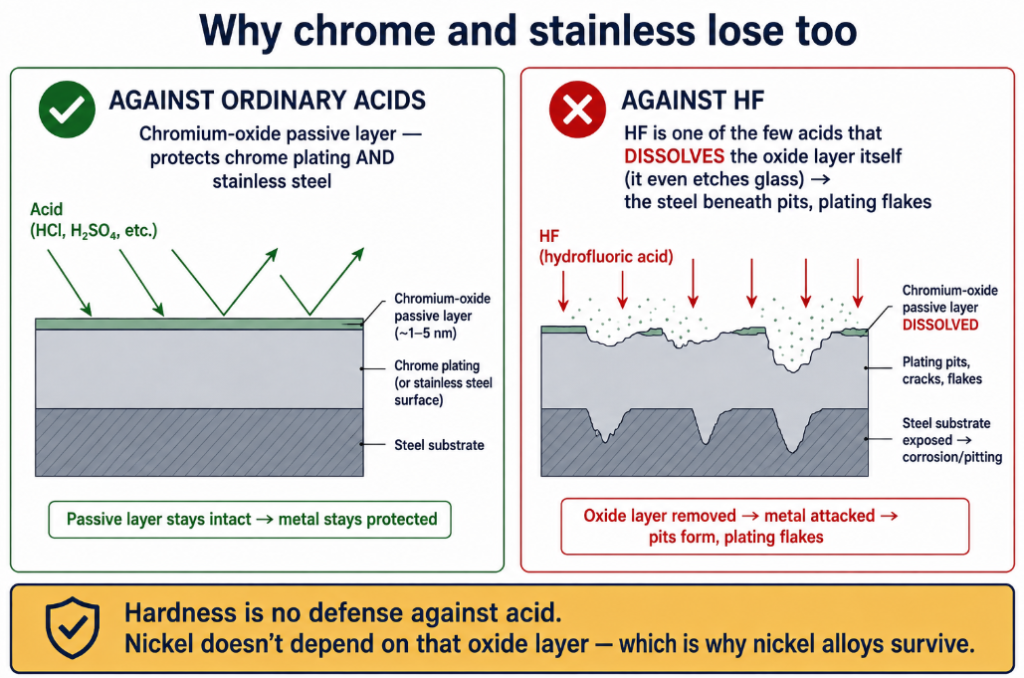
Ordinary corrosion logic says “add chrome” — and against most chemistries, that works, because chromium protects itself with a tough chromium-oxide passive layer. HF is the exception: it’s one of the few acids that dissolves that oxide layer itself (the same reason HF etches glass, which shrugs off other acids). The consequences on an extruder:
- Bare tool steel is attacked directly — molten perfluoropolymer contact pits standard steel within hours to days of operation.
- Hard chrome plating is undermined: HF attacks the chromium oxide and the plating loses its protection, then the steel beneath pits and the plating flakes.
- Stainless steel relies on the same chromium-oxide passivation — which is why stainless is not a fluoropolymer answer either, despite its reputation.
- Nitrided surfaces are hard, not chemically immune — hardness is no defense against acid.
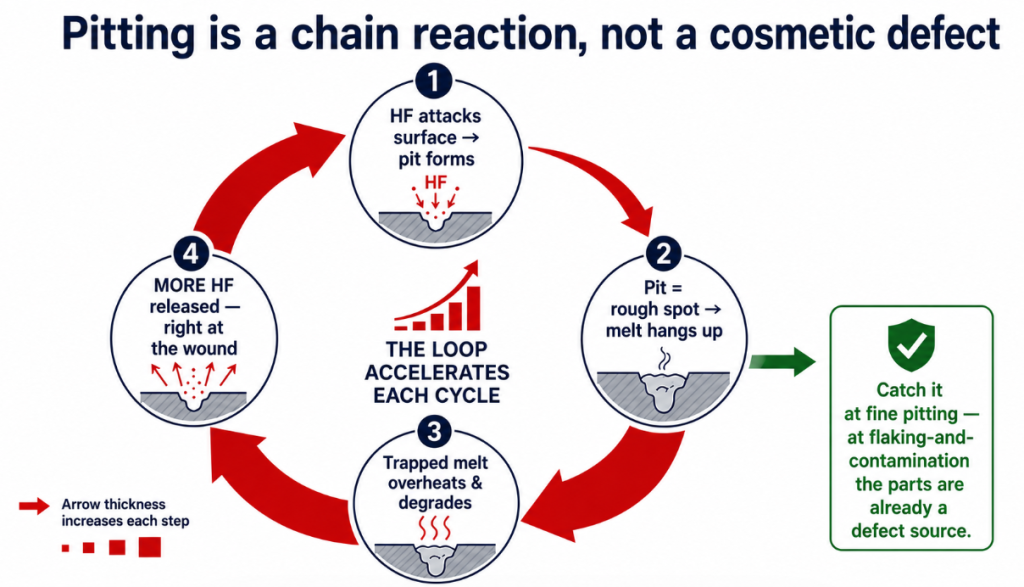
And the damage self-accelerates: every corrosion pit is a rough spot where melt hangs up, sits, overheats, and degrades — releasing more HF exactly where the surface is already wounded. Pitting on a fluoropolymer line isn’t a cosmetic defect; it’s a chemical chain reaction getting started, by the same stagnation logic that creates black specks on PVC lines. (The PVC parallel is exact, incidentally — PVC releases HCl the way fluoropolymers release HF; fluorine chemistry is simply the more aggressive version.)
How to Recognize the Attack Early
| Sign | Where you’ll see it | What it means |
|---|---|---|
| Fine pitting, dulling, or “orange peel” on flights and root | Hottest zones first — metering section, screw tip, die end | HF attack underway |
| Chrome flaking or blistering | Anywhere plated | Plating undermined — the steel beneath is already involved |
| Metal contamination or dark specks in product | High-purity tubing especially | Corrosion products shedding into the melt |
| Clearance opening faster than the material’s abrasiveness explains | Wear measurements | Corrosion is doing the “wear” — pits are being wiped away |
Catch it at the fine-pitting stage and the parts may be salvageable or at least run out their planned life; catch it at flaking-and-contamination and the screw and barrel are becoming a defect source for every kilogram they touch.
Why Nickel Alloys Survive
Nickel doesn’t depend on a chromium-oxide layer for protection — nickel and high-nickel alloys are intrinsically resistant to fluorides, which is why the fluorochemical industry itself builds HF service equipment from nickel alloys. On extruders, that translates to the established specification: Inconel 625 / Hastelloy C-276 class alloys for the screw and every melt-contact component, and nickel-based bimetallic liners for the barrel. The full product-side picture — including the strength trade-off these alloys bring (roughly half the yield strength of screw steel, which is why cold starts snap them) and how to specify by resin grade — is on our screw and barrel for fluoropolymer extrusion page, with the alloy family background on the nickel base alloy barrel page.
What Operations Can and Can’t Do
Good operating practice slows the chemistry; it does not repeal it:
- Hold temperature discipline. HF release climbs steeply with overheating — tight control (and verified thermocouples) keeps release at its unavoidable minimum instead of its degradation maximum.
- Eliminate residence-time traps. Streamlined, polished flow paths and clean shutdowns deny the melt the chance to sit, degrade, and gas out. Never let fluoropolymer cook in a hot barrel during a stop.
- Dry the resin. Moisture doesn’t cause the fluorine chemistry, but water plus fluoride is hydrofluoric acid — wet resin makes the environment more aggressive.
- Purge before and after with a stable polyolefin so fluoropolymer isn’t the material sitting through heat-up and cool-down.
- But know the limit: on PVDF at 220°C, discipline plus good high-nickel surfaces can be a long-term answer. On FEP and PFA at 350°C+, no procedure protects ordinary steel — the metallurgy has to change, and pretending otherwise just schedules the pitting for a few weeks later.
Fluoropolymers corrode screws and barrels because their chemistry guarantees a little HF at melt temperature — an acid that defeats steel, chrome, and stainless alike by dissolving the very oxide layers they hide behind — so the durable answer was never a harder surface or a better procedure, but a metal that doesn’t care about fluoride: nickel.
At BLOOM, we build the nickel-alloy screws and nickel-based bimetallic barrels that fluoropolymer duty demands — specified honestly by resin, from PVDF-class high-nickel surfaces to full Hastelloy-class melt paths for PFA. If your parts are showing the early signs above, send our engineering team photos of the pitting, your resin and temperatures, and the parts’ service history on WhatsApp and we’ll tell you whether they’re salvageable and what the replacement should be made of. For what standard surface treatments can and can’t handle, see our coating and surface treatment guide.
References and Further Reading
- Processing and Workplace Safety Tips for Fluoropolymer Medical Tubing, Plastics Technology, 2018 — high-nickel alloys (Inconel 625 / Hastelloy C-276) for all melt-contact components and nickel-based bimetallic barrel liners as the established fluoropolymer specification: https://www.ptonline.com/articles/processing-and-workplace-safety-tips-for-fluoropolymer-medical-tubing
- US Patent 8,318,819 (USPTO) — HF released in fluoropolymer extrusion as highly acidic, corroding barrels, screws, and dies; non-Hastelloy/Inconel surfaces unable to survive perfluoropolymer melt contact under normal process conditions: https://image-ppubs.uspto.gov/dirsearch-public/print/downloadPdf/8318819