
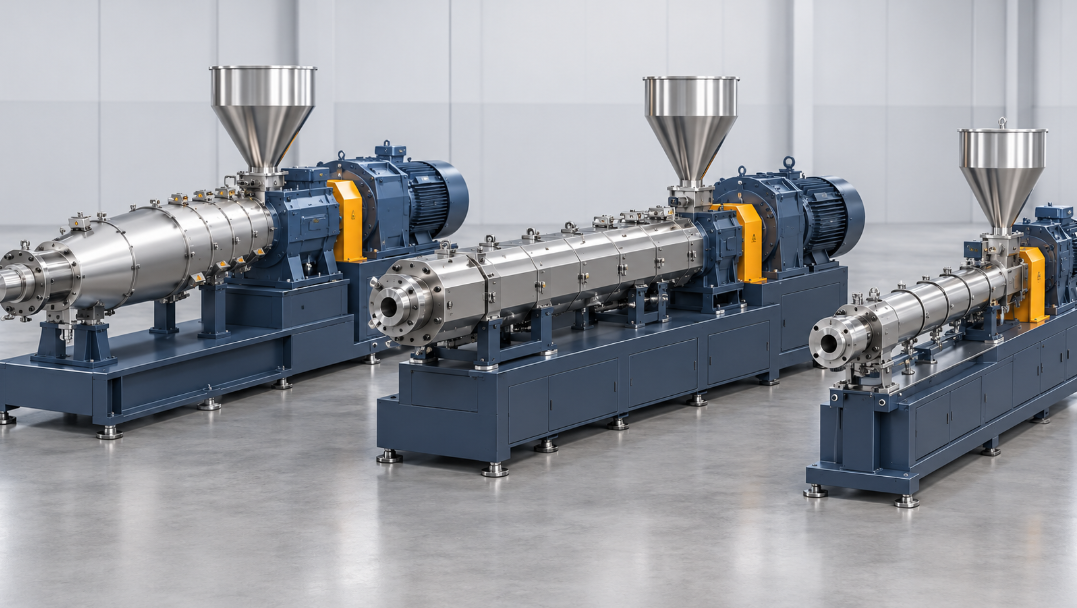
There are three main types of PVC extruder — conical twin screw, parallel counter-rotating twin screw and single screw — and the first thing that decides between them is what you feed. Powder dry blend for rigid pipe, profile and WPC goes to a counter-rotating twin screw; compounded pellets and soft PVC go to a single screw. Whichever type you run, its screw and barrel decide how well it handles PVC and how long it lasts, because PVC is heat-sensitive, corrosive when it degrades and often loaded with abrasive filler.
By the BLOOM Engineering Team
This PVC extruder guide explains how each type handles the material, which parts matter most, what wears first and how to keep the screw and barrel healthy. If you are choosing a machine, see the PVC extruder models we build.
Why PVC Is Hard on an Extruder
Three properties of PVC shape every PVC extruder design:
| PVC property | What it does to the extruder | Design response |
|---|---|---|
| Narrow processing window | Little margin between a good melt and degradation; shear heat pushes the melt toward the limit | Low-shear counter-rotating screws; temperature-controlled screw cores |
| Releases HCl when it degrades | Acid attacks steel: pitting on the screw, the barrel bore and the die path | Chrome-plated screws; nickel-based or bimetallic barrel surfaces |
| Abrasive fillers in rigid grades (calcium carbonate, titanium dioxide) | Wears flight tips and the barrel bore | Hard bimetallic barrels; hardfaced flights |
How narrow the window is shows in the settings a rigid PVC compound producer gives for twin screw extrusion of dry blend: barrel 325–365°F (about 163–185°C), die 345–365°F (174–185°C) and melt 370–390°F (188–199°C). Those ranges leave little room for shear heat, which is why rigid PVC often needs the screw cooled from the inside all the way to its tip, and why the same guide recommends temperature-controlled, oil-filled screws, vacuum venting and bimetallic barrels.
Types of PVC Extruders and How Each Handles PVC
Conical twin screw PVC extruders
Two counter-rotating screws taper from a large diameter at the feed end to a small one at the discharge. The size is written as two numbers — 65/132 means 65 mm at the small end and 132 mm at the large end. The large feed end takes powder easily, and the narrowing channels give built-in compression. Across our standard sizes, from 35/77 to 92/188, outputs run from about 40 to 500 kg/h at screw speeds of a few tens of rpm. Conical machines are the common choice for small and medium pipe, window and door profiles, and WPC. How the sizes work and how a conical set wears are covered in our conical twin screw barrel guide.
Parallel counter-rotating twin screw PVC extruders
The screws are cylinders of constant diameter, turning in opposite directions like the conical type. They are generally chosen once output and pipe size outgrow conical machines. For the trade-offs between the two twin screw designs, see conical vs parallel twin screw extruders.
Both twin screw types share the mechanism that makes them suit PVC — and the one that wears them. Closely intermeshing counter-rotating flights carry material forward in near-closed chambers with little shear. As melt is squeezed through the narrow calender gap between the screws, it pushes them apart and toward the barrel wall. Research on a counter-rotating extruder running rigid PVC found that this separating force rises with screw speed and as the gap closes, concentrates barrel wear between 30° and 60° from the vertical, and is the reason these machines run at low speeds — large ones generally below 50 rpm.
Single screw PVC extruders
A single screw is the usual choice for PVC that arrives as compounded pellets: soft PVC hose, cable sheathing and soft profiles. The compounding — dispersing stabilisers, plasticisers and pigments — has already been done, so the single screw’s job is to melt and pump gently. Rigid PVC dry blend is normally run on counter-rotating twin screws instead. For a wider comparison, see single vs twin screw extruders.
What about co-rotating twin screws?
Co-rotating twin screws are the standard compounding machine for most polymers, but they are a less common choice for direct extrusion of rigid PVC: their intensive mixing adds shear heat that PVC tolerates poorly. The different families are explained in types of twin screw extruders.
| Conical twin screw | Parallel counter-rotating twin screw | Single screw | |
|---|---|---|---|
| Usual feed | Dry blend | Dry blend | Compounded pellets |
| Conveying | Positive, low shear | Positive, low shear | Drag flow |
| Typical products | Small and medium pipe, profiles, WPC, foam board | Larger pipe, high-output lines | Soft PVC hose, cable sheathing, soft profiles |
| Screw core temperature control | Oil-filled, temperature-controlled | Oil-filled, temperature-controlled | Used where needed |
| Wear parts | Matched conical screw pair and barrel | Matched parallel screw pair and barrel | Screw and barrel |
Inside a PVC Extruder: The Parts That Matter
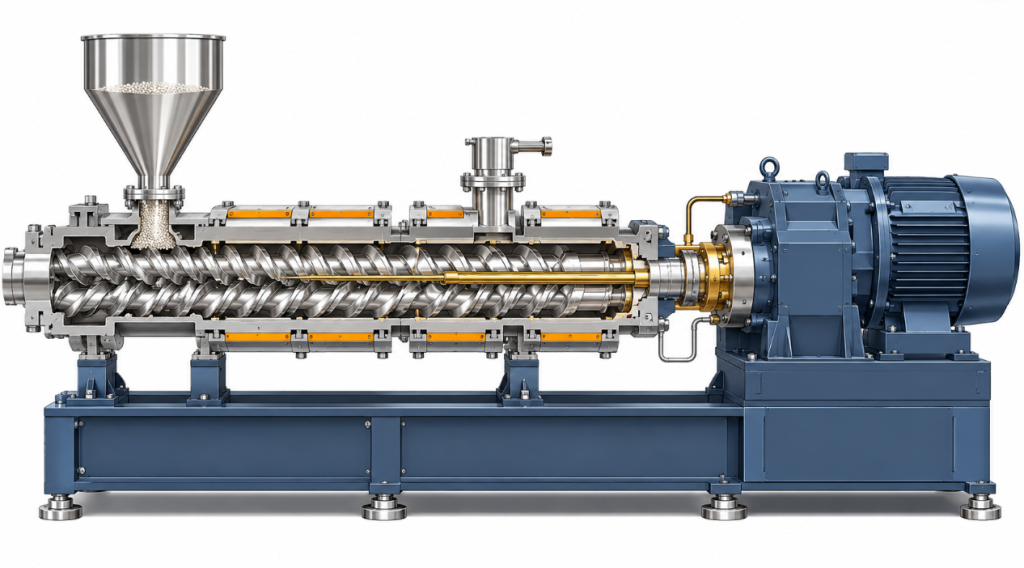
Beyond the screw type, a handful of components decide whether a PVC extruder runs steadily:
| Component | Role with PVC | What to check when buying or replacing |
|---|---|---|
| Dosing feeder | Meters dry blend into the twin screws, so the feed rate rather than the screws sets output | Feed rate range matches your output; stable metering at low rates |
| Screws | Convey, compress, vent and pump with minimal shear | Flight design for your formulation; surface treatment; core bore for oil |
| Screw temperature control | Oil circulating through the screw cores removes shear heat | Oil unit capacity; rotary union and internal tube matched to the screws |
| Barrel | Heating and cooling along the process; the wear surface | Heating zones; cooling method; nitrided or bimetallic bore |
| Vacuum vent | Removes moisture and volatiles before the melt reaches the die | Vent position; vacuum pump capacity |
| Gearbox and thrust bearings | Carry the separating forces between the screws and the thrust from die pressure | Torque and thrust ratings for the screw size |
| Adapter and die connection | Carries the melt to the die without dead spots | Streamlined flow path; flush sensor ports |
Dead spots in the flow path are where PVC sits, degrades and later appears as black specks — see what causes black specks in PVC extrusion. For heaters, thermocouples and cooling on the barrel, see extruder barrel temperature control hardware, and for why PVC needs venting at all, see when you need a vented extruder screw.
PVC Extruder Screws and Barrels: Materials That Last
The screw and barrel surfaces are chosen against the two attacks PVC brings — corrosion and abrasion. These are the options we use and the figures we work to:
| Surface | Applies to | Key figures | Best against |
|---|---|---|---|
| Nitriding (38CrMoAlA) | Screws and barrel bore | HV 950–1,000, case 0.5–0.7 mm | General wear on lightly filled PVC |
| Hard chrome plating over nitriding | Screws | ≥ 950 HV, 0.05–0.10 mm thick | HCl corrosion; helps the melt release |
| Bimetallic barrel layer (Ni + WC alloy) | Barrel | 1.0–2.0 mm deep, HRC 56–65 | High calcium carbonate loading, recycled PVC, WPC |
| Plasma-welded hardfacing | Screw flights | Cobalt-, nickel- or iron-based alloys | Flight-tip wear on filled compounds |
The detailed comparison — including compression ratio and which coating to choose for which PVC grade — is in our guide to the PVC extruder screw and barrel. For how thick a nitrided case really is, see how thick is the nitrided layer.
What Wears First on a PVC Extruder
Wear on a PVC extruder builds slowly, so the useful question is not whether parts are wearing but which one is wearing fastest on your line:
| Part | Cause | Early symptom | What to do |
|---|---|---|---|
| Screw flight tips | Abrasion from fillers | Output falls at the same screw speed; melt temperature rises | Measure flight clearance against the limit |
| Barrel bore at 30°–60° (twin screw) | Calender-gap separating forces | Output loss, surging | Measure each lobe at the angled positions, not just top to bottom |
| Chrome on the screws | HCl from degraded PVC | Pitting, sticking, specks | Strip and re-plate before the base metal is attacked |
| Vent zone and adapter | Degraded material building up in slow-flow areas | Black specks, discolouration | Clean, check temperature control, remove dead spots |
| Screw core temperature control | Oil unit or rotary union failing | Yellowing, scorching on the screw surface | Check oil flow and temperature |
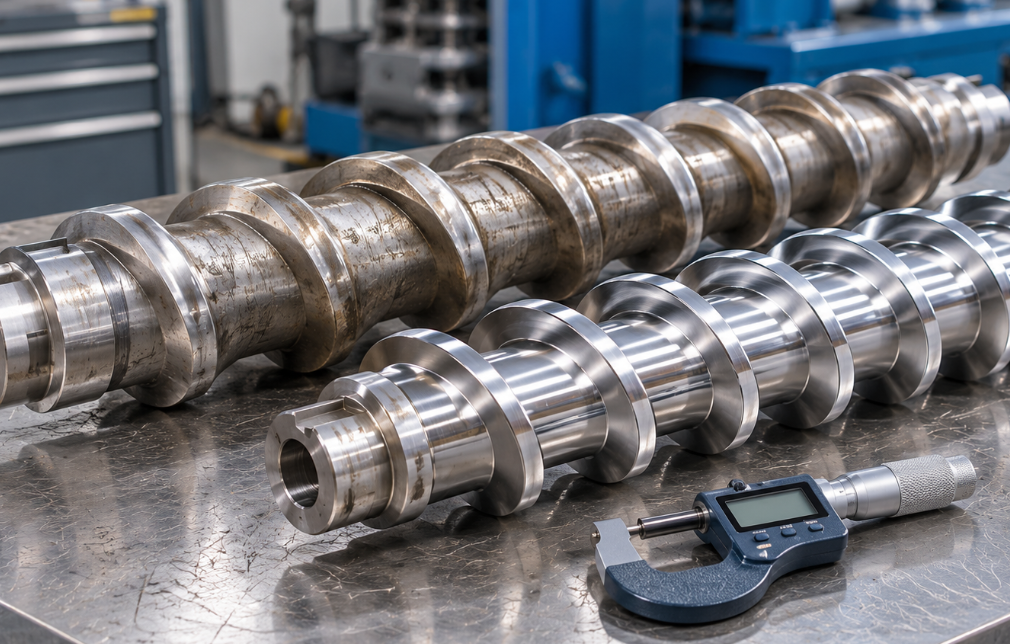
Measuring is the only reliable way to tell which part is responsible. Use our screw wear limit calculator to compare clearance with the replacement point, follow how to measure twin screw barrel wear for the barrel, and work through why extruder output drops if the cause is not obvious. Colour problems are covered in why PVC turns yellow in the extruder.
Keeping a PVC Extruder’s Screw and Barrel Healthy
Most premature screw and barrel failures on PVC lines trace back to a few habits:
- Never start cold. Bring every zone to temperature and let it soak before turning the screws; cold starts are one of the most common reasons screws break. See why extruder screws break.
- Do not leave PVC sitting hot. Purge with a heat-stable compound before a stop, so degraded PVC does not sit in the channels releasing acid.
- Look after the screw oil system. Oil level, flow, temperature and rotary-union leaks are all easy to check and expensive to ignore.
- Respect the speed range. On counter-rotating screws, higher speed raises the forces that wear the barrel as well as the melt temperature.
- Measure on a schedule. Record clearances when the set is new and at each planned shutdown, so you can see the trend rather than one number.
- Plan the next set. Know your supplier’s lead time, or keep a spare set if downtime is expensive.
Rebuild, Replace or Buy a New PVC Extruder?
When performance falls, the fix can be anything from a screw rebuild to a new machine:
| Situation | Best move | Where to start |
|---|---|---|
| Screws worn, barrel still within limits | Rebuild or replace the screws, machined to the barrel’s measured bore | Extruder screw rebuilding |
| Chrome worn or pitted, flights in good shape | Strip and re-plate the screws | Can a chrome-plated screw be replated |
| Whole set worn, machine otherwise sound | New screw and barrel set — upgraded if the filler loading has risen | Conical barrel and other screw and barrel |
| Need more output, a new product, or a switch from pellets to dry blend | A PVC extruder of the right type and size | PVC extruder |
| Gearbox and drive worn as well as the screw set | Compare a full overhaul with a new machine | PVC extruder |
PVC Extruder Guide FAQ
What is the difference between a PVC extruder and a PE extruder?
A PVC extruder is built for low shear and corrosion: counter-rotating twin screws or low-shear single screws, chrome-plated or corrosion-resistant surfaces, temperature-controlled screw cores and vacuum venting. A typical PE extruder uses a higher-shear single screw on nitrided steel, because polyethylene is thermally stable and does not release acid.
Why does a PVC extruder need vacuum venting?
Dry blend carries moisture and volatiles that would otherwise end up as bubbles or surface defects in the product. Vacuum venting is part of the setup recommended for twin screw extrusion of rigid PVC dry blend.
Can I run PVC on an extruder built for PE or PP?
Not reliably. A screw designed for polyolefins usually adds more shear heat than PVC tolerates, and nitrided steel without chrome or a corrosion-resistant alloy will pit once the PVC starts to degrade. At minimum, the screw and barrel need to be specified for PVC.
Why are PVC extruder screws chrome-plated?
Chrome resists the HCl that PVC releases as it degrades and gives a smooth surface the melt releases from easily. When the chrome wears or pits, the screw can be stripped and re-plated.
What temperature does a PVC extruder run at?
For rigid PVC dry blend on a twin screw extruder, one compound producer’s guide gives a barrel of about 163–185°C, a die of 174–185°C and a melt of 188–199°C. Your compound supplier’s data sheet is the reference for your formulation.
How do I know the screw and barrel are worn?
Output falling at the same screw speed, rising melt temperature and surging are the usual signs. Confirm by measuring flight clearance and the barrel bore — on twin screw machines, including the 30°–60° positions.
A PVC extruder is defined by its screw and barrel: match the machine type to what you feed, the surfaces to your formulation, and measure wear before it shows up in your product.
Whether you need a new screw and barrel set or a complete machine, send us your product, output and formulation on WhatsApp. We make the screws and barrels in our own shop and build the PVC extruders they run in.
References and Further Reading
- Westlake Compounds (2022). Extrusion Processing Guide — Rigid Dry Blend PVC Compound (Twin-Screw Extruder). https://www.link2westlake.com/resource/1652730681000/ProcessingGuides/RigidDryblendExtrusionProcessingGuide.pdf
- Demirci, A., Teke, I., Polychronopoulos, N. D., & Vlachopoulos, J. (2021). “The Role of Calender Gap in Barrel and Screw Wear in Counterrotating Twin Screw Extruders.” Polymers, 13(7), 990. https://www.mdpi.com/2073-4360/13/7/990
- Anderson, R. (2012). “How to Spec’ Screws & Barrels For Running Corrosive Materials.” Plastics Technology. https://www.ptonline.com/articles/how-to-spec-screws-barrels-for-running-corrosive-materials
- Plastics Technology. “EXTRUSION: When Internal Screw Cooling Makes Sense.” Plastics Technology. https://www.ptonline.com/articles/extrusion-when-internal-screw-cooling-makes-sense
- Womer, T., & Spalding, M. (2023). “Troubleshooting Screw and Barrel Wear in Extrusion.” Plastics Technology. https://www.ptonline.com/articles/troubleshooting-screw-and-barrel-wear-in-extrusion

Pingback: PVC Extruder Screw & Barrel: Material, Coating & Ratio
Pingback: Extruder Screws and Barrels: The Complete Guide