
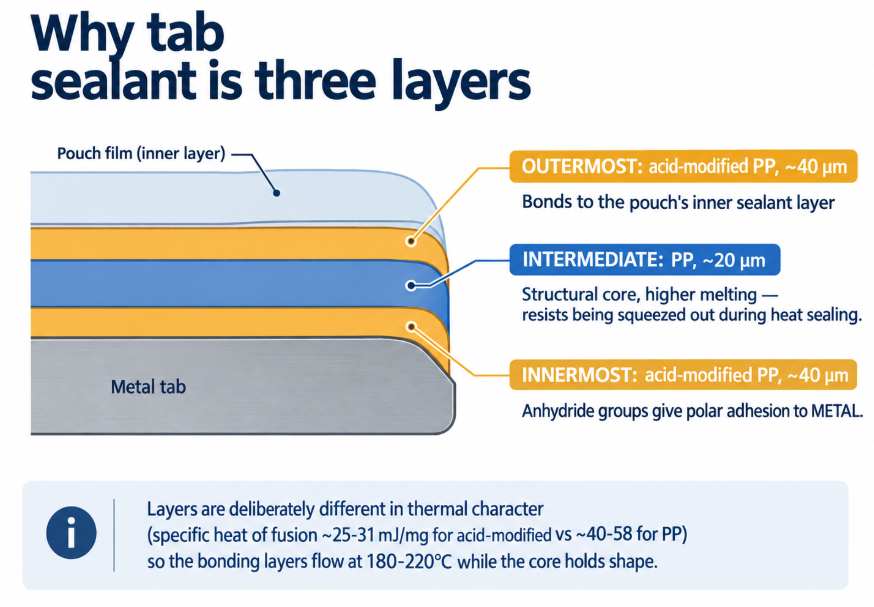
BLOOM manufactures screws, barrels, and twin-screw elements for lithium pouch-cell packaging films — the multilayer tab sealant that seals around the electrode tabs, and the sealant layers of aluminium laminate pouch film. These are small, thin, unglamorous films that decide whether a cell leaks. A tab sealant is typically a three-layer coextrusion of acid-modified polypropylene / PP / acid-modified PP at around 40/20/40 µm, and the acid-modified layers exist for one reason: to bond to metal. That single requirement — a polar, grafted polyolefin, made and processed inside a narrow chemical window — is what makes these lines different from ordinary cast film. This page covers the layer structure, the reactive-extrusion side, and what both demand from the hardware.
By the BLOOM Engineering Team
Why These Films Are Multilayer
A pouch cell is sealed by heat, and the seal has to bond two dissimilar things at once: the aluminium/metal of the tab and pouch, and the polyolefin of the film itself. Plain PP does the second but not the first. Acid-modified PP — polypropylene grafted with maleic anhydride or similar — does both, because the anhydride functionality gives it polar groups that adhere to metal.
Hence the structure, documented across pouch-cell patents:
| Layer | Typical material | Typical thickness | Job |
|---|---|---|---|
| Innermost | Acid-modified PP | ~40 µm | Bonds to the tab metal |
| Intermediate | PP | ~20 µm | Structural core, higher melting — resists being squeezed out during heat sealing |
| Outermost | Acid-modified PP (or PP) | ~40 µm | Bonds to the pouch film’s inner sealant layer |
The layers are deliberately different in thermal character — published examples specify distinctly different specific heats of fusion per layer (acid-modified layers around 25–31 mJ/mg, PP layers around 40–58 mJ/mg). That difference is engineered: during heat sealing at roughly 180–220°C, the bonding layers must soften and flow while the core layer holds its shape.
Pouch laminate film uses the same idea. Its sealant side is itself split — a first sealant layer of acid-modified PP next to the aluminium barrier, and a second cast-PP layer inboard — with the two layers deliberately different in yield strength (a documented design specifies a difference of 66–120%) and layer thicknesses around 10–60 µm and 20–70 µm respectively.
What this means for the screws: every layer is thin, every layer has a different melt character, and the layers must arrive at the die matched. That’s a coextrusion problem before it’s a screw problem — but it’s solved with screws.
The Grafted Resin: A Chemistry Window the Screw Can Move
Acid-modified polyolefins are made by grafting maleic anhydride onto the polymer backbone, and the graft ratio sits in a narrow window. Documented for a maleic-acid-modified polyethylene sealant used in lithium cells:
- Above ~0.2% graft ratio → moisture permeability increases, making the material unsuitable as a lithium cell sealant.
- Below ~0.05% → adhesion to the terminal plates degrades, and it can’t do its job.
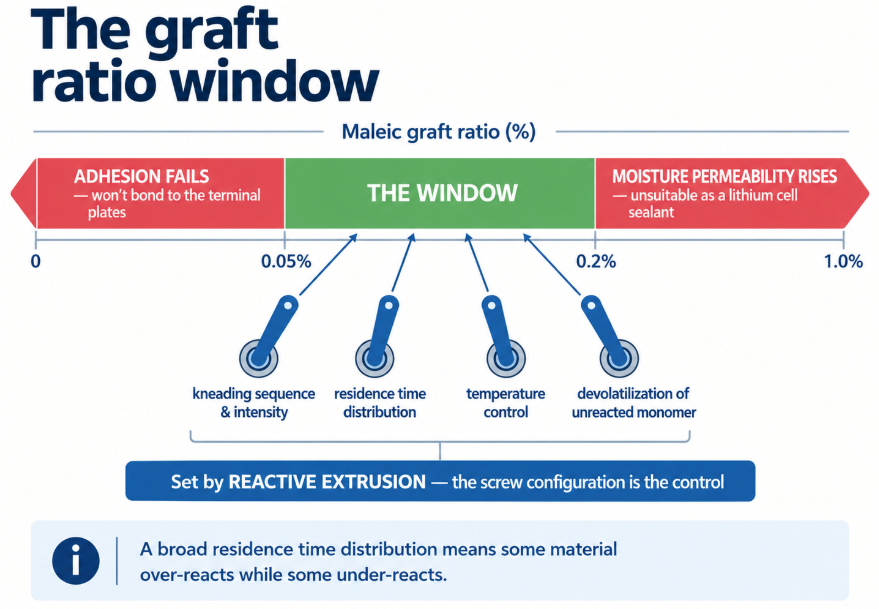
That window matters to anyone running a twin-screw line, because grafting is done by reactive extrusion — polymer, monomer, and peroxide initiator fed to a twin-screw extruder, where screw configuration, temperature, and residence time determine how much grafting happens and how much chain degradation comes with it.
If you compound your own grafted resin, the screw configuration is the graft ratio control:
- Kneading sequence and intensity set the mixing and reaction conditions.
- Residence time distribution determines reaction completeness — and a broad distribution means some material over-reacts while some under-reacts.
- Temperature control governs both grafting rate and the competing degradation reactions.
- Devolatilization removes unreacted monomer and by-products, which otherwise carry through into the film — see when you need a vented screw.
The element-configuration principles are the same ones covered in our twin-screw elements guide and compounding and masterbatch guide — applied to a reaction rather than a blend.
⚠️ Processing note: anhydride functionality is chemically reactive by design, and grafted resins are moisture-sensitive — hydrolysed anhydride is acid. For hardware, that argues for corrosion-aware surface specification on lines running high-acid-content grades continuously, in the same family of reasoning as our nickel base alloy page, and for dry, sealed material handling. Specify against your actual grade’s acid content rather than assuming “it’s just PP.”
The Film Line: Thin Layers, Matched Extruders
On the coextrusion side, the demands are the familiar cast-film ones sharpened by thickness:
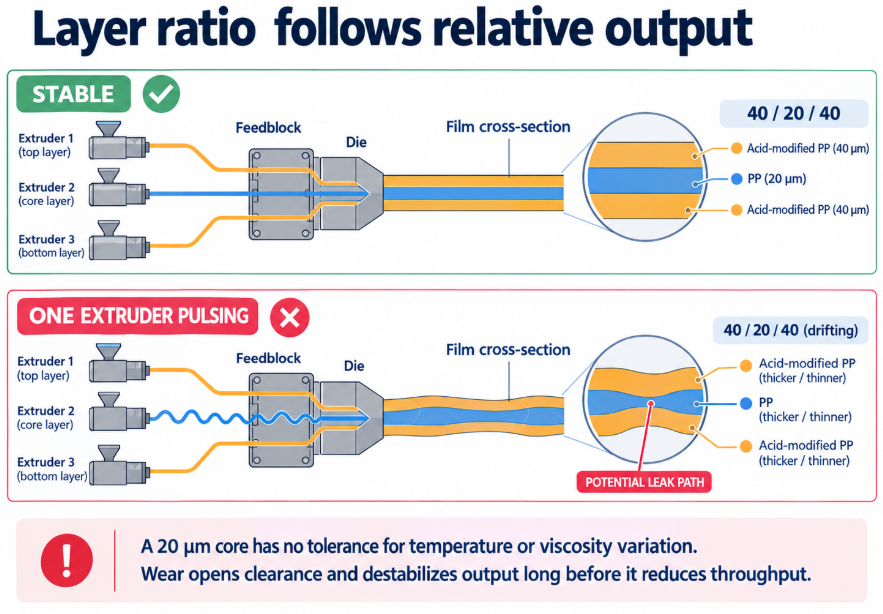
- Melt uniformity per layer. A 20 µm core layer has no tolerance for temperature or viscosity variation — non-uniform melt prints as layer-thickness variation, and a thin spot in a sealant layer is a potential leak path. The mechanism is the same one behind gauge variation.
- Matched extruders. Three layers means multiple extruders whose melts must arrive at the feedblock with compatible temperatures and stable outputs. Screws that behave consistently — and identically where layers are identical — are the foundation. Mismatched layer temperature causes interfacial instability and layer non-uniformity.
- Output stability above all. Layer ratio is set by relative output; output pulsation on any extruder changes the layer structure in real time.
- Cleanliness. These films sit inside a sealed cell against electrolyte. Gels, degraded material, and contamination are functional defects, not cosmetic ones — the same standard as our battery separator hardware, which means streamlined, mirror-polished, dead-spot-free geometry.
- Low-shear melting. PP grades here are not hard to melt; the risk is over-working them. Gentle geometry protects both the polymer and, on grafted grades, the graft chemistry.
What We Supply
| Item | For | Construction |
|---|---|---|
| Cast film screws and barrels | Tab sealant and pouch sealant layers | Low-shear, streamlined, mirror-polished; matched sets for coextrusion |
| Twin-screw elements and barrels | Reactive extrusion of grafted resins, compounding | Wear- and corrosion-aware grades; devolatilization configurations |
| Matched multi-extruder sets | 3-layer and 5-layer lines | Consistent, repeatable performance layer to layer |
| Reverse engineering | Existing lines | From worn parts or drawings, with full documentation |
Every part ships with material certificates, hardness reports, and dimensional records — see our acceptance inspection checklist.
Frequently Asked Questions
Our layer thickness drifts over a run — is that the screw? Often, yes. Layer ratio follows relative output, so any output instability shows up as layer drift. Check output stability and screw wear before adjusting the die; wear opens clearance and destabilizes output long before it reduces throughput — see our wear limit calculator.
We buy grafted resin rather than making it. Does the reactive-extrusion section apply to us? Not directly — but it explains why grades vary. If two lots of “the same” acid-modified PP behave differently, graft ratio and residual monomer are usually why.
Do acid-modified grades need special surface treatment? It depends on acid content, temperature, and how continuously you run. We’d rather see your grade’s specification than give a blanket answer — tell us what you run and we’ll say whether standard, chrome, or nickel-alloy surfaces are appropriate.
Can you supply matched screw sets for a 3-layer line? Yes — that’s the normal request for these lines, and consistency between the screws matters as much as each screw individually.
Tab sealant and pouch film are the least glamorous parts of a lithium cell and among the least forgiving: thin layers whose thickness is a leak path, a bonding chemistry that only works inside a narrow graft window, and a service environment where a gel or a contaminant is a cell failure rather than a cosmetic flaw.
If you produce tab sealant, pouch laminate sealant layers, or the grafted resins that go into them, send our engineering team your layer structure and thicknesses, resin grades, line configuration, and extruder models on WhatsApp and we’ll specify screws and barrels for it. For our other lithium battery applications, see our pages on battery separator, dry battery electrodes, and solid electrolyte membranes.
References and Further Reading
- US Patent 10,109,826 (USPTO) — tab sealant constructions including three-layer laminates of acid-modified polypropylene innermost (~40 µm), PP intermediate (~20 µm) and outer layers, with specified per-layer specific heats of fusion: https://image-ppubs.uspto.gov/dirsearch-public/print/downloadPdf/10109826
- US Patent 4,732,825 (USPTO) — the maleic-acid graft ratio window for lithium cell sealants: above 0.2% increases moisture permeability making the material unsuitable, below 0.05% degrades adhesion to the terminal plates: https://image-ppubs.uspto.gov/dirsearch-public/print/downloadPdf/4732825
- US Patent 12,537,246 (USPTO) — pouch film stack with a first sealant layer of acid-modified PP adjacent the aluminium barrier and a second cast-PP sealant layer, with specified yield-strength difference (66–120%) and layer thicknesses: https://image-ppubs.uspto.gov/dirsearch-public/print/downloadPdf/12537246



Pingback: Twin Screw Liquid Injection Barrel: Where to Inject