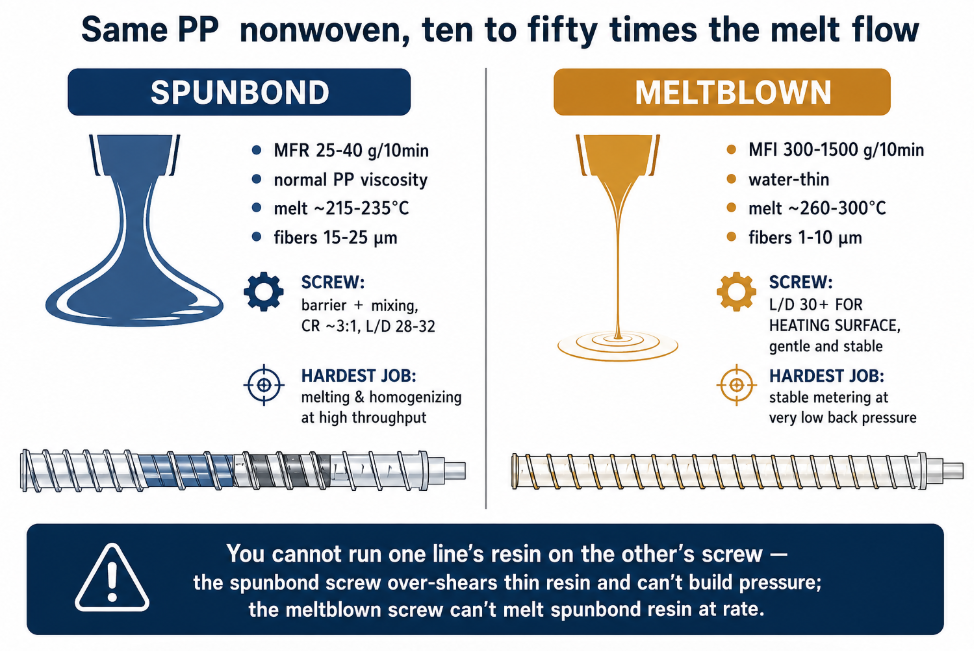
Spunbond and meltblown both make PP nonwovens, but they run resins whose melt flow differs by a factor of ten to fifty — spunbond around MFR 25–40, meltblown at MFI 300–1500 — and that single fact makes their screws almost opposites. Spunbond needs a conventional barrier screw that melts and homogenizes a normal-viscosity PP at high throughput. Meltblown needs a long screw whose length exists to add external heat, not shear, because a water-thin melt generates almost none of its own — and it must meter that melt stably at very low back pressure, which is the hardest pumping problem in fiber extrusion. Here’s how each is specified, and why running one line’s screw on the other doesn’t work.
By the BLOOM Engineering Team
The Viscosity Gap That Defines Everything
| Spunbond | Meltblown | |
|---|---|---|
| Resin melt flow | MFR ~25–40 g/10 min | MFI 300–1500 g/10 min (some processes 100–2000) |
| Melt character | Normal PP viscosity | Water-thin |
| Melt temperature | ~215–235°C (resin temp below ~220°C makes die pressure unstable) | ~260–300°C; melting point + 10–50°C |
| Fiber diameter | ~15–25 µm | 1–10 µm |
| Screw’s hardest job | Melting and homogenizing at high throughput | Stable metering at very low back pressure |
| Typical screw | Barrier + mixing, CR ~3:1 | Long L/D for heating surface; gentle, stable |
Meltblown resin is deliberately low in molecular weight with a narrow molecular weight distribution — that’s what lets high-velocity hot air attenuate it into microfibers. Spunbond resin stays at ordinary fiber-grade viscosity because the filaments are drawn mechanically by air jets, not blown apart.
One consequence worth stating plainly: you cannot run meltblown resin on a spunbond screw, or vice versa, and expect either to work. The spunbond screw over-shears the thin resin and can’t build stable pressure; the meltblown screw can’t melt the higher-viscosity resin at spunbond throughput.
Spunbond: A Conventional High-Output Screw, Done Well
Spunbond is closer to familiar territory — PP at normal viscosity, melted and homogenized, then metered to a beam feeding hundreds or thousands of spinneret holes across the machine width. Documented production lines use exactly what you’d expect: a 3:1 compression ratio barrier-flight single screw feeding through a pump to the spin beam.
The specification points:
- Barrier melting plus distributive mixing. Complete melting matters because unmelts become filament breaks, and melt uniformity across the full die width sets basis-weight uniformity. See barrier screw vs general purpose.
- L/D 28–32:1 typically — real melting capacity for high throughput (commercial lines run 200 kg/h per metre of width and beyond).
- Uniformity across the width is the product spec. A spunbond beam is fed from one melt stream; any thermal or viscosity variation prints as basis-weight variation across the web, exactly the way it prints as gauge variation in cast and blown film.
- Melt temperature discipline. Resin temperatures below roughly 220°C make die pressure unstable and hurt spinnability — but excessive temperature degrades. The window is real, and shear heat from an over-aggressive screw eats into it.
- Long continuous campaigns. Spunbond lines run for weeks; wear resistance and thermal stability matter more than peak output.
Meltblown: The Opposite Brief
Everything changes when the melt is water-thin:
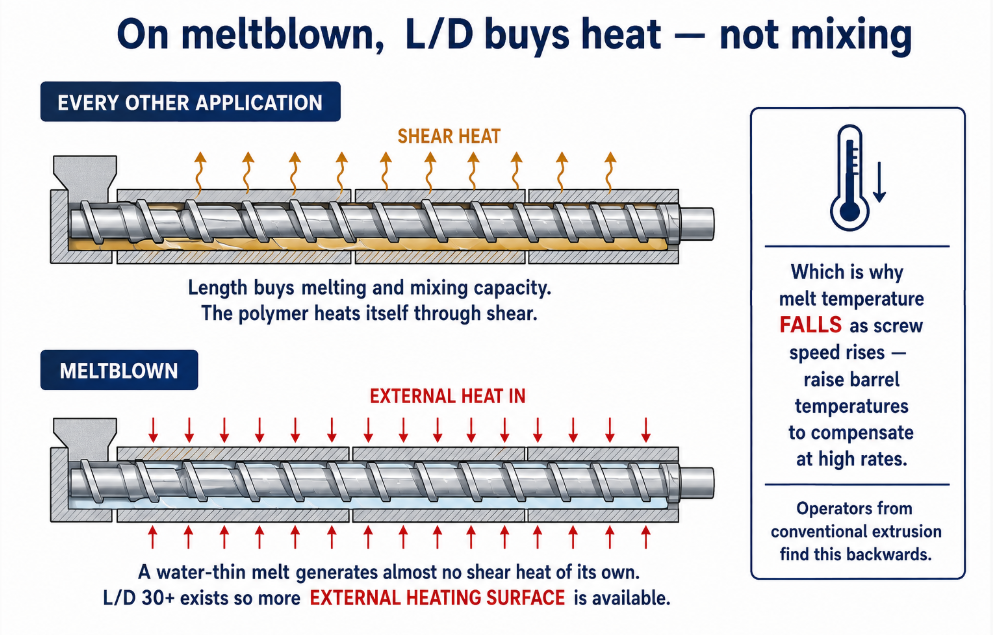
The L/D is long for heating, not mixing. This is the counter-intuitive one. Meltblown extruders run 30:1 L/D or more specifically so that more external heating surface is available — because a very low viscosity melt generates almost no shear heat of its own. On every other application L/D buys melting and mixing capacity; here it buys conducted heat.
Melt temperature falls as you speed up. For the same reason: with little shear heating, raising screw speed and output actually decreases melt temperature, so barrel temperatures must be raised to compensate at high rates. Operators coming from conventional extrusion find this backwards — they’re used to shear heat pushing melt temperature up with speed.
Stability at almost no back pressure is the hard part. A conventional screw relies on melt viscosity to build and hold pressure. At MFI 1000+, there is very little viscosity to work with, so pressure fluctuation translates directly into throughput fluctuation — and throughput per hole controls fiber diameter and shot formation. The screw must deliver an unwavering feed to the pump under conditions that give it almost nothing to push against.
The MFI window has both a floor and a ceiling. Above roughly MFI 2000 the nozzle back pressure becomes inadequate and spinning stability suffers; below about 100–150 the melt won’t attenuate into fine fibers. Meltblown lives inside a viscosity window, and the screw has to keep the melt there — which is why degradation control matters as much as melting.
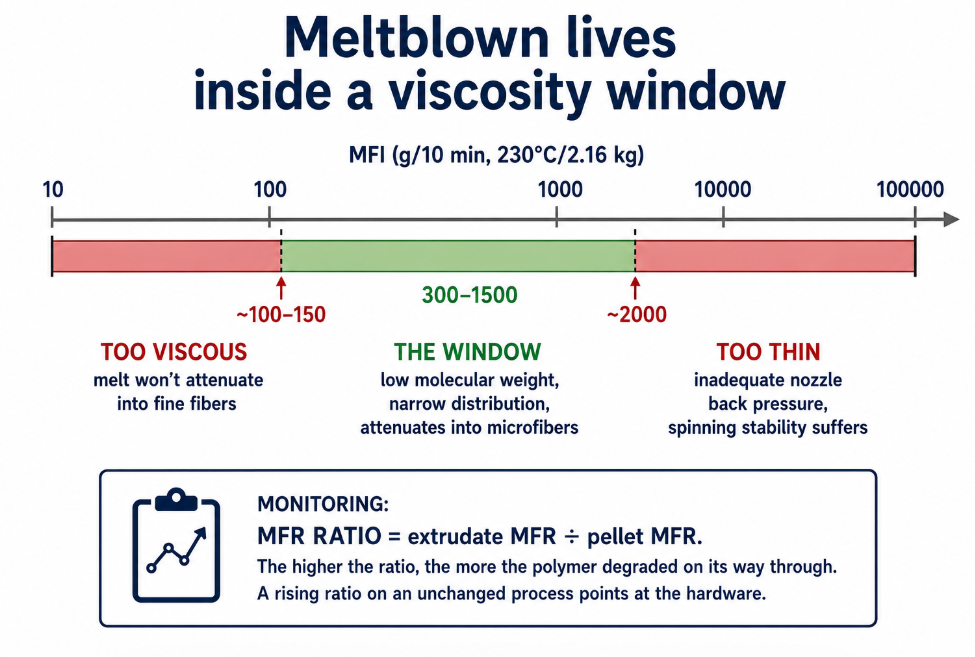
Watch the MFR ratio. Divide the extrudate’s MFR by the pellet’s MFR: the higher that ratio, the more the polymer degraded on its way through. It’s a direct, cheap measure of what your screw and process are doing to the resin — and a rising ratio on an unchanged process points at the hardware.
⚠️ One important note on “high-shear” meltblown resin production. Some producers deliberately use very high shear (single screws at 3600 rpm, barrels above 300°C) to thermally degrade standard-grade PP up to MFR above 1000 for meltblown use. That is a compounding process for making the resin — not how a meltblown fiber line should treat its feedstock. On the fiber line, degradation is the enemy, not the method.
Wear on Nonwoven Lines
Nonwoven duty looks gentle — unfilled PP, no glass fiber — and mostly it is. Two things change that:
- Additive masterbatches. Hydrophilic, antistatic, colour, and softness additives are standard, and some carry mineral content. Specify the wear surface for the actual recipe, not for “PP.”
- Continuous running. Spunbond and meltblown lines run for weeks at a time; even modest wear rates accumulate. Nitrided construction is often adequate, but high-utilization lines and additive-heavy recipes justify bimetallic construction.
And on both processes, wear shows up as product variation before it shows up as output loss — because clearance opening destabilizes the pressure the pump depends on. Check against the wear limit calculator at the first sign of drifting basis weight or rising shot count.
Symptoms and What They Point To
| Symptom | Likely cause |
|---|---|
| Shot (polymer droplets in the web) | Melt temperature too low, viscosity too high, or unstable throughput per hole |
| Fibers coarser than target | Melt temperature low, or throughput per hole too high |
| Basis weight varying across the width | Melt temperature/viscosity non-uniformity feeding the beam |
| Basis weight varying over time | Output instability — pressure fluctuation at the pump |
| Die pressure unstable (spunbond) | Resin temperature too low, or melting incomplete |
| Rising MFR ratio, unchanged process | Degradation increasing — check residence time, hot spots, and wear |
| Filament breaks on spunbond | Unmelts or gels; incomplete melting capacity |
| Melt temperature falling as output rises (meltblown) | Normal — raise barrel temperatures to compensate |
Spunbond and meltblown are a useful reminder that “PP nonwoven” is not one duty: one screw is asked to melt and homogenize at volume, the other to keep a nearly inviscid melt stable and inside a narrow viscosity window — and the length that helps the first do its job is, on the second, mostly just a longer heater.
At BLOOM, we build extruder screws and barrels for spunbond, meltblown, and SMS lines — barrier-and-mixing geometry for spunbond throughput, and long, gentle, stability-focused designs for meltblown’s low-viscosity duty. If your line is fighting shot, coarse fibers, basis-weight drift, or a rising MFR ratio, send our engineering team your resin MFI, throughput per hole, machine L/D, and temperature profile on WhatsApp and we’ll tell you whether it’s geometry, wear, or process. For the wider spinning picture, see our extruder screw for fiber spinning guide.
References and Further Reading
- US Patent 10,501,875 (USPTO) — meltblown resin MFR of 100–2000 g/10 min (preferably ≤1500 for adequate nozzle back pressure and high spinning stability), and extruder temperatures set 10–50°C above the resin’s melting point: https://image-ppubs.uspto.gov/dirsearch-public/print/downloadPdf/10501875
- Meltblown Technology (Dr. Ahmad Farag) — meltblown polymer requirements of MFI 300–1500 with low molecular weight and narrow distribution, meltblown extruders at 30+ L/D for greater external heating surface, and melt temperature decreasing as screw speed and output rise: https://www.linkedin.com/pulse/meltblown-technology-dr-ahmad-farag
- Controlled Degradation of Commercial Resin for Meltblown Nonwoven Fabric Sheet Production, NCBI PMC — deliberately shear-degrading standard PP to MFR above 1000 for meltblown use, at 3600 rpm and barrel temperatures above 300°C: https://www.ncbi.nlm.nih.gov/pmc/articles/PMC8619702/