
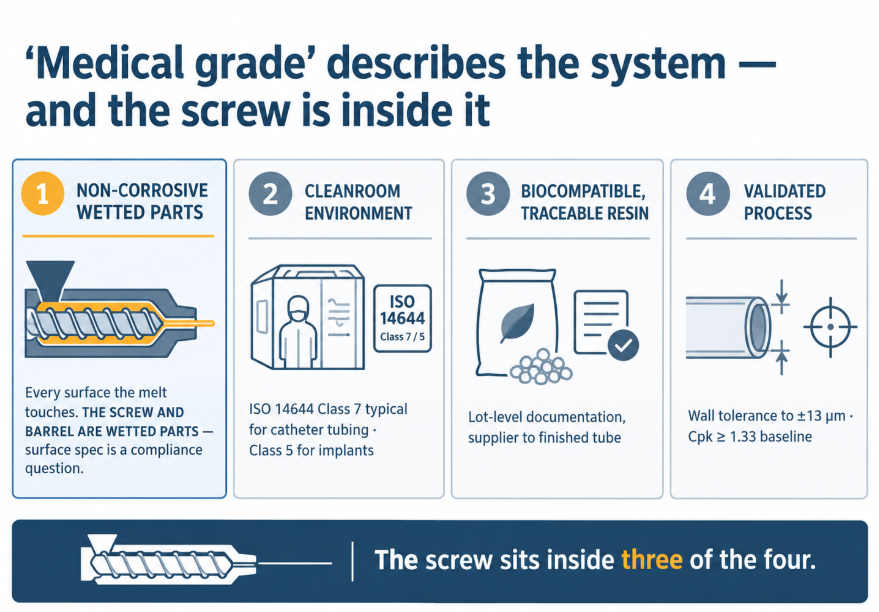
A medical extrusion line is defined by four constraints: non-corrosive wetted parts, a controlled cleanroom environment, biocompatible and traceable resin, and a validated process holding wall tolerances as tight as ±13 µm. The screw sits inside three of those four. Medical tubing runs at ODs from 0.38 mm with tolerances around ±0.01 mm and walls down to 0.06 mm, on materials ranging from soft TPU to PEEK — which means output stability, melt cleanliness, and documented material provenance matter more here than raw throughput ever will. This guide covers what medical duty demands of the hardware.
By the BLOOM Engineering Team
The Four Constraints — and Where the Screw Sits
| Constraint | What it means | Screw implication |
|---|---|---|
| Non-corrosive wetted parts | Every surface the melt touches must be stainless or otherwise non-corrosive | The screw and barrel are wetted parts — surface specification is a compliance question, not just a wear question |
| Cleanroom environment | ISO 14644 Class 7 typical for catheter tubing; Class 8 for some non-implant work; Class 5 for implants | Parts must arrive clean and suitably packaged; flow surfaces must not shed |
| Biocompatible, traceable resin | Lot-level documentation from resin supplier to finished tube | Nothing the screw adds may compromise it |
| Validated process | Wall tolerance to ±0.0005 in (13 µm); Cpk ≥ 1.33 as a baseline expectation | Output stability is the whole specification |
That first row is the one most buyers overlook when sourcing a screw. On a medical line the screw isn’t a machine component that happens to touch polymer — it’s a wetted part in a regulated process, and its material, surface treatment, and documentation are part of the line’s compliance story.
What ±13 µm Actually Demands
The tolerances published across the industry put the problem in perspective:
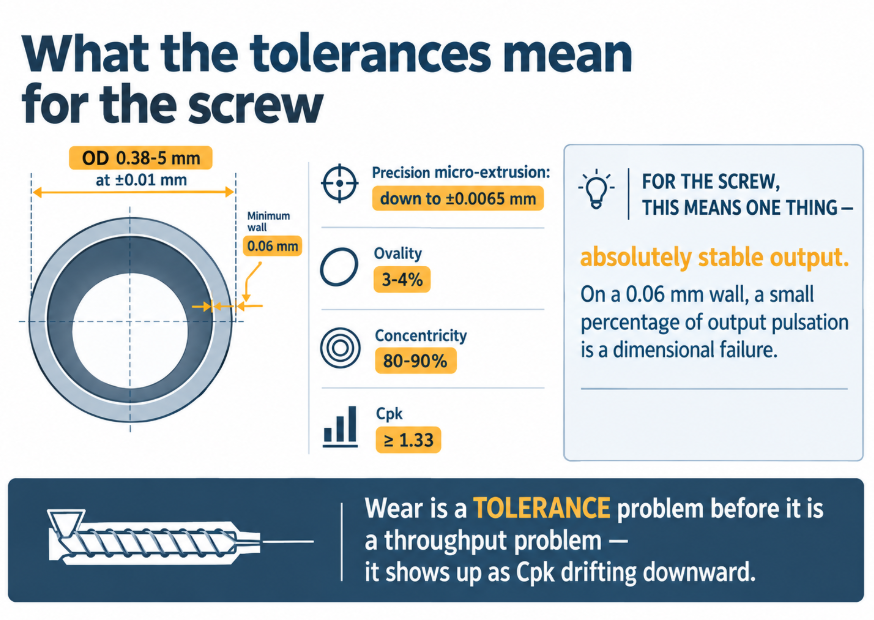
- OD from 0.38 mm to 5 mm at ±0.01 mm, walls down to 0.06 mm minimum
- Tolerances as tight as ±0.0065 mm on precision micro-extrusion
- Ovality 3–4%, concentricity 80–90%
- Cpk ≥ 1.33 as the baseline capability expectation
For the screw, all of that reduces to one requirement: absolutely stable output. On a 0.06 mm wall, a small percentage of output pulsation is a dimensional failure — the same mechanism as gauge variation in film, but with no room at all. Which means:
- Surging is not tolerable at any level — feeding and melting must be stable, not merely adequate.
- Melt temperature uniformity drives dimensional consistency — viscosity variation becomes diameter variation through a small die.
- Screw and barrel wear is a tolerance problem before it’s a throughput problem. Clearance opening destabilizes output long before it costs kilograms; on a medical line that shows up as Cpk drifting downward. Check against our wear limit calculator when capability starts sliding.
Medical Materials Are Not One Duty
The materials list spans nearly the whole polymer spectrum, and they ask for different screws:
| Material family | Typical use | Screw considerations |
|---|---|---|
| TPU, TPE | Flexible catheter shafts, pump tubing | Soft, tacky pellets — feed section design matters; low shear to protect properties |
| Pebax (PEBA) | Catheter shafts across a stiffness range | Processable, but grade-to-grade viscosity varies widely; melt uniformity governs |
| Nylon (PA) | Balloon and shaft tubing | Hygroscopic — see drying nylon |
| PEEK | High-performance shafts, structural | 350–400°C class — heat-stable metallurgy; see our PEEK screw specification |
| Fluoropolymers (FEP, PFA, PTFE-lined) | Lubricious liners, jackets | Corrosive — nickel-alloy melt path; see fluoropolymer screw and barrel |
| PVC, PE, PET | IV sets, drainage, general tubing | Conventional duties with medical cleanliness overlaid |
The practical consequence: a line that runs several of these families is compromising on most of them. Where volumes justify it, dedicated screws per material family outperform a universal screw — the same conclusion we reach on cable lines, and for the same reason.
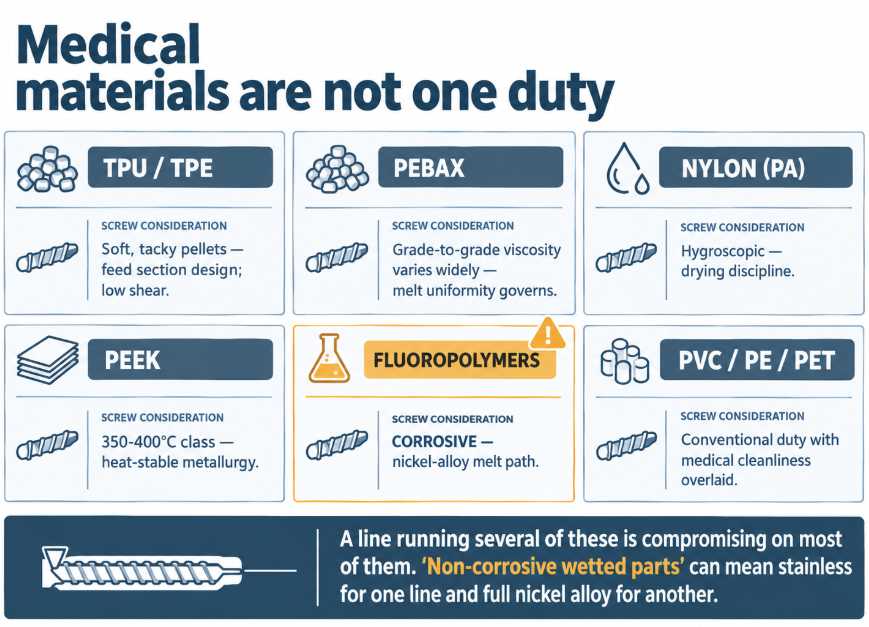
Note also that fluoropolymer work reintroduces a corrosion problem the rest of the medical materials don’t have — which is why “non-corrosive wetted parts” can mean stainless for one line and full nickel-alloy for another.
Micro-Extrusion: Small Screws, Different Problems
Catheter tubing runs on small extruders, and small screws behave differently:
- Thermal mass is low. Small barrels respond quickly to changes — good for control, unforgiving of disturbances. Barrel temperature hardware matters proportionally more; see our barrel temperature control guide.
- Residence time can be long relative to output. Running a small screw far below capacity means the polymer sits, which matters for heat-sensitive medical grades.
- Every dimensional error is proportionally larger. A clearance that would be trivial on a 90 mm screw is a significant fraction of a small screw’s channel depth — so manufacturing tolerance on the screw itself, and straightness (TIR), matter more, not less. See our acceptance inspection checklist.
- Multi-lumen and multilayer add extruders, not simplicity. Lines producing up to 24 lumens, up to three layers, and taper/bump profiles need every contributing extruder to behave consistently — matched screws across a coextrusion set.
Cleanliness: A Gel Is a Device Defect
In a catheter wall measured in tens of microns, a gel or a degraded particle isn’t a cosmetic flaw — it’s a weak point in a device that goes inside a patient. The requirements are the same ones we build to for battery separator and other zero-tolerance applications:
- Fully streamlined, radiused, mirror-polished flow surfaces — no unswept pockets where material can sit and degrade into black specks.
- Surfaces that don’t shed. Wear debris entering the melt is contamination in a regulated product.
- No corrosion pitting. Pits trap material, which degrades — and on fluoropolymer duty, corrosion is a live risk rather than a theoretical one.
- Clean handling and packaging for cleanroom transfer.
Documentation: The Part Medical Buyers Actually Check
Medical device manufacturing runs on traceability. Under ISO 13485 — now aligned into US regulation through the FDA’s QMSR update that integrates ISO 13485:2016 into 21 CFR Part 820 — lot-level documentation runs from raw material supplier to finished product. That expectation extends to the equipment in the wetted path.
What a screw supplier should be able to provide:
- Material certificates for the base steel and any surfacing alloy
- Hardness and case-depth reports
- Dimensional and straightness (TIR) inspection records
- Surface treatment specification — what was applied, how thick, verified how
- Consistent, documented manufacturing so a repeat order is genuinely the same part
A supplier who measures has these; one who doesn’t, can’t produce them after the fact. On a medical line that isn’t a nice-to-have — it’s what lets your own quality system trace the process.
On a medical extrusion line the screw is quietly inside the regulated envelope: a wetted part whose surface, stability, and provenance all end up in someone’s device history record — which is why the specification conversation should start with materials and documentation, not with throughput.
At BLOOM, we build extruder screws and barrels for medical tubing lines — corrosion-appropriate wetted surfaces (from stainless-class through nickel alloy for fluoropolymer duty), streamlined mirror-polished geometry, tight manufacturing tolerances for micro-extrusion, and full material, hardness, and dimensional documentation with every part. If you’re specifying a medical line or replacing screws where capability has drifted, send our engineering team your materials, tube dimensions and tolerances, extruder model, and documentation requirements on WhatsApp and we’ll quote against your specification — including the paperwork.
References and Further Reading
- Medical Grade Extruder: USP Class VI, FDA Compliance & Tubing Applications, UDTECH — the four defining constraints of a medical-grade extrusion system (non-corrosive wetted parts, ISO 14644 cleanroom, biocompatible traceable resin, validated process to ±0.0005 in wall tolerance), single- versus twin-screw suitability, and the FDA QMSR update integrating ISO 13485:2016 into 21 CFR Part 820: https://ud-machine.com/blog/medical-grade-extruder
- Medical Tubing Extrusion Service, CUUMed — published capability ranges: OD 0.38–5 mm at ±0.01 mm, minimum wall 0.06 mm, ovality 3–4%, concentricity 80–90%, ISO 13485 facility and Class 100,000 cleanroom: https://www.cathetermachine.com/Product/1051
- Medical Tubing Extrusion Technology: A Guide to Precision Manufacturing, jMedtech — cleanroom classes by application (ISO Class 7 typical for catheter tubing, Class 5 for implants), Cpk ≥ 1.33 as the baseline capability expectation, and lot-level traceability requirements: https://jmedtech.com/news/Medical-Tubing-Extrusion-Technology-A-Guide-to-Precision-Manufacturing.html


Pingback: TPU and Pebax Medical Tubing: The Right Screw