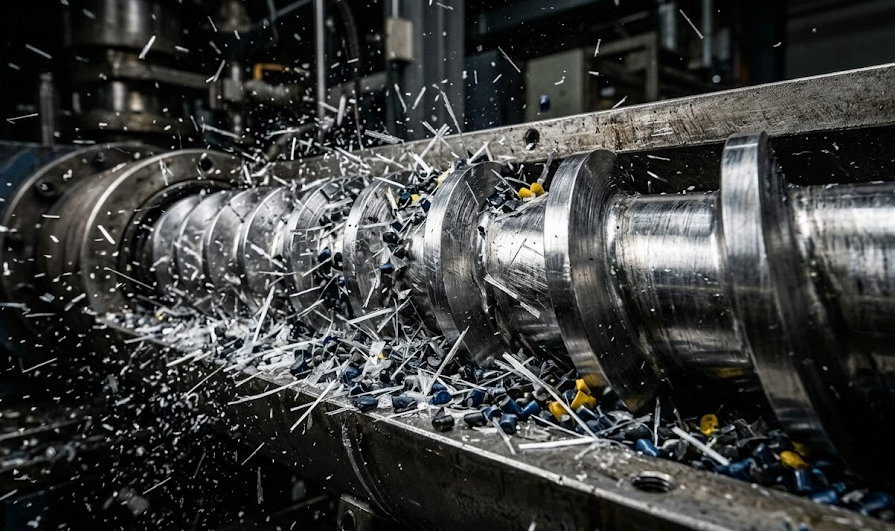
In the realm of plastic extrusion and injection molding, the screw and barrel are the core components that dictate production stability, product quality, and long-term operational costs. As plastic formulations become increasingly complex—incorporating high filler contents, glass fibers, flame retardants, and post-consumer recycled (PCR) materials—the issues of wear and corrosion on screw surfaces have become more severe than ever before.
Faced with a dazzling array of material options on the market, plant managers and engineers often find themselves in a dilemma: Should they opt for the economical 38CrMoAlA nitrided steel, invest in the longer-lasting bimetallic alloys, or pursue the ultimate wear resistance of through-hardened tool steel (Tool Steel / CPM)?
This article provides an in-depth analysis of these three mainstream screw materials from four dimensions: metallurgical principles, mechanical properties, suitable applications, and Total Cost of Ownership (TCO). Our goal is to help you make the most cost-effective decision for your production line.
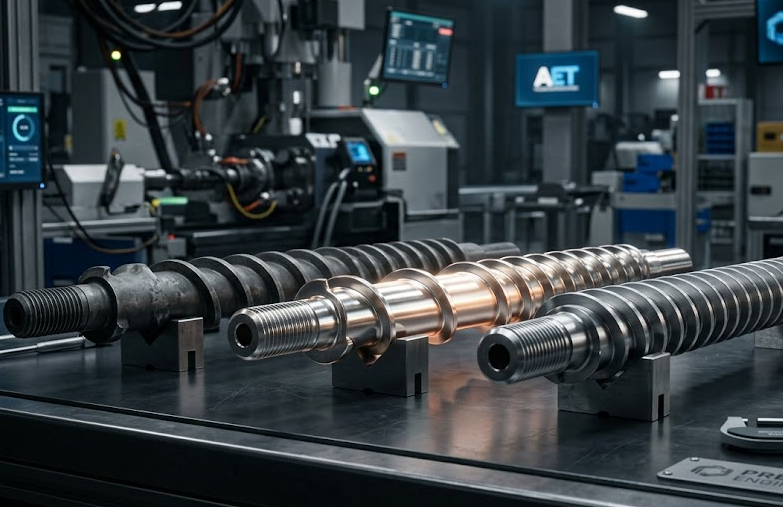
1. 38CrMoAlA Nitrided Steel: The Cornerstone of Industry Standards
38CrMoAlA is a high-quality alloy structural steel containing chromium (Cr), molybdenum (Mo), and aluminum (Al). It currently accounts for approximately 80% of the extrusion and injection screw market . Its core advantage lies in its exceptional nitriding performance.
Metallurgical Characteristics and Hardening Mechanism
During manufacturing, 38CrMoAlA steel first undergoes a quenching and tempering process, giving the core a tough hardness of 28-32 HRC. Subsequently, through gas or ion nitriding processes, nitrogen atoms diffuse into the steel surface and combine with the aluminum elements to form extremely hard aluminum nitrides . This process endows the screw surface with an exceptionally high hardness of HV 900-1020 (roughly equivalent to HRC 57-65) .
However, the limitation of nitriding lies in its very thin hardened layer, which is typically only 0.5-0.8 mm thick . This means that once this thin “armor” is worn through, the softer base material inside is rapidly exposed, and the wear rate accelerates exponentially.
Suitable Applications and Limitations
38CrMoAlA nitrided screws are highly suitable for processing general-purpose plastics with stable formulations and low abrasiveness, such as Polyethylene (PE), Polypropylene (PP), Polystyrene (PS), and standard ABS . Under these mild conditions, nitrided screws offer excellent dimensional stability and cost-effectiveness.
However, when faced with high proportions of calcium carbonate, glass fibers, or corrosive halogenated flame retardants, the weak resistance of the thin nitrided layer is exposed. Furthermore, because the hardened layer is integral to the base material, once wear exceeds the limit, it usually cannot be locally repaired and must be entirely scrapped and replaced .
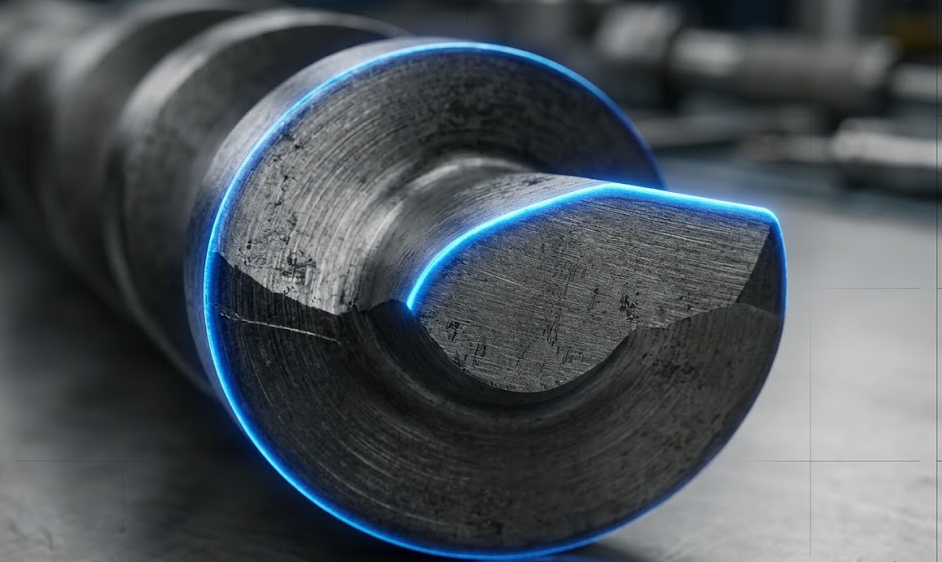
2. Bimetallic Alloys: The Weapon Against High Wear and Corrosion
To overcome the issue of the overly thin hardened layer in nitrided steel, bimetallic technology emerged. A bimetallic screw is not a single material but a composite structure: a thick layer of special hard alloy is applied to a tough alloy steel base (such as 4140) via centrifugal casting or PTA (Plasma Transferred Arc) welding .
Metallurgical Characteristics and Hardening Mechanism
The thickness of the bimetallic layer can typically reach 1.5-2.5 mm, which is more than three times that of a nitrided layer . This alloy is usually composed of nickel-based, cobalt-based, or iron-based materials, and tungsten carbide particles can be added as needed to further enhance wear resistance.
For example, the industry-renowned Colmonoy 56 is a nickel-based alloy with a hardness of HRC 50-55. It not only possesses excellent resistance to abrasive wear but also maintains superb corrosion resistance at high temperatures . This metallurgically bonded thick alloy layer allows bimetallic screws to significantly slow down the rate of bore enlargement when facing micro-cutting and particle erosion.Recycled plastics make bimetallic almost mandatory — recycled screw guide.
Suitable Applications and Limitations
Bimetallic screws are the ideal choice for processing highly abrasive and highly corrosive materials. They are widely used in Wood-Plastic Composites (WPC), Stone Plastic Composite (SPC) flooring, high-calcium PVC, glass-fiber reinforced engineering plastics, and complex post-consumer recycled (PCR) extrusion lines .
Under these harsh conditions, the lifespan of a bimetallic screw is typically 2 to 3 times that of a standard nitrided screw . Additionally, when the bimetallic layer reaches its wear limit, some screws and barrels can be repaired through re-welding or casting, thereby extending the life of the base material. The main limitation is the complex manufacturing process, which results in a significantly higher initial procurement cost compared to nitrided screws.
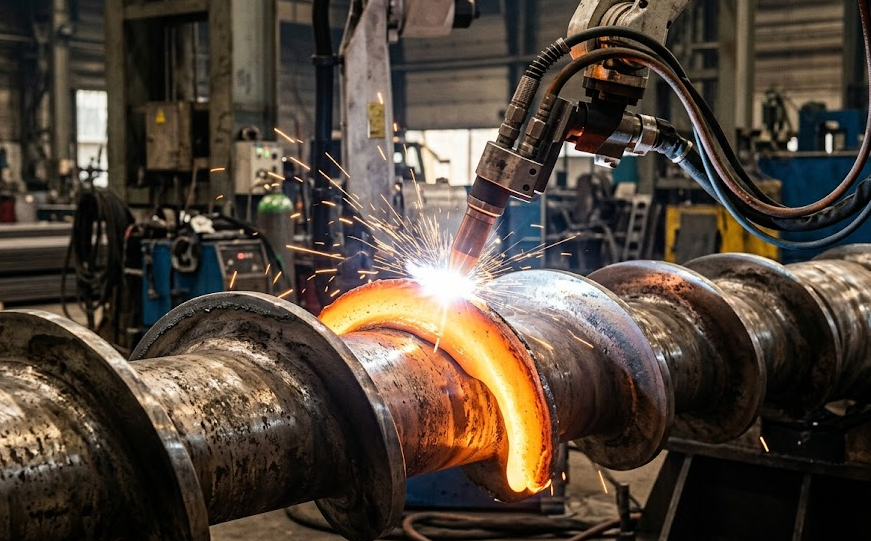
3. Through-Hardened Tool Steel (Tool Steel / CPM): The Ultimate Solution for Extreme Wear
When a production line needs to process extremely high proportions of glass fibers (e.g., 30%-50% glass-fiber reinforced PA/PBT) or extremely abrasive fillers, even bimetallic coatings may fall short. In such cases, through-hardened tool steel, particularly CPM (Crucible Particle Metallurgy) steel manufactured via powder metallurgy, becomes the ultimate solution.
Metallurgical Characteristics and Hardening Mechanism
Unlike the “surface hardening” of nitrided steel and the “coating hardening” of bimetallic materials, tool steel is through-hardened. This means that from the flight of the screw to the root, the entire component possesses the same extremely high wear resistance .
Traditional tool steels like D2 and H13 can achieve a hardness of HRC 58-62 through heat treatment. However, modern high-end screws tend to use the CPM series of materials. The CPM process utilizes Hot Isostatic Pressing (HIP) technology to press metal powders into dense steel ingots under extremely high temperatures and pressures, thereby achieving an extremely high density and uniformity of alloy carbides that traditional casting processes cannot match .
•CPM 10V: Contains extremely high vanadium and carbon, providing the highest wear resistance currently available in the powder metallurgy series, though its toughness is relatively lower .
•CPM 9V: Slightly reduces vanadium and carbon content, significantly improving toughness while maintaining extremely high wear resistance. It is currently the industry standard material for high-performance extrusion and injection screws .
•CPM S90V: A high-chromium tool steel whose wear resistance is comparable to CPM 9V, but it also possesses excellent corrosion resistance similar to 400 series stainless steel .
Suitable Applications and Limitations
Through-hardened tool steel screws are designed specifically for the most demanding conditions. Because hard fillers like glass fibers cause severe scouring and erosion at the root of the screw during extrusion, and bimetallic coatings typically only cover the top of the flights or the inner wall of the barrel, solid CPM screws provide irreplaceable protection for the screw root .
The limitation of this material is its extremely high cost—typically 3 to 4 times that of a nitrided screw—as well as its processing difficulty and longer delivery times. Furthermore, certain high-hardness CPM materials (like 10V) are relatively brittle and carry a risk of fracture when subjected to massive torque or unexpected impact.
Core Parameters and Performance Comparison
To intuitively demonstrate the differences between these three materials, we have compiled the following key parameter comparison matrix:
| Evaluation Dimension | 38CrMoAlA Nitrided Steel | Bimetallic | Through-Hardened Tool Steel (CPM 9V) |
| Hardening Structure | Surface nitrided layer | Metallurgically bonded alloy liner/coating | Solid through-hardened material |
| Hardened Layer Thickness | 0.5 – 0.8 mm | 1.5 – 2.5 mm | Throughout the entire part (No limit) |
| Surface Hardness | HV 900-1020 (~HRC 57-65) | HRC 58-65 (Depends on alloy) | HRC 54-58 (Maintained at high temps) |
| Abrasive Wear Resistance | Moderate | Excellent | Outstanding (Resists glass fiber scouring) |
| Chemical Corrosion Resistance | Fair | Good to Excellent | Excellent (Specific grades like S90V) |
| Base Toughness | Good | Good | Moderate (Requires protection from impact) |
| Repairability | Extremely difficult (Usually scrapped) | Can be re-welded/re-cast | Usually unrepairable |
| Relative Initial Cost | 1.0x (Baseline) | 1.8x – 2.5x | 3.0x – 4.5x |
| Typical Applications | PE, PP, PS, ABS (Pure resins) | WPC, SPC, High-calcium PVC, PCR | High-percentage glass-fiber reinforced plastics |
Total Cost of Ownership (TCO) and Decision Recommendations
When selecting a screw material, comparing only the initial purchase price often leads to a trap. The true basis for decision-making should be the Total Cost of Ownership (TCO).
Unexpected downtime caused by screw wear on a medium-to-large extrusion line can result in capacity losses of thousands to tens of thousands of dollars per day. Furthermore, the increased clearance caused by screw wear leads to melt backflow, increased shear heat, decreased output, and out-of-tolerance product dimensions. These hidden costs often far exceed the price difference of a high-end screw.
Engineer’s Selection Guide:
1.If you are processing pure resins or low-filler materials, and your formulation is stable long-term, the 38CrMoAlA nitrided screw is absolutely the most cost-effective choice. It guarantees stable production with the lowest initial investment.
2.If you are processing high-calcium PVC, Wood-Plastic Composites (WPC), Stone Plastic Composites (SPC), or recycled materials (PCR) containing numerous impurities, it is strongly recommended to upgrade to a bimetallic screw. Its thick alloy layer effectively resists abrasive cutting, extending the replacement cycle by 2 to 3 times and significantly reducing downtime frequency .
3.If you specialize in producing high-performance engineering plastics with over 30% glass fiber reinforcement, do not hesitate—choose through-hardened tool steel (e.g., CPM 9V) directly. Although the initial investment is substantial, it protects the screw root from severe erosion, and the resulting 4 to 5 times lifespan extension will quickly recoup the investment cost.
No single screw material is a panacea; perfect selection is built upon a precise balance of processed materials, process parameters, and economic benefits. As a professional custom extruder screw manufacturer, we deeply understand the decisive role of materials science in plastic processing.
Is your production line facing frequent screw wear or declining output?
Contact our engineering team today for a free wear assessment and a customized material upgrade plan. Let us use cutting-edge metallurgical technology to safeguard your extrusion production line.