Filament breaks have three families of cause — the spin pack and spinneret, the quench and downstream, and the melt arriving at the pump — and only the third is the screw’s. The fastest way to tell them apart is the pattern: breaks at one position point downstream of the pump; breaks across all positions, or drifting worse over months, point upstream at the melt and the screw. Once the pattern points upstream, there are only four things a screw actually does wrong: it leaves unmelts, it degrades the polymer, it lets material stagnate into gels, or it delivers unstable pressure to the pump. This guide is the diagnostic sequence — how to place the fault before you pull anything apart.
By the BLOOM Engineering Team
Step 1: Read the Pattern Before You Touch Anything
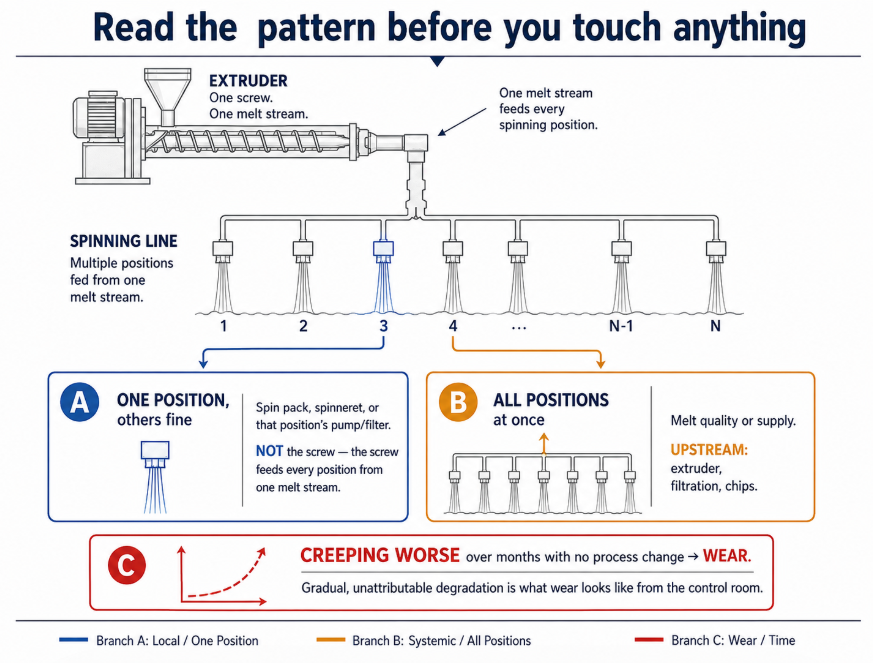
The distribution of breaks is the single most informative piece of evidence, and it’s free:
| Pattern | What it points to |
|---|---|
| One position, others fine | Spin pack, spinneret, or that position’s pump/filter — not the screw (the screw feeds all positions from one melt stream) |
| All positions, simultaneously | Melt quality or melt supply — upstream: extruder, filtration, chips |
| Breaks right after a pack change | Pack assembly, filtration, or air entrapment — not the screw |
| Worse at high throughput, better when slowed | Melting capacity or residence/shear balance — screw-related |
| Worse at low throughput | Residence time — the screw is oversized for the rate |
| Creeping worse over weeks/months, no process change | Wear — clearance destabilizing pump inlet pressure |
| Appeared after a chip lot change | Chip IV, moisture history, or contamination — not the screw |
| Appeared after ambient/season change | Drying and moisture handling |
Two of these deserve emphasis, because they’re the ones most often mis-assigned.
“All positions at once” is an upstream signature. A spinneret problem is local by nature. When every position degrades together, the common element is the melt stream — and the screw is the largest single influence on it.
“Slowly worse over months, nothing changed” is a wear signature. Nobody changed anything, which is exactly why it’s suspicious: gradual, unattributable degradation is what wear looks like from the control room.
Step 2: The Four Things a Screw Actually Does Wrong
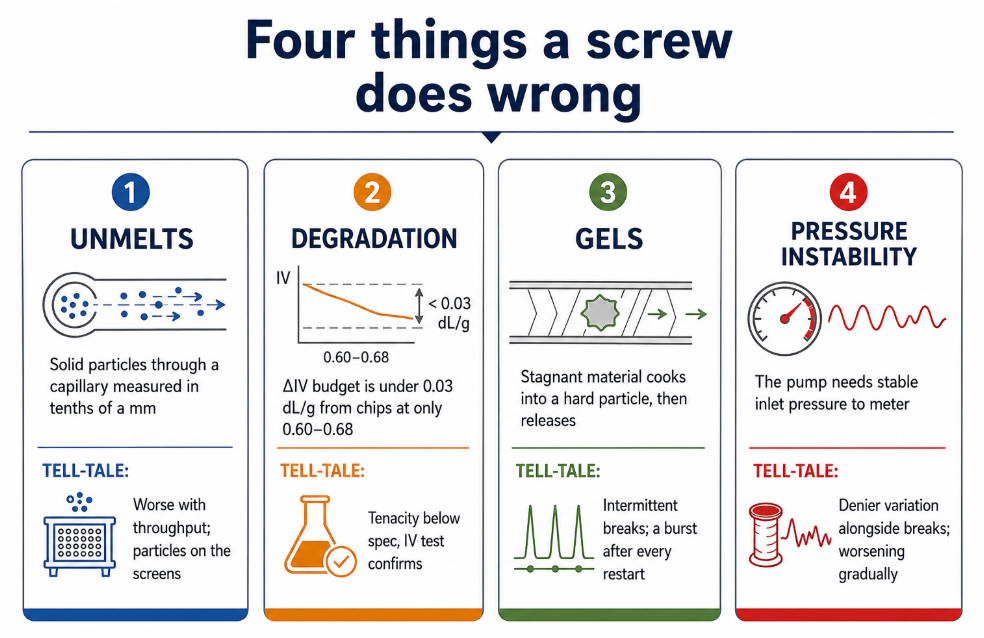
Once the pattern says upstream, the screw’s contribution narrows to four mechanisms:
1. Unmelts — incomplete melting
Solid or partially-melted polymer reaching the pack is a mechanical defect passing through a capillary measured in tenths of a millimetre. Causes: insufficient melting capacity for the throughput (L/D or compression ratio), a screw running far above its design rate, or a feed problem.
Tell-tale: breaks worsen with throughput; screen-pack pressure rises with visible particles on the screens.
2. Degradation — the polymer arrives weaker than it left the dryer
This is the IV problem, and in polyester it’s measurable: melt spinning tolerates roughly ΔIV < 0.03 dL/g, from chips that start at only 0.60–0.68. Melt above ~285°C, excessive residence time, or excessive shear spends that budget, and a filament spun from degraded polymer breaks because it is genuinely weaker — the full treatment is in PET filament spinning: designing the screw for IV retention.
Tell-tale: tenacity below spec, IV test confirms the loss, breaks accompanied by low mechanical properties rather than visible defects.
3. Gels — stagnation, not melting
Material caught in a dead spot doesn’t just degrade a little; it cooks until it’s a hard, cross-linked or carbonized particle, then releases into the melt stream. One gel is one broken filament or one blocked capillary. Sources: unswept corners, worn or scored surfaces, corrosion pits, and material left hot through a stop.
Tell-tale: intermittent breaks with no pattern in time; a burst of breaks after every restart (material sat hot through the stop); rising filter pressure between pack changes.
4. Pressure instability — the pump can’t fix what it isn’t given
A metering pump delivers a fixed volume per revolution, but it needs stable inlet pressure to do it. If the screw surges, the pump’s output — and therefore denier — fluctuates with it. Causes: feeding instability, melting instability, or worn clearance letting melt recirculate over the flights.
Tell-tale: denier variation alongside breaks; pressure trace at the pump inlet wandering; symptoms worsening gradually over months.
Step 3: The Two Questions That Separate Process From Hardware
Before pulling a screw, two checks resolve most cases:
Question 1 — Does changing temperature change anything? In documented melt-spinning trials, a screw with the wrong compression ratio (1.7 instead of 3.5–3.7) caused widespread filament breakage that ±5°C of barrel temperature adjustment could not remedy. That’s the cleanest test there is: if a ±5°C move in either direction changes nothing, the problem is geometry, not process — and no amount of further temperature work will find it.
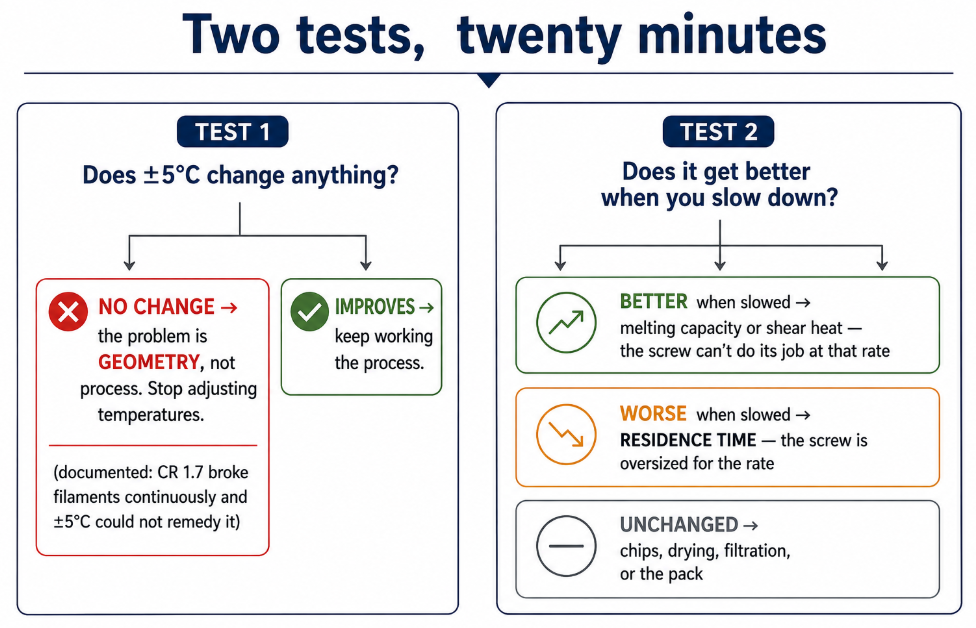
Question 2 — Does it get better when you slow down?
- Better when slowed → melting capacity or shear heat: the screw can’t do its job at that rate.
- Worse when slowed → residence time: the screw is too large for the rate, and the polymer is degrading while it waits.
- Unchanged → look at chips, drying, filtration, or the pack.
The general framework — the pump’s role, the ±2°C uniformity target, the four-zone temperature scheme — is in our extruder screw for fiber spinning guide.
Step 4: If It’s Wear
Wear deserves its own note because it produces the most confusing version of this problem: nothing changed, and everything slowly got worse.
Clearance opens
  → melt recirculates over the flight tips
     → pump inlet pressure less stable  → denier variation
     → more shear + longer effective residence  → IV loss → weaker filament
        → breakage rate creeps upward
Two things make it easy to miss. First, output barely moves at the start — a spinning line’s pump keeps delivering volume, so the loss shows up as quality long before anyone sees kilograms. Second, the abrasive agent is often unrecognised: TiO₂ delustrant in semi-dull and full-dull grades is a hard mineral, so fiber lines wear faster than “unfilled polymer” suggests.
Measure before you speculate — pull the screw, measure flight OD and barrel bore, and check them against the wear limit calculator and how much wear is acceptable. If the clearance has opened toward twice as-new, you’ve found your answer, and the fix is a rebuild or replacement — with the wear surface specified for your actual delustrant load this time.
The Diagnostic Sequence, in Order
- Read the break pattern — one position or all? (This alone eliminates half the possibilities.)
- Check what changed — chip lot, drying, ambient, maintenance, throughput.
- Test the temperature question — if ±5°C changes nothing, stop adjusting process.
- Test the throughput question — better or worse when slowed?
- Look at filter pressure history — rising between pack changes means gels or degradation upstream.
- Confirm with an IV test if tenacity is off — it separates degradation from mechanical defects.
- Measure the screw and barrel — especially if the pattern is “slowly worse, nothing changed.”
- Only then question the screw design — machine healthy, chips good, wear within limits, and it still breaks? The geometry was never right for the duty.
Most filament breakage is diagnosed backwards — starting with the screw because it’s the expensive suspect, or with temperatures because they’re the easy knob — when the break pattern, the throughput response, and a ±5°C test would have placed the fault in twenty minutes.
At BLOOM, we build extruder screws and barrels for filament, staple, and nonwoven lines — and we’ll help you work out whether the screw is actually your problem before you spend anything. If breaks are creeping upward or you can’t place the fault, send our engineering team your break pattern, throughput response, melt temperatures, chip IV, TiO₂ content, and any wear measurements on WhatsApp and we’ll tell you honestly what we think it is.
References and Further Reading
- US Patent 4,871,501 (USPTO) — melt-spinning trials in which a compression ratio of 3.5–3.7 spun continuously without broken filaments, while 1.7 caused widespread breakage that ±5°C of cylinder temperature adjustment could not remedy: https://image-ppubs.uspto.gov/dirsearch-public/print/downloadPdf/4871501
- Polyester Filament Spinning Production Line: FDY, POY & HOY Guide, Shengbang — hydrolytic degradation from insufficient drying reducing IV and causing filament breakage, poor tenacity and inconsistent denier: https://www.shengbang-machine.com/news/industry-news/polyester.html
- Polyester Fiber: Molecular Engineering, Performance Optimization and Industrial Applications, PatSnap Eureka — the ΔIV < 0.03 dL/g control limit in melt spinning and its link to fiber integrity: https://eureka.patsnap.com/materials/polyester-fiber-engineering