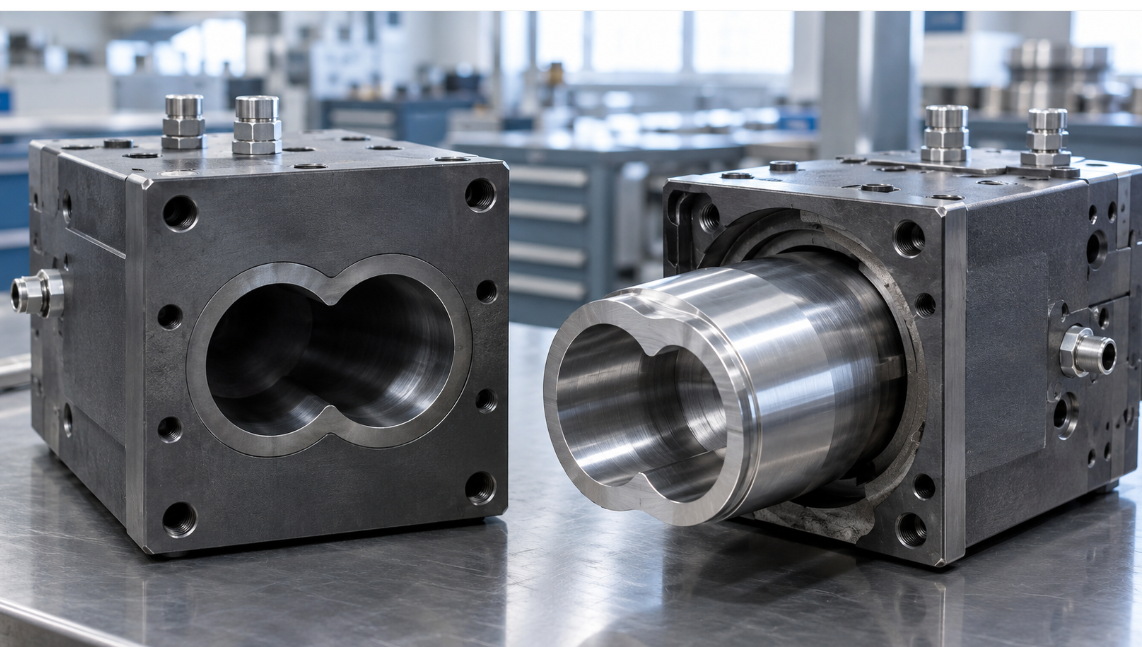
A solid twin screw barrel is one block of steel with the figure-8 bore hardened in place; a lined twin screw barrel is a steel housing with a replaceable wear liner fitted into it. Solid barrels cost less up front and suit unfilled, low-wear compounds. Lined barrels cost more at first, but they put a premium wear alloy only where the melt touches — and when the bore wears out, you replace the liner and keep the housing, with its heating, cooling, flanges and ports. As a rule of thumb, abrasive or corrosive compounds and long production runs favour lined barrels; unfilled resins, light duty and small lab machines favour solid ones.
By the BLOOM Engineering Team
This guide compares the two constructions on what actually decides the purchase: bore material, wear reserve, repair options, heat transfer and cost over the barrel’s life. It also explains why most production lines should not choose one construction for the whole barrel, but section by section.
Lined vs Solid Twin Screw Barrel: What Is Actually Different
A co-rotating twin screw barrel is built from sections, typically four to six diameters long, each heated and cooled on its own. Every section can be either construction:
- Solid barrel section. One forged or rolled steel block. The figure-8 bore is machined directly into it and then hardened — usually by nitriding a nitriding steel such as 38CrMoAlA, or by hardening a steel such as 42CrMo. Heating, cooling channels, flanges and ports are all in the same block, so when the bore is worn out, the whole section is.
- Lined barrel section. A housing in ordinary steel, plus a figure-8 liner (also called a sleeve or bushing) made of a wear-resistant or corrosion-resistant alloy. The housing carries the heating, cooling and mounting features; the liner carries the wear. When the liner is worn, it is removed and a new one fitted.
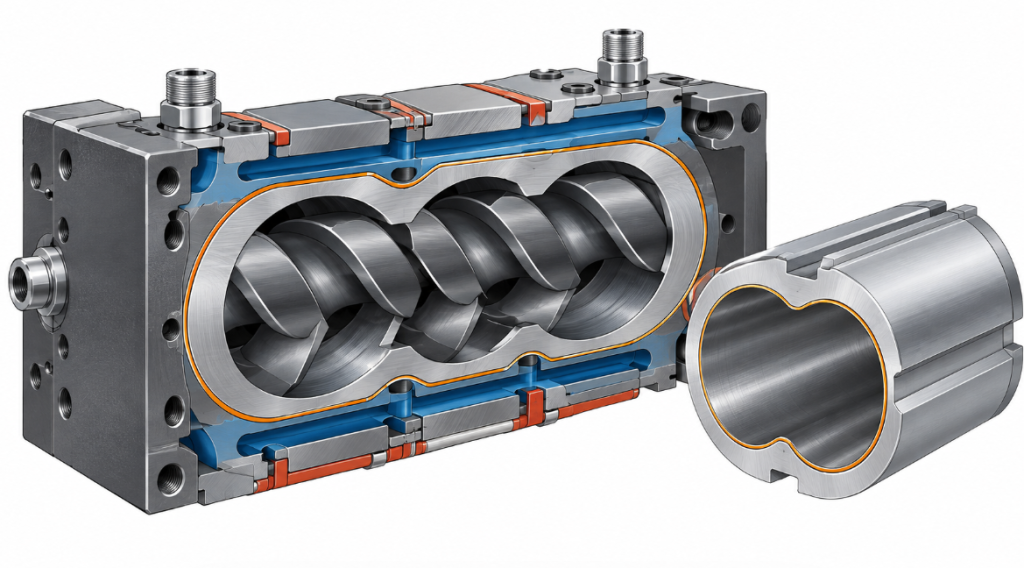
Engineers have been working on how to hold a hard liner in a twin bore for decades. Patents from the 1970s and 1980s describe liners set in place with a cast filler that let a worn sleeve be pressed out, and split liners clamped into the housing halves — both written to solve the same two problems: hard liner alloys are difficult to machine to tolerance, and a liner has to sit in exact alignment with the housing. Today the common approach is a liner press-fitted into the housing, which holds well but makes replacement a workshop job rather than a line-side one.
Lined vs Solid Twin Screw Barrel at a Glance
| Factor | Solid barrel section | Lined barrel section |
|---|---|---|
| Construction | One steel block; bore hardened in place | Steel housing plus replaceable figure-8 liner |
| Bore materials available | Limited to steels that can be nitrided or hardened as a whole block | Wide: spray-welded and bimetallic alloys, nickel- and cobalt-based alloys, powder-metallurgy tool steels, corrosion-resistant steels |
| Wear reserve | The hardened layer — a nitrided case is typically 0.5–0.7 mm deep | The full wear-alloy layer; our spray-welded layers are 1.5–2.5 mm |
| Upfront cost | Lower | Higher — two parts plus precision fitting |
| When the bore is worn | Replace the whole section | Replace the liner; keep the housing |
| Heat transfer | Direct from heater to bore | Through one extra interface; good with a correct fit |
| Corrosion resistance | Limited with nitrided steel | Can be specified for corrosive compounds |
| Best for | Unfilled resins, light duty, small sizes, sections that see little wear | Fillers, corrosive compounds, long runs, high-wear sections |
Why the Bore Material Decides Twin Screw Barrel Life
The construction does not wear out — the bore surface does. What a liner really buys you is freedom to choose the bore material, and that choice sets the service life.
In a solid nitrided barrel, the hard case is shallow. Our nitrided 38CrMoAlA parts carry a case about 0.5–0.7 mm deep at HV 950–1,000; once abrasive filler has worn through it, the softer steel underneath wears much faster. Making the whole block from a premium wear alloy instead is rarely economical, and fully lining a long barrel by hot isostatic pressing has been described in the patent literature as labour-intensive and costly. A separate liner solves this: the expensive alloy goes only where the melt touches.
| Bore option | Construction | Wear resistance | Corrosion resistance | Typical compounds |
|---|---|---|---|---|
| BLM01 (≈ grade 45 steel), 55–58 HRC | Solid | Basic | Low | Unfilled commodity resins, cost-sensitive lines |
| BLM02 (≈ 42CrMo), 60–62 HRC | Solid | Moderate | Low | General compounding with light filler loading |
| BLM03 (≈ 38CrMoAlA), nitrided | Solid | Good while the case lasts | Moderate | Unfilled polymers, mild corrosion |
| Spray-welded liner | Lined | High | Depends on alloy | Mineral-filled and fibre-filled compounds |
| BLM60 nickel-based liner, HRC 62–64 | Lined | High | High | Glass fibre plus flame retardants; wear plus corrosion |
| BLM6 cobalt alloy 6, HRC 40–45 | Lined | Moderate | Very high | Strong-acid and other corrosive service |
| Powder-metallurgy tool steel (e.g. CPM 10V type) | Lined | Very high | Low to moderate | Highly abrasive fillers |
| Corrosion-resistant stainless steels (e.g. AISI 440C type) | Lined | Moderate | High | Corrosive compounds with little abrasion |
One point applies to every option: corrosion-resistant alloys conduct heat less well than ordinary steels, which affects temperature control and is one reason the screw elements and barrel bore should be specified as a pair. For more on the alloys, see bimetallic vs nitrided barrel, nickel-base alloy extruder barrel and tungsten carbide screw and barrel. For how deep a nitrided case really is, see how thick is the nitrided layer.
The Cost of a Lined vs Solid Twin Screw Barrel Over Its Life
The purchase price is the smaller part of the decision. What matters is how many times the bore will wear out during the years you plan to run the line, and what each wear-out costs:
Solid section cost  = price of section × number of sections you will buy
                    + downtime cost × number of changes

Lined section cost  = price of lined section
                    + price of liner and fitting × number of liner changes
                    + downtime cost × number of changes
If a solid section will outlast your planning horizon, the second term is zero and the lower purchase price wins. If the bore wears out every year or two, a lined section replaces only the liner each time — and with a better alloy, it may need fewer changes in the first place. In practice the pattern looks like this:
| Compound | Bore wear rate | Solid section | Lined section | Usually cheaper |
|---|---|---|---|---|
| Unfilled PE, PP, PS | Slow | Often lasts the whole planning horizon | Pays for a liner you may never change | Solid |
| Moderate talc or calcium carbonate loading | Moderate | One or more section replacements | Liner changes instead of new sections | Close — run the numbers |
| Glass fibre, flame-retardant or heavily mineral-filled | Fast in melting and kneading zones | Repeated section replacements | Liner changes, and a harder alloy that lasts longer | Lined |
| PVC, fluoropolymers, halogen-containing compounds | Corrosion-driven | Nitrided steel is a poor match | Corrosion-resistant liner alloy | Lined |
To compare clearance and wear limits for your diameter, use our screw wear limit calculator, and for why fibre-filled compounds wear barrels so quickly, see why glass fiber reinforced plastic wears extruder screws fast.
Mix Them: Choosing Lined or Solid Section by Section
Twin screw barrel sections do not wear evenly. Wear concentrates where solids are still being melted, where fillers enter at a side feeder, and in the kneading zones; conveying sections further downstream often wear much more slowly. Because every section is a separate part, you do not have to make one choice for the whole barrel:
- Lined for the sections where fillers enter, the melting and kneading zones, and any section that has needed replacing before.
- Solid for low-wear sections such as downstream conveying zones on an unfilled or lightly filled compound.
- Replaceable port inserts at side feeders and vents, where abrasive material strikes the opening edges.
The way to find out which sections are which on your machine is to measure them — each lobe, in each section — as described in how to measure twin screw barrel wear. Our articles on the feed barrel, vent barrel, liquid injection barrel and discharge barrel explain what each section type faces.
When a Solid Twin Screw Barrel Is the Right Choice
A solid barrel is not the “cheap” option; it is the right option when the bore is unlikely to wear out before the line is rebuilt or retired:
- Unfilled or lightly filled resins — PE, PP and PS compounding without abrasive fillers.
- Low running hours — lines that run a shift a day, or seasonal production.
- Small lab and pilot extruders — where the housing is small and inexpensive, so reusing it saves little.
- Low-wear sections on any machine — as part of a mixed barrel.
- Tight first-cost budgets on non-abrasive work, where a nitrided BLM03 section gives good value.
When a Lined Twin Screw Barrel Pays Off
A lined barrel earns back its higher price when wear or corrosion is the real problem:
- Abrasive fillers — glass fibre, talc, calcium carbonate, mineral flame retardants and conductive or ceramic fillers.
- Corrosive compounds — PVC, fluoropolymers and halogen-containing flame-retardant systems, where nitrided steel is a poor match. See screw barrel for fluoropolymer extrusion.
- Long production runs — three-shift compounding where every unplanned barrel change costs output.
- Complex housings — sections with intricate cooling, side-feed or vent openings, which are expensive to make again from scratch.
This is also where our own liner work is focused. We moved our liner production from sintering to spray welding, and we rate our spray-welded liners at 3 to 5 times the service life of conventional sintered liners. In 2023 we completed development of a bimetallic liner for parallel twin screw extruders.
Replacing a Twin Screw Barrel Liner: What Happens and What Can Go Wrong
Because modern liners are press-fitted, replacing one is a workshop operation, not a line-side job. The usual sequence is:
- Measure first. Map wear lobe by lobe and section by section, so you only reline the sections that need it.
- Remove the worn liner and clean the housing seat.
- Inspect the housing for scoring, corrosion or distortion at the liner seat, and for the condition of cooling channels and flange faces. A damaged seat must be corrected before a new liner can be fitted.
- Fit the new liner to the specified interference, with port openings aligned to the housing.
- Finish the bore and verify the figure-8 geometry and center distance on a coordinate measuring machine, so the relined section lines up with its neighbours without steps at the joints.
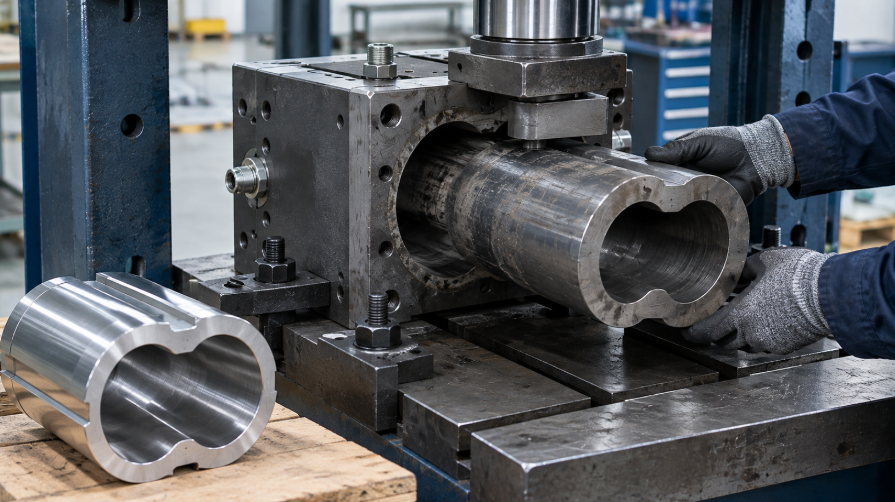
The risks are worth knowing before you order:
- A loose fit lets the liner move or rotate, and leaves gaps that slow heat transfer and can trap degraded material.
- Misaligned ports create ledges at side feeders, vents and injection points.
- Steps between sections — a relined section must match the bore of the sections on either side.
- Hard liner alloys are brittle; they must be handled and pressed carefully to avoid cracking.
For single-screw barrels, relining works differently — see extruder barrel repair vs replacement. For the heating side of the housing, see extruder barrel temperature control hardware.
What to Specify When Ordering a Lined or Solid Twin Screw Barrel
| Item | Why it matters |
|---|---|
| Extruder make and model, or barrel model | Sets the bore diameter, center distance and section interfaces |
| Bore diameter and center distance | The figure-8 geometry every section must match |
| Section length and position along the barrel | Sections are typically 4–6 diameters long; position decides duty |
| Section type | Closed, open, vent, side-feed or liquid-injection section |
| Flange, bolt pattern or tie-rod arrangement | Must mate with the neighbouring sections |
| Heating and cooling layout | Heater type and cooling channel positions in the housing |
| Bore material and hardness | Solid grade, or liner alloy and hardness |
| Liner fit and port inserts | Interference fit, port positions, replaceable inserts at openings |
| Compound and filler loading | Decides lined or solid, and which alloy |
| Records required | Material certificate, hardness report, dimensional (CMM) report |
We make standard barrel models from BLM-20 to BLM-135 and build to drawings for other machines. More detail is on our barrel body and liner sleeve pages.
Lined vs Solid Twin Screw Barrel FAQ
Can a solid barrel section be converted to a lined one?
Sometimes. The bore has to be machined out to make room for a liner, so it depends on the housing’s wall thickness and on where the cooling channels run. Send us the section drawing or dimensions and we can tell you whether it is practical.
How many times can a liner be replaced?
As many times as the housing seat stays sound. Each replacement starts with an inspection of the seat; if it is scored, corroded or distorted, it has to be corrected first, and eventually the housing itself is replaced.
Does a liner reduce heating and cooling performance?
It adds one interface between the heater and the melt. With a correct press fit and full contact the effect is small; a loose fit, or a low-conductivity corrosion-resistant alloy, slows the bore’s response to temperature changes. That is why the fit is checked, not assumed.
Can I mix lined and solid sections on one extruder?
Yes. Each section is a separate part, so lined sections can go where wear concentrates and solid sections elsewhere, as long as every section matches the figure-8 geometry of its neighbours.
Which construction is better for glass-fibre compounds?
Lined, at least for the sections where the fibre enters and is worked — the side-feed, melting and kneading sections — with an abrasion-resistant liner alloy. Downstream conveying sections can often stay solid.
Do you make both?
Yes. We make solid sections in BLM01, BLM02 and BLM03, and lined sections with spray-welded or bimetallic liners in alloys up to nickel-based BLM60 and cobalt-based BLM6. See our screw barrel manufacturer page for how we build barrels and matched screw sets.
In short, choose a solid section where the bore will outlast your planning horizon, a lined section where it will not — and decide section by section, not once for the whole barrel.
If you are replacing worn twin screw barrel sections or planning a new barrel for a filled or corrosive compound, send us your extruder model, section drawings or bore measurements, and the compound you run on WhatsApp. Our engineers will tell you which sections should be lined, which can stay solid, and which liner alloy fits your formulation.
References and Further Reading
- Russell, K. W. (2023, updated 2024). “How to Configure Your Twin-Screw Barrel Layout.” Plastics Technology. https://www.ptonline.com/articles/how-to-configure-your-twin-screw-barrel-layout
- Womer, T., & Spalding, M. (2023). “Troubleshooting Screw and Barrel Wear in Extrusion.” Plastics Technology. https://www.ptonline.com/articles/troubleshooting-screw-and-barrel-wear-in-extrusion
- Anderson, R. (2012). “How to Spec’ Screws & Barrels For Running Corrosive Materials.” Plastics Technology. https://www.ptonline.com/articles/how-to-spec-screws-barrels-for-running-corrosive-materials
- Seufert, W. (1975). Screw extruder housing with a wear-resistant lining. US Patent 3,900,188. https://patents.google.com/patent/US3900188A/en
- Scherping, C. K., & Parth, W. J. (1983). Split wear liner for twin bore barrel assembly. US Patent 4,385,876. https://patents.google.com/patent/US4385876A/en
- Dienst, M., & Aschemann, A. (1992). Wear-resistant housing for an extrusion device. US Patent 5,110,284. https://patents.google.com/patent/US5110284A/en
- Padmanabhan, B. (2015). Extruder barrel section with cooling and heating system. European Patent EP 2 368 690 B1. https://data.epo.org/publication-server/rest/v1.2/patents/EP2368690NWB1/document.html