
By the BLOOM Engineering Team
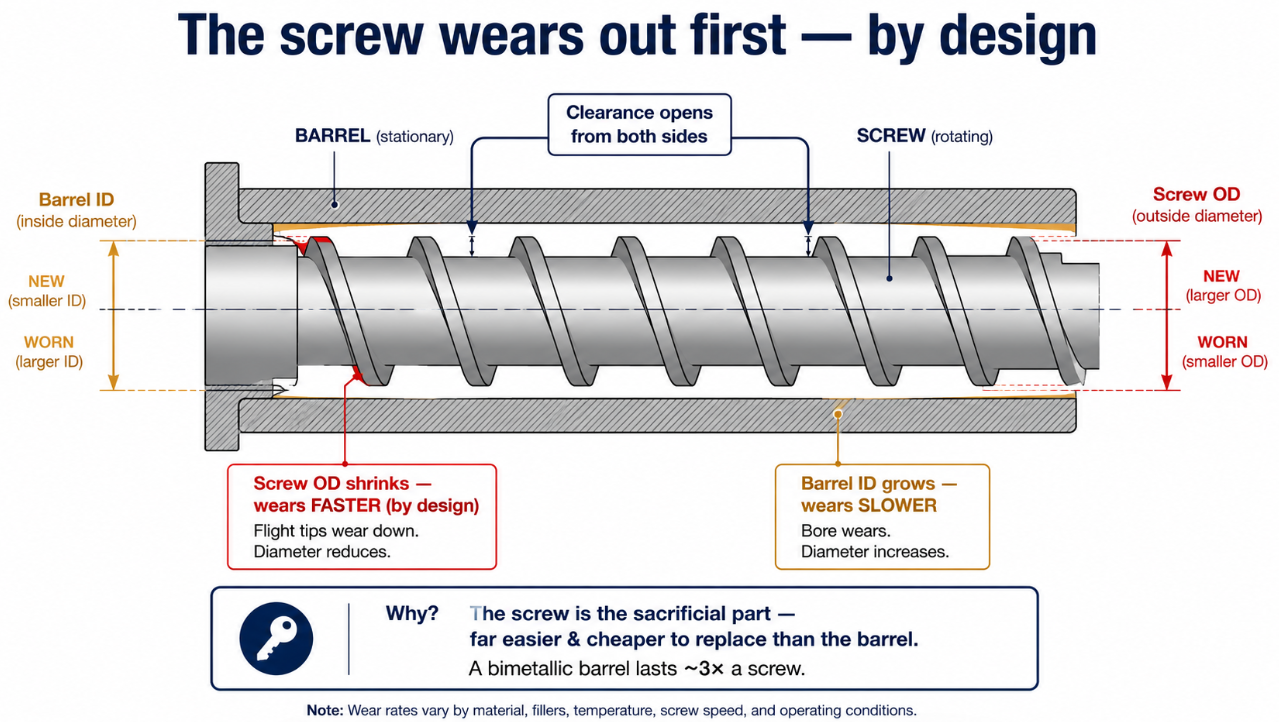
Quick answer: the screw is designed to wear out faster than the barrel — deliberately, because a screw is far easier and cheaper to replace than a barrel. Both wear at the same time (the screw’s outer diameter shrinks while the barrel’s bore grows, opening the clearance from both sides), but screws are engineered as the “sacrificial” part so that the more expensive barrel lasts longer. A bimetallic barrel typically lasts about three times as long as a screw. That said, you must measure both — because a new screw dropped into a worn barrel won’t restore performance. Here’s how it actually works.
Wear Happens to Both — From Both Sides
First, the reality: wear isn’t an either/or. As soon as the screw starts turning, it wears against the barrel, and the gap between them — the flight clearance — opens up from two directions at once:
- The screw’s outer diameter shrinks as the flight tips wear down.
- The barrel’s inner diameter grows as the bore wears out.
Both effects add up to a wider clearance, and clearance is what governs performance. Here are the hard numbers worth carrying away:
- As-new flight clearance ≈ screw diameter ÷ 1,000 per side (about 0.1% of diameter). For a 90 mm screw that’s roughly 0.09 mm per side; for a 120 mm screw about 0.12 mm.
- Replacement point ≈ 2× the as-new clearance. Once total clearance opens to roughly twice the original — for a 90 mm screw, when it reaches about 0.18–0.25 mm — melt leakage back over the flights becomes significant and output drops measurably.
- A practical red flag: output down 10–15% at the same screw speed, or measured clearance beyond about 0.1–0.15% of nominal diameter, means it’s time to assess repair or replacement.
Once clearance opens past about twice the as-new value, melt leaks back over the flights instead of being pumped forward, and output drops. So when people ask “which wears out,” the honest answer is “both, simultaneously” — but they don’t wear at the same rate, and that’s where the design comes in.
The Screw Is Designed to Wear Faster — On Purpose
Here’s the part that surprises people: the faster wear on the screw is intentional. The rate of wear on the screw is designed to occur faster than the wear on the barrel, for a simple practical reason — it is far easier and cheaper to replace a screw than a barrel (Davis-Standard: feedscrew and barrel maintenance).
Think about it from a maintenance standpoint:
- A screw can be pulled out and swapped in a day, especially if a spare is kept on hand.
- A barrel is a much bigger job — it’s the heavy structural tube the whole machine is built around, often requiring the extruder to be largely disassembled.
So screws are built to take the brunt of the wear and be replaced periodically, protecting the barrel as the longer-lived component. This is why a well-built bimetallic barrel typically lasts about three times the service life of a screw — the barrel’s hard liner is engineered to outlast several screws (Plastics Technology: troubleshooting screw and barrel wear).
That 3:1 ratio depends on the metallurgy, though. It assumes the barrel has a high-alloy bimetallic liner — typically a centrifugally-cast iron-based composite (nickel-, iron-chromium-, or tungsten-carbide-bearing) reaching about 950–1,100 HV — bonded into the steel base. Against that hard liner, an ordinary nitrided 38CrMoAlA screw (a ~0.5–0.8 mm case at HV 900–1,100) is the softer, faster-wearing part. And on highly abrasive work — 30%+ glass fiber, for instance — even a hard liner won’t save a plain nitrided screw, which can wear out in months. There, the screw’s flight tips themselves need hardfacing: Stellite (cobalt-based) or Colmonoy (nickel-based) weld overlay, or tungsten carbide, applied to the crests to match the liner’s wear resistance. The full alloy comparison is in our Stellite vs Colmonoy guide. For how long that actually is in years, see our guide on how long a bimetallic barrel lasts.
Where the Barrel Wears: The Transition Zone
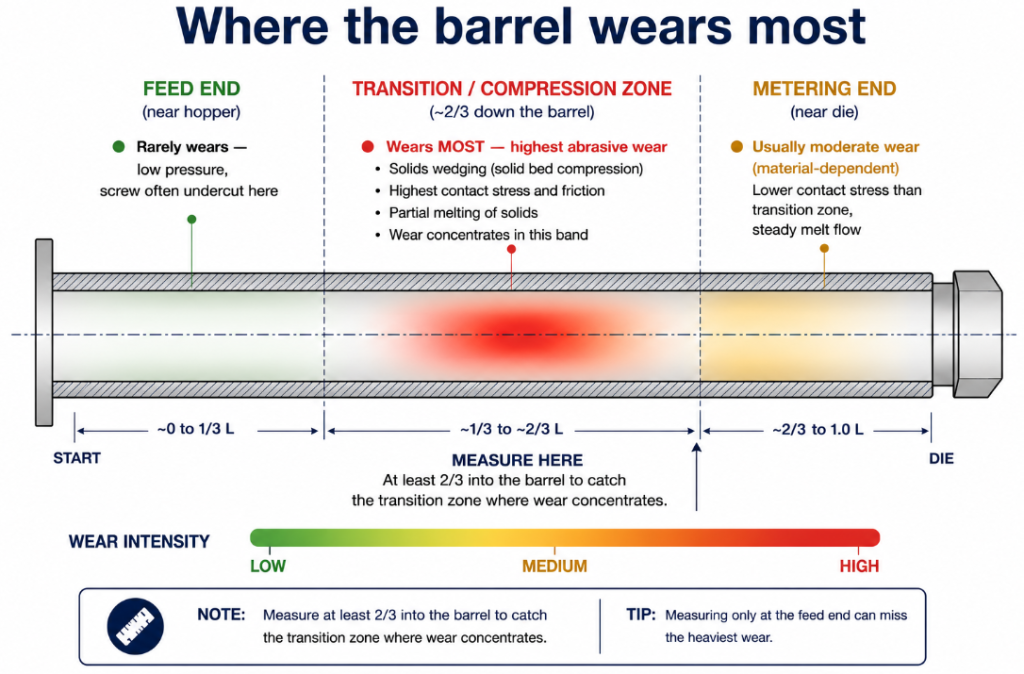
When the barrel does wear, it doesn’t wear evenly along its length — and knowing where helps you measure it. The heaviest barrel wear is usually in the transition (compression) zone, roughly two-thirds of the way down the barrel, where solid pellets are being compressed and melted and the pressure against the bore is highest.
A few patterns worth knowing:
- The feed end (near the hopper) rarely wears — there’s little pressure there, and many screws are deliberately undercut in the feed section anyway.
- The transition zone wears most — this is where solids wedge and pressure peaks, sometimes forcing the screw against one side of the bore (galling).
- Filled materials accelerate it everywhere — glass fiber and mineral fillers grind both parts faster, as covered in our guide on why glass-fiber-reinforced plastic wears screws fast.
This is why, when measuring a barrel, you check at least two-thirds of the way in to capture the transition area where wear concentrates.
Here’s how the two parts compare at a glance:
| Component | Primary wear zone | Measurement tool | Main root cause |
|---|---|---|---|
| Screw | Flight tips & push-flank OD | Outside micrometer (flight OD) | Solid-bed friction, glass-fiber abrasion, mechanical side load |
| Barrel (bimetallic) | Transition / compression zone (~2/3 down) | Bore gauge (barrel ID) | Peak melt pressure, solids wedging, galling |
Both are measured against the original drawing dimensions, and the clearance — the sum of the two — is what determines whether the machine still performs.
The Critical Point: Measure Both Before Replacing Either
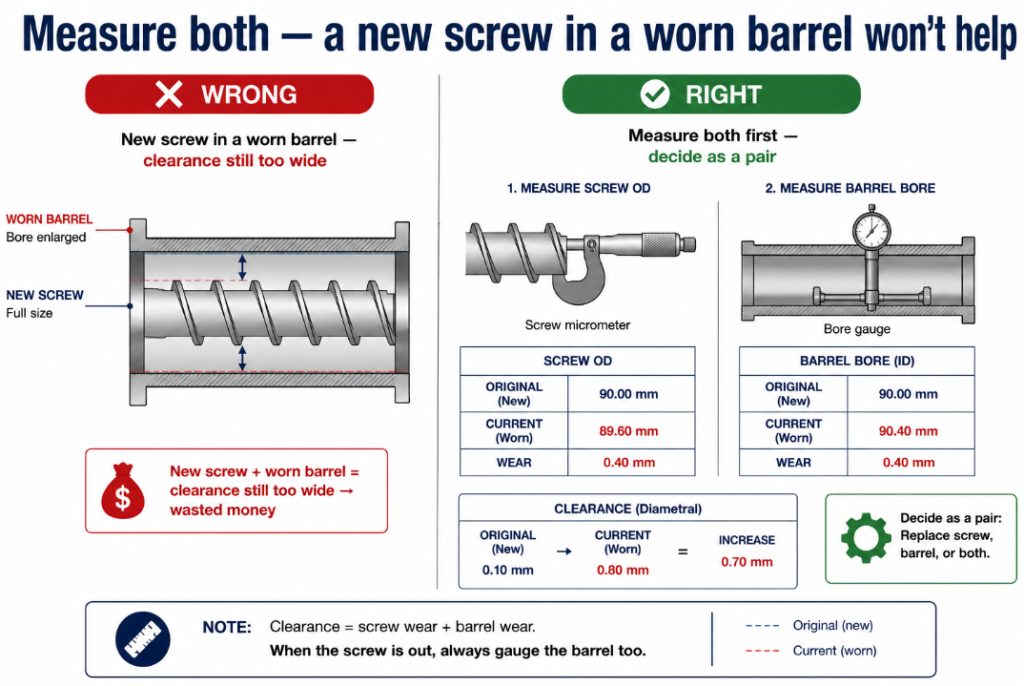
Here’s where the “screw wears first” rule has a costly trap. Because the screw wears faster, the instinct is to replace just the screw and move on. But the clearance is the sum of screw wear and barrel wear — so if the barrel has also worn, a brand-new screw in a worn barrel will not restore the clearance, and you’ll be disappointed with the result.
The rule we follow, and recommend:
- When the screw is out, always measure the barrel bore too. The screw being out is your one easy opportunity to gauge the barrel.
- Compare both to the original dimensions. Screw OD with a micrometer, barrel ID with a bore gauge, against the as-new drawing.
- Decide as a pair. If the barrel is still within spec, a new or rebuilt screw alone restores performance. If the barrel is also worn past its limit, you need to address both — a new screw alone is wasted money.
For the specific clearance limits and how to judge them, see our guide on how much screw wear is acceptable, and for the full measurement method, our screw and barrel wear analysis. Getting the screw out correctly to measure both is covered in how to remove an extruder screw from the barrel.
What This Means for Planning
The practical upshot of “screw wears first, barrel lasts longer” is a sensible maintenance strategy:
- Treat the screw as the part you’ll replace more often — keep a spare screw on hand so a worn one can be swapped without a long shutdown.
- Treat the barrel as the long-term component — protect it by catching screw wear early (a badly worn screw can accelerate barrel wear through galling) and by specifying a bimetallic barrel for abrasive work.
- Inspect on a schedule so you catch wear at “worn” (rebuildable) rather than “destroyed” (replacement plus lost production).
- Match the screw and barrel — they wear as a pair and perform as a pair, so a rebuilt screw should go back into a barrel that’s still in spec.
The “screw wears first” design is ultimately good news for your maintenance budget — it concentrates the wear on the cheaper, easier-to-replace part and protects the expensive barrel — but it only works in your favor if you measure both when the screw is out and replace based on the real clearance rather than assuming a fresh screw alone will fix a tired machine, because the screw and barrel always wear, and last, as a pair.
At BLOOM, we manufacture both extruder screws and bimetallic barrels, and we help customers measure and decide whether a worn machine needs a new screw, a barrel, or both. If your output is dropping and you’re not sure whether the screw, the barrel, or both have worn, send our engineering team your screw diameter, measured clearances, and what you process on WhatsApp and we’ll help you sort it out. For the complete wear picture, see our screw and barrel wear analysis.


Pingback: Screw Barrel Manufacturer: Barrels, Liners and Matched Screw Sets Built From Our Own Alloys