
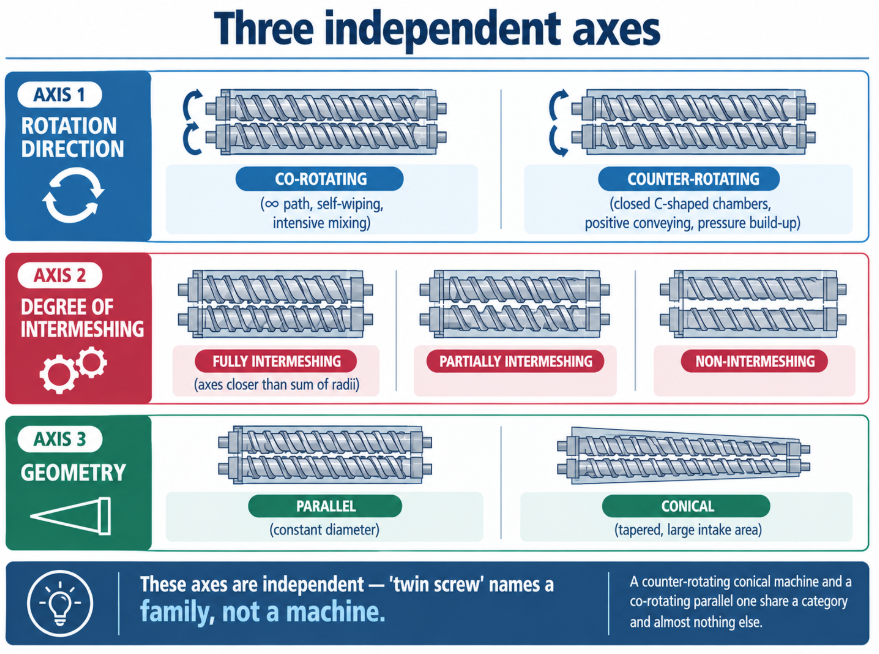
Twin screw extruders are classified along three independent axes — rotation direction (co-rotating or counter-rotating), degree of intermeshing (fully intermeshing, partially intermeshing, or non-intermeshing), and screw geometry (parallel or conical) — and the combination determines what the machine is good at. Co-rotating intermeshing machines dominate compounding because they mix intensively and are self-wiping; counter-rotating intermeshing machines dominate profile extrusion because they trap material in closed C-shaped chambers and build pressure positively. Those axes are independent, so “twin screw” describes a family, not a machine. This guide covers each axis, what the practical combinations are used for, and how the classification maps to the screws, barrels, and elements the machine actually runs on.
By the BLOOM Engineering Team
Axis 1: Rotation Direction
The single most consequential distinction.
| Co-rotating | Counter-rotating | |
|---|---|---|
| Screws turn | Same direction | Opposite directions |
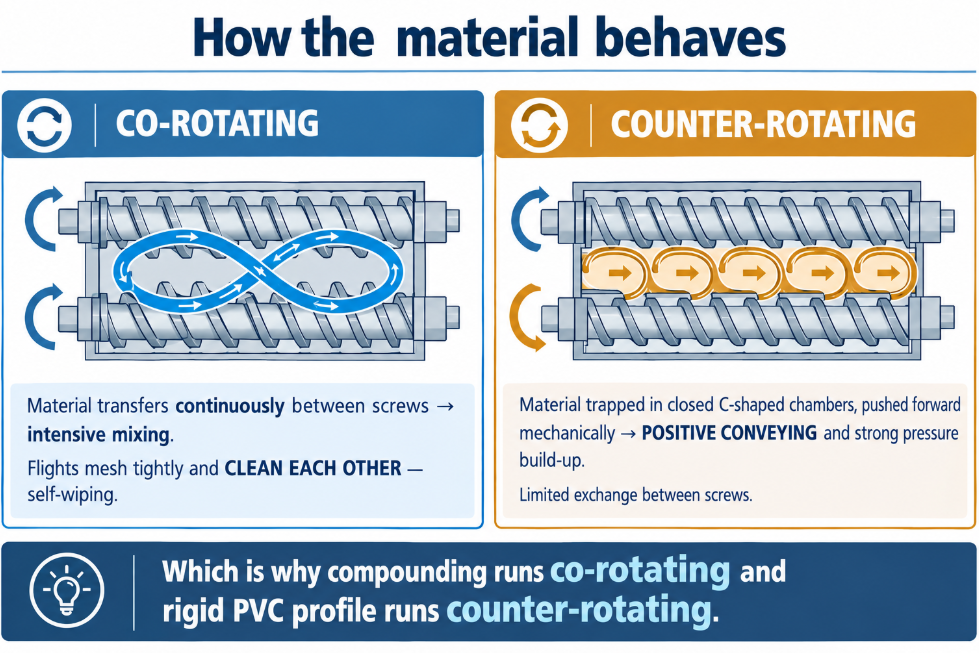
| Material behaviour | Follows a figure-of-eight (“∞”) path around both screws | Trapped in a series of closed C-shaped chambers moved axially |
| Core strength | Intensive mixing — distributive and dispersive | Positive conveying and pressure build-up |
| Self-cleaning | Yes — flights wipe each other (“self-wiping”) | Limited |
| Typical duty | Compounding, masterbatch, reactive extrusion, devolatilization | Profile and pipe extrusion, especially rigid PVC |
| Shear character | Configurable via elements | Higher shear in the nip; gentle overall conveying |
The C-chamber behaviour is what makes counter-rotating machines the forming choice: because the material is enclosed and pushed forward mechanically, output is positive and pressure generation is excellent — which is exactly what a profile die wants. The trade-off is mixing: material stays in its chamber, so there’s limited exchange between screws or along the machine.
Co-rotating machines invert both properties. Material transfers continuously between the screws, which is why they mix so well — and because the flights mesh tightly and clean each other, they self-wipe rather than letting material sit. That combination is why virtually all modern compounding runs co-rotating.
A newer variant worth knowing: differential-speed counter-rotating designs run the two screws at different speeds to introduce shear in the meshing zone and improve dispersion — an attempt to add mixing to the counter-rotating architecture without giving up its conveying character.
Axis 2: Degree of Intermeshing
| Type | Geometry | Character |
|---|---|---|
| Fully intermeshing | Distance between screw axes is less than the sum of the outer radii — flights engage tightly | Maximum mixing and positive conveying; self-wiping in co-rotating form |
| Partially intermeshing | Partial engagement | Intermediate |
| Non-intermeshing | Screws don’t engage; two adjacent single screws in a common bore | Long residence, gentle; used for devolatilization and some specialty duties |
Intermeshing is what gives twin screws their most useful practical advantage over single screws: positive conveying that handles hard-to-feed materials — powders, slippery resins, low-bulk-density flake — that a single screw struggles to grip. It also gives twin screws their characteristic short residence time with a narrow residence time distribution (RTD), which matters enormously for heat-sensitive materials and for reactive processes where every particle should see the same history.
Combined with Axis 1, four architectures exist — co-rotating intermeshing, co-rotating non-intermeshing, counter-rotating intermeshing, and counter-rotating non-intermeshing — of which co-rotating intermeshing is by far the most widely used, and counter-rotating intermeshing is the most common of the counter-rotating family.
Axis 3: Parallel vs Conical
| Parallel | Conical | |
|---|---|---|
| Screw form | Constant diameter along length | Tapered — larger at feed, smaller at discharge |
| Feed area | Standard | Large intake area, good for low-bulk-density feedstock |
| Torque | Distributed along length | High torque available at the feed end where it’s needed |
| Typical use | Compounding, general twin-screw duty | Rigid PVC pipe and profile, powder feedstock |
This axis is covered in depth — including which to choose and why — in our conical vs parallel twin screw extruders guide.
What the Combinations Are Actually Used For
| Application | Usual architecture | Why |
|---|---|---|
| Compounding, masterbatch, filled compounds | Co-rotating, fully intermeshing, parallel | Intensive mixing; modular elements; self-wiping — see our compounding guide |
| Rigid PVC pipe and profile | Counter-rotating, intermeshing (often conical) | Positive conveying, pressure build-up, gentle to a heat-sensitive resin — see our PVC screw and barrel guide |
| Reactive extrusion (grafting, polymerization) | Co-rotating intermeshing | Controlled residence time distribution; staged element configurations |
| Devolatilization | Co-rotating intermeshing, or non-intermeshing for gentle long-residence work | Vent sections and surface renewal — see when you need a vented screw |
| Battery electrode and electrolyte mixing | Co-rotating intermeshing | Precise shear control over abrasive powders — see our dry electrode and solid electrolyte pages |
| Recycling and devolatilizing dirty feedstock | Co-rotating intermeshing, vented | Handles variable bulk density and volatiles |
The Part That Matters More Than the Type: Configuration
A modern co-rotating machine is modular — processing elements are mounted on splined shafts so the extruder can be adapted to different processing requirements. That means two machines of identical type and size can behave completely differently depending on how their elements are arranged.
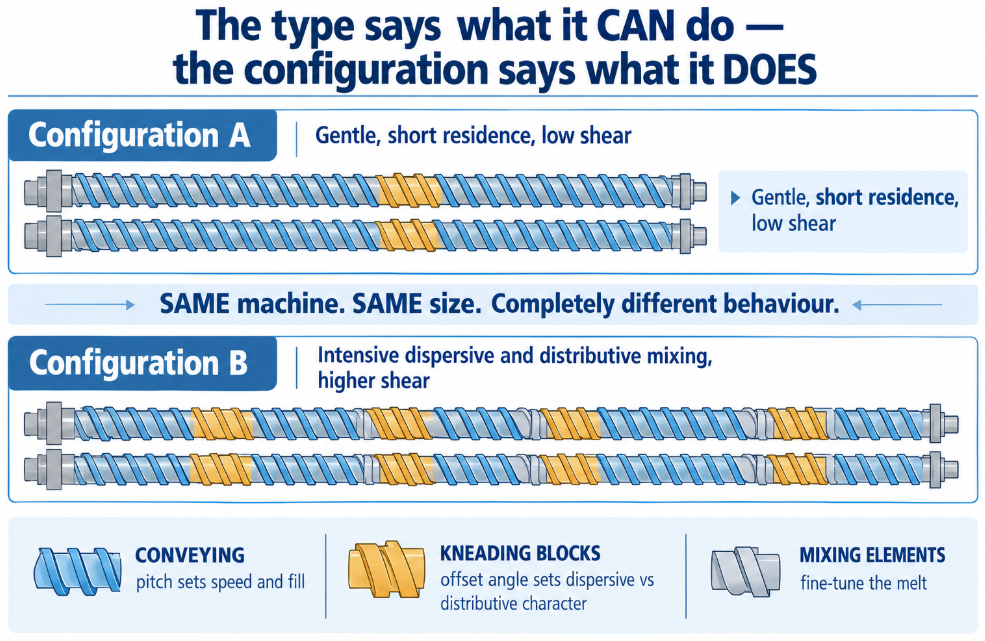
Practically, the classification tells you what a machine can do; the element configuration decides what it does:
- Conveying elements move material; pitch sets speed and fill.
- Kneading blocks provide mixing, with their offset angle determining dispersive versus distributive character.
- Mixing and specialty elements fine-tune the melt.
Because mixing in a co-rotating extruder divides into distributive (rearranging components without necessarily reducing particle size — high forces not required) and dispersive (breaking agglomerates with shear), and because element choice determines which you get, configuration is where twin-screw performance is actually decided. Our twin-screw elements guide and mixing section selection guide cover this in detail, and the process side is in our twin-screw extrusion process and configurations guide.
And If You’re Choosing Between Single and Twin
The classification above assumes twin is the right family. If that’s still open, the trade-off — simplicity and output versus mixing capability and feeding flexibility — is covered in our single screw vs twin screw extruders guide.
Frequently Asked Questions
1. What are the main types of twin screw extruders? They classify on three independent axes: rotation direction (co-rotating or counter-rotating), degree of intermeshing (fully intermeshing, partially intermeshing, or non-intermeshing), and screw geometry (parallel or conical). Combining the first two axes gives four architectures, of which co-rotating intermeshing is by far the most widely used.
2. What is the difference between co-rotating and counter-rotating twin screw extruders? Co-rotating screws turn in the same direction and move material in a figure-of-eight path between both screws, giving intensive mixing and a self-wiping action. Counter-rotating screws turn in opposite directions and trap material in closed C-shaped chambers, giving positive conveying and strong pressure build-up but limited mixing.
3. Which type is best for compounding? Co-rotating, fully intermeshing, parallel. It mixes intensively, accepts modular element configurations, and self-wipes rather than letting material stagnate — which is why virtually all modern compounding runs this architecture.
4. Which type is used for rigid PVC pipe and profile? Counter-rotating intermeshing, often conical. The closed C-chambers convey positively and build the pressure a profile die needs, while the overall conveying action stays gentle on a heat-sensitive resin.
5. What does “intermeshing” actually mean? On a fully intermeshing machine the distance between the screw axes is less than the sum of the outer radii, so the flights physically engage. Non-intermeshing machines have screws that don’t engage — effectively two adjacent single screws in a common bore.
6. What does “self-wiping” mean, and which type does it? Self-wiping (or self-cleaning) means the flights of the two screws clean each other as they mesh, leaving little opportunity for material to sit and degrade. It’s a property of closely intermeshing co-rotating machines.
7. Why do twin screws handle powders and slippery materials better than single screws? Intermeshing gives positive conveying — the material is moved mechanically rather than dragged by friction against the barrel. That’s what allows twin screws to feed powders, low-bulk-density flake, and slippery resins that a single screw struggles to grip.
8. What is residence time distribution (RTD), and why does it matter? RTD describes the spread of times different material elements spend in the machine. Twin screws give short residence times with a narrow distribution, meaning most material sees a similar thermal and shear history — critical for heat-sensitive polymers and for reactive extrusion, where consistency of history determines consistency of product.
9. What is a differential-speed counter-rotating twin screw? A counter-rotating design in which the two screws run at different speeds, introducing shear in the meshing zone to improve dispersion. It’s an attempt to add mixing capability to the counter-rotating architecture without giving up its positive conveying character.
10. Parallel or conical — how do I choose? Conical screws taper from a large feed end to a smaller discharge, which gives a large intake area for low-bulk-density feedstock and high torque where it’s needed. Parallel screws are the general-purpose choice, especially for compounding. The full comparison is in our conical vs parallel twin screw extruders guide.
11. Does the type of extruder determine performance? Only partly. The architecture sets what the machine can do; the element configuration on the shafts determines what it actually does. Two machines of identical type and size can behave completely differently depending on how their conveying elements, kneading blocks, and mixing elements are arranged.
12. What are kneading blocks and how do they change mixing? Kneading blocks are the elements that supply mixing work, and the offset angle between their lobes determines whether the mixing is primarily dispersive (breaking agglomerates with shear) or distributive (rearranging components without necessarily reducing particle size). See our twin-screw elements guide.
13. Do I need a twin screw at all, or will a single screw do? Single screws are simpler, cheaper, and excellent at high-output extrusion of one material. Twin screws earn their cost where you need mixing capability, difficult feeding, devolatilization, or reactive processing. The trade-off is covered in our single screw vs twin screw extruders guide.
14. Are twin screw elements interchangeable between machine brands? Generally no — element geometry, shaft splines, and dimensions are specific to the machine. Replacements are either built to the manufacturer’s drawings or reverse-measured from your existing elements, which is how most replacement sets are produced.
15. What wears out first on a twin screw extruder, and what does it cost me? The elements in the high-shear zones (kneading blocks especially) and the barrel bore. On filled or abrasive duty this happens faster than most operators expect, and the first symptom is usually product variation rather than lost output, because clearance opening destabilizes the process before it reduces throughput. Check your parts against our wear limit calculator.
“Twin screw extruder” names a family with at least four architectures and two geometries, and the differences between them are not subtle — a counter-rotating conical machine and a co-rotating parallel one share a category and almost nothing else — so the useful question is never “which twin screw is best” but “which architecture matches what I’m making, and how should its elements be configured.”
At BLOOM, we manufacture the wear parts these machines run on — twin-screw elements, screws, and barrels for co-rotating and counter-rotating machines, parallel and conical, in wear grades matched to your material. We’re not a machine builder; we’re who you come to when the elements are worn, the barrel bore has opened up, or you need a set matched to a configuration. Send our engineering team your machine make and model, screw diameter, element configuration or drawings, and what you process on WhatsApp, and we’ll quote reverse-engineered or drawing-built replacements with full material and dimensional documentation — see our screws and barrels pages, and our acceptance inspection checklist for what should arrive with them.
References and Further Reading
- US Patent 9,079,334 (USPTO) — twin screw extruders with intermeshing or non-intermeshing screws in co-rotating or counter-rotating designs, intermeshing screws giving improved feeding and positive conveying for hard-to-feed materials such as powders and slippery resins, and short residence times with narrow residence time distribution: https://image-ppubs.uspto.gov/dirsearch-public/print/downloadPdf/9079334
- US Patent 11,485,063 (USPTO) — counter-rotating twin screws enclosing material in independent C-shaped chambers pushed toward the outlet, giving good pressure-building ability for extrusion molding, and the differential-speed counter-rotating variant developed to strengthen dispersion in the meshing zone: https://image-ppubs.uspto.gov/dirsearch-public/print/downloadPdf/11485063
- US Patent 10,207,423 (USPTO) — modern co-rotating extruders built modularly with processing elements on screw shafts, tightly meshing flights making the screws self-wiping/self-cleaning, and the distributive versus dispersive mixing distinction: https://image-ppubs.uspto.gov/dirsearch-public/print/downloadPdf/10207423

Pingback: The Twin Screw Discharge Barrel: Where Pressure Costs You Heat and Wear