
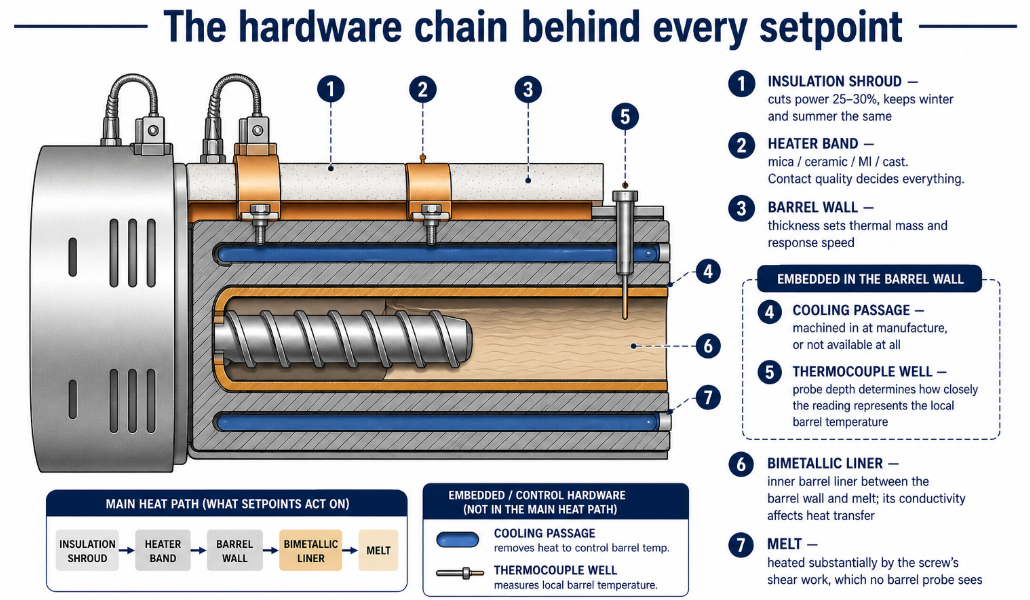
Extruder barrel temperature control is only as good as four pieces of hardware — the heater bands, the thermocouples and where they sit, the cooling system, and the barrel itself. Setpoints are the easy part; whether the steel actually reaches and holds that temperature depends on band type and contact quality, thermocouple immersion depth, cooling response, and the barrel’s own wall thickness and liner construction. Most “temperature problems” that operators chase with setpoint changes are hardware problems: a band making poor contact, a thermocouple reading the wrong thing, or a barrel whose thermal mass was never matched to the duty. This guide covers the hardware — what each part does, how to specify it, and why the barrel you buy determines the control you can achieve.
By the BLOOM Engineering Team
Heater Bands: Four Types, Different Jobs
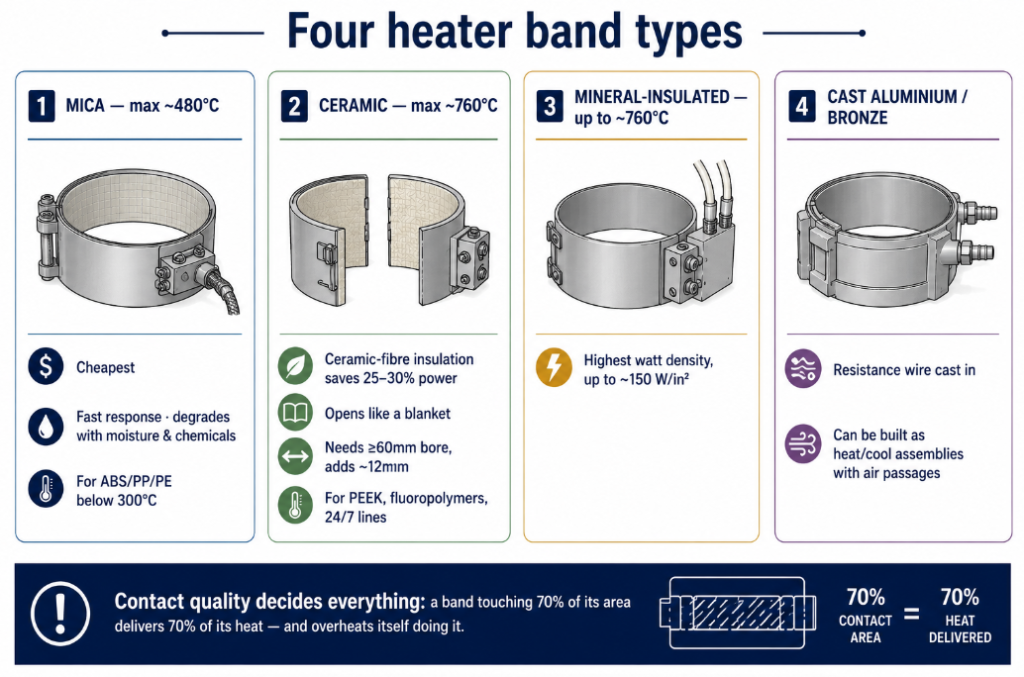
Nearly all extruder barrels are heated by electric bands clamped around the outside, and the insulation material inside the band sets its ceiling and its character:
| Band type | Max temperature | Character | Best for |
|---|---|---|---|
| Mica | ~480°C (900°F) | Cheapest, fast response, reasonably high watt density; degrades with moisture and chemicals, shorter life | ABS, PP, PE duty below ~300°C; short-cycle work; capex-constrained plants |
| Ceramic | ~760°C (1400°F) | Ceramic-fibre insulation cuts power consumption 25–30%; opens fully like a blanket for installation; needs ≥60 mm bore and adds ~12 mm thickness | PEEK, fluoropolymers, nylon; large barrels; 24/7 continuous lines |
| Mineral-insulated (MI) | up to ~760°C | Highest watt densities — up to ~150 W/in² | High-demand, high-temperature applications |
| Cast aluminium / bronze | Moderate | Resistance wire cast into a split cylinder; can be built as heat/cool assemblies with air passages | Lines needing integrated cooling in the same band |
Two practical points that matter more than the table:
Contact quality decides everything. A band transfers heat by conduction, so the barrel surface must be clean, round, and free of bumps and scale — a band that touches on 70% of its area delivers 70% of its heat and overheats itself doing it. Correct installation includes tightening the band, powering it to roughly half operating temperature (~175°C), cutting power, and re-tightening to take up thermal expansion. Bands installed once and never re-tightened are among the most common causes of a zone that “can’t reach setpoint.”
Insulation shrouds are not optional on high-temperature work. Ceramic-fibre insulating covers cut power consumption by roughly a quarter to a third — and just as importantly, they reduce the influence of ambient conditions, which is what makes a line behave the same in winter as in summer.
Thermocouples: The Part That Lies
The single most dangerous fault in barrel temperature control is not a dead heater — it’s a thermocouple that reports the wrong number, because the controller then confidently holds the barrel at the wrong temperature.
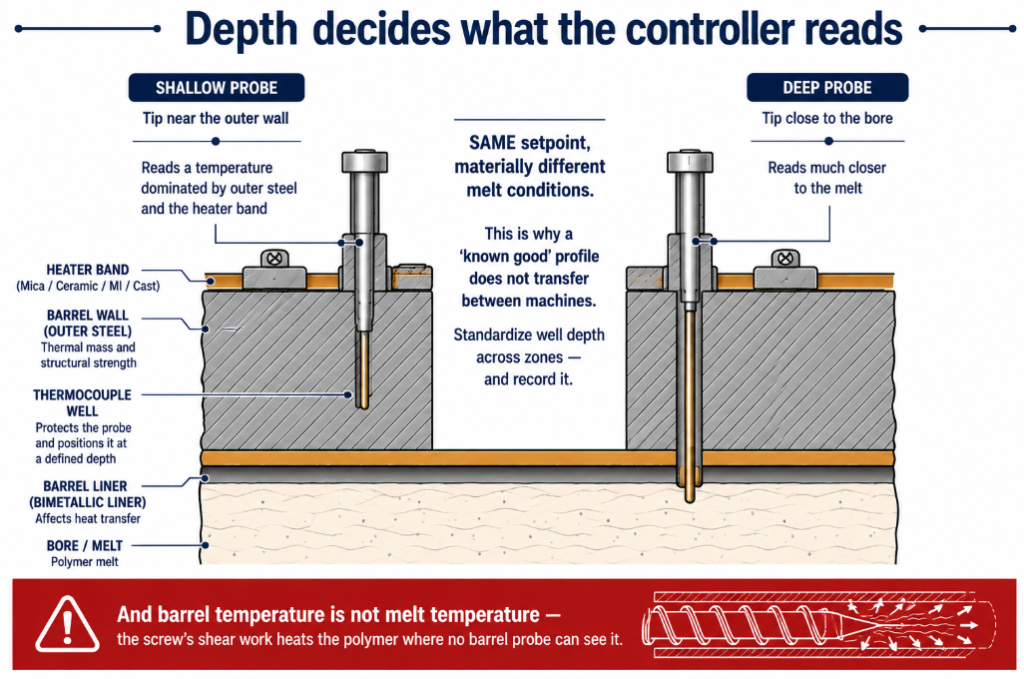
Two things determine what a thermocouple actually measures:
- Immersion depth. A shallow-mounted probe reads a temperature dominated by the barrel’s outer steel and the heater band; a deep-mounted probe reads closer to the bore. The same setpoint on differently-mounted probes gives materially different melt conditions — which is why a “known good” temperature profile doesn’t transfer between machines. Standardize probe depth across zones, and record it.
- Contact at the bottom of the well. A probe that isn’t seated properly, or a well packed with debris, reads slow and low. Spring-loaded probes exist for exactly this reason.
And the deeper truth: barrel temperature is not melt temperature. The thermocouple measures steel; the polymer is heated substantially by the screw’s own shear work, which no barrel probe sees directly. On high-shear conditions the melt can run far hotter than the barrel reads. That gap — and how to diagnose it — is covered in our extrusion process optimization guide; here the point is a hardware one: if you need to know melt temperature, you need a melt probe, not a better barrel setpoint.
Zoning: How Many, and Why
Zone count follows barrel size and process complexity: small extruders up to about 3 inches typically carry three or four heating/cooling zones, while larger machines run six or more. Twin-screw compounding barrels go much further — modular barrels are often segmented into 10–14 independently controlled sections on long L/D machines.
Two specification realities:
- More zones is not automatically better. Each zone adds a controller, a thermocouple, a failure mode, and a tuning job. Over-zoning a simple line buys complexity, not control.
- Zones are not equal. The feed and metering ends are the active ones; mid-barrel zones on many single-screw lines sit with cooling barely engaged, because that’s where shear heat is doing the work. A zone that is always at 100% duty, or always calling for cooling, is telling you something about the screw — not about the heater.
That second point connects to a theme worth stating plainly: chronic temperature compensation is usually a screw problem. If operators keep raising a zone far above the material’s normal profile just to keep the line stable, the honest diagnosis is often insufficient melting capacity — an L/D or screw-design shortfall, as covered in our L/D ratio guide and screw design guide. No heater upgrade fixes a screw that can’t melt the throughput.
Cooling: The Half Everyone Under-Specifies
Heating gets the attention, but on most production lines at rate, the screw’s shear work is putting more energy into the polymer than the heaters are — which makes cooling the active control element, not the heaters. Air cooling (blowers on finned zones) is simpler and lower-maintenance; liquid cooling (water or oil through barrel passages) removes heat far faster and holds tighter tolerance, at the cost of complexity and maintenance.
The specification questions that actually matter — response speed, zone independence, maintenance burden, and total cost — are covered in our barrel cooling systems guide. The hardware point here: cooling capacity has to be specified for the shear heat your screw generates at full rate, which means it’s a screw-and-barrel decision made together, not a bolt-on afterthought.
The Barrel Itself: The Variable Nobody Quotes
Here’s the part that belongs to us rather than to the heater supplier — and the part buyers rarely think about when comparing barrel quotes:
- Wall thickness sets thermal mass and response. A heavier barrel is more stable against disturbances but slower to respond and slower to heat up; a lighter one responds quickly but drifts more with ambient and load changes. Neither is “better” — it’s a match to the duty, and it’s fixed the day the barrel is made.
- The bimetallic liner changes heat transfer. A barrel is not homogeneous steel: the alloy liner and the steel backing have different thermal conductivities, and the liner sits exactly between the heater and the melt. Liner family and thickness are part of the thermal path — see how thick a bimetallic liner is and our bimetallic screw and barrel page.
- Cooling passages are machined in, or they aren’t. Whether a barrel can take liquid cooling — and how evenly it distributes it — is decided in manufacture. Retrofitting is expensive to impossible.
- Thermocouple well placement and depth are likewise built in. A barrel whose wells sit at inconsistent depths will never give a clean, transferable temperature profile, no matter what controller you buy.
- Surface condition under the bands matters for contact: a barrel with a scaled, scored, or out-of-round outer surface starves its own heaters.
The practical implication: when you specify a barrel, you are specifying the temperature control the line can achieve. Zone layout, cooling provision, well depth, wall thickness, and liner construction are all decisions made at manufacture, and they set the ceiling that heater bands and controllers work under.
Symptoms and What They Point To
| Symptom | Hardware to check first |
|---|---|
| Zone won’t reach setpoint | Band contact and tightness; failed band; poor surface under the band |
| Controller reads on-setpoint but product says otherwise | Thermocouple drift, wrong immersion depth, or bad seating |
| Zone overshoots repeatedly | Cooling response too slow, or controller tuning |
| Melt hotter than every barrel setpoint | Shear heat — a screw/geometry matter, not a heater matter |
| Zone permanently at 100% duty | Undersized heating, heavy heat loss (missing insulation), or a screw that isn’t melting |
| Zone permanently calling for cooling | Shear heat concentration — normal mid-barrel, suspicious elsewhere |
| Profile behaves differently winter vs summer | Missing or damaged insulation shrouds |
| Zone-to-zone results won’t transfer between machines | Inconsistent thermocouple well depth |
Barrel temperature control is a hardware chain — band, contact, probe, well, cooling, and the barrel’s own construction — and setpoints only command the part of that chain that’s physically able to respond, which is why a temperature problem that survives every setpoint change has almost always stopped being a temperature problem.
At BLOOM, we manufacture extruder barrels and screws with the thermal side specified deliberately — zone layout, thermocouple well depth and placement, cooling passage provision, wall thickness, and liner construction matched to your material and duty rather than copied from a generic drawing. If you’re specifying a new barrel, or fighting a zone that never behaves, send our engineering team your machine details, material, temperature profile, and the symptom on WhatsApp and we’ll tell you whether it’s the hardware, the barrel, or the screw.
References and Further Reading
- Extrusion — Pressure, Temperature, Heating and Cooling Control, Paulson Training Programs — barrel heater types (mica, ceramic, cast) and typical zone counts by extruder size: https://paulsontraining.com/extrusion-pressure-temperature-heating-cooling-control/
- Ceramic vs Mica Band Heaters: Technical Selection Guide, HT Heater — temperature ceilings, ceramic-fibre energy savings, minimum bore and added thickness for ceramic bands, and selection by process: https://www.ht-heater.com/ceramic-vs-mica-band-heater-guide/
- Mica Insulated Extruder Band Heaters, Eurolinia — installation practice: clean, true contact surface, and re-tightening after heating to ~175°C to take up thermal expansion: https://infra-heater.com/catalog/other-heaters/mica-band-heaters.html


Pingback: Foam Extrusion Screws: The Extruder That Cools