
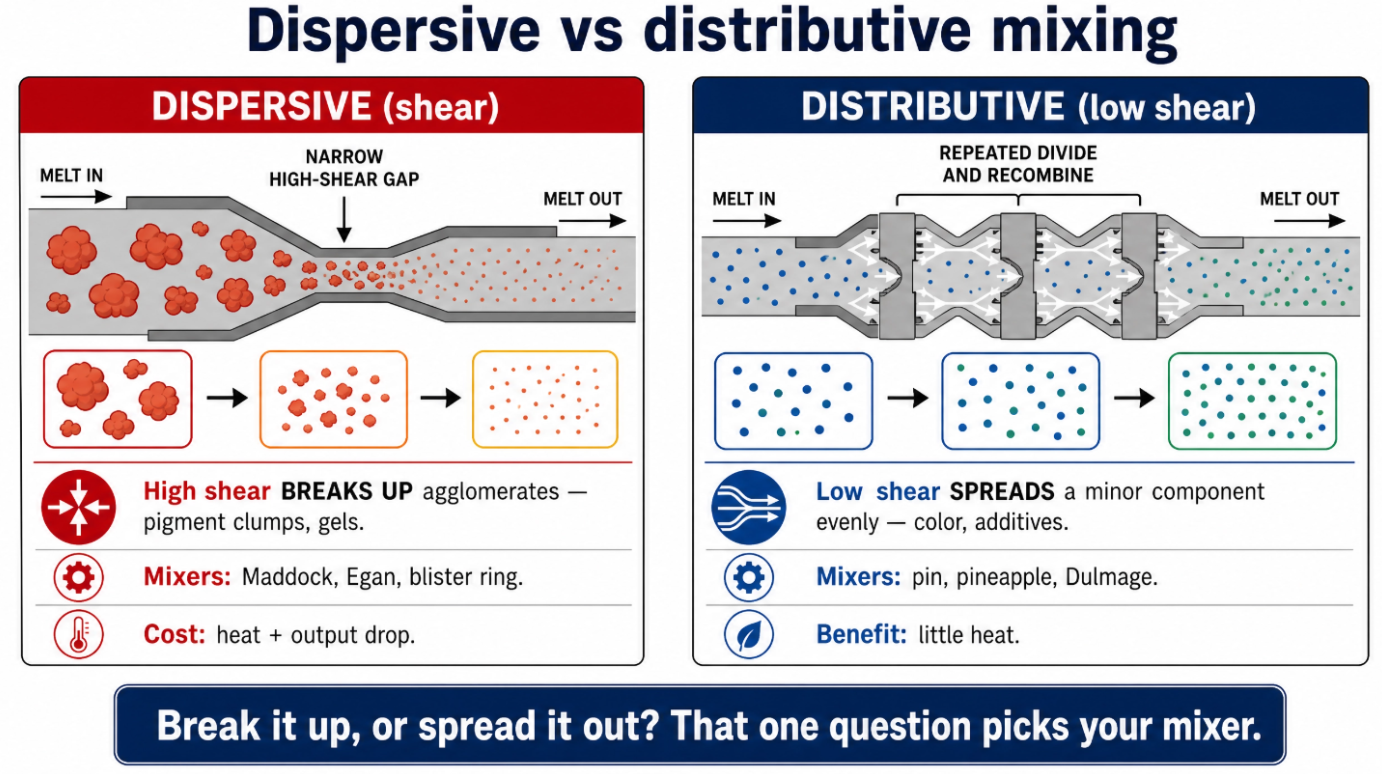
Quick answer: choose a mixing section by matching the mixer type to the job — dispersive mixers (Maddock, Egan, blister ring) use high shear to break up agglomerates like pigment clumps and gels, while distributive mixers (pin, pineapple, Dulmage) use low shear to spread an additive evenly through the melt. Get it backward and you cause problems: a Maddock on a shear-sensitive material overheats it, and a pin mixer on a hard-to-disperse pigment leaves it clumped. The one distinction that governs the whole decision is dispersive versus distributive — break-it-up versus spread-it-out. Here’s what each common mixer does, how to pick, and the trade-offs each one costs you. This is the deep dive on mixing sections; for where they sit among screw types overall, see our extruder screw types guide.
By the BLOOM Engineering Team
The One Distinction That Governs Everything: Dispersive vs Distributive
Every mixing decision starts here, because it maps directly to your problem:
- Dispersive (shear) mixing forces the melt through a narrow, high-shear gap that physically breaks apart agglomerates — pigment clumps, filler aggregates, unmelted gel, cross-linked particles. If your problem is lumps that need breaking, you need dispersive. The cost: high shear means more heat and usually a pressure/output penalty.
- Distributive mixing repeatedly divides and recombines the melt stream to spread a minor component evenly — color, additives, a second polymer — without high shear. If your problem is uneven distribution (streaks, poor homogeneity), you need distributive. The benefit: much less shear heat, so it suits shear-sensitive materials.
Every real mixer does some of both, but each is primarily one or the other, and matching that primary action to your actual problem is the whole game. As the industry puts it, most of the time a distributive mixer is the better choice for homogenizing temperature, color, or additives with minimal added melt temperature — dispersive is reserved for when you specifically need to shear particles apart.
The Common Mixing Sections
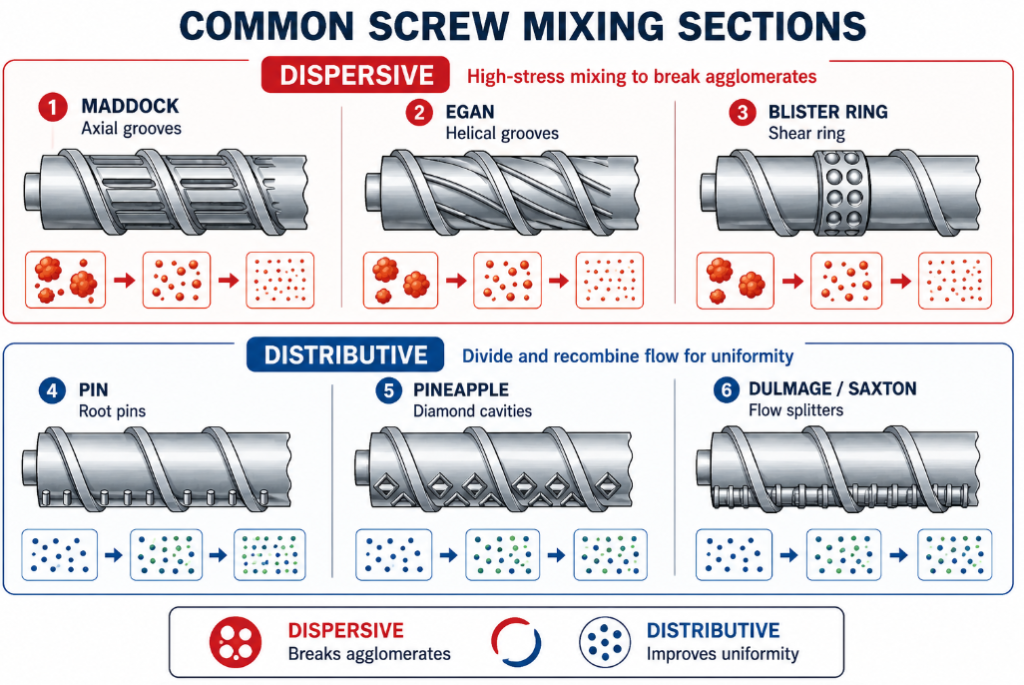
| Mixer | Type | Best at | Trade-off |
|---|---|---|---|
| Maddock (Union Carbide) | Dispersive | Breaking pigment clumps & gels; acts as a melting check (nothing unmelted passes) | High shear heat; notable output/pressure drop; constant-depth grooves can stagnate — poor for heat-sensitive resins |
| Egan / Leroy | Dispersive | Same shear mixing as Maddock, helically arranged | Tapered helical channels reduce stagnation and consume less pressure than Maddock — less output loss |
| Blister ring | Dispersive | Simple full-melt shear barrier; also a melt seal | Large pressure drop → significant output reduction |
| Pin | Distributive | Spreading additives/color with low shear; simple, robust | Less aggressive; won’t break hard agglomerates |
| Pineapple (slotted/diamond) | Distributive | Chaotic dividing/recombining — very good for adding color | Moderate shear; distributive only |
| Dulmage / Saxton | Distributive | Many narrow channels divided and recombined repeatedly — strong homogenizing | Distributive only; won’t disperse |
The pattern is consistent: dispersive mixers sit close to the barrel to create a high-shear gap; distributive mixers use many small features (pins, slots, channels) on the screw root to reroute the flow. That physical difference is why one shears and the other doesn’t.
How to Choose: Match the Mixer to the Problem
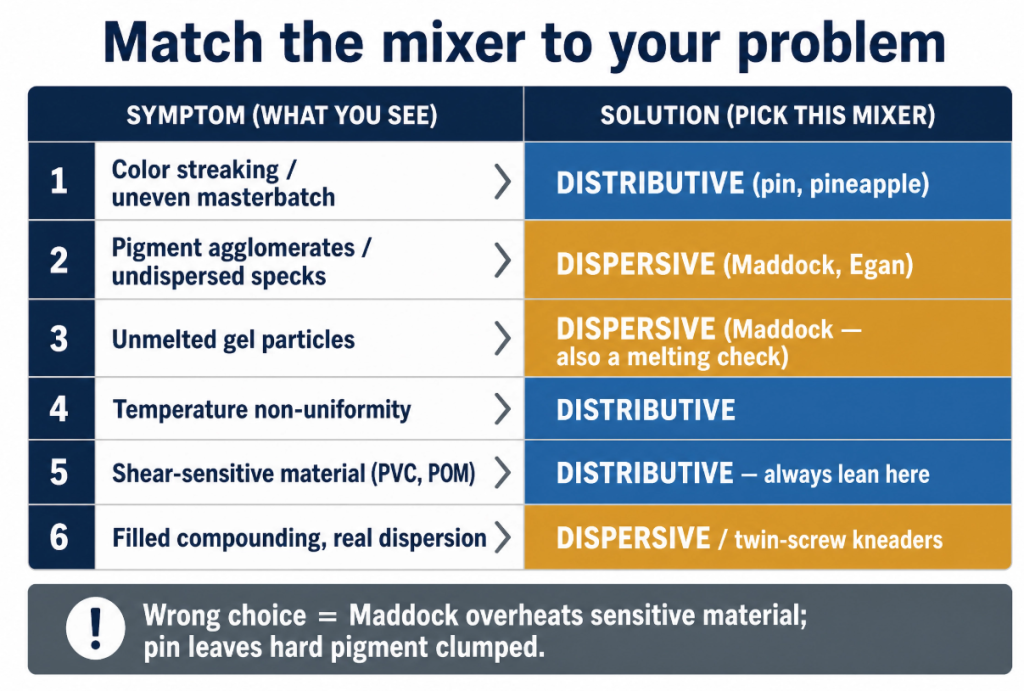
Work from your actual symptom or goal:
- Color streaking / uneven masterbatch → distributive (pin, pineapple, Dulmage). The color is present but not evenly spread; you need division, not shear. Pineapple is a favorite for color.
- Pigment agglomerates / specks of undispersed colorant → dispersive (Maddock or Egan). The clumps must be physically broken — distributive mixing will just move the clumps around.
- Unmelted gel particles → dispersive (Maddock), which doubles as a melting check that holds back anything unmelted.
- Temperature non-uniformity across the melt → distributive, which homogenizes temperature with minimal added heat.
- Shear-sensitive material (PVC, POM, some TPEs) → distributive, always lean this way — a Maddock’s shear heat can degrade the material. For heat-sensitive resins the mixer choice is part of a whole low-shear screw strategy; see our PVC screw guide.
- Filled/compounded materials needing real dispersion → often dispersive, or a combination; heavy compounding is where twin-screw kneading elements take over, covered in our twin-screw elements guide.
Pairing a Mixer With a Barrier Screw
A very common configuration is a barrier melting section followed by a mixing section — and there’s a clear best practice. Because the barrier section already ensures complete melting, what the metering zone usually needs is homogenization, not more shear — so distributive mixers are usually the better match for barrier screws. The exception is when particles small enough to slip through the barrier still need shearing apart, which calls for a dispersive element. This barrier-plus-mixer combination is the standard for demanding film and any process where melt uniformity sets the product spec — see our blown film screw guide and the broader barrier-vs-GP decision.
The Trade-Off Every Mixer Shares: Output and Heat
No mixing section is free. Every one of them disrupts flow, and that disruption costs something:
- Pressure and output. Dispersive mixers especially — a Maddock or blister ring drops pressure and reduces output; helical designs (Egan) and distributive mixers cost less. If a screw lost output after a mixer was added, that’s expected, not a fault — the question is whether the mixing gained is worth the output given up.
- Shear heat. Dispersive mixing converts shear into heat, raising melt temperature — the very thing that makes it wrong for heat-sensitive materials.
- Stagnation risk. Constant-depth designs (classic Maddock grooves) have corners where material can sit and degrade — a real concern for heat-sensitive resins and a source of black specks, which is why tapered/helical designs exist. This connects to the black specks and degradation story.
Choosing a mixing section comes down to one honest question — do you need to break something up or spread something out? — because that single distinction points to dispersive or distributive, and from there the specific mixer follows from your material’s shear sensitivity, your output needs, and whether it’s riding behind a barrier section, with the universal caveat that every mixer trades some output and adds some heat for the mixing it delivers.
At BLOOM, we design and build extruder screws with the right mixing section for your material and goal — dispersive where you need to break up agglomerates, distributive where you need even distribution without the heat, and the correct pairing behind a barrier section — rather than defaulting to whatever’s standard. If you’re fighting color streaks, pigment specks, or temperature non-uniformity and aren’t sure which mixer solves it, send our engineering team your material, the mixing problem, and your machine details on WhatsApp and we’ll specify the right section. For the full design picture, see our screw design guide.
References and Further Reading
- Extrusion: Barrier Screws and Mixers, Plastics Technology (J. Frankland), 2018 — dispersive vs distributive mixers, why distributive types usually suit barrier screws, and the Maddock/Egan/pineapple distinctions: https://www.ptonline.com/articles/extrusion-barrier-screws-and-mixers
- Influence of the Design Solutions of Extruder Screw Mixing Tip…, Polymers / NCBI PMC, 2020 — experimental comparison of pineapple, cut-rings, and Maddock mixing tips (distributive vs dispersive characterization): https://pmc.ncbi.nlm.nih.gov/articles/PMC6960559/
- Screw Extruder With Improved Dispersive Mixing (US5932159A), Google Patents — Maddock, Egan, blister ring, pin, Dulmage, Saxton, and pineapple sections and their dispersive/distributive classification: https://patents.google.com/patent/US5932159A/en



Pingback: Extruder Screws for Solid Electrolyte Membranes
Pingback: TPU and Pebax Medical Tubing: The Right Screw
Pingback: Types of Twin Screw Extruders: Classification Guide
Pingback: XPS Foam Board: Why New Blowing Agents Need New Screws
Pingback: Thermally Conductive Compounds: Gentler Mixing Wins