By the BLOOM Engineering Team
Quick answer: use a side feeder when a material needs to enter the process downstream of the main feed — most often for glass fiber and reinforcing fibers (to preserve fiber length), high filler loadings (to avoid feed-throat bridging), and heat- or shear-sensitive additives (to protect them from early heat and shear). Side feeding introduces materials after the polymer has already melted, giving you control that main-throat feeding can’t. Here are the specific situations where it’s the right call, and why.
What a Side Feeder Does
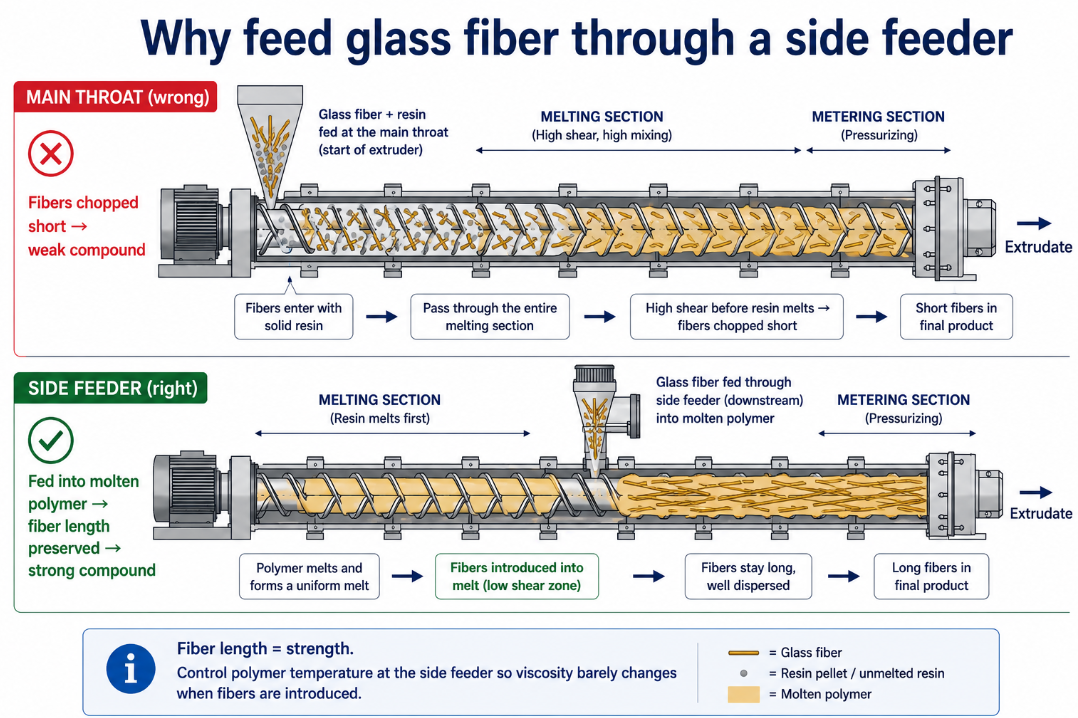
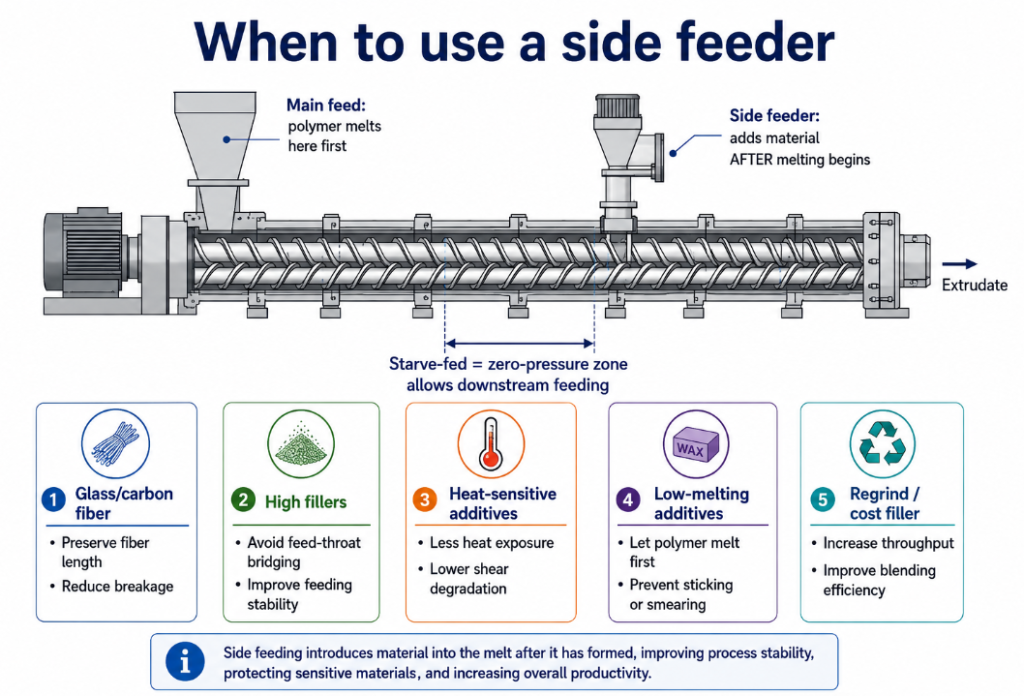
A side feeder (or side stuffer) is a secondary feeding device mounted on the side of the barrel, downstream from the main feed hopper. Instead of dumping every ingredient in at the start, it injects specific materials into the melt at a chosen point along the screw — after partial or complete melting has begun.
This matters because a twin-screw extruder is starve-fed: the screw channels aren’t completely full, so there are zero-pressure zones along the barrel where a side feeder can introduce material into the melt stream without back-pressure fighting it. That zero-pressure feature is what makes downstream feeding possible. The result is staged, controlled addition — exactly what demanding compounds need.
As a quick reference, here is where common materials should enter the process:
| Material | Feed location | Why |
|---|---|---|
| Base polymer / resin | Main throat | Needs the full melting section to melt |
| Glass / carbon fiber | Side feeder (downstream) | Preserve fiber length — avoid the melting section |
| High mineral filler (CaCO₃, talc) | Side feeder (often split) | Avoid bridging & overloading the feed zone |
| Flame retardants | Side feeder | Avoid bridging; some are heat-sensitive |
| Organic pigments / sensitive additives | Side feeder (downstream) | Limit heat & shear exposure |
| Low-melting additives (waxes, lubricants) | Side feeder | Let polymer melt first, avoid slip |
| Regrind / cost filler | Side feeder | Boost throughput without overloading main feed |
| Heat-stable, free-flowing additives | Main throat | No benefit to delaying |
The sections below explain the reasoning behind each of these.
Situation 1: Glass Fiber and Reinforcing Fibers
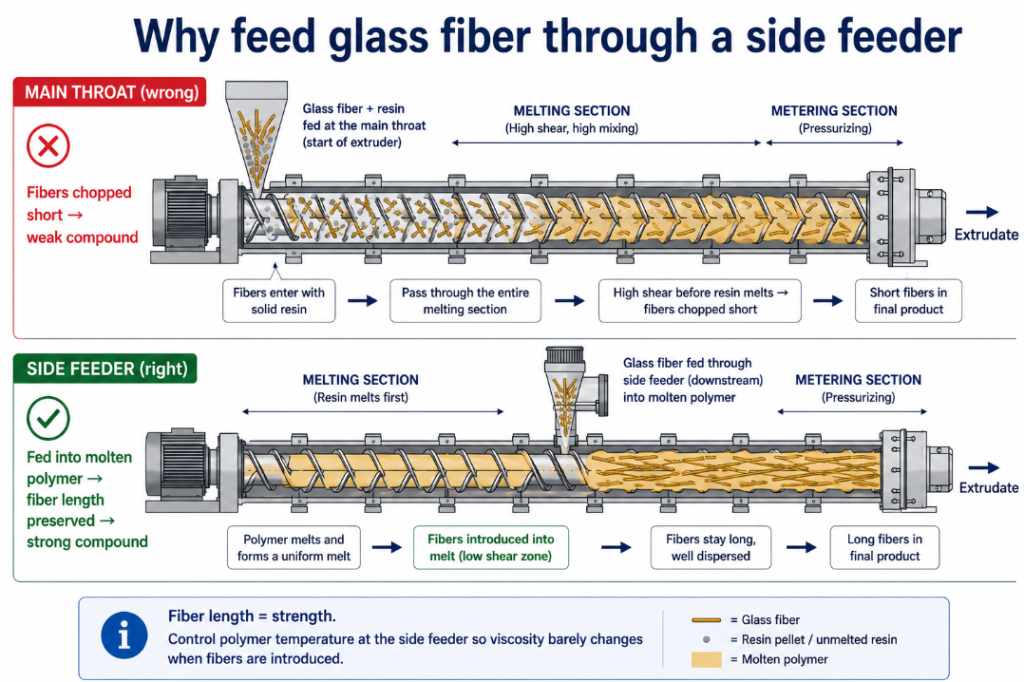
This is the most common reason to side-feed. Glass fiber, carbon fiber, and other reinforcements should almost always be added downstream through a side feeder, after the polymer is already molten — never through the main throat with the resin.
The reason is fiber length. Fiber length is what gives a reinforced compound its strength, and feeding fibers through the main feed throat subjects them to the entire melting section — where they get chopped short by the unmelted resin and aggressive melting elements. Introducing glass into already-molten polymer through a side feeder lets the fiber wet out and disperse with far less breakage, preserving length and therefore strength. Best practice also controls the polymer temperature at the introduction point so viscosity barely changes as the glass enters (Plastics Technology, “Improving Twin-Screw Compounding of Reinforced Polyolefins”). This is the same fiber-abrasion world covered in our guide on why glass-fiber-reinforced plastic wears screws fast — fibers are hard on equipment and fragile in length, which is why how and where you feed them matters.
Situation 2: High Filler Loadings
When a formulation calls for a lot of filler — calcium carbonate, talc, flame retardants, titanium dioxide — side feeding solves two problems at once:
- Feed-throat bridging. Large amounts of powder fed through the main throat can bridge (arch over and block the opening) or feed inconsistently. A side feeder injects the filler directly into a zone where there’s enough melt to carry it, bypassing the bridging problem.
- Overloading the melting section. Pushing all the filler through the front overloads the early screw. Splitting it downstream maintains stable melt viscosity and pressure, and lets you run higher total throughput without choking the feed zone.
For very high filler loadings, fillers are often split between the main feed and one or more downstream side feeders to balance the load along the screw.
Situation 3: Heat- and Shear-Sensitive Additives
Some ingredients are damaged by the full heat and shear history of the screw. Adding them downstream through a side feeder limits their exposure — they enter late, spend less time at temperature, and see lower peak shear (in the later screw zones, viscosity has dropped, so the same screw speed produces lower stress). Candidates for downstream feeding:
- Organic pigments and colorants that degrade or shift color with too much heat.
- Functional additives — antioxidants, blowing agents, active compounds — that lose effectiveness if cooked.
- Heat-sensitive or previously-recycled polymers with lower heat tolerance from prior processing.
Introducing these late protects their properties, which is why masterbatch, pharmaceutical, and specialty-compound producers rely on downstream side feeding.
Situation 4: Low-Melting Additives (a Subtle One)
There’s a less obvious case worth knowing. Low-melting additives — waxes, lubricants, some low-melt components — are by nature lubricants, and if fed up front they make the polymer slip through the melting section so it doesn’t fully melt, leaving solid polymer fragments in the compound. Feeding the polymer first and adding the low melters downstream lets the polymer melt completely before the lubricating additives enter, then the additives melt quickly and incorporate cleanly (Plastics Technology, “Configuring the Twin-Screw Extruder”). It’s a counterintuitive but important reason to side-feed.
Situation 5: Regrind and Cost-Saving Fillers
Side feeding also lets you add regrind or low-cost filler downstream to boost throughput and reduce material cost, without overloading the primary feed zone — a practical economic lever for compounders.
When You DON’T Need a Side Feeder
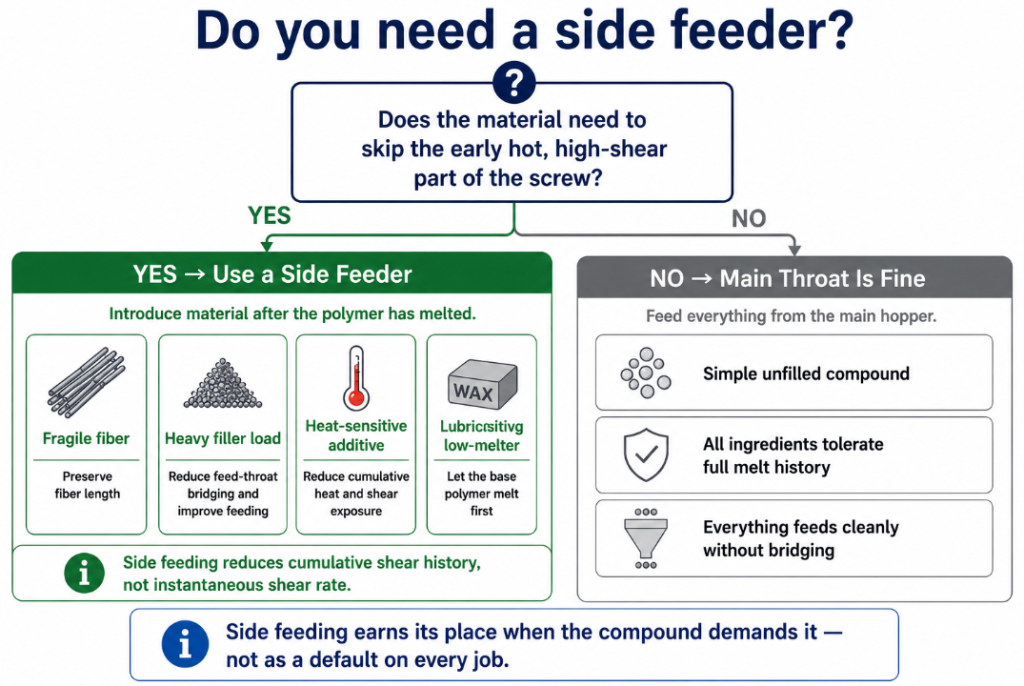
To keep it balanced: if you’re running a simple, unfilled compound where all ingredients tolerate the full melt history and feed cleanly through the main throat, a side feeder adds cost and complexity for no benefit. Side feeding earns its place specifically when fiber length, filler level, additive sensitivity, or feeding behavior demands staged introduction — not as a default on every job.
Here’s the trade-off at a glance:
| Factor | Main-throat feeding | Side feeding (downstream) |
|---|---|---|
| Heat & shear exposure | Full screw history | Reduced — enters late |
| Fiber length | Chopped short | Preserved |
| High filler handling | Risk of bridging / overload | Bypasses bridging, balances load |
| Equipment cost & complexity | Lower | Higher (extra feeder + barrel section) |
| Throughput on filled compounds | Limited by feed zone | Higher — load split along screw |
| Best for | Simple, heat-stable, free-flowing recipes | Fibers, high fillers, sensitive or low-melt additives |
Side feeding comes down to one question: does the material need to skip the early, hot, high-shear part of the screw? If it’s a fragile fiber, a heavy filler load, a heat-sensitive additive, or a lubricating low-melter, the answer is yes and a side feeder protects your compound’s quality — but if everything in the recipe is happy going in at the main throat together, the simpler setup is the right one, which is the same match-the-equipment-to-the-job logic that governs screw and barrel design.
At BLOOM, we manufacture twin-screw extruder screws and barrels — including side-feeder barrel sections and the screw element configurations that make staged feeding work for fibers, high fillers, and sensitive additives. If you’re configuring a compounding line and deciding where and how to feed your materials, send our engineering team your formulation and machine details on WhatsApp and we’ll help you set it up. For more on compounding screw design, see our twin-screw compounding screw guide.