Quick answer: yes — wood flour must be dried before WPC extrusion, typically to below about 1–4% moisture depending on your process and screw type. Wood fiber absorbs water, and any moisture left in it flashes to steam at extrusion temperatures, creating bubbles, voids, and surface defects (“measles”) that ruin the profile and weaken it. Unlike PET, WPC has a second line of defense — venting during extrusion removes some moisture — but pre-drying is still essential. Here is how dry it needs to be, why, and how drying and venting work together.
By the BLOOM Engineering Team
Why Wet Wood Flour Ruins WPC
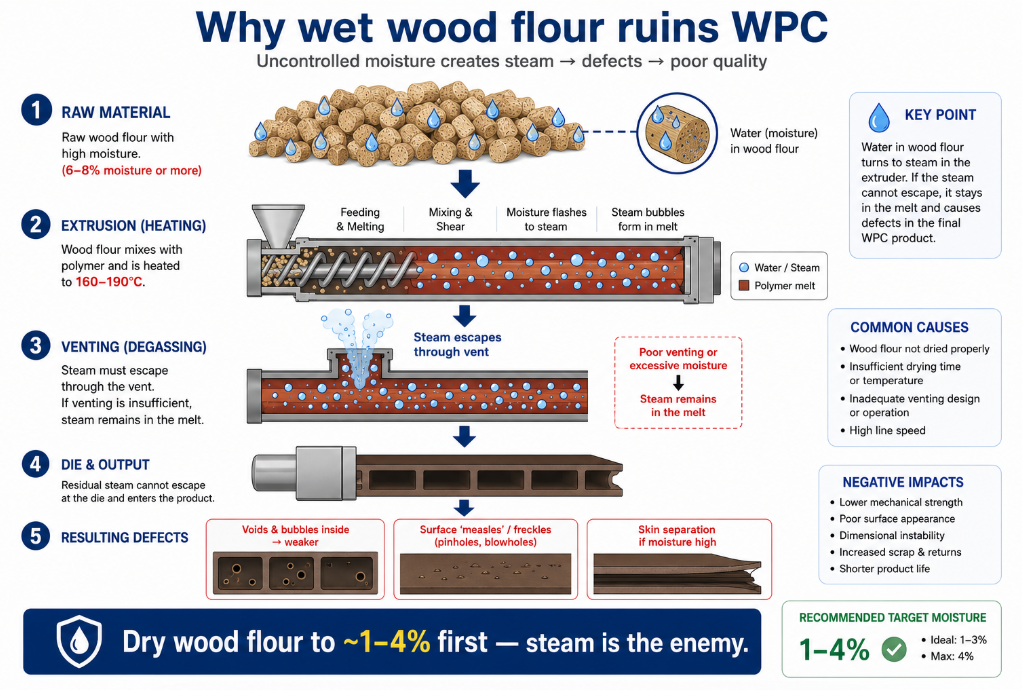
Wood is hygroscopic — it readily absorbs and holds water, and raw wood flour can arrive with 6–8% moisture or more. The problem is what that water does at WPC processing temperatures (typically 160–190°C): it turns to steam. And steam trapped in a polymer melt does exactly what you’d expect — it expands and forms gas pockets.
The visible consequences in the finished profile:
- Voids and bubbles inside the profile, which directly reduce mechanical strength.
- Surface defects — localized bubbles called “measles” or “freckles” under the skin of the profile.
- Skin separation — if the moisture is high enough, the profile’s skin can separate almost entirely from the underlying material as the water vaporizes and expands (Plastics Technology, “Wood-Plastics Composites Done Right”).
- Poor consistency and weak zones — uneven dispersion and weak spots throughout.
So drying isn’t a quality nicety — wet wood flour produces visibly defective, mechanically weaker product. It’s one of the disciplines that separates reliable WPC producers from the rest.
How Dry Does Wood Flour Need to Be?
The target depends on your manufacturing platform and — importantly — your extruder type:
| Target moisture | When it applies |
|---|---|
| Below ~1% | Common spec for many WPC lines, especially profile/decking |
| ~2–4% | Achievable with co-rotating twin-screw extruders that tolerate more moisture and vent well |
| Below ~2% | A typical practical compromise many producers use |
Two things drive the difference:
- Extruder type matters. Co-rotating twin-screw extruders achieve better surface renewal of the melt and can tolerate higher wood moisture in the feed — the ideal wood moisture for them is often cited as 2–4%. Counter-rotating and single-screw setups are less forgiving and want drier feed.
- Venting matters. A machine with good atmospheric and vacuum venting removes a lot of moisture during processing, relaxing how dry the incoming flour must be (more on this below).
The practical point: there’s no single universal number — it’s set by your equipment. A capable WPC screw and barrel built for the job lets you run reliably; for how WPC screw design handles wood fiber, see our WPC extruder screw guide.
Drying and Venting Work Together
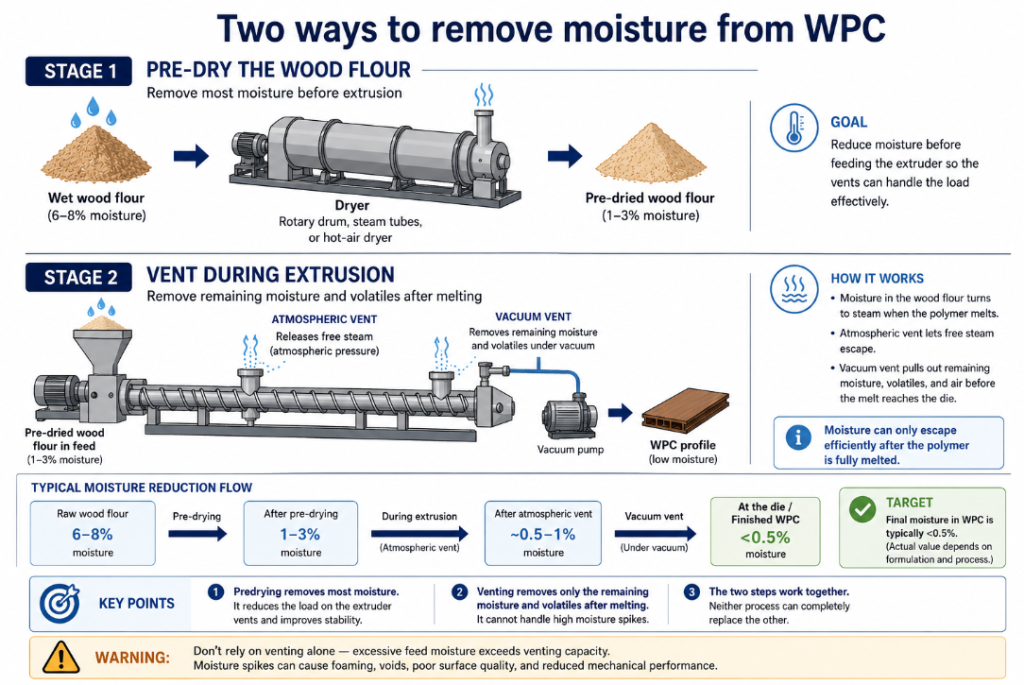
WPC has an advantage PET doesn’t: you can remove moisture in two places — before and during extrusion. The best practice uses both:
- Pre-dry the wood flour in a dryer (rotary drum, steam tubes, or hot-air/desiccant systems) to get the bulk of the moisture out before it enters the machine.
- Vent during extrusion — an atmospheric vent flashes off a few percent of water vapor early, and a downstream vacuum vent pulls out the remainder before the die. In practice, wood flour fed at 6–8% can be brought down to ~2% through venting alone, but starting drier makes this far more reliable.
This two-stage approach is why WPC can tolerate wood flour that isn’t bone-dry, the way PET must be — but it does not mean you can skip pre-drying. Relying on venting alone leaves no margin: any spike in incoming moisture overwhelms the vents and defects appear. Pre-drying gives the vents a manageable load. (Note: this is different from PET, where moisture chemically degrades the polymer — see drying PET before extrusion — whereas in WPC the main moisture problem is physical steam, plus protecting the wood from heat.)
Don’t Overheat: The Other Half of the Problem
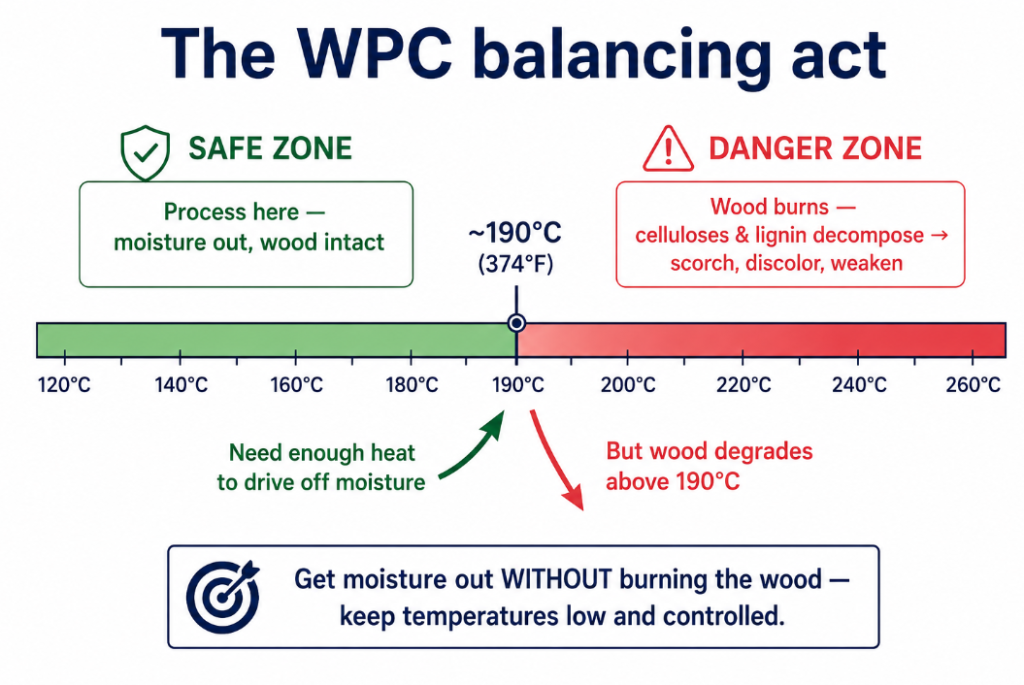
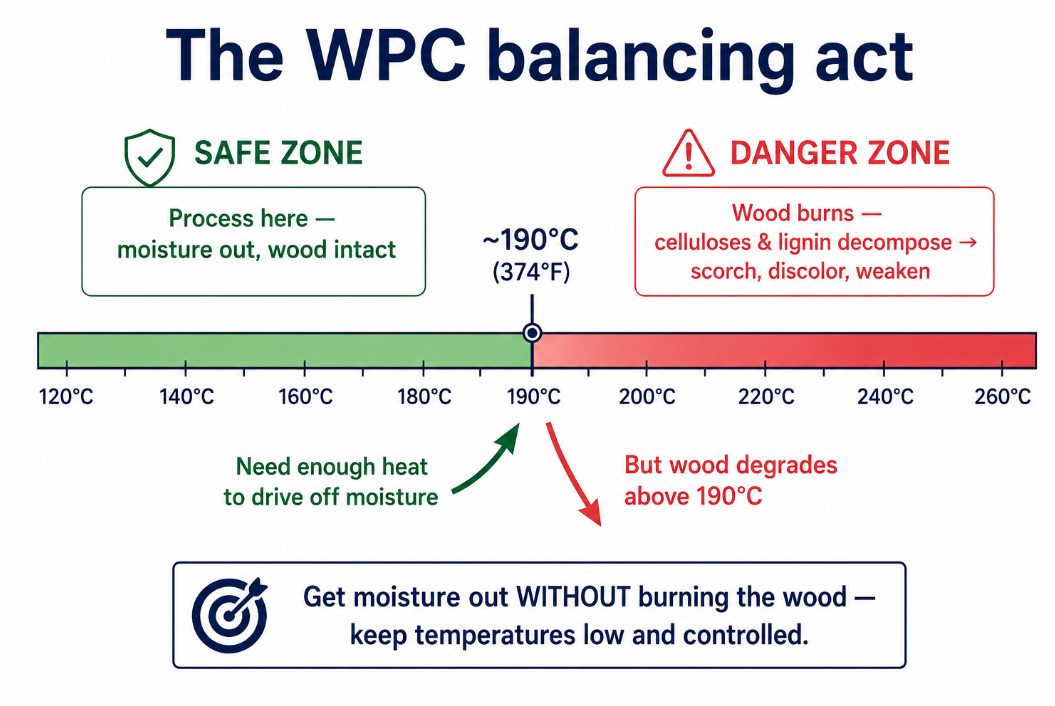
Drying wood flour has a hard constraint that PET doesn’t: wood itself degrades with heat. The celluloses and lignin in wood thermally decompose above about 190°C (374°F), which is the same temperature limit the wood-plastics processing literature warns against exceeding (Plastics Technology) — so you can’t just crank up drying or melt temperatures to drive off water. Push past ~190°C and the wood scorches, discolors, and loses strength, and the WPC degrades.
This creates the central WPC balancing act: get the moisture out, but keep both the drying temperature and the melt temperature low enough that the wood doesn’t burn. It’s why WPC runs at relatively low, tightly-controlled processing temperatures, and why screw design that melts the plastic efficiently without generating excess shear heat matters so much — the wood can’t take the heat that a pure-plastic process might tolerate. Wood flour that arrives so wet it needs aggressive drying, or so contaminated it needs high temperatures, fights this constraint directly.
Drying wood flour isn’t optional for WPC, but it isn’t the chemical absolute that PET drying is either — it’s a physical-steam problem you solve with a combination of pre-drying to your equipment’s target (roughly 1–4% depending on screw type and venting) and venting during extrusion, all while keeping temperatures below the ~190°C point where the wood itself starts to burn, which together give you a dense, strong, defect-free profile instead of a bubbly, weak one.
At BLOOM, we build extruder screws and barrels for WPC — designed to melt and convey wood-filled compound efficiently at the low, controlled temperatures wood demands, with venting that handles residual moisture and wear protection for the abrasive filler. If you’re processing WPC and fighting bubbles, voids, or wood scorch, send our engineering team your formulation, wood content, and machine details on WhatsApp and we’ll help. For more on the wood-fiber wear and screw design challenges, see our WPC extruder screw guide.