
a barrier screw is worth the upgrade when your problem is incomplete melting, unstable output, or non-uniform melt temperature at production speed — it commonly delivers 20%+ more output and dramatically better melt uniformity. It’s not worth it when you run heat-sensitive material, run at low speeds where a general-purpose screw already melts fully, or when your real problem is wear rather than design. The honest version: a barrier screw is a better melting machine, not a universally better screw. Here’s what it actually does, the numbers, and the specific cases where the upgrade pays for itself versus where it’s the
wrong fix.
By the BLOOM Engineering Team
The Core Difference: How Each Screw Melts
The difference is entirely in the melting mechanism, and that’s what drives every pro and con.
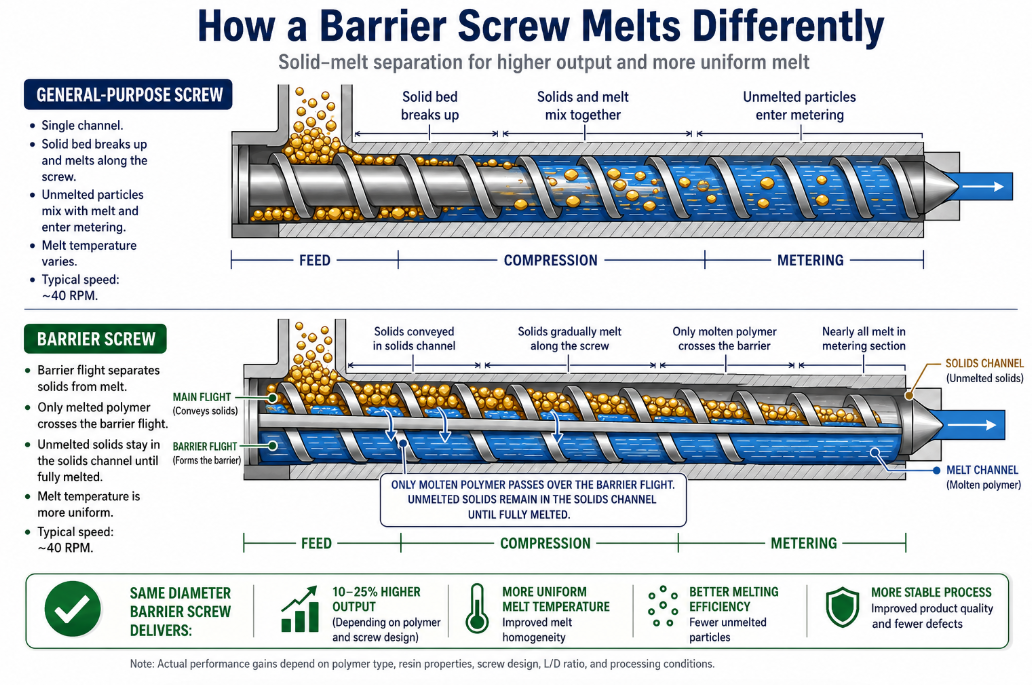
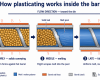
A general-purpose (GP) screw melts by compressing solids in a single channel. It works, but it has a known weakness: as melting proceeds, the solid bed breaks up, and chunks of unmelted pellet get carried forward into the metering zone unmelted — because nothing separates melt from solids. The result at higher speeds is unmelted particles, temperature variation, and pressure surging. Independent testing (a University of Massachusetts study) found the GP design had the highest throughput but insufficient mixing, with excessive variation in melt temperature and pressure above 40 RPM.
A barrier screw adds a second flight in the melting zone that splits the channel into two: a solids channel and a melt channel. Only fully-melted polymer can cross the barrier into the melt channel, so unmelted solids are physically held back until they melt. This lets the designer choose where melting completes, eliminates solid-bed break-up, and delivers a thermally homogeneous melt to the die — usually without needing an add-on mixer.
The Numbers: What the Upgrade Buys
| Metric | General-purpose screw | Barrier screw |
|---|---|---|
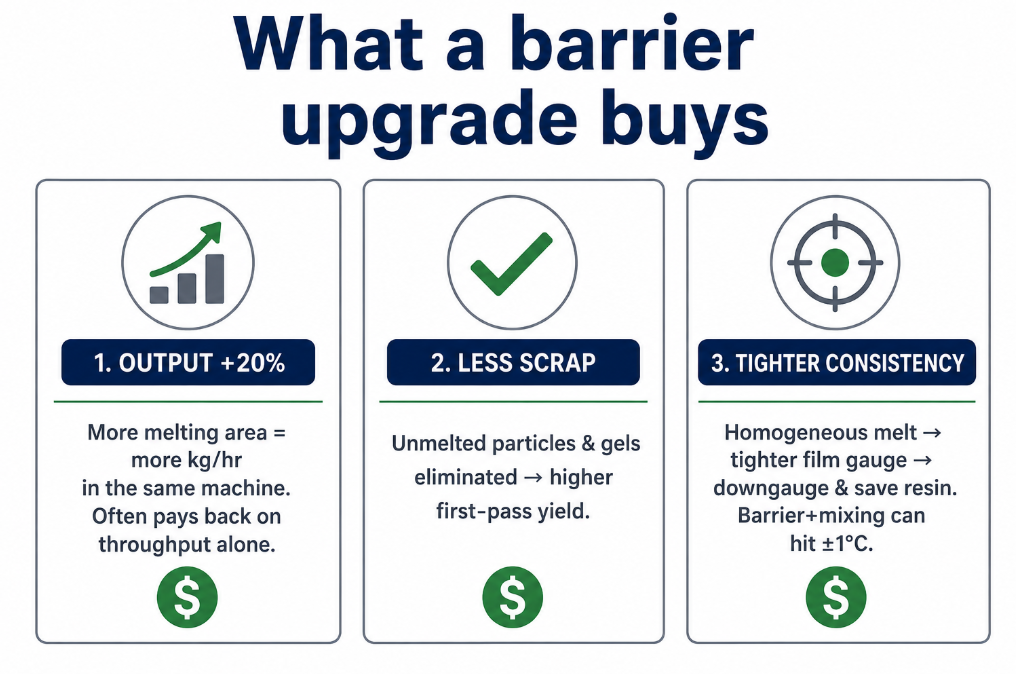
| Output (same diameter/L/D) | Baseline | Commonly 20%+ higher — more melting area |
| Unmelted particles | Common at higher speeds (solid-bed break-up) | Largely eliminated — solids held until melted |
| Melt temperature uniformity | Varies above ~40 RPM | Much tighter; barrier + mixing can reach ±1°C |
| Melt pressure stability | Surging / “screw beat” | More stable |
| Energy per kg | Baseline | Often lower (efficient melting) |
Three of these convert directly into money:
- Output. More melting capacity in the same machine means more kilograms per hour without a bigger extruder — the upgrade often pays back purely on throughput.
- Scrap. Unmelted particles and gels become rejects. Eliminating them raises first-pass yield.
- Consistency. In film especially, gauge uniformity is extremely sensitive to melt-temperature uniformity — a thermally homogeneous melt tightens the gauge, which lets you downgauge toward target and save resin.
When a Barrier Screw Is Worth It
The upgrade pays off in these situations:
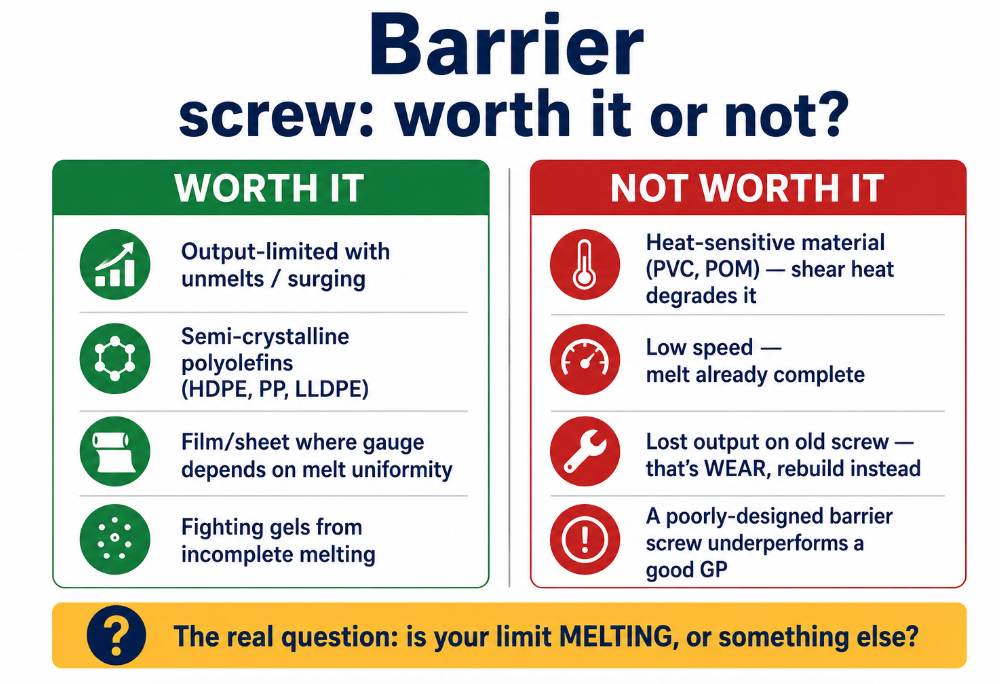
- You’re output-limited and melting-limited. If you’re pushing the GP screw fast and seeing unmelted particles or surging, a barrier screw lets you run faster with a complete melt — the clearest win.
- You run semi-crystalline polyolefins (HDPE, PP, LLDPE). These shear-tolerant resins are the ideal barrier-screw case — they take the higher shear well and benefit most from the melting capacity.
- Melt uniformity drives your quality. Blown and cast film, sheet, and any process where temperature homogeneity sets the product spec. Our blown film screw guide covers why film lives or dies on melt uniformity.
- You’re fighting gels or unmelts from a GP screw. If the root cause is incomplete melting, the barrier design attacks it directly — see eliminating gels and fish-eyes.
When It’s NOT Worth It (the Honest Part)
A barrier screw is the wrong fix in several real cases — and a manufacturer who only sells you “yes” isn’t doing you a favor:
- Heat-sensitive materials. The barrier and mixing sections have large surface area and generate more shear heat at higher speeds. For PVC, POM, and other heat-sensitive resins, that extra shear heat can cause degradation — the opposite of what you want. A GP or specialized low-shear screw is often the better choice for these; see our PVC screw guide.
- Low-speed operation where the GP screw already melts fully. If you run slowly enough that melting is complete on your current screw, the barrier design solves a problem you don’t have — you’d pay for capacity you won’t use.
- Your real problem is wear, not design. A worn GP screw that’s lost output doesn’t need a barrier upgrade — it needs its clearance restored. Rule wear out first with our wear limit calculator; if it’s worn, a rebuild is the cheaper answer, not a new barrier screw.
- Poorly-designed barrier screws underperform. Barrier performance is highly sensitive to the barrier flight’s clearance and length. A badly-designed barrier screw can trap material in the barrier flights (its own dead-spot degradation) and perform worse than a good GP screw. The design has to be right — which is a reason to buy from someone who designs, not just copies.
The Decision, in Practice
Bringing it together:
| Your situation | Recommendation |
|---|---|
| Output-limited, unmelts/surging, polyolefin | Upgrade to barrier — the classic payback case |
| Film/sheet where gauge depends on melt uniformity | Upgrade to barrier (with mixing) |
| Heat-sensitive material (PVC, POM) | Stay GP / low-shear — barrier shear heat risks degradation |
| Low speed, melt already complete | Stay GP — no problem to solve |
| Lost output on an old screw | Measure wear first — likely a rebuild, not an upgrade |
| Buying a barrier screw | Buy a designed one — barrier performance is design-sensitive |
The barrier-vs-GP question really comes down to one diagnosis: is your limitation melting or something else? If you’re melting-limited on a shear-tolerant material, a barrier screw is one of the highest-return upgrades in extrusion — but if your issue is heat sensitivity, low-speed operation, or wear, the barrier screw is an expensive answer to the wrong question, and the right move is a different screw, the same screw rebuilt, or a low-shear design.
At BLOOM, we design and build both general-purpose and barrier extruder screws and barrels — and we’ll tell you honestly which your application needs rather than defaulting to the more expensive one. If you’re weighing a barrier upgrade and want a straight assessment, send our engineering team your material, current output, screw speed, and the problem you’re trying to solve on WhatsApp and we’ll tell you whether a barrier screw, a different design, or a rebuild is the real answer. For the full range of screw types, see our extruder screw types guide and screw design guide.
References and Further Reading
- Kazmer et al., Design and Evaluation of General Purpose, Barrier, and Multichannel Plasticating Extrusion Screws, Polymer Engineering & Science (Wiley), 2020 — instrumented testing showing the GP screw’s excessive melt-temperature and pressure variation above 40 RPM: https://4spepublications.onlinelibrary.wiley.com/doi/full/10.1002/pen.25333
- The Melting Precision of Barrier Screws, Plastics Technology, 2018 — how the barrier design designs-in complete melting and delivers thermally homogeneous melt without an add-on mixer: https://www.ptonline.com/articles/the-melting-precision-of-barrier-screws
- Improve Production Rates Via Screw Design — Barrier vs. General Purpose vs. Melt Uniformity, Plastics Technology, 2024 — the limits of GP screws and the melt-uniformity perspective: https://www.ptonline.com/articles/improve-production-rates-via-screw-design-barrier-vs-general-purpose-vs-melt-uniformity-


Pingback: Spunbond and Meltblown Screws: Two Nonwoven Lines, Opposite Problems
Pingback: TPU and Pebax Medical Tubing: The Right Screw