Quick answer: yes — a longer screw isn’t automatically better, and too high an L/D ratio brings real downsides: longer residence time that degrades heat-sensitive materials, more accumulated shear heat, higher torque demand, higher cost, and — counterintuitively — it can actually limit output. “Longer is always better” is one of the most common misconceptions in extrusion. The right L/D is matched to your material, not maximized. Here is what actually goes wrong when a screw is too long, and how to think about it.
By the BLOOM Engineering Team
The “Longer Is Always Better” Myth
A higher L/D (length-to-diameter ratio) does give each section of the screw more room to do its job — more melting, more mixing space, better devolatilization. So it’s tempting to assume a 36:1 screw will always beat a 24:1 screw. It won’t. For the wrong material, a longer screw causes more degradation, not less — and as one industry source bluntly puts it, assuming longer is always better is simply a mistake. A short screw with the right design can outperform a longer one for a specific material.
The reality is that L/D is a trade-off, not a “more is better” dial. The standard range is roughly 20:1 to 36:1, with screws beyond 40:1 reserved for special purposes (double venting, compounding, high-speed processing) — not as a default upgrade. As a quick reference for matching L/D to the job:
| Material / application | Recommended L/D | Why |
|---|---|---|
| Heat-sensitive (PVC, POM/acetal, CPE) | ~20:1–24:1 | Short residence time limits thermal degradation |
| Reactive / crosslinkable (silane XLPE) | Shorter, controlled | Less time in heat = less scorch risk |
| General PE / PP | ~28:1–32:1 | Balanced melting and output |
| Highly filled / engineering plastics | ~30:1–34:1 | Length for dispersion and complete melting |
| Compounding / reactive (twin-screw) | 36:1–60:1+ | Mixing length and residence time are the point |
| Devolatilization / double venting | 36:1+ | Extra length needed for venting zones |
Check your own screw’s L/D ratio with the calculator below:
Treat these as starting points, not rigid rules — the right value depends on your specific material, screw geometry, and output target.
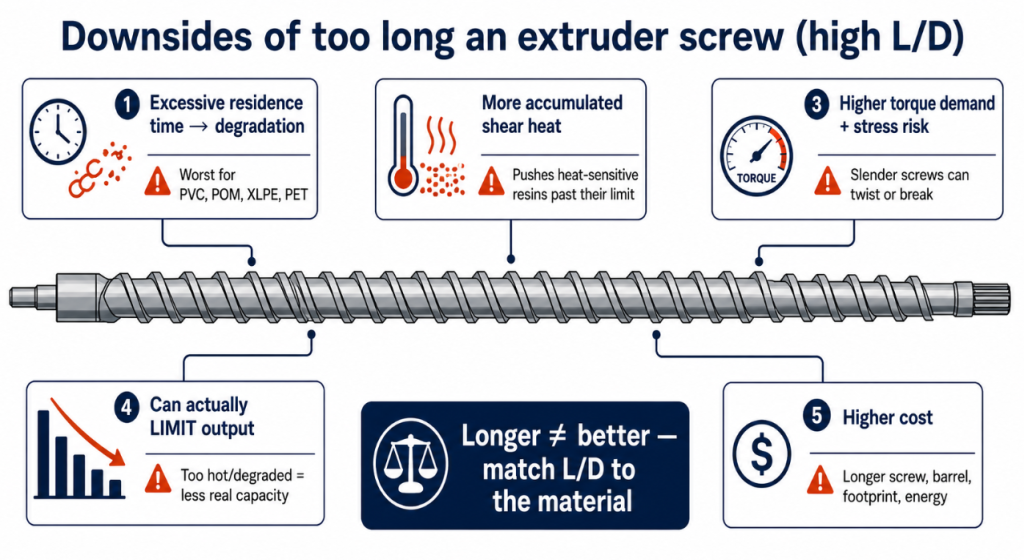
Disadvantage 1: Excessive Residence Time → Degradation
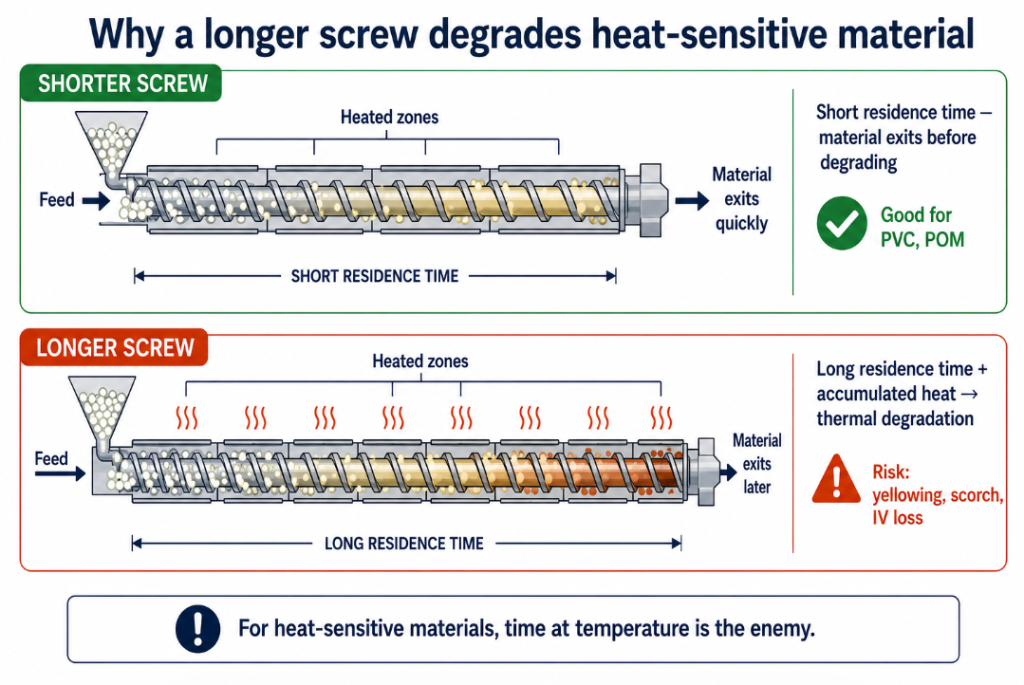
This is the biggest one. The longer the screw, the longer the polymer spends inside the hot barrel — and for heat-sensitive materials, time at temperature is exactly what causes thermal degradation.
A longer screw means longer residence time, which raises the risk of thermal degradation and can hurt both plasticization and final extrudate quality. The materials most at risk:
- Heat-sensitive resins like PVC and POM (acetal) degrade with excess residence time and accumulated heat — for these, a shorter L/D is generally preferred.
- Reactive/crosslinkable materials like silane XLPE begin crosslinking (scorch) when held too long in heat — a very long screw raises the scorch risk.
- PET and other materials where extra thermal history drops molecular weight.
For these materials, a long screw isn’t a benefit you’re paying extra for — it’s a liability that degrades your product. This is the same residence-time logic behind why PVC turns yellow and why PET loses IV; see our compression ratio guide for how screw geometry and heat-sensitive materials interact.
Disadvantage 2: More Accumulated Shear Heat
A longer screw doesn’t just add residence time — it adds shear. More screw length means more accumulated shear heat input into the melt. A higher L/D provides more time for melting and mixing, but it also results in longer residence times and higher accumulated shear heat, which is highly detrimental to heat-sensitive polymers like PVC or POM. For a material that’s already fighting to stay below its degradation temperature, the extra shear heat from an over-long screw pushes it the wrong way.
Disadvantage 3: Higher Torque Demand (and Stress Risk)
A longer screw demands more torque to turn, and the problem compounds if you raise screw speed to use the extra length. Using a longer screw and then increasing screw speed can significantly increase torque — and for screws with smaller diameters, a stress analysis becomes essential to ensure the screw can withstand the increased torque without failing. In other words, a longer screw can push a slender screw toward its mechanical limits, raising the risk of the screw twisting or breaking.
This is where the screw material matters. A standard nitriding steel like 38CrMoAlA may not have the core torsional strength for a long, slender, high-torque screw; high-torque and long-L/D screws often need a tougher base — through-hardened tool steels (D2/SKD11, or hot-work grades like SKD61/H13 for heat) or high-speed steel cores — to resist twisting, with the wear-resistant surface (nitriding, hardfacing, or a bimetallic approach) applied on top. The longer the screw and the higher the torque, the more the base-metal strength — not just the surface hardness — becomes the limiting factor. This ties directly to why screws snap — see our guide on removing a broken extruder screw.
Disadvantage 4: It Can Actually Limit Output
The most counterintuitive downside: buying a longer extruder in pursuit of more output can backfire. As Plastics Technology explains, a screw that is too long for the overall processing situation can actually limit output — so the tendency to buy longer and longer L/D extruders can actually penalize overall performance (Plastics Technology, “How Much L/D Do You Really Need?”, 2022). If the material comes out too hot or too degraded, the singular focus on rate ends up reducing the extruder’s real capability. More length is not more capacity if it cooks the material on the way out.
Disadvantage 5: Higher Cost
The straightforward one: a longer screw and barrel cost more to manufacture, and a longer machine has a larger footprint and higher energy use. Paying for L/D you don’t need — or that actively hurts your material — is wasted money on top of the processing penalties.
So When IS a Long Screw the Right Choice?
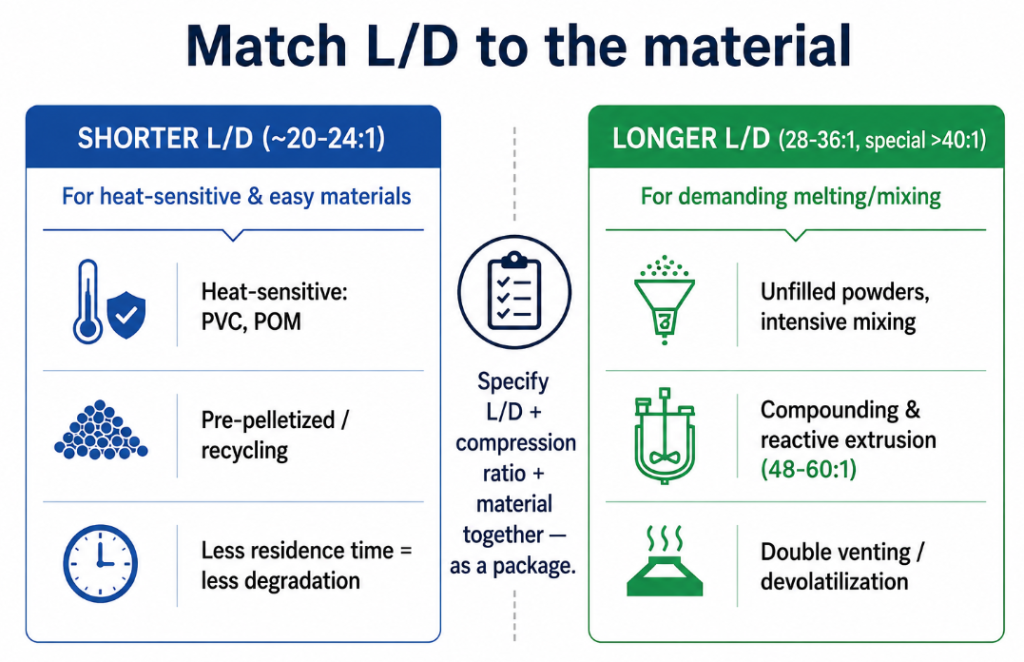
To be fair, high L/D exists because it genuinely helps in the right situations — this article is about too long for the job, not “long is bad.” A higher L/D is the right call for:
- Materials needing intensive melting/mixing — unfilled powders, demanding compounds, highly filled materials needing dispersion.
- Compounding and reactive extrusion — where mixing length and residence time are the point (twin-screw compounders run 48:1 to 60:1+ for exactly this reason).
- Devolatilization — double-venting needs the extra length.
- Custom/toll houses — who never know next year’s material and value the flexibility of a longer machine over a dedicated short one.
The deciding principle is the same in every case: L/D should be specified together with the compression ratio and the material as a package, not maximized in isolation — a long screw with the wrong geometry for a heat-sensitive material over-shears and degrades it, while the right L/D matched to what you actually run gives clean, complete melting without cooking the polymer, which is why the answer is never simply “buy the longest screw available.” See our full L/D ratio guide for choosing the right value, and our compression ratio guide for the parameter that works alongside it.
At BLOOM, we design extruder screws with the L/D matched to your material and process — long enough to melt and mix completely, but not so long that it degrades heat-sensitive polymers or wastes cost — along with matched barrels. If you’re choosing an L/D or wondering whether a longer screw is helping or hurting your specific material, send our engineering team your material and process details on WhatsApp and we’ll advise the right length for the job.