Extruder screws are core components in the processing industries such as plastics, rubber, and food, with their design and performance directly impacting product quality and production efficiency. Understanding the professional terminology of extruder screws is crucial for industry professionals, researchers, and anyone interested in this field. This article will combine domestic and international professional resources to explain key professional terms in the extruder screw industry in detail, and through multiple comparison tables, help readers gain a more intuitive and in-depth understanding of this complex and precise mechanical component.
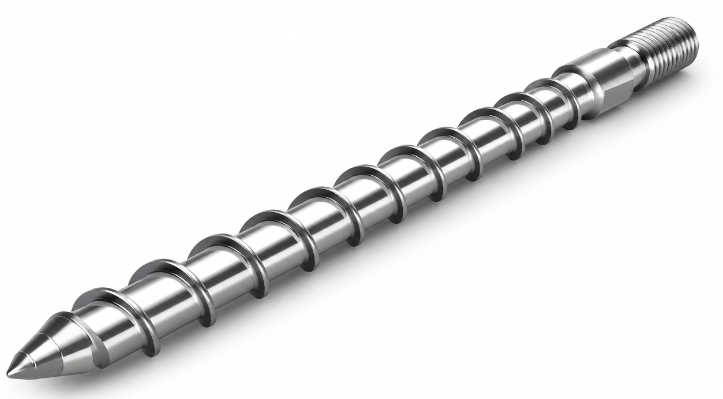
Basic Concepts and Parameters
Diameter (D)
The diameter of the screw is an important parameter for measuring the output of an extruder. It usually refers to the maximum outer diameter of the screw.
Length-to-Diameter Ratio (L/D Ratio)
The length-to-diameter ratio refers to the ratio of the effective working length (L) of the screw to its diameter (D). It directly affects the plasticization degree and residence time of the material within the extruder. A larger L/D ratio leads to more thorough material plasticization and more uniform mixing, but it may also increase the risk of material scorching and the difficulty of screw processing. Common L/D ratios for plastic modification are between 30-40, such as 36:1 or 30:1 .
Screw Channel Depth (H)
Screw channel depth refers to the distance from the bottom of the thread to the outer diameter of the screw. It determines the material holding capacity of the screw channel, affecting material conveying capability and shear action.
Flight Width (e)
Flight width is the width of the screw thread, which reflects the magnitude of shear action on the material during processing. Thicker flights generally imply greater shear force.
Clearance Between Screw and Barrel
This is one of the critical parameters for extruder quality, referring to the gap between the outer diameter of the screw and the inner diameter of the barrel. A reasonable clearance typically ranges from 0.3-2mm. An excessively large clearance (e.g., exceeding 5mm) can lead to reduced extruder performance and is even considered a
“warning line” .
Main Motor Speed (N)
Main motor speed refers to the maximum rotational speed of the screw, which determines the processing range and greatly influences output. Higher speeds result in greater shear action, aiding in dispersion and mixing, but excessively high speeds can lead to material thermal degradation and insufficient residence time, resulting in uneven mixing. Domestic extruders typically operate between 500-600 r/min .
Motor Power and Heating Power (P)
Motor power is the power required to drive the screw rotation, while heating power provides the heat necessary for material plasticization. These parameters collectively determine the overall energy consumption and processing capacity of the extruder.
Single Screw vs. Twin Screw Extruders
Extruders are primarily divided into single screw and twin screw types. Single screw extruders have a relatively simple structure, relying mainly on friction and drag flow to convey material. Twin screw extruders, on the other hand, offer superior mixing, devolatilization, and self-cleaning capabilities, making them suitable for more complex processing requirements .
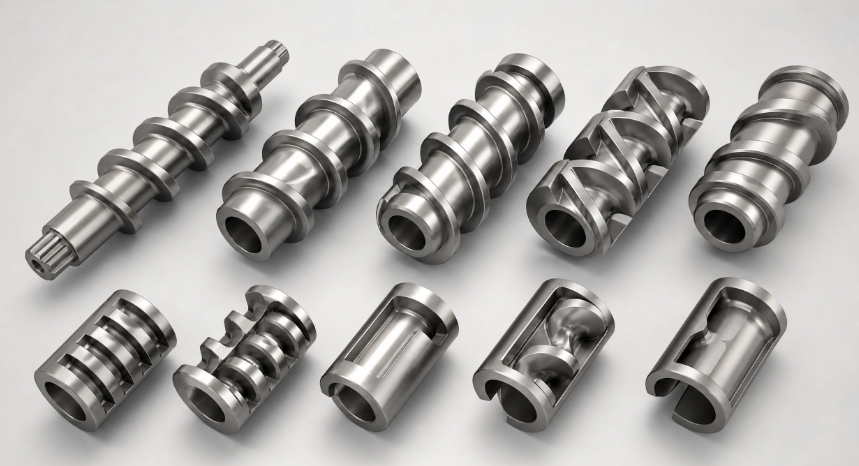
Table 1: Core Characteristics Comparison of Single Screw vs. Twin Screw Extruders
| Comparison Aspect | Single Screw Extruder | Twin Screw Extruder |
| Conveying Mechanism | Friction and drag flow | Positive displacement |
| Mixing Capability | Weaker, primarily distributive mixing | Extremely strong, excellent distributive and dispersive mixing |
| Devolatilization Performance | General | Excellent (rapid surface renewal) |
| Self-Cleaning Capability | None | Strong (especially co-rotating intermeshing type) |
| Applicable Materials | Single materials, conventional pipe/sheet extrusion | Complex formulations, powders, heat-sensitive materials, reactive extrusion |
| Equipment Cost | Lower (relatively simpler) | Higher (typically about twice that of single screw) |
| Energy Efficiency | General | Higher (efficient and energy-saving) |
Functional Zones of the Screw
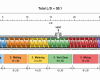
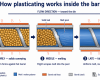
Extruder screws are typically divided into multiple functional zones, each performing different tasks to achieve effective material conveying, plasticization, mixing, and homogenization .
Feeding Zone (Conveying Section)
Primarily responsible for conveying solid material from the feed port to the next section and preventing material overflow. This section usually employs deep-channel forward threads or large-pitch forward threads with gradually decreasing channel volume to improve conveying efficiency.
Melting Zone (Melting Section)
In this zone, material is fully melted and initially homogenized through heat transfer and the screw’s frictional shear action. Kneading blocks, shear elements, or reverse threads are often incorporated to enhance shearing and mixing effects.
Mixing Zone (Plasticizing/Mixing Section)
Aims to further refine and homogenize material components, forming an ideal structure with both distributive and dispersive mixing functions. The arrangement of screw elements in this section is usually more complex to achieve efficient mixing.
Venting Zone (Venting Section)
Used to remove moisture, low molecular weight substances, and other impurities from the material. Reverse threads or reverse kneading blocks are often placed at the entrance of the vent port to seal the melt and build pressure, while large-pitch screw elements or multi-start small-pitch threads are used to increase the melt surface area, facilitating gas removal.
Metering Zone (Discharge Section)
Primarily responsible for conveying and pressurizing the melt, building a certain pressure at the die exit to ensure material density, and further mixing, ultimately achieving smooth extrusion and molding. The pitch or channel of the screw blocks in this section usually gradually decreases to achieve a pressurizing effect.
Mixing Mechanisms: Distributive and Dispersive
There are two main types of mixing actions in extruder screws: Distributive Mixing and Dispersive Mixing. Understanding the difference between these is crucial for optimizing screw design.
Table 2: Comparison of Distributive and Dispersive Mixing Mechanisms
| Comparison Aspect | Distributive Mixing | Dispersive Mixing |
| Core Purpose | Uniform spatial distribution of components | Breaking down agglomerates into fine particles, reducing dispersed phase size |
| Mechanism | Melt division, recombination, displacement flow | High shear stress, elongational stress |
| Physical Manifestation | Component relocation without changing particle size | Particles are fractured, broken down |
| Applicable Scenarios | Color blending, polymer blending with good compatibility | Filler dispersion (e.g., calcium carbonate, carbon black), breaking down gels |
| Required Screw Elements | Toothed discs, pin screws, large-angle kneading blocks | Narrow-gap shear blocks, reverse threads, small-angle kneading blocks |
Screw Element Geometric Parameters (Twin Screw Extruder)
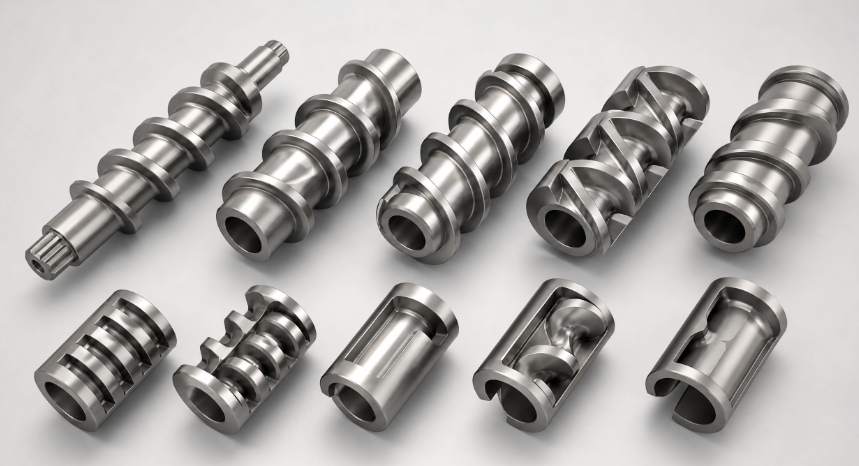
For twin screw extruders, the screw is composed of various modular elements, mainly including conveying elements and mixing elements. Screw elements with different pitches have significant functional differences.
Table 3: Functional Comparison of Conveying Elements with Different Pitches
| Element Type | Pitch Characteristics | Main Functions and Applications | Mixing Effect |
| Large Pitch Thread | Pitch 1.5D ~ 2D | Fast conveying, increased output; suitable for heat-sensitive materials (shortens residence time); venting section (increases surface area) | Lower |
| Medium Pitch Thread | Between large and small | Balances conveying and pressurization; often used for mixing zone transition | Medium |
| Small Pitch Thread | Pitch around 0.4D | Builds pressure, improves melting degree; used in metering zone, stabilizes extrusion | Higher |
Mixing elements mainly include “K” series (kneading blocks) and “M” series (toothed). Taking “K” series kneading blocks as an example, their stagger angle has a decisive influence on the mixing effect.
Table 4: Influence of Kneading Block Stagger Angle on Mixing Effect
| Stagger Angle | Conveying Capacity | Residence Time | Distributive Mixing Effect | Dispersive Mixing Effect | Typical Application |
| 30° (Forward) | Strong | Short | Weaker | Good | Initial melting, balancing conveying and preliminary shearing |
| 45° (Forward) | Medium | Medium | Good | Optimal | Core melting and strong dispersive mixing section |
| 60° (Forward) | Weak | Long | Stronger | Poorer | Extended residence time, enhanced distributive mixing |
| 90° (Neutral) | None (pure mixing) | Longest | Optimal | Medium | Strong distributive mixing, no axial conveying capacity |
| Reverse | Obstructs conveying | Extremely long | Extremely strong | Extremely strong | Creates high-pressure zone, forced melting and ultimate mixing |
Materials and Surface Treatment (Metallurgical Comparison)
Extruder screws are subjected to severe abrasive wear and chemical corrosion during operation. Selecting appropriate materials and surface treatment processes is crucial for extending screw life and reducing Total Cost of Ownership (TCO) .
Table 5: In-depth Comparison of Mainstream Extruder Screw Materials and Treatment Processes
| Evaluation Aspect | 38CrMoAlA Nitrided Steel | Bimetallic Alloys | Through-Hardened Tool Steel (e.g., CPM 9V) |
| Hardened Structure | Surface nitrided layer | Metallurgically bonded alloy liner/coating | Solid through-hardened material |
| Hardened Layer Thickness | 0.5 – 0.8 mm | 1.5 – 2.5 mm | Throughout the entire component (unlimited) |
| Surface Hardness | HV 900-1020 (~HRC 57-65) | HRC 58-65 (depends on specific alloy) | HRC 54-58 (stable at high temperatures) |
| Abrasive Wear Resistance | Medium | Excellent | Outstanding (resists glass fiber erosion) |
| Chemical Corrosion Resistance | General | Good to Excellent | Excellent (specific grades like S90V) |
| Substrate Toughness | Good | Good | Medium (needs protection from impact) |
| Repairability | Very difficult (usually scrapped) | Can be re-welded/cast | Usually not repairable |
| Relative Initial Cost | 1.0x (baseline) | 1.8x – 2.5x | 3.0x – 4.5x |
| Typical Application Scenarios | Pure resins (PE, PP, PS, ABS) | High-calcium PVC, Wood Plastic Composites (WPC), Post-Consumer Recycled (PCR) materials | High-proportion glass fiber reinforced engineering plastics (>30% GF) |
Note: Data referenced from Extruder-Parts metallurgical comparison data .
Conclusion
The extruder screw is a highly specialized field with numerous underlying principles and technical details. By mastering basic parameters such as diameter and L/D ratio, understanding the fundamental differences between single and twin screws, deeply analyzing distributive and dispersive mixing mechanisms, and combining this with a comparative analysis of screw element geometries and advanced metallurgical materials, we can more scientifically select extruders and optimize processes. We hope this article and its five detailed comparison tables provide readers with a comprehensive, professional, and internationally-oriented knowledge map of extruder screws.
Frequently Asked Questions (FAQ)
Q1: How to determine if an extruder screw needs repair or replacement?
A1: Common signs that an extruder screw may need repair or replacement include: decreased output, increased energy consumption, poor material plasticization or unstable extrusion, reduced product quality (e.g., spots, bubbles, color differences), obvious signs of wear or corrosion on the screw or barrel, insufficient torque, or even screw breakage . Regular inspection of screw wear and timely assessment based on changes in production performance are crucial.
Q2: How to choose the right extruder screw for different materials?
A2: Screw selection should be based on material characteristics and processing requirements. For pure resins or low-filled materials, 38CrMoAlA nitrided steel screws are usually a cost-effective choice. When processing high-calcium PVC, Wood Plastic Composites (WPC), or Post-Consumer Recycled (PCR) materials, bimetallic screws are recommended to resist abrasive wear. For high-proportion glass fiber reinforced engineering plastics, through-hardened tool steel screws are necessary to cope with extreme wear and corrosion . Additionally, single screws are suitable for simple processes and single materials, while twin screws are ideal for complex formulations and high mixing requirements .
Q3: What are the main causes of extruder screw wear, and how can it be effectively prevented?
A3: Screw wear is primarily caused by abrasive wear (e.g., hard particles in the material), corrosive wear (e.g., acidic or alkaline components in the material), and adhesive wear (metal-to-metal contact) . Preventive measures include: selecting wear-resistant and corrosion-resistant screw materials and surface treatments (e.g., bimetallic, tungsten carbide coatings) ; avoiding cold starts; ensuring uniform heating; optimizing process parameters to avoid improper shear and excessively high temperatures; and properly handling polymers containing abrasive additives .
Q4: How does the “Length-to-Diameter Ratio (L/D)” of an extruder screw affect the extrusion process?
A4: The L/D ratio is the ratio of the effective length of the screw to its diameter. A larger L/D ratio means a longer residence time for the material in the screw, leading to more thorough plasticization and mixing, which helps improve product quality. However, an excessively large L/D ratio can lead to excessive material shear, increased risk of thermal degradation (scorching), and also increases the difficulty and cost of screw manufacturing. Therefore, an appropriate L/D ratio should be selected based on specific materials and product requirements, with common L/D ratios for plastic modification ranging from 30-40 .
Q5: How to perform daily maintenance on an extruder screw to extend its service life?
A5: Daily maintenance is key to extending screw life. This mainly includes: regularly cleaning the screw and barrel to prevent material carbonization; inspecting the screw and barrel for wear and tear, and addressing issues promptly; ensuring proper gearbox lubricant levels and regular replacement; checking that heating and cooling systems are functioning correctly to ensure accurate temperature control; avoiding dry running and cold starts; and using appropriate purging materials for cleaning when shutting down .
References
Single Screw Extruder vs Twin Screw Extruder – USEON.
Extruder Screw Material Comparison: 38CrMoAlA vs. Bimetallic vs. Tool Steel.
Common Problems with Extruder Screws and How to Fix Them – Pinyi Screw.
Screw Wear: Causes, Consequences, Solutions – Bausano.
Causes of extrusion screw wear & how to minimize them – Santa Fe Machine.
Extruder Barrels and screws Maintenance: A Practical Guide to … – SN Extruder.