
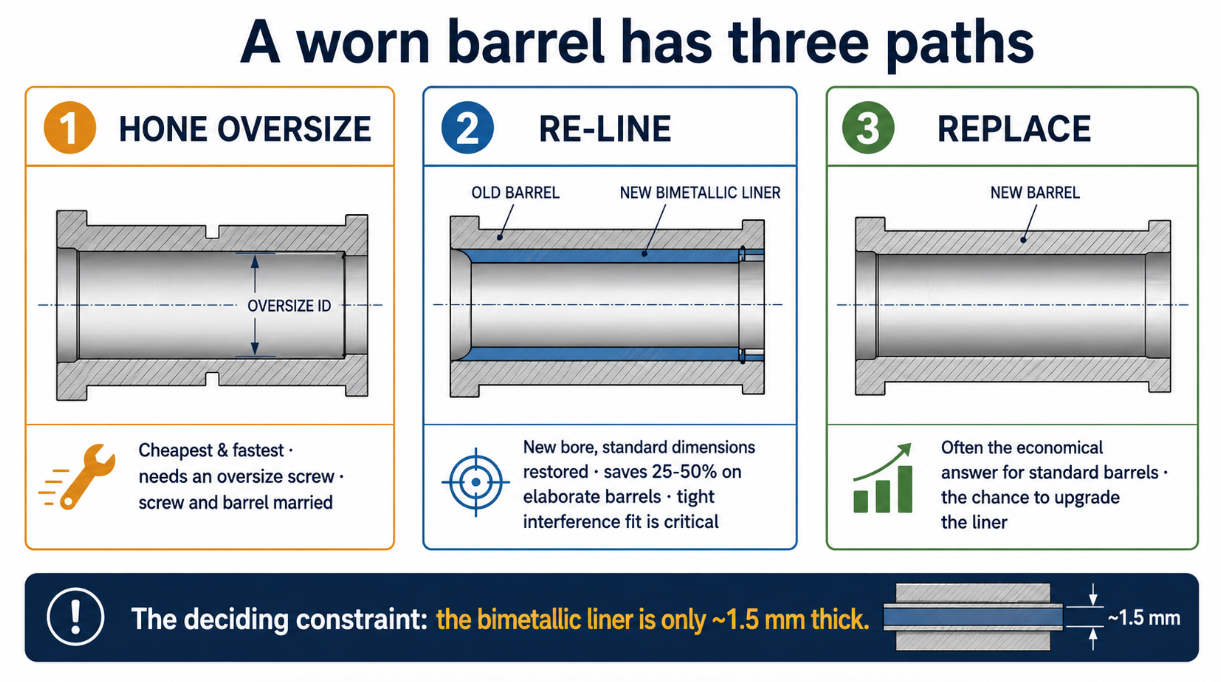
Quick answer: a worn extruder barrel has three paths — honing the bore to an even oversize (and pairing it with an oversize screw), re-lining it with a new bimetallic sleeve, or replacing it. Honing is the cheapest and fastest but marries the screw to that barrel; re-lining can save 25–50% versus a new barrel under the right circumstances; and for ordinary standard extrusion barrels, replacement is often the economical answer, because new extrusion barrels are relatively affordable and the repair margin is small. The deciding constraint most buyers don’t know: the bimetallic liner is only about 1.5 mm thick when finished — that’s all the material there is to work with. Here’s how each path works, the honest economics, and how to decide from your measurements.
By the BLOOM Engineering Team
The Constraint That Frames Everything: ~1.5 mm of Liner
A bimetallic barrel’s wear resistance lives in a thin, centrifugally-cast alloy liner bonded to the steel backing — and the finished liner is typically only about 1.5 mm (0.060 in.) thick. Every millimeter of bore wear, and every honing pass, consumes it. That single number decides most repair questions:
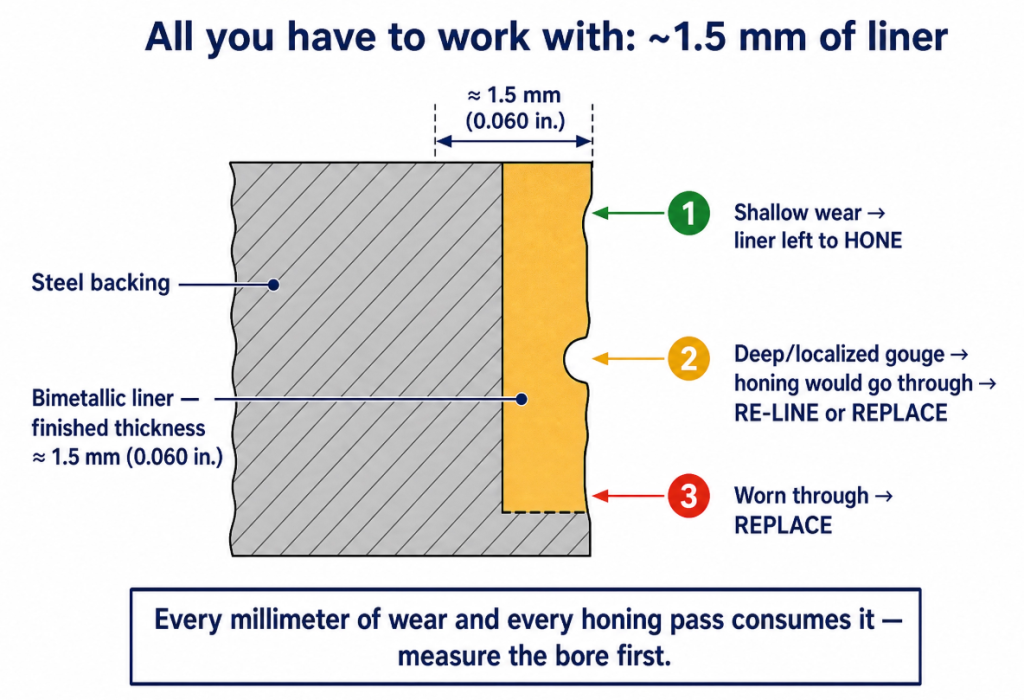
- Shallow, smooth wear → there’s liner left to hone.
- Deep or localized gouging → honing to clean it up would go through the liner; the repair must be a re-line or a replacement.
- Liner already worn through anywhere → honing is off the table entirely.
So the first step is always the same: measure the bore along its full length (worst point governs — usually the transition zone, about two-thirds down, as covered in does the screw or the barrel wear out first), and compare against the original ID to see how much liner the wear has consumed.
Option 1: Honing to Oversize — the Budget Path
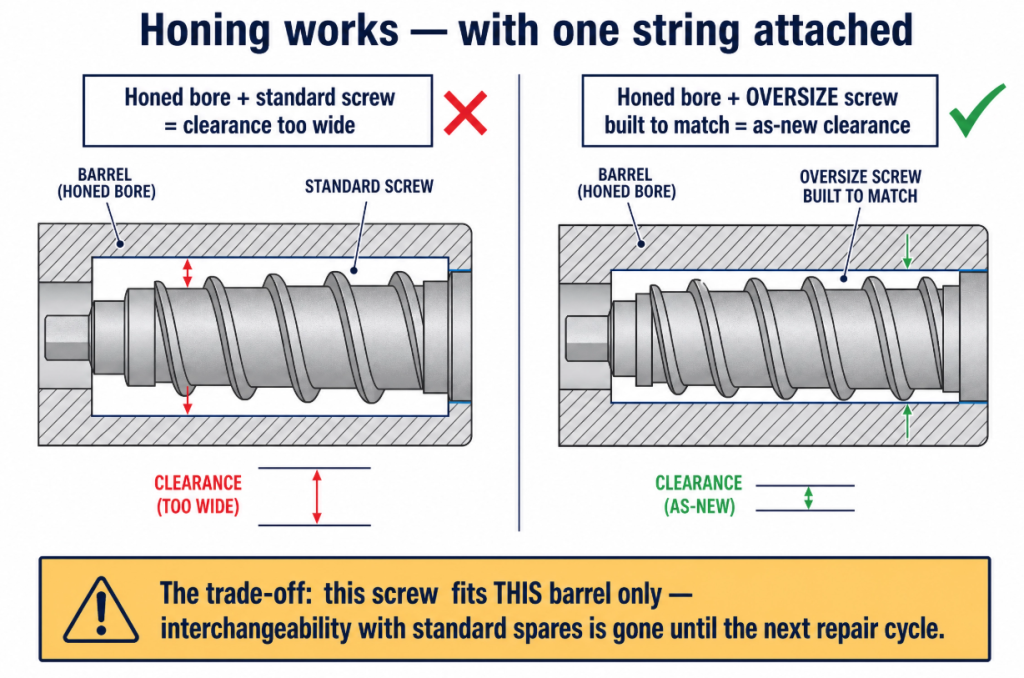
Honing re-machines the bore smooth, round, and straight at a slightly larger diameter — “100% cleanup” — removing the wear damage without replacing anything. It’s the fastest and cheapest repair, with one big string attached:
- The bore is now oversize, so a standard screw runs loose in it. The fix is to pair it with a screw built or rebuilt oversize to match the honed bore — restoring as-new clearance at the enlarged dimension.
- The trade-off: screw and barrel are married. That oversize screw fits that barrel only; interchangeability with standard spares is gone until the next repair cycle.
- The limit: liner thickness. Honing only works while there’s healthy liner remaining after cleanup — which is why deep wear disqualifies it.
For an older line where the goal is a few more economical years, honing plus a matched oversize screw is often the lowest-cost route back to as-new clearance.
Option 2: Re-Lining — a New Bore in the Old Barrel
Re-lining (re-sleeving) bores out the worn liner and installs a newly-manufactured thin-walled bimetallic sleeve into the original steel backing, restoring the barrel to standard dimensions — screw interchangeability included. Two honest points from the industry literature:
- Done right, a re-lined barrel performs equal to a new one. The critical requirement is an extremely tight metal-to-metal interference fit between sleeve and backing — typically achieved by precision boring and heat-shrinking — and not every shop can do it well. A corner-cutting re-line transfers heat poorly and hurts the process.
- The economics are conditional. Savings of 25–50% versus a new barrel are achievable under the right circumstances — but making a sleeve involves nearly all the steps of making a new barrel, so for ordinary barrels the margin can shrink toward zero. Where re-lining clearly pays: large barrels, water- or oil-jacketed barrels, grooved-feed sections, pin barrels, and other elaborate constructions whose replacement cost is high.
- Partial (short) sleeves are the economical variant: because wear concentrates in the transition zone, re-lining just the worn section — rather than the full length — restores performance at a fraction of the full re-line cost, where the barrel design allows it.
Option 3: Replacement — More Often the Answer Than You’d Think
Here’s the honest part most repair-focused articles skip: for standard, unjacketed extrusion barrels, a new barrel is often the economical choice. New extrusion barrels cost meaningfully less than injection barrels of similar size, which leaves little margin for a repair that involves most of the same manufacturing steps. Replacement is the right call when:
- The liner is worn through or the wear is too deep to hone or economically sleeve.
- The backing itself is damaged — cracked, bent, or with damaged threads/flanges.
- The barrel is a standard size and construction where a repair quote approaches the new price.
- You want an upgrade anyway — replacement is the chance to move from a basic liner to a tungsten-carbide-grade bimetallic for abrasive work, exactly as with screws. A barrel that wore out prematurely on glass-filled compound shouldn’t be re-lined to the same specification; see how long a bimetallic barrel lasts for what the right liner buys.
The Decision at a Glance
| Situation | Best path | Why |
|---|---|---|
| Shallow, even wear; liner healthy after cleanup | Hone + oversize screw | Cheapest, fastest; accept the married pair |
| Deep/localized wear; large, jacketed, grooved, or pin barrel | Re-line (full or partial) | 25–50% savings vs the high cost of replacing an elaborate barrel |
| Wear concentrated in one zone; design allows | Partial (short) sleeve | Restores the worn section at a fraction of full re-line cost |
| Standard barrel; repair quote near new price | Replace | New extrusion barrels are relatively affordable — no repair margin |
| Liner worn through, backing damaged | Replace | Nothing left to repair against |
| Premature wear on abrasive material | Replace with upgraded liner | Re-lining the same spec repeats the failure |
And one rule that applies to every row: decide screw and barrel together. Clearance is the sum of both parts’ wear — run your measurements through the screw wear limit calculator, and never pair a fresh part with a worn one and expect as-new performance.
What to Measure and Send for an Assessment
- Bore ID at multiple points along the length (bore gauge) — especially the transition zone; note the worst reading and where it is.
- The original barrel drawing or nominal ID, so wear depth can be calculated against the ~1.5 mm liner budget.
- The matching screw’s flight OD measurements — the decision is a pair decision.
- Barrel construction details — plain, jacketed, grooved feed, vented — because they swing the repair-vs-replace economics.
- What you process — filler content drives the liner recommendation if replacing or re-lining.
A worn barrel isn’t automatically a repair job or automatically a replacement — it’s a measurement question: how much of the ~1.5 mm liner is left, how elaborate the barrel is, and what the matching screw needs — so measure the bore, measure the screw, and choose the path the numbers point to rather than the one a repair shop or a barrel salesman defaults to.
At BLOOM, we manufacture new bimetallic barrels and build screws to standard or oversize dimensions to match honed bores — so whichever path your measurements point to, we can quote it honestly, including telling you when a repair isn’t worth it. Send our engineering team your bore measurements, barrel construction, and screw OD readings on WhatsApp and we’ll help you decide between honing, re-lining, and replacement — and build whichever part the decision calls for.
References and Further Reading
- Barrel Repair: When Does It Make Sense?, Plastics Technology — repair savings of 25–50% under the right circumstances, why repair isn’t viable for most barrels, the sleeve/interference-fit process, and where elaborate barrels shift the economics: https://www.ptonline.com/articles/barrel-repair-when-does-it-make-sense
- Troubleshooting Screw and Barrel Wear in Extrusion, Plastics Technology — the ~0.060 in. (1.5 mm) finished bimetallic liner thickness, barrel ID tolerances, and measuring bore wear when the screw is out: https://www.ptonline.com/articles/troubleshooting-screw-and-barrel-wear-in-extrusion


Pingback: How to Measure Twin Screw Barrel Wear: The Figure-8 Bore Method