
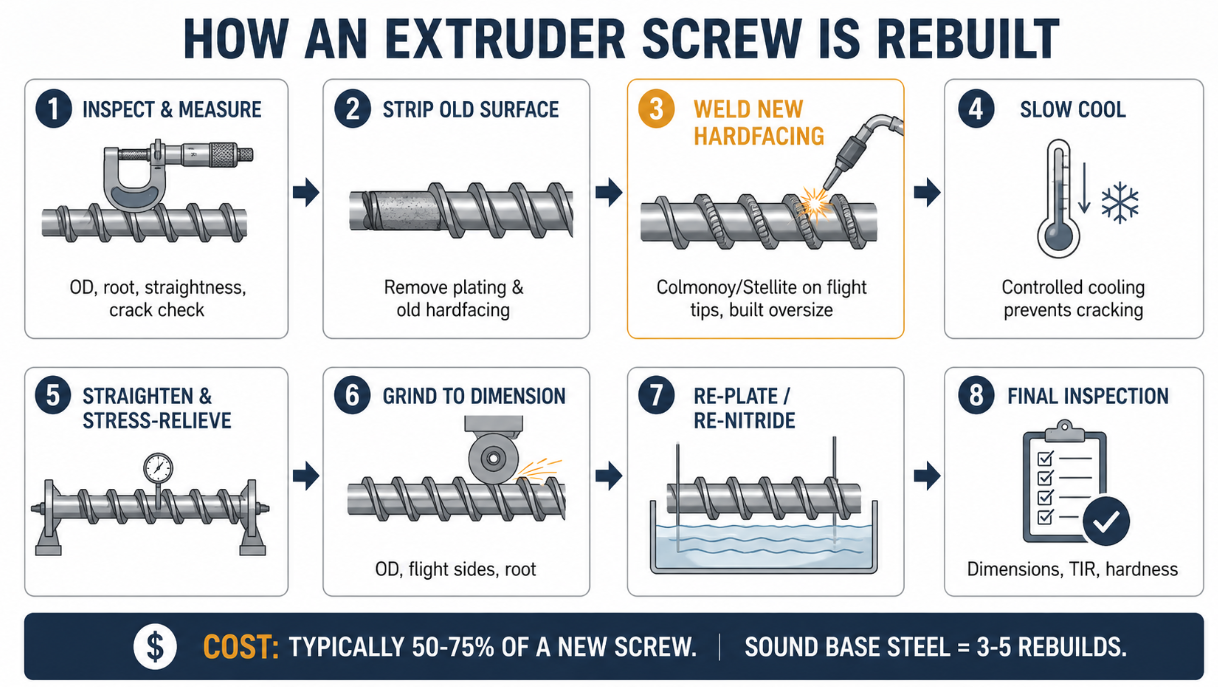
Quick answer: rebuilding a worn extruder screw means stripping the old surface, welding new hardfacing onto the flight tips, and precision-grinding the screw back to dimension — it typically costs 50–75% of a new screw, and a screw with sound base steel can be rebuilt 3–5 times over its life. Rebuilding wins when the wear is on the flights and the core is healthy; replacement wins when the screw is bent, cracked, root-worn, or was the wrong design for the job in the first place. Here’s what a proper rebuild involves, the numbers behind the decision, and the cases where rebuilding is false economy.
By the BLOOM Engineering Team
What a Proper Rebuild Actually Involves
A rebuild is not “welding some metal on and polishing it.” Done correctly, it’s a controlled manufacturing process — and knowing the steps helps you judge whether a quote is for a real rebuild or a cosmetic one:
| Step | What happens | Why it matters |
|---|---|---|
| 1. Inspection & measurement | Flight OD along the full length, root diameter, straightness, dye-penetrant check for cracks | Determines if the screw is even a rebuild candidate |
| 2. Strip the old surface | Chrome or nitride layer removed; old hardfacing ground off the flight tops | New weld must bond to clean base metal |
| 3. Weld new hardfacing | Nickel- or cobalt-based alloy (Colmonoy, Stellite) laid on the flight tips by PTA welding, built oversize | Restores the wear surface — the heart of the rebuild |
| 4. Controlled slow cooling | Screw buried in insulating medium for extended cooling | Prevents weld and base-metal cracking |
| 5. Straighten & stress-relieve | Bend and residual stress corrected | A rebuilt screw that isn’t straight destroys itself and the barrel |
| 6. Grind back to dimension | OD ground to spec; flight sides ground; root repaired and polished | Restores the actual geometry, not just the diameter |
| 7. Re-plate or re-nitride | Chrome plating or nitriding reapplied where the application needs it | Restores corrosion protection and root wear resistance |
| 8. Final inspection | Dimensions, straightness/TIR, hardness, surface finish | Verifies the screw actually meets drawing spec |
The hardfacing alloy is chosen for the duty — standard nickel-based grades for general work, tungsten-carbide-bearing grades for heavily glass-filled materials. The alloy choice is the same decision as on a new screw, covered in our Stellite vs Colmonoy guide.
The Numbers Behind the Decision
- Cost: typically 50–75% of a new screw. The larger and more complex the screw, the more the rebuild saves in absolute terms — big twin-screw elements and long single screws are where rebuilds shine.
- Rebuild count: about 3–5 times on a screw with sound base steel. The practical limit is flight width: each rebuild cycle grinds the flight sides, and once the flights have narrowed appreciably, the geometry is no longer the design geometry. A rebuild done carefully, without unnecessary side-grinding, preserves more future rebuilds.
- Lead time: usually shorter than a new screw, because there’s no machining from bar stock — a real advantage when a line is down.
- What it restores: performance, not just appearance. A correct rebuild returns the clearance to as-new, which is what recovers the lost output and melt quality — the whole point. For where your screw stands against the limits, run your numbers through our screw wear limit calculator.
The Option Most Buyers Don’t Know: Rebuilding Oversize to Fit a Worn Barrel
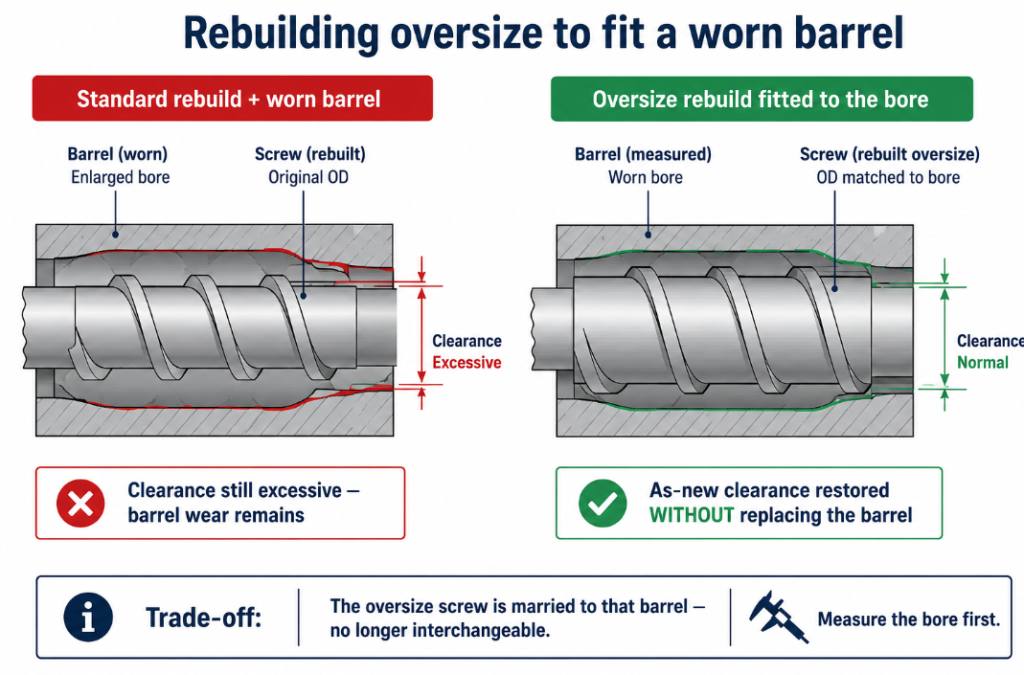
Here’s a practical option worth knowing. Clearance is the sum of screw wear and barrel wear — so a screw rebuilt to original dimension and dropped into a worn barrel still runs with excess clearance. When the barrel bore has worn beyond spec but the liner is otherwise healthy, a screw can instead be rebuilt slightly oversize, custom-fitted to the measured bore of your actual barrel. That restores the running clearance without replacing the barrel.
The trade-off is honest: an oversize screw is married to that barrel — it’s no longer interchangeable with a standard one. But for an older line where a barrel replacement is hard to justify, measuring the bore and building the screw to fit it is often the most economical way back to as-new clearance. It’s one more reason the barrel must always be measured before deciding anything — see does the screw or the barrel wear out first.
When Rebuilding Wins — and When It’s False Economy
| Situation | Rebuild or replace? | Why |
|---|---|---|
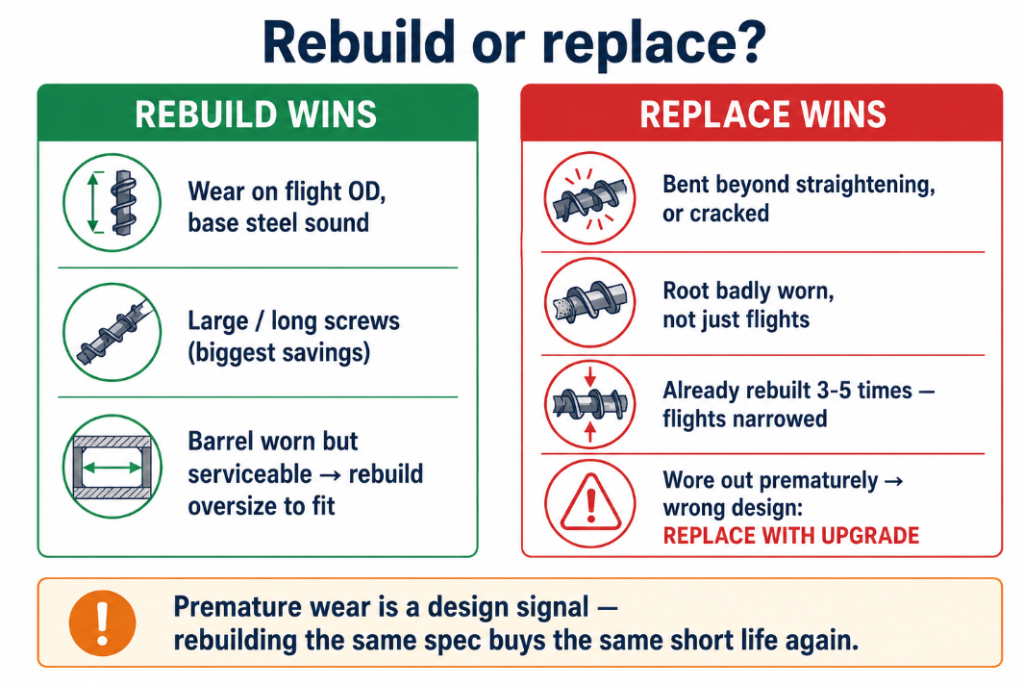
| Wear concentrated on flight OD, base steel sound | Rebuild | The classic case — hardfacing restores exactly what wore |
| Large-diameter or long screw | Rebuild (usually) | Absolute savings are biggest where new screws cost most |
| Barrel worn but serviceable | Rebuild oversize to fit | Restores clearance without a new barrel |
| Screw bent beyond straightening, or cracked | Replace | Structural integrity can’t be welded back |
| Root badly worn or corroded, not just flights | Replace (usually) | Root reconstruction plus flights approaches new-screw cost |
| Already rebuilt 3–5 times; flights narrowed | Replace | The geometry is no longer the design |
| Small-diameter screw | Replace (often) | Rebuild cost approaches new-screw cost — the saving evaporates |
| Screw wore out prematurely / wrong design for the material | Replace with upgrade | Rebuilding repeats the weakness; replacement is the chance to fix it |
The last row deserves emphasis, because it’s the mistake we see most. If a screw wore out in a year on glass-filled compound, the problem isn’t age — it’s that the screw’s material or surface wasn’t specified for the duty. Rebuilding it to the same specification buys you the same short life again. Premature wear is a design signal: the replacement (or even the rebuild) should upgrade the hardfacing, the base material, or the geometry to match the real duty — see how to select screw materials.
What to Send for a Rebuild Assessment
A serious rebuild quote starts with data, not a price list. What the assessment needs:
- Flight OD measured at several points along the screw (worst point governs), and the barrel bore measurement — both, always.
- Photos of the flights, root, and any damaged areas.
- The material you process (and filler content) — it sets the hardfacing recommendation.
- The original drawing if you have it — otherwise the screw itself can be reverse-measured.
From that, an honest shop tells you one of three things: it’s a straightforward rebuild, it’s a rebuild-oversize-to-your-barrel case, or the screw isn’t worth rebuilding and here’s why. Getting that answer before committing is the whole value of the inspection step.
A rebuild is the right call more often than not — when the base steel is sound, it returns as-new clearance at 50–75% of the cost and usually faster — but the decision should always start from measurements of both screw and barrel, an honest look at how many rebuilds the screw has already had, and the question of whether the original design was right for the duty in the first place.
At BLOOM, we both manufacture new extruder screws and barrels and rebuild worn ones — hardfacing, grinding, straightening, and re-plating back to drawing spec, or oversize to fit your measured barrel. Send our engineering team your screw diameter, measured OD and bore, photos, and the material you run on WhatsApp and we’ll tell you straight whether your screw is worth rebuilding, needs replacing, or should be upgraded to a tougher specification. For the wear limits that drive the decision, see how much extruder screw wear is acceptable.
References and Further Reading
- Troubleshooting Screw and Barrel Wear in Extrusion, Plastics Technology — the clearance limits and performance losses that trigger the rebuild-or-replace decision: https://www.ptonline.com/articles/troubleshooting-screw-and-barrel-wear-in-extrusion
- Essential Feedscrew and Barrel Maintenance, Davis-Standard — screw and barrel wear economics and maintenance practice: https://davis-standard.com/custom_blog/essential-feedscrew-and-barrel-maintenance-part-ii/


Pingback: Conical Twin Screw Barrel: Sizes, Wear & Specs