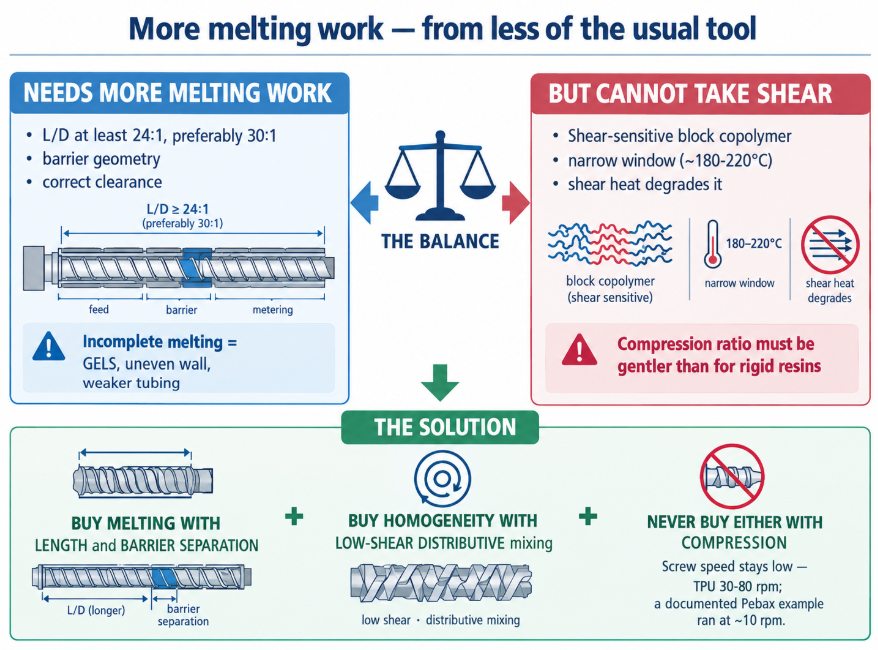
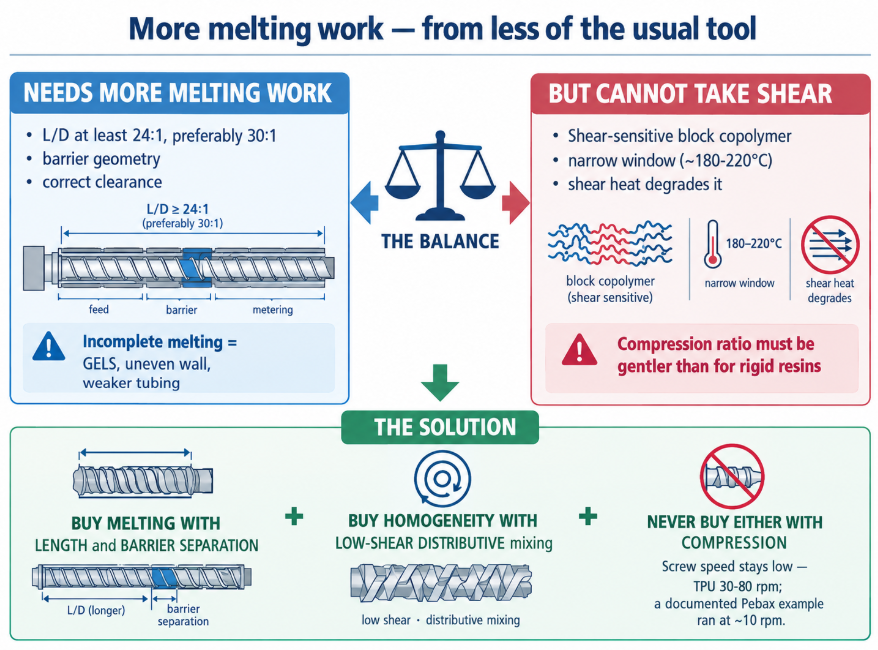
TPU and Pebax present the screw with a contradiction — they need substantial melting work (L/D of at least 24:1, preferably 30:1, with barrier geometry) because incomplete melting produces gels and uneven walls, but they are shear- and heat-sensitive with narrow processing windows, so that melting work cannot come from compression and shear. The resolution: buy melting with length and barrier separation, buy homogeneity with low-shear distributive mixing, and never buy either with aggressive compression. Both are block copolymers, both hydrolyse if the pellets aren’t dry, and both are soft enough that feeding and clearance behave differently than with rigid resins. Here’s the specification.
By the BLOOM Engineering Team
Why These Resins Are Difficult
TPU and Pebax (PEBA) are both block copolymers — soft segments giving flexibility, hard segments giving strength — and that structure is exactly what makes them fussy:
| Property | Consequence for the screw |
|---|---|
| Shear-sensitive | Excess shear heat degrades the polymer; compression ratio must be gentler than for rigid resins |
| Narrow processing window | Extrusion around 180–220°C for TPU; precise zone-by-zone control needed to avoid under-melting at one end and degradation at the other |
| Hydrolysis-prone | Moisture at melt temperature attacks the chain — a drying problem the screw cannot fix |
| Soft, sometimes tacky pellets | Feed section behaviour differs from rigid pellets; bridging and slip are real |
| Stays soft after the die | Cooling must be gradual and controlled — a downstream issue, but it means dimensional errors from the screw are locked in later, not corrected |
Melting: The Requirement Everyone Under-Specifies
Material-supplier guidance is unusually specific here: an L/D of at least 24:1, and preferably 30:1, so the TPU has time to melt uniformly before reaching the die. Too low, and you get incomplete melting — which shows up as gels, uneven wall thickness, and weaker tubing.
Two things follow.
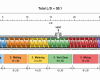
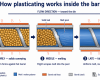
First, a barrier screw with a mixing section is the right architecture. The barrier separates melted TPU from portions that haven’t fully melted, and the mixing section then blends everything together — attacking the unmelt problem structurally rather than by turning the heat up. The general case is in our barrier screw vs general-purpose guide; on shear-sensitive resins the mixing element must be distributive, not dispersive — homogenizing without adding shear heat, per our mixing section selection guide.
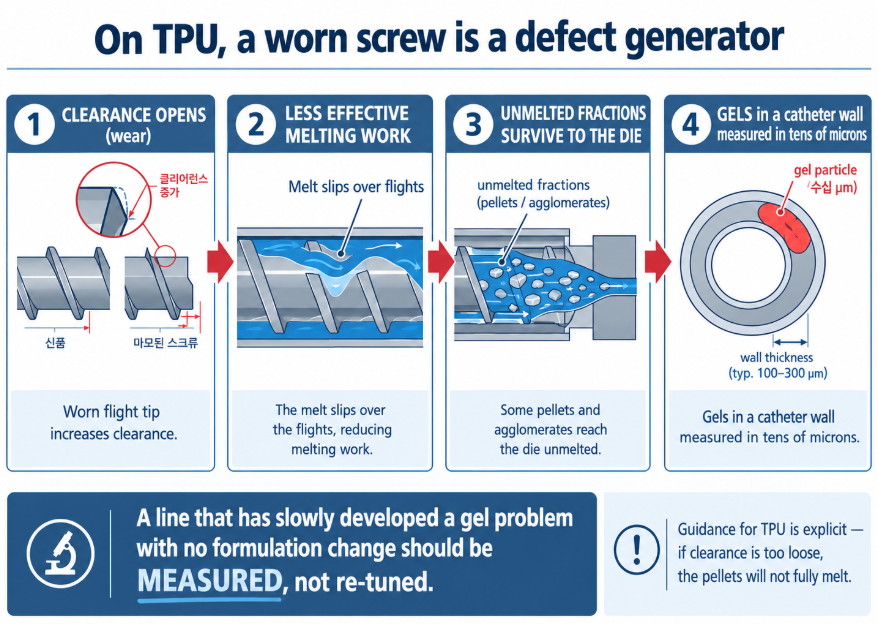
Second — and this is the part most processors miss — screw clearance affects melting, not just output. Guidance for TPU is explicit: if clearance is too loose, the pellets will not fully melt, and gels or fish eyes appear. That reframes wear entirely on these lines:
Clearance opens (wear)
   → less effective melting work
      → unmelted fractions survive to the die
         → GELS in a catheter wall measured in tens of microns
So on a TPU or Pebax line, a worn screw is a quality defect generator before it is a capacity problem — and a line that has slowly developed a gel problem with no formulation change should be measured, not re-tuned. Check against our wear limit calculator; the gel-diagnosis logic itself is in our gels and fish-eyes guide.
But Not With Shear: The Compression Ratio Constraint
Everything above says “more melting work.” The constraint says “not from shear.” TPU is shear-sensitive, so screws use a gentler compression ratio than rigid plastics, avoiding the shear heat that degrades the material.
That leaves a specific division of labour:
- Length (L/D 24–30:1) provides residence for conductive melting.
- Barrier geometry ensures completeness rather than relying on brute compression.
- Distributive mixing provides homogeneity with little or no temperature rise.
- Compression ratio stays moderate — it is not the tool for this job.
- Screw speed stays low. TPU commonly runs at 30–80 rpm; a documented Pebax tubing example ran an 18 mm extruder at around 10 rpm. Slow, gentle, and complete beats fast and hot.
The same “get the mixing from length and geometry, never from compression and shear” pattern appears in LSZH cable compounds — different reason (filler dehydration there, polymer degradation here), identical resolution.
Moisture: The Problem the Screw Can’t Solve
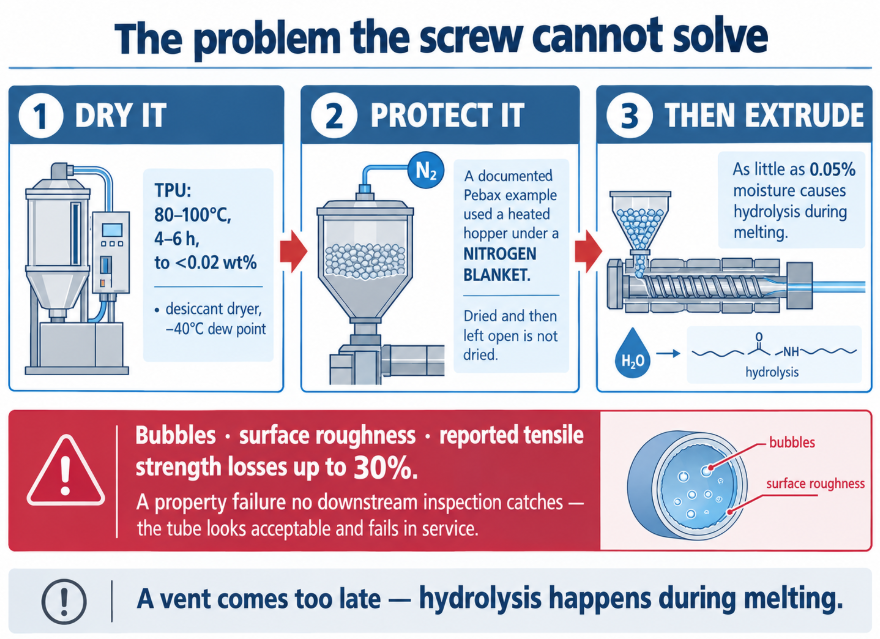
Both resins hydrolyse, and the numbers are unforgiving:
| Parameter | TPU (medical grade) | Pebax (documented example) |
|---|---|---|
| Drying temperature | 80–100°C | ~75°C, overnight |
| Drying time | 4–6 hours (some grades 3–4 h) | Overnight |
| Target moisture | <0.02 wt% | <0.15 wt% for that grade |
| Dryer type | Desiccant, dew point −40°C or lower | Oven, then protected hopper |
| What failure looks like | Bubbles, surface roughness, reduced mechanical strength | Same family of defects |
As little as 0.05% moisture by weight can cause hydrolysis during melting, and improperly dried TPU has been reported to lose up to 30% of tensile strength. That is a material property failure that no downstream inspection catches — the tube looks acceptable and fails in service.
Two practical points:
- Protect the pellets after drying. The Pebax example placed dried pellets in a heated hopper under a nitrogen blanket specifically to prevent re-absorption before extrusion. Dried and then left open is not dried.
- The screw cannot vent this away. Hydrolysis happens during melting, and a vent comes too late — the same limitation as with PET and nylon. Drying is upstream of everything the screw can do.
Feeding Soft Pellets
Soft and tacky pellets don’t convey like rigid ones. Practical considerations:
- Feed throat cooling matters. Heat conducting back toward the hopper softens pellets before they should soften, encouraging bridging and slip. Documented medical-polymer lines run chilled feed sections for exactly this reason.
- Feed section geometry should convey positively without compacting soft pellets into a plug.
- Regrind and additive handling changes bulk density and flow — worth flagging if feeding becomes erratic after a material change.
Symptoms and What They Point To
| Symptom | Most likely cause |
|---|---|
| Gels / fish eyes | Incomplete melting: insufficient L/D, no barrier, or clearance too loose from wear |
| Bubbles, surface roughness, weak tubing | Moisture — drying, or re-absorption after drying |
| Uneven wall thickness | Incomplete melting, or output instability |
| Melt hotter than setpoints; discoloration | Excess shear — compression ratio or screw speed too aggressive |
| Erratic feeding, output surging | Soft-pellet bridging or slip; feed throat too warm |
| Gels appearing gradually over months | Wear — measure before re-tuning |
| Dimensional drift only at high rates | Melting capacity reached — the screw can’t melt that throughput gently |
TPU and Pebax ask the screw to do more melting work than a rigid resin needs, using less of the tool that normally does it — so the answer is a longer, barrier-equipped, gently-compressed screw turning slowly, with distributive mixing to finish the job and dry pellets to make any of it worthwhile.
At BLOOM, we build extruder screws and barrels for TPU, Pebax, and TPE medical tubing — barrier geometry with low-shear distributive mixing, moderate compression, tight manufacturing tolerance for micro-extrusion, and full material and dimensional documentation. If you’re fighting gels, dimensional drift, or a line that used to run clean, send our engineering team your resin grade and Shore hardness, tube dimensions, extruder model and L/D, screw speed, and drying setup on WhatsApp and we’ll tell you whether it’s geometry, wear, or moisture. For the wider medical picture, see our medical tubing screw and barrel guide.
References and Further Reading
- Maximizing the Potential of TPU Extrusion in Medical Tubing Applications, Medical Design Briefs, 2024 — Lubrizol engineering guidance on L/D of at least 24:1 and preferably 30:1, incomplete melting causing gels and uneven wall thickness, clearance too loose preventing full melting, and barrier screws with mixing sections as the remedy: https://www.medicaldesignbriefs.com/component/content/article/52164-maximizing-the-potential-of-tpu-extrusion-in-medical-tubing-applications
- US Patent 11,986,988 (USPTO) — a documented Pebax 7233 medical tubing example: resin dried to below ~0.15% moisture, held in a heated hopper under a nitrogen blanket to prevent re-absorption, extruded on an 18 mm single screw at roughly 10 rpm: https://image-ppubs.uspto.gov/dirsearch-public/print/downloadPdf/11986988
- From TPU Pellets to Finished Tube: Inside a Modern TPU Tubing Production Line — drying at 80–90°C for 3–4 hours with a desiccant dryer at −40°C dew point, as little as 0.05% moisture causing hydrolysis, and reported tensile strength losses up to 30% from improperly dried pellets: https://www.tpu8.com/from-tpu-pellets/