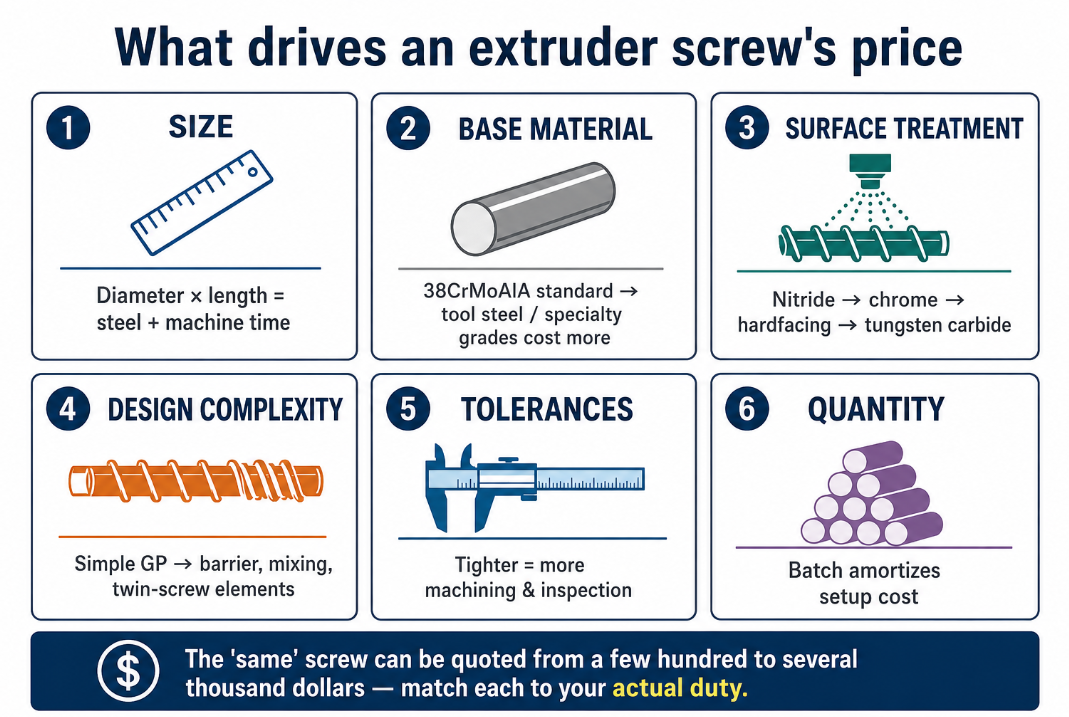
Quick answer: an extruder screw’s price is driven by six things — size, base material, surface treatment and hardfacing, design complexity, required tolerances, and quantity — which is why the “same” screw can be quoted anywhere from a few hundred to several thousand dollars. The single most important thing to understand as a buyer is that a low quote usually means a cheaper input somewhere — thinner or lower-grade steel, skipped heat treatment, or a shortcut surface — and that shortcut shows up later as short life or a breakage that costs far more than the price difference. Here’s what actually drives the number, and how to read a quote so you’re comparing like with like.
By the BLOOM Engineering Team
The Six Factors That Set the Price
| Factor | Cheaper | More expensive |
|---|---|---|
| Size (diameter × length) | Small diameter, short | Large diameter, long — more steel, bigger machines |
| Base material | Standard nitriding steel (38CrMoAlA) | Tool steels, HSS cores, specialty corrosion-resistant grades |
| Surface treatment | Nitriding only | Hard chrome, hardfacing (Colmonoy/Stellite), tungsten carbide, full encapsulation |
| Design complexity | Simple single-flight GP screw | Barrier, mixing sections, twin-screw elements, vented designs |
| Tolerances | Standard | Tight tolerances for precision/medical/tight-gauge work |
| Quantity | One-off | Repeat/batch orders (setup cost amortized) |
1. Size
The most intuitive factor: a bigger screw is more steel and needs bigger lathes, grinders, and heat-treat capacity. Diameter and flighted length both drive it — a long, large-diameter screw can cost many times what a small one does simply in material and machine time.
2. Base Material
The base steel is a real cost lever. Standard nitriding steel (38CrMoAlA) is the economical default and right for most jobs. But high-torque or long screws may need through-hardened tool steel or a high-speed-steel core for torsional strength, and corrosive processes may need specialty grades — all of which cost more than the standard steel. The material decision is covered in our screw material selection guide.
3. Surface Treatment and Hardfacing
This is often the biggest single swing in price, because it’s where wear resistance is bought. A nitrided-only screw is the baseline; adding hard chrome (corrosion), hardfacing the flights with nickel- or cobalt-based alloy (abrasion), tungsten-carbide grades (severe abrasion), or full encapsulation each adds cost — and each buys service life in the right application. Running glass-filled compound without hardfacing is false economy; paying for tungsten carbide to run unfilled PP is wasted money. The alloy-by-alloy breakdown is in our Stellite vs Colmonoy guide and the full menu in our coating guide.
4. Design Complexity
A simple general-purpose single-flight screw is the cheapest to make. A barrier screw with a mixing section, a twin-screw built from many kneading and conveying elements, or a vented two-stage design all take more engineering and more machining — and cost accordingly. This is design cost buying performance: a barrier screw costs more but can deliver 20%+ more output, which is the barrier-vs-GP upgrade decision.
5. Tolerances
Tighter tolerances cost more to hold — more careful machining, more grinding passes, more inspection. Precision film, medical, and tight-gauge work justify the tighter tolerances; general pipe and profile may not need them. Paying for precision you don’t need is waste, but under-specifying tolerance for a demanding job causes quality problems from day one.
6. Quantity
Setup, programming, and fixturing are largely fixed costs spread across the order. A one-off replacement carries all of that on a single piece; a repeat or batch order amortizes it, lowering the per-screw price. If you know you’ll need spares, ordering together is usually cheaper per unit.
Why the Lowest Quote Is Usually a Trap
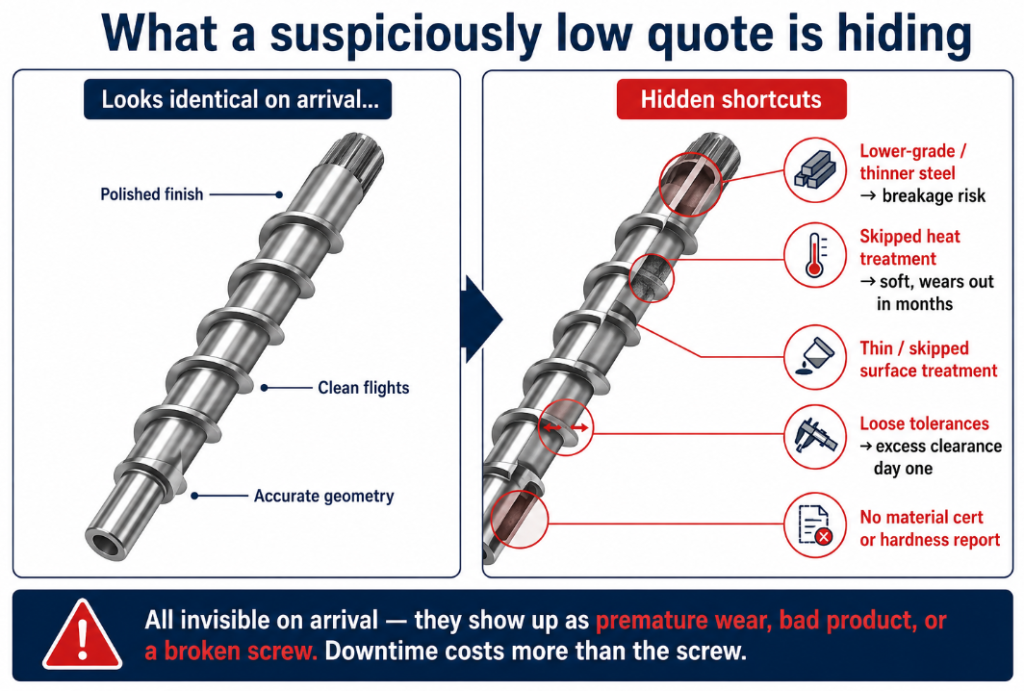
Buyers searching on price alone routinely find the “same” screw quoted from a few hundred to several thousand dollars — and assume the cheap one is a bargain. It rarely is. The low price almost always comes from a cheaper input you can’t see in a photo:
- Lower-grade or thinner steel that lacks torsional strength — a breakage risk.
- Skipped or shortened heat treatment — the screw looks identical but is soft, and wears out in months.
- Thinner or skipped surface treatment — nitriding case too shallow, chrome too thin, hardfacing omitted.
- Loose tolerances — runs with excess clearance from day one, costing output.
- No documentation — no material certificate, no hardness report, because measuring costs money and they didn’t.
The trap is that all of these are invisible on arrival and only reveal themselves in service — as premature wear, degraded product, or a broken screw that takes downtime and sometimes the barrel with it. In extrusion, downtime routinely costs more than the screw itself, so a screw that fails early is far more expensive than the “expensive” screw that lasted. This is why the buyers who get the best value don’t chase the lowest number — they specify clearly and compare quotes at equal specification.
How to Get a Quote You Can Actually Compare
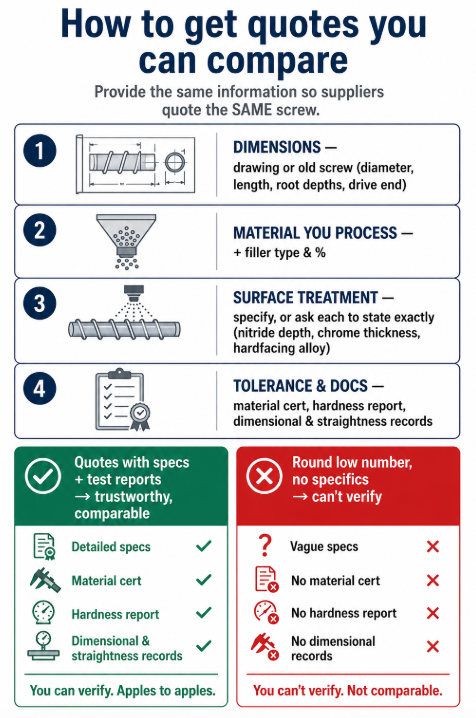
The way to avoid all of this is to make suppliers quote the same screw. Provide, up front:
- Dimensions — a drawing, or the old screw to reverse-measure (diameter, length, root depths, drive-end/spline).
- The material you process — and filler type/percentage, which drives the material and hardfacing recommendation.
- Surface treatment required — or ask each supplier to state exactly what they’re quoting (nitride depth, chrome thickness, hardfacing alloy).
- Tolerance and documentation expectations — material cert, hardness report, dimensional and straightness records.
A supplier who quotes with all of this specified — and includes the test reports — is quoting a screw you can trust; one who gives a suspiciously round low number with no specifics is quoting something you can’t verify. Our custom screw RFQ guide walks through exactly what to send, and our acceptance inspection checklist covers how to verify the screw matches the quote when it arrives.
The price of an extruder screw is really the sum of decisions about size, steel, surface, complexity, and precision — each of which should be matched to your actual duty rather than minimized blindly — so the goal isn’t the lowest quote, it’s the right specification quoted honestly, because a correctly-specified screw at a fair price is always cheaper over its life than a cheap screw that wears out or breaks.
At BLOOM, we quote extruder screws and barrels transparently — the steel, the surface treatment, the tolerances, and the test reports all specified, so you know exactly what you’re paying for and can compare fairly. Send our engineering team your drawing or old screw details, the material you run, and your application on WhatsApp and we’ll quote the right screw for the job and prove its quality with documentation. For how to specify it, see our RFQ guide.
References and Further Reading
- How to Choose the Best Extruder Screw (buying guide), Alibaba — price varies widely by size, material, and complexity; red flags include suppliers lacking material certifications, test documentation, or offering unusually low prices suggesting substandard materials: https://smartbuy.alibaba.com/buyingguides/extruder-screw
- What Does the Extruder Screw Price Depend On?, SKR Machinery — transparent engineering information and defined technical boundaries as the basis for sound pricing, versus chasing superficially low quotes: https://www.skrscrew.com/what-does-the-extruder-screw-price-depend-on/