When sourcing OEM extruder parts, the initial price tag often commands the most attention. However, seasoned procurement managers and extrusion engineers know that the true cost of a component is measured on the production floor, not on the invoice. A batch of substandard screw barrels can lead to catastrophic consequences, ranging from unexpected machine downtime to the complete contamination of an entire production run. For OEM buyers, finding a supplier with the lowest price is never the ultimate goal; securing a partner with an uncompromising and verifiable quality control process is.
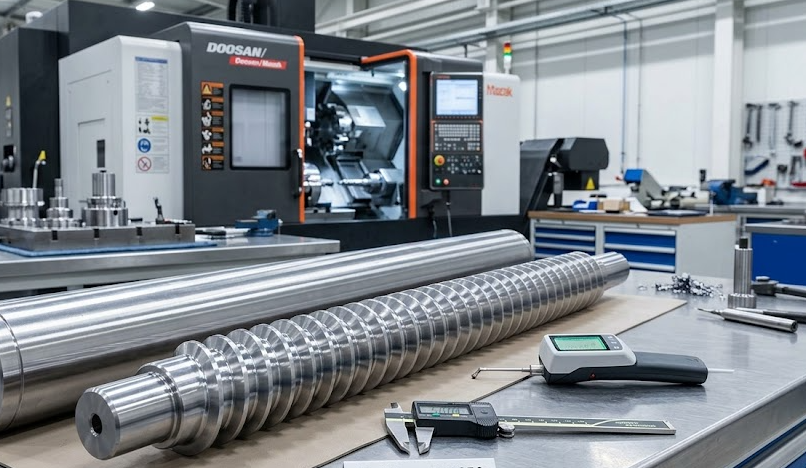
The challenge lies in distinguishing between suppliers who merely claim to have high standards and those who actually implement them. This comprehensive guide provides a practical, data-driven framework to evaluate an extruder parts supplier’s quality control process. By examining specific technical parameters, material certifications, and inspection methodologies, you can confidently select a screw barrel manufacturer that will protect your production efficiency and bottom line.
Why Quality Control Is Non-Negotiable for Extruder Parts
The screw and barrel are the heart of any extrusion or injection molding machine. They are subjected to immense mechanical stress, high temperatures, and corrosive environments. Their manufacturing precision directly dictates the melt quality, output rate, and overall lifespan of the equipment. Even microscopic deviations from specified tolerances can trigger a cascade of processing issues.
To understand the financial impact of poor quality control, consider the relationship between screw wear and production output. According to industry data, a minor increase in the radial clearance between the screw flight and the barrel wall inevitably leads to leakage flow. For instance, a 3.5-inch screw experiencing just 0.020 inches (approximately 0.5 mm) of wear can cause an average production loss of 9% in a standard extrusion process . In more severe cases, a 10% decrease in the outer diameter of an injection screw can result in a staggering 25% reduction in output .
“When the radial clearance between the screw flights and barrel wall increases, leakage flow is inevitable. The operator will typically see a reduction in throughput and an increase in melt temperature, forcing higher rpm and energy consumption to maintain the desired rate.” — Plastics Technology
These figures illustrate why compromising on the quality of OEM extruder parts is a false economy. A supplier lacking rigorous quality control might deliver a screw barrel that initially fits, but premature wear due to inferior materials or improper surface treatment will quickly erode any upfront savings through lost productivity and increased energy consumption. Therefore, evaluating a supplier’s quality control process is not just a procurement formality; it is a critical risk management strategy.
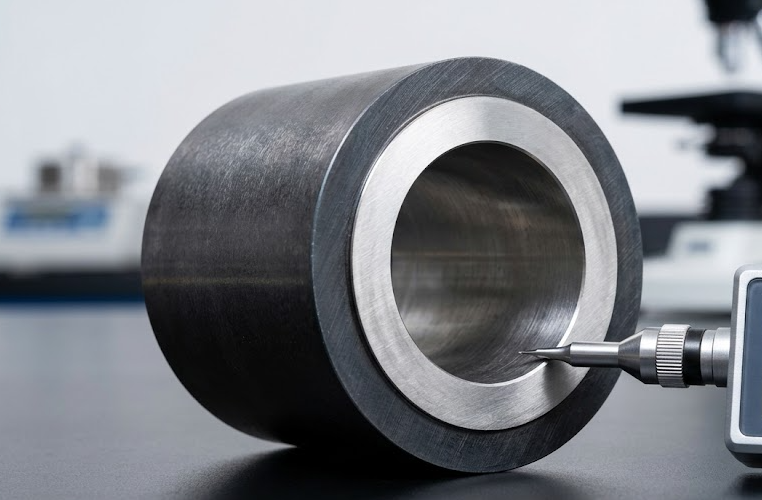
Step 1: Verify Raw Material Standards
The foundation of a high-quality screw barrel is the raw material used in its construction. No amount of precision machining can compensate for inferior steel. When evaluating a screw barrel manufacturer, the first step is to scrutinize their raw material sourcing and verification protocols.
A reputable supplier should not merely state that they use “good steel.” They must provide verifiable documentation. For standard applications, the extruder barrel and screw blanks should be forged (not cast) from high-grade anti-corrosion and wear-resistant alloy steels, such as 38CrMoAlA or 40Cr .
When auditing a supplier, demand to see their Material Test Reports (MTR) or Mill Test Certificates. Furthermore, their incoming quality control (IQC) process should include independent verification of the material’s chemical composition and mechanical properties.
Key material parameters to verify include:
- Quenching and Tempering: After rough processing, the material should be quenched and tempered to achieve a base hardness of HB 260–290 . This ensures the core of the screw has the necessary toughness to withstand high torque without snapping.
- Nitriding Specifications: For nitrided screw barrels, the depth of the nitrided layer on the inner hole of the barrel should be strictly controlled within the range of 0.40–0.70 mm, achieving a surface hardness of ≥ 950 HV. For the screw thread, the nitrided layer should be 0.3–0.6 mm deep with a hardness of 740–840 HV.
If a supplier hesitates to provide these specific metallurgical data points or relies solely on verbal assurances, consider it a major red flag.
Step 2: Assess Dimensional Inspection Capabilities
Dimensional accuracy is the critical factor that determines how well the screw and barrel will interact. The clearance between the screw flight and the barrel wall must be maintained within tight tolerances to ensure optimal plasticizing efficiency and prevent material degradation.
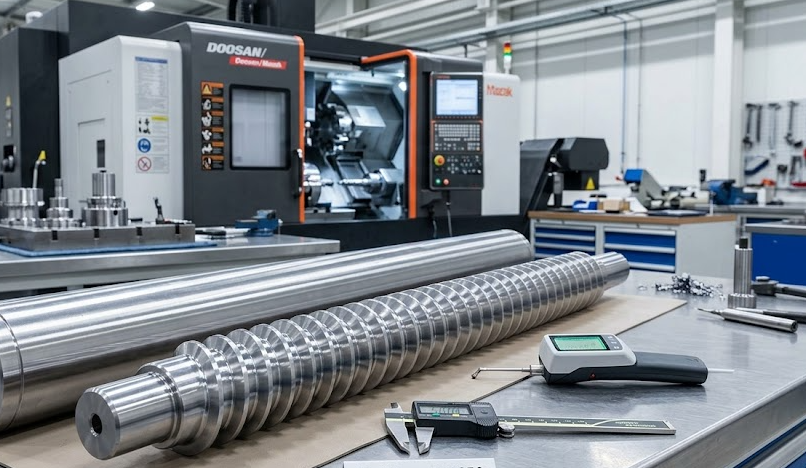
Evaluating a supplier’s dimensional inspection capabilities requires looking beyond their production machinery and focusing on their metrology lab. A supplier committed to quality will invest heavily in precision measurement equipment.
During your evaluation, inquire about the specific tolerances they guarantee and the equipment they use to verify them. You should expect to see the following standards:
- Inner Hole Accuracy: The machining accuracy of the barrel’s inner hole should conform to Level 7 accuracy standards (e.g., GB 1184-1996), with a surface roughness (Ra) not exceeding 1.6 µm
- Screw Outer Circle Accuracy: The outer circle of the finished extruder screw should meet H8 level accuracy requirements (e.g., GB/T1801-1999). The surface roughness of the thread bottom groove and outer circle should be exceptionally smooth, not exceeding 0.8 µm.
To verify these micro-level tolerances, the supplier must utilize advanced inspection tools. Ask if they employ Coordinate Measuring Machines (CMM) for full-dimensional verification, rather than relying solely on manual calipers and micrometers. Furthermore, request a sample Dimensional Inspection Report. A comprehensive report will map out the exact measurements taken at multiple points along the entire length of the screw and barrel, proving that the critical flight clearance is consistent from the feed zone to the metering zone.
Step 3: Evaluate the Quality Management System (QMS)
A single perfect sample does not guarantee consistent quality across a bulk order. True reliability stems from a robust Quality Management System (QMS) that governs every stage of the manufacturing process. When evaluating an OEM extruder parts supplier, you are essentially auditing their organizational discipline.
The most universally recognized indicator of a mature QMS is ISO 9001 certification. Statistical evidence strongly supports the value of this certification; suppliers who are compliant with ISO standards experience 30% fewer audit-related issues. However, simply holding a certificate is not enough. You must verify that the QMS is actively implemented on the shop floor.
When assessing their QMS, request to review their Quality Manual and Process Flow Charts. These documents should clearly map out the manufacturing journey, identifying Critical Control Points (CCPs) where inspections are mandatory. A reliable supplier will not rely solely on final inspection (IQC); they will implement Statistical Process Control (SPC) to monitor key dimensions during machining, catching deviations before they result in defective parts.
Furthermore, inquire about their policy on quality records. A trustworthy supplier will retain detailed production and inspection records for a minimum of 3 to 7 years, ensuring accountability long after the parts have been delivered.
Step 4: Check Surface Treatment & Hardness Testing
The surface treatment of a screw barrel—whether it is gas nitriding or the application of a bimetallic alloy—is the primary defense against abrasive and corrosive wear. It is also the manufacturing step where unscrupulous suppliers are most likely to cut corners, as the defects are invisible to the naked eye.
For standard applications, nitrided screw barrels are common. However, for processing highly abrasive materials like glass-fiber reinforced plastics or recycled resins, a bimetallic screw barrel is essential. Bimetallic barrels feature a special alloy layer (typically 1.5–2.5 mm thick) cast inside the barrel, which provides significantly higher wear resistance and a much longer service life compared to standard nitrided barrels.
To evaluate a supplier’s surface treatment quality control, you must demand empirical data. Do not accept vague claims about “high hardness.”
- For Nitrided Parts: Request a nitriding depth inspection report, which should ideally be verified through metallographic sectioning, proving the depth meets the 0.40–0.70 mm standard.
- For Bimetallic Parts: The alloy layer must be tested using a calibrated hardness tester (HRC/HV). Ask for the actual test data and photographs of the testing process.
- Brittleness Testing: The brittleness of the extruder screw should not exceed Grade 2. Excessive brittleness, often caused by improper heat treatment, can lead to catastrophic screw breakage under high torque conditions.
A confident supplier will readily provide these detailed reports and will often welcome third-party testing by organizations like SGS or Intertek to validate their claims.
For quick reference, the table below summarizes the key technical parameters you should verify when evaluating any OEM extruder parts supplier:
| Parameter | Nitrided Screw Barrel | Bimetallic Screw Barrel | Standard / Source |
|---|---|---|---|
| Base Material | 38CrMoAlA or 40Cr forged steel | 38CrMoAlA outer + alloy lining | GB standard [4] |
| Core Hardness (after Q&T) | HB 260–290 | HB 260–290 | [4] |
| Surface/Layer Hardness | ≥ 950 HV (barrel); 740–840 HV (screw) | HV 1000–1200+ (inner alloy) | [4] [6] |
| Protective Layer Depth | 0.40–0.70 mm (barrel); 0.30–0.60 mm (screw) | 1.5–2.5 mm (cast alloy lining) | [4] [6] |
| Inner Bore Roughness (Ra) | ≤ 1.6 µm | ≤ 1.6 µm | GB 1184-1996 [4] |
| Screw OD Roughness (Ra) | ≤ 0.8 µm (thread root) | ≤ 0.8 µm (thread root) | GB/T1801-1999 [4] |
| Screw Brittleness Grade | ≤ Grade 2 | ≤ Grade 2 | [4] |
| Best Application | Standard PE, PP, PS, ABS | Recycled plastics, GF-filled, PVC | [6] |
Step 5: Demand Process Traceability
In the complex world of OEM manufacturing, process traceability is the bedrock of accountability. If a screw barrel fails prematurely in your facility, the supplier must be able to trace that specific component back through every step of its manufacturing history to identify the root cause.
Effective traceability requires a systematic approach to data collection. When evaluating a supplier, verify that they assign a unique serial number or batch code to every single screw and barrel they produce. This identifier should link to a comprehensive production record that details:
- The specific batch of raw material used (linked to the MTR).
- The exact heat treatment furnace cycle and temperature logs.
- The operators responsible for each machining and inspection step.
Forward-thinking extruder parts suppliers in China and globally are increasingly adopting Manufacturing Execution Systems (MES) or IoT devices to digitize this tracking process. A supplier that can instantly pull up the complete digital history of a part demonstrates a high level of operational maturity and a genuine commitment to quality assurance.
Step 6: Conduct a Factory Audit (On-site or Virtual)
While document reviews are essential, they cannot replace the insights gained from a factory audit. Whether conducted in person or via a live video tour, an audit allows you to verify that the supplier’s stated capabilities match their actual shop floor reality.
When conducting an audit of a screw barrel manufacturer, focus your attention on these critical areas:
- Production Equipment: Look for specialized machinery. Do they have dedicated deep-hole drilling machines, heavy-duty CNC lathes, and specialized bimetallic centrifugal casting equipment? General-purpose machine shops often struggle to achieve the specific tolerances required for extruder parts.
- Inspection Equipment Calibration: A CMM or hardness tester is only as good as its last calibration. Ask to see the calibration stickers on their primary measuring devices to ensure they are current and certified by a recognized metrology institute.
- Shop Floor Management: Observe the general organization of the facility. Are in-process materials clearly labeled? Is there a designated, segregated area for non-conforming products? A clean, well-organized factory (often adhering to 5S principles) is a strong indicator of disciplined quality management.
Red Flags: Signs of a Supplier You Should Avoid
During your evaluation process, be on the lookout for these warning signs that indicate a high risk of poor quality control:
- “Trust Us” on Materials: They cannot provide verifiable Material Test Reports (MTR) and rely on vague statements like “we use the best steel.”
- Suspiciously Low Pricing: Their quote is significantly below market average, yet they refuse to provide samples or accept small-batch trial orders.
- Unverifiable Certifications: They claim to be ISO 9001 certified, but the certificate is expired, or they cannot provide the registration number for verification.
- Vague Tolerances: They are evasive when asked about specific dimensional tolerances, surface roughness (Ra) values, or testing methodologies, and cannot provide a sample inspection report.
- Resistance to Audits: They refuse to allow third-party inspections or are unwilling to conduct a comprehensive virtual factory tour.
Conclusion
Evaluating an OEM extruder parts supplier’s quality control process is fundamentally about assessing their viability as a long-term manufacturing partner. The cost of a poorly manufactured screw barrel extends far beyond its purchase price, impacting your energy consumption, material waste, and overall production efficiency.
By systematically verifying their raw material standards, dimensional inspection capabilities, QMS maturity, surface treatment data, and process traceability, you can filter out unreliable vendors. Remember, a true manufacturing partner will not shy away from these rigorous questions; they will welcome the opportunity to prove their commitment to quality.
Ready to evaluate a reliable partner? Download our comprehensive Supplier Quality Audit Checklist and contact our engineering team today to discuss your custom extruder parts requirements.