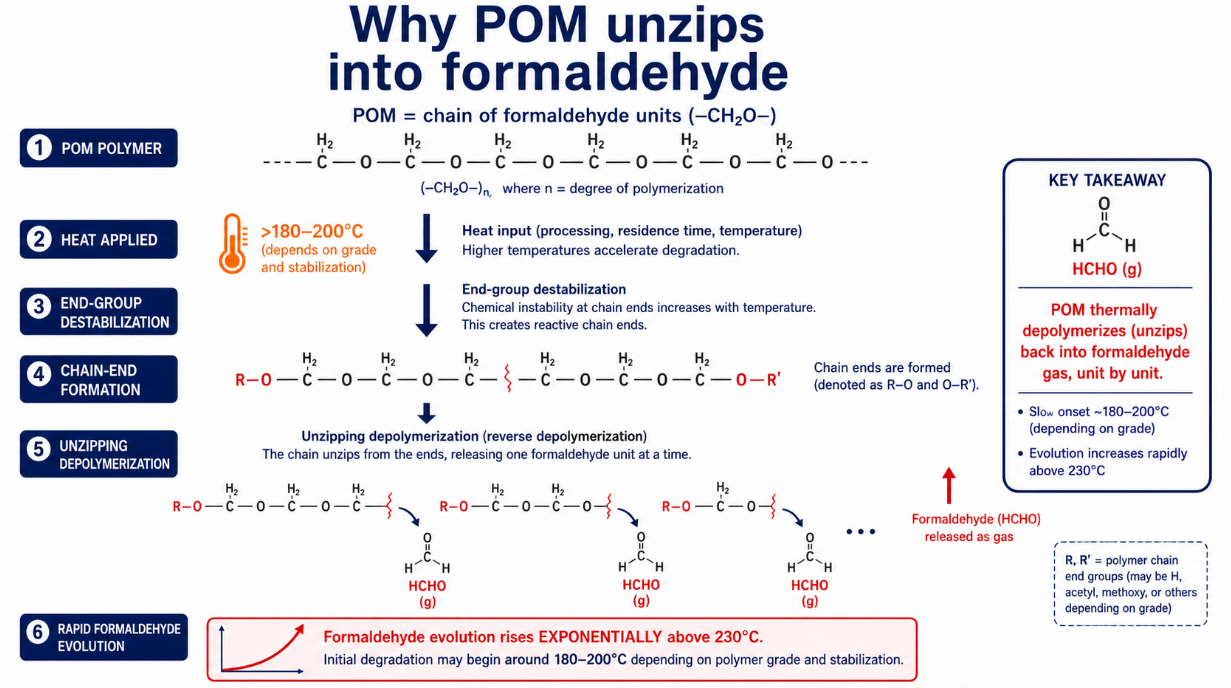
Quick answer: POM degrades because it is literally a polymer of formaldehyde — heat above its narrow processing window (roughly 190–230°C) makes it “unzip” back into the formaldehyde gas it was built from, a process called depolymerization. POM begins depolymerizing around 150°C and the formaldehyde evolution rate climbs exponentially above 230°C, so the entire challenge of processing acetal is staying inside a tight temperature-and-time window. Here are the real numbers, the mechanism, and how to keep POM from unzipping on your line.
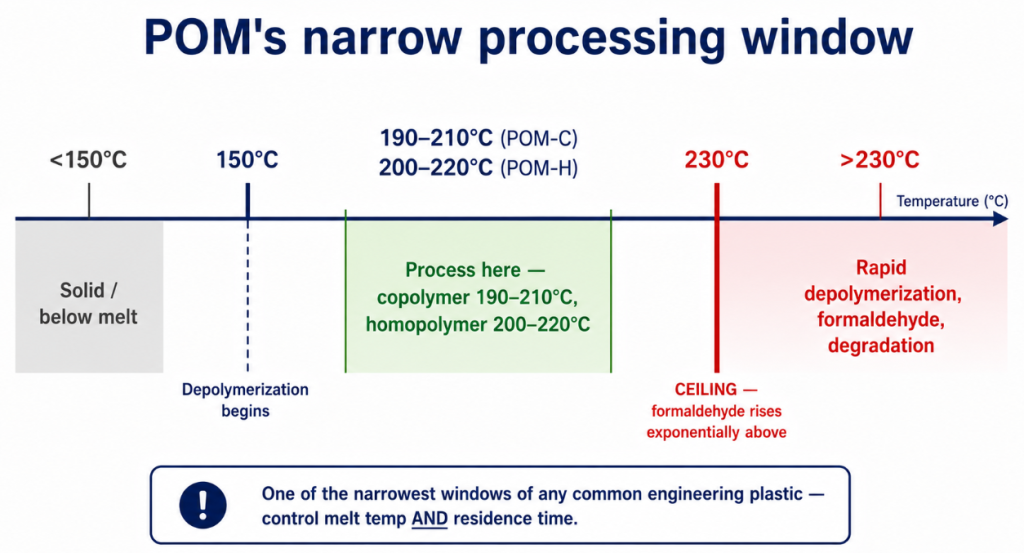
The Hard Numbers
| Parameter | POM copolymer (POM-C) | POM homopolymer (POM-H) |
|---|---|---|
| Recommended melt temperature | 190–210°C | 200–220°C |
| Absolute upper limit | ~230°C (formaldehyde rises exponentially above) | ~230°C |
| Depolymerization onset | begins ~150°C | begins ~150°C |
| Drying before processing | 80°C, 2–4 hours | 80°C, 2–4 hours |
| Thermal stability | Better — broader window | Less stable — narrower window |
The single most important number is the ~230°C ceiling — above it, formaldehyde evolution increases exponentially, not linearly, so a small overshoot causes a large jump in degradation. POM has one of the narrowest processing windows of any common engineering plastic, which is why melt-temperature control and residence-time control matter more with acetal than with almost anything else you’ll run.
The Mechanism: POM Unzips Back Into Formaldehyde
To understand POM degradation you have to understand what POM is. POM (polyoxymethylene, also called acetal or polyacetal) is a chain of repeating formaldehyde units (–CH₂O–). It was made by polymerizing formaldehyde, and heating reverses that reaction.
The degradation sequence:
- Random chain scission initiates the breakdown — the main chain breaks at points along its length. Academic thermogravimetric studies identify this random scission as the initiation mechanism.
- Depolymerization (“unzipping”) follows — once a chain end is exposed, the polymer unzips unit by unit, releasing formaldehyde gas. This is literally the polymerization reaction running backward.
- Oxidative degradation accelerates everything when oxygen is present — oxygen attacks the chain and speeds formaldehyde release through oxidative chain scission.
Mass-spectrometry analysis of degrading POM confirms the products directly: the main degradation product is formaldehyde, with carbon dioxide (and, in air, water) also formed. So the “why does it release formaldehyde” question has a precise answer — the formaldehyde isn’t a contaminant or additive, it’s the polymer itself coming apart back into its building block.
Why Copolymer Resists Degradation Better Than Homopolymer
One of the most useful practical facts about acetal: the two families degrade differently, and it affects your processing window.
- POM homopolymer (POM-H) has less inherent thermal stability. Its chain ends are more prone to initiating the unzipping reaction, so it degrades faster and has a narrower safe window.
- POM copolymer (POM-C) is made by copolymerizing with a small fraction of a stabilizing comonomer, which interrupts the unzipping — when depolymerization reaches a comonomer unit, it stops rather than running the whole chain. This gives POM-C better thermal stability, a broader molding window, less processing discoloration, and better dimensional control in demanding conditions.
The practical implication: if formaldehyde release and thermal degradation are causing you trouble, switching from homopolymer to copolymer grade often widens your processing window enough to solve it — one reason copolymer is frequently the safer default for challenging extrusion.
The Stabilizer Trap: Degradation Compounds With Reprocessing
Commercial POM contains heat stabilizers and formaldehyde scavengers that suppress degradation — but they are consumed as they work. This creates a trap that catches processors using regrind:
Every pass through the extruder consumes some of the stabilizer package. Academic reprocessing studies (running POM through up to six processing cycles) show continuous stabilizer consumption as a main process during thermal ageing, which in some cases causes a strong reduction in the thermal stability of the material. In plain terms: the more times POM has been processed, the less stabilizer it has left, and the more readily it degrades. Too much regrind, or regrind that’s already been through several heat histories, arrives with its protection depleted and unzips far more easily than virgin material.
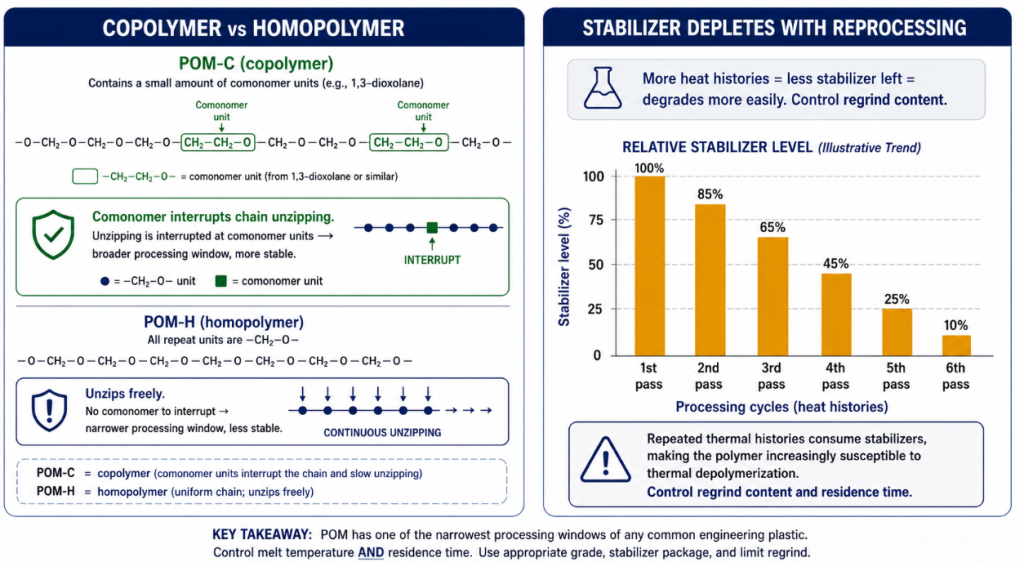
This is why POM demands tight regrind control — and why a batch that ran fine yesterday can degrade today if the regrind fraction crept up.
How to Keep POM From Degrading
Bringing it together, controlling POM degradation on an extruder comes down to respecting the narrow window:
- Hold melt temperature in range and never exceed ~230°C — the exponential formaldehyde curve above that point punishes overshoot severely. Watch actual melt temperature, not just setpoints, and account for shear heat.
- Minimize residence time — POM sitting in a hot barrel keeps unzipping, so avoid oversized machines, dead spots, and stalls. A screw designed for low shear heat and streamlined flow helps directly.
- Control regrind — limit the regrind fraction and don’t reuse material that’s already been through multiple heat histories, because its stabilizer is depleted.
- Dry the pellets — POM is also moisture-sensitive (surface defects), so dry at ~80°C for 2–4 hours; this is a smaller effect than the thermal one but still matters.
- Consider copolymer grade — POM-C’s broader window is often the simplest fix for a persistent degradation problem.
- Purge properly on shutdown — never leave POM sitting in a hot barrel during a stop; degraded POM releasing formaldehyde under pressure is both a quality and a safety concern.
POM degradation isn’t a sign of bad material or a bad machine — it’s the inherent chemistry of a polymer that reverts to formaldehyde when it gets too hot for too long, so processing acetal successfully is fundamentally about discipline within a narrow window: the right melt temperature, the shortest practical residence time, controlled regrind, and a screw that melts it gently rather than overheating it, which together keep the polymer as a polymer instead of letting it unzip back into the gas it came from.
At BLOOM, we design extruder screws and barrels for heat-sensitive engineering plastics like POM — low-shear geometry and streamlined flow that melt the material efficiently without generating the excess heat or dead-spot residence time that drives depolymerization. If you’re extruding acetal and fighting formaldehyde odor, voids, or degradation, send our engineering team your grade, melt temperatures, and symptoms on WhatsApp and we’ll help you sort out whether it’s temperature, residence time, regrind, or the screw. For the broader engineering plastics picture, see our engineering plastics screw guide, and for another heat-and-moisture-sensitive material, our nylon drying guide.
References and Further Reading
- Kim et al., Thermally Triggered Vanishing Bulk Polyoxymethylene for Transient Electronics, Scientific Reports (Nature), 2019 — POM thermal degradation temperature (~238°C) and depolymerization mechanism: https://www.nature.com/articles/s41598-019-54565-5
- Archodoulaki et al., Thermal degradation behaviour of poly(oxymethylene): degradation and stabilizer consumption, Polymer Degradation and Stability (ScienceDirect), 2004 — random chain scission initiation, formaldehyde and CO₂ as main products: https://www.sciencedirect.com/science/article/abs/pii/S0141391004000758
- Thermal-oxidative induced degradation behaviour of POM copolymer detected by TGA/MS, ResearchGate — stabilizer consumption over up to six reprocessing cycles: https://www.researchgate.net/publication/244357789_Thermal-oxidative_induced_degradation_behaviour_of_polyoxymethylene_POM_copolymer_detected_by_TGAMS