By KARA, at Bloom Extruder Screw & Barrel — 26 years in twin-screw element manufacturing and on-site field service. Last updated 28 May 2026.
Anyone who has spent time in a plastics compounding plant knows the biggest threat to an extruder isn’t a mechanical breakdown — it’s contamination. If you just finished a run of black flame-retardant ABS and need to switch to clear PC, failing to thoroughly clean the screws and barrel will produce carbonized residues (black specks) and color streaking that can turn tons of your next batch into scrap.
This is not a marginal problem. Purging-compound specialists at Asaclean note that carbon has a strong affinity for metal, so degraded polymer builds up in layers and then breaks free downstream, contaminating product runs long after the original material is gone (Asaclean, Carbon Contamination). Twin-screw lines are especially vulnerable because of their dead spots and tight kneading-block geometries.
Below are the four cleaning methods actually used on the shop floor — with the hard-learned lessons veteran operators rarely write down, plus the engineering reasons behind each rule.
Quick Comparison: The 4 Methods at a Glance
| Method | Typical Cost | Downtime | Risk to Screw | Best For |
|---|---|---|---|---|
| 1. Purging compound | Low–medium (compound) | 15–30 min | None | Routine color / material changeover |
| 2. Pull & manual clean | Medium (labor) | 2–8 hr | Low if done right (brass tools) | Dark→light, heat-sensitive resins, heavy carbon |
| 3. Torching / burn-off | Low | 1–2 hr | High — warping & annealing | Last resort only; generally avoid |
| 4. Hydro-cleaning | High capex / outsourced | Varies | None (non-destructive) | Kneading blocks, dead zones, high-value screws |
1. Purging Compounds: The Everyday Workhorse
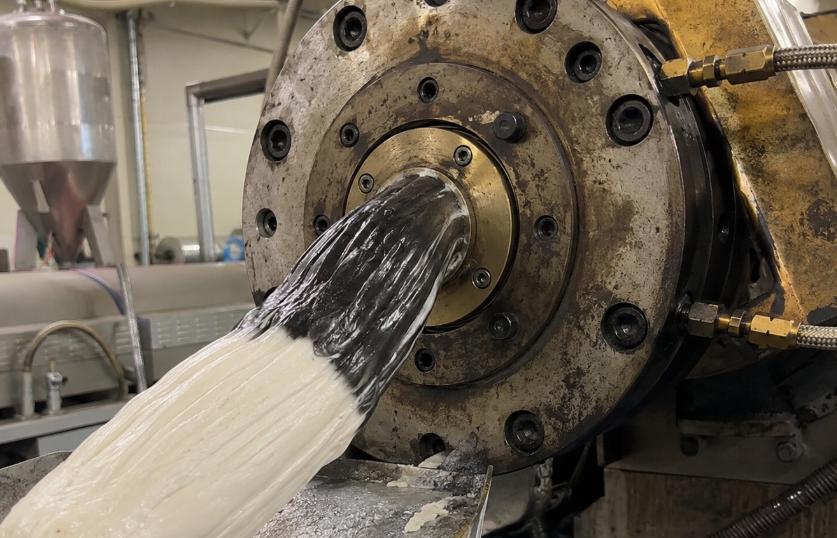
This is the standard method for quick color or material changeovers — but it isn’t foolproof. Many operators try to save money by pushing the next batch of production resin through the barrel, only to waste half a ton of material that still comes out streaked.
This instinct is exactly what the experts warn against. In a Plastics Technology roundtable, purging specialists and machinery maker Leistritz agreed on Tip #1: don’t use production resin, regrind, or additives to purge — they aren’t designed to clean and aren’t a substitute for commercial purging compounds (Plastics Technology, “Seven Cost-Saving Purging Tips for Compounding Twins”). The reason is physical: commodity resins like bare PE or PP have low viscosity and simply lack the “scrubbing power” to drag stubborn colorants out of the screw’s dead zones.
Veteran’s advice:
- Don’t cheap out on commercial purging compounds. Good purges contain active chemical agents and mechanical scrubbing media — the difference between washing a greasy pan with plain water versus dish soap and a sponge.
- “Pulse” the RPMs. Don’t run at constant speed. Surge the screw speed (for example, fluctuating between 15 and 60 RPM). These pressure spikes mechanically shock carbon buildup off the barrel walls and out of mixing elements.
- Purge before you have a problem. Asaclean’s field data shows changeover time varies wildly with resin — an olefin barrel may clean in ~20 minutes while styrenics and nylons build carbon that drags cleaning out far longer. Preventive purging beats waiting for streaks to appear.
2. Pulling the Screws: The Deep Clean
When purging compounds fail, or when you face severe polymer degradation and carbon buildup, you physically pull the screws from the barrel. This is where the real work begins — and where the costliest mistakes happen.
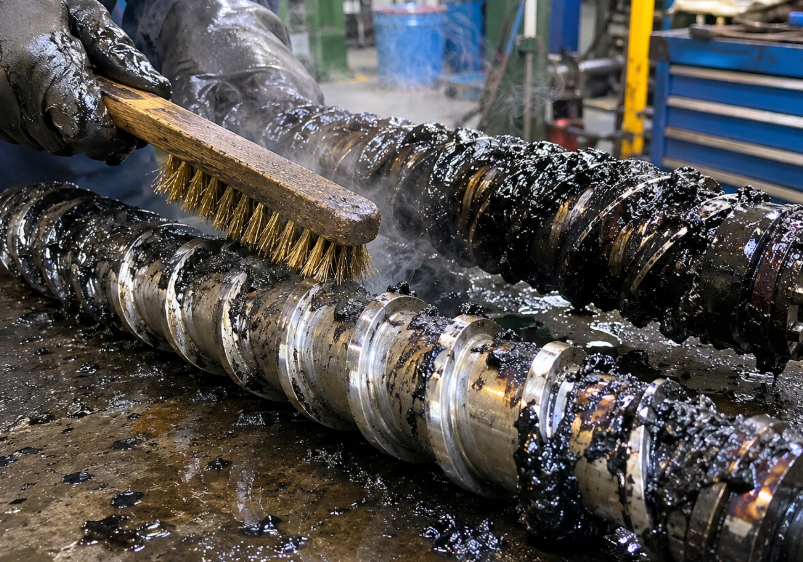
The golden rule: do it hot. The moment the screws are pulled, clean them while the polymer is still in a melt state. Use brass brushes and brass scrapers exclusively. Never let anyone near a screw with a steel wire brush or an iron putty knife.
Here’s the engineering reason most “how-to” articles skip. Extruder screws are typically made from nitrided alloy steel — 38CrMoAlA (DIN 1.8509) or 4140. After nitriding, the surface case reaches roughly HV 900–1100 hardness at a depth of only 0.4–0.8 mm (industry-standard spec confirmed across major screw manufacturers, e.g. JED Machinery; see also the metallurgical study of 38CrMoAl nitriding in Coatings, MDPI/NIH). That case is extremely hard but thin and brittle. A steel tool scratches it, and every scratch becomes a permanent micro-crater where degraded plastic hides and re-carbonizes on every future run. Once that case is breached, no purge will keep your product clean.
The reassembly trap. Cleaning the screw is only half the battle. If modular screw elements go back in the wrong order, or the operator fails to align the splines and the phase angle of the twin screws correctly, starting the motor will instantly snap the screw shaft or chew up the barrel liner. Photograph every step before disassembly.
💡 Real case — the steel-brush shortcut that cost a month A masterbatch compounder switched to a steel wire brush “to save time” during a routine screw pull on a 50 mm co-rotating twin screw. Within two weeks the line developed persistent black specks that no purging compound could clear. Teardown revealed dozens of fine scratches across the nitrided flights — each a micro-crater trapping and carbonizing polymer on every run. The element set (a $8,000–12,000 replacement) had to be re-nitrided. The few minutes “saved” with the steel brush cost a month of intermittent scrap. Lesson: on a nitrided screw, tool choice is not negotiable — brass only.
Tooling Do’s and Don’ts
| Do ✅ | Don’t ❌ | Why it matters |
|---|---|---|
| Brass brushes & scrapers | Steel wire brushes, iron knives | Steel breaches the HV 900–1100 nitrided case; micro-craters trap & carbonize polymer |
| Clean while hot (melt state) | Let polymer cool & harden | Hot polymer wipes off; cold carbonized polymer bonds to the metal |
| Photo every step before teardown | Reassemble from memory | Wrong element order / phase angle snaps the shaft on start-up |
3. Torching / Burn-Off: The Old-School Danger Zone
In many older plants, the moment an operator sees hardened plastic on a screw flight they grab an acetylene torch and start blasting. Stop them.
Why it’s dangerous. Screws are machined from alloy steels like 4140 and 38CrMoAlA. They aren’t afraid of fire — they’re afraid of localized overheating. An oxy-acetylene flame burns at roughly 3,100–3,300 °C, while these steels are tempered at only ~480–560 °C. Concentrated flame heat far above the tempering temperature causes localized annealing (softening) and warping. A warped twin screw becomes a meat grinder — it destroys the barrel wall the moment it rotates. If you see the steel turn a bluish tint, the surface hardness in that spot is already ruined.
If you absolutely must use heat: ban acetylene entirely. Use only a cooler propane torch, keep the flame constantly moving, and never dwell on one spot. Better still, use a temperature-controlled fluidized-sand burn-off oven, which heats the whole part uniformly and avoids local hot spots.
4. High-Pressure Water Washing (Hydro-Cleaning): Modern & Non-Destructive
High-end compounding facilities increasingly use automated hydro-cleaning machines that blast plastic off the metal with high-kinetic water jets.
- 100% non-destructive — zero risk of heat warping (unlike torching) and zero metal scratching (unlike manual scraping). The nitrided case stays intact.
- Reaches the dead zones — water jets penetrate the tight gaps inside kneading blocks, which are notoriously hard to clean by hand.
- Limitations — the machines are a significant capital investment, and fully carbonized, rock-hard “dead spots” may need pre-softening before the water pressure can break them free.
For high-value modular twin-screw element sets, the non-destructive nature usually justifies the cost over the screw’s service life.
Decision Guide: Which Method, When
| Your situation | Recommended method |
|---|---|
| Light → dark color, routine changeover | Purging compound (Method 1) |
| Dark → light, or heat-sensitive resin (PVC, POM) | Pull screws, manual deep clean (Method 2) |
| Stubborn carbonized “rock” inside kneading blocks | Hydro-cleaning (Method 4) |
| Hardened plastic on flights, no other option | Propane only — never acetylene (Method 3, with caution) |
There is no one-size-fits-all method. The principle that ties them together: the quality of your cleaning directly dictates the yield of your next run. Spending an extra hour on a proper teardown is almost always cheaper than scrapping a ton of speck-filled resin.
Frequently Asked Questions
Q: How often should I physically pull the screws on a twin-screw extruder? There’s no universal timetable — it depends on what you run. For continuous single-material production, pulling every 3–6 months for preventive inspection is typical. But if you frequently switch between very different polymers, run heat-sensitive materials (PVC, POM), or start seeing unexplained black specks, pull them immediately for a deep clean and visual inspection. Color-masterbatch producers may pull screws daily.
Q: Can I just use my standard production resin to purge? Technically yes, but it’s poor economics. Commodity resins lack the chemical agents and scrubbing action needed to clean the tight clearances of kneading and mixing elements. You’ll likely waste hundreds of pounds of good resin and hours of machine time to achieve what a few pounds of dedicated purging compound does in ~15 minutes — a point purging specialists make repeatedly (Plastics Technology).
Q: What’s the safest way to remove rock-hard carbonized plastic (black specks)? If high-abrasion purging compounds fail, do a manual teardown: pull the screws and scrub the flights with brass brushes while the polymer is still hot. If carbon is baked on like stone, the safest modern options are high-pressure hydro-cleaning or a temperature-controlled fluidized-sand burn-off oven. Never use a high-heat acetylene torch or steel tools — they permanently warp or scratch the nitrided screw.
Q: Why am I still getting black specks right after a thorough screw cleaning? If the screws are clean but contamination persists, it’s hiding elsewhere. Check the die head, screen changer / breaker plate, and the inner barrel wall. Polymer degrades and lodges in gaps around breaker plates and sensor ports. A clean screw inside a dirty barrel still produces scrap.
About the Author
Kara at Bloom Extruder Screw & Barrel (Zhangjiagang, Jiangsu), a manufacturer of twin-screw and single-screw elements, barrels, and liners since 2000. She has 26 years of experience in nitrided and bimetallic screw manufacturing and on-site extruder field service across compounding, masterbatch, and profile lines.
Bloom manufactures replacement screws, barrels, liners, and modular screw elements in 38CrMoAlA, bimetallic, and powder-metallurgy materials. Contact Kara or request a quote.
Sources & Further Reading
Nitrided screw/barrel hardness specification (HV 900–1100, case depth 0.4–0.8 mm) — JED Machinery product data. https://www.jed-machinery.com/products/chrome-nitride-bimetallic-single-screw-and-barrel-for-plastic-extruder-machine/.
Plastics Technology — “The Experts Speak: Seven Cost-Saving Purging Tips for Compounding Twins” (Asaclean, Leistritz Extrusion, Asahi Kasei). https://www.ptonline.com/articles/the-experts-speak-seven-cost-saving-purging-tips-for-compounding-twins
Asaclean — “Eliminate Black Specks & Carbon Contamination.” https://www.asaclean.com/solutions/carbon-contamination
Asaclean — “Cost-Saving Purging Tips for Twin Compounders.” https://www.asaclean.com/process/compounding
Nitriding metallurgy of 38CrMoAl steel — Coatings (peer-reviewed, NIH/PMC). https://www.ncbi.nlm.nih.gov/pmc/articles/PMC12430714/