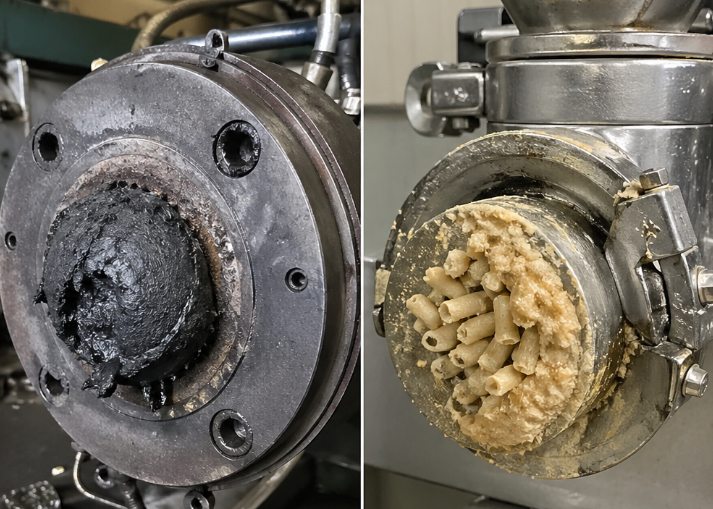
Die head blockages occur when material flow is restricted or completely stopped at the extrusion die. This results in:
- Uneven product thickness – Varying from zone to zone
- Complete flow stoppage – Requiring emergency shutdown
- Pressure spikes – Risk of equipment damage
- Product dimensional inconsistency – Out-of-spec products
- Production downtime – Costly equipment idle time
Occurrence Rate: 80% of extruders experience die blockage issues
Risk Level: 🔴 HIGH RISK
Average Downtime per Incident: 2-4 hours
Root Cause Analysis
1. Accumulated Degraded Material (40% of cases)
Why it happens:
- Material degrades at high temperature
- Degraded material solidifies and adheres to die surfaces
- Accumulation over time restricts flow
- Thermal cycling accelerates degradation
Typical Buildup Timeline:
- Week 1-2: Minimal buildup, no impact
- Week 3-4: Slight pressure increase (5-10%)
- Week 5-6: Noticeable pressure increase (15-25%)
- Week 7-8: Significant restriction (30-50%)
- Week 9+: Blockage risk increases dramatically
2. Insufficient Die Temperature (25% of cases)
Why it happens:
- Die heater malfunction or failure
- Temperature setpoint too low
- Inadequate insulation around die
- Cold ambient conditions
Temperature Requirements by Material:
| Material | Min Die Temp | Recommended | Max Die Temp |
| PE | 180°C | 200-220°C | 240°C |
| PP | 190°C | 210-230°C | 250°C |
| PET | 240°C | 270-290°C | 310°C |
| PA6 | 240°C | 270-290°C | 310°C |
| PVC | 170°C | 190-210°C | 220°C |
Temperature Impact on Flow:
| Temperature | Melt Viscosity | Flow Rate | Blockage Risk |
| -10°C below optimal | Very high | Very low | Critical |
| -5°C below optimal | High | Low | High |
| Optimal | Normal | Normal | Minimal |
| +5°C above optimal | Lower | Higher | Minimal |
| +10°C above optimal | Very low | Very high | High (degradation) |
3. Improper Die Design (20% of cases)
Why it happens:
- Die channels have dead zones
- Flow distribution is uneven
- Channel geometry creates turbulence
- Inadequate channel sizing for material viscosity
Die Design Parameters:
| Parameter | Poor Design | Good Design | Excellent Design |
| Dead zones | Present | Minimal | Eliminated |
| Flow uniformity | ±20% variance | ±5% variance | ±2% variance |
| Channel geometry | Sharp corners | Rounded transitions | Optimized curves |
| Pressure drop | >50 bar | 20-30 bar | <15 bar |
| Residence time | >60 seconds | 30-45 seconds | 20-30 seconds |
4. Foreign Material Contamination (15% of cases)
Why it happens:
- Metal particles from worn equipment
- Dust or debris from environment
- Contamination in recycled material
- Inadequate filtration
Contamination Sources:
- Worn screw and barrel (metal particles)
- Hopper environment (dust, moisture)
- Recycled material (various contaminants)
- Upstream equipment (degraded material)
Die Maintenance and Cleaning Procedures
Preventive Cleaning Schedule
Daily (5 minutes):
- Visual inspection for discoloration
- Check for unusual pressure readings
- Listen for unusual sounds
- Monitor temperature stability
Weekly (30 minutes):
- Record pressure readings
- Check die temperature uniformity
- Inspect for material buildup
- Clean die exterior
Monthly (2 hours):
- Partial die disassembly
- Clean accessible channels
- Inspect for corrosion or damage
- Replace worn seals
Quarterly (6-8 hours):
- Complete die disassembly
- Deep cleaning of all channels
- Inspection for wear or damage
- Replacement of damaged components
- Pressure testing
Die Cleaning Procedure
Equipment Needed:
- Soft brass brushes (non-abrasive)
- Cleaning solvents (material-specific)
- Compressed air
- Soft cloths
- Safety equipment (gloves, eye protection)
Step-by-Step Process:
- Safety First
- Shut down extruder completely
- Allow die to cool to safe temperature (<50°C)
- Disconnect electrical power
- Lock out energy sources
- Initial Inspection
- Document condition with photos
- Note location and extent of buildup
- Identify any visible damage
- Check for corrosion
- Disassembly
- Remove die from extruder (follow OEM procedure)
- Separate manifold sections carefully
- Document component order for reassembly
- Inspect internal surfaces
- Cleaning
- Soak in appropriate solvent (30-60 minutes)
- Use soft brass brush to gently remove buildup
- Flush with compressed air (low pressure)
- Repeat until clean
- Final rinse with clean solvent
- Inspection
- Examine all surfaces under bright light
- Check for corrosion or pitting
- Measure channel dimensions if possible
- Document findings
- Reassembly
- Replace worn seals and gaskets
- Reassemble in reverse order
- Apply appropriate thread sealant
- Torque bolts to specification
- Testing
- Reinstall on extruder
- Run empty test (no material)
- Check for leaks
- Verify temperature uniformity
- Run with material at low speed
- Monitor pressure and quality
Die Blockage Solutions
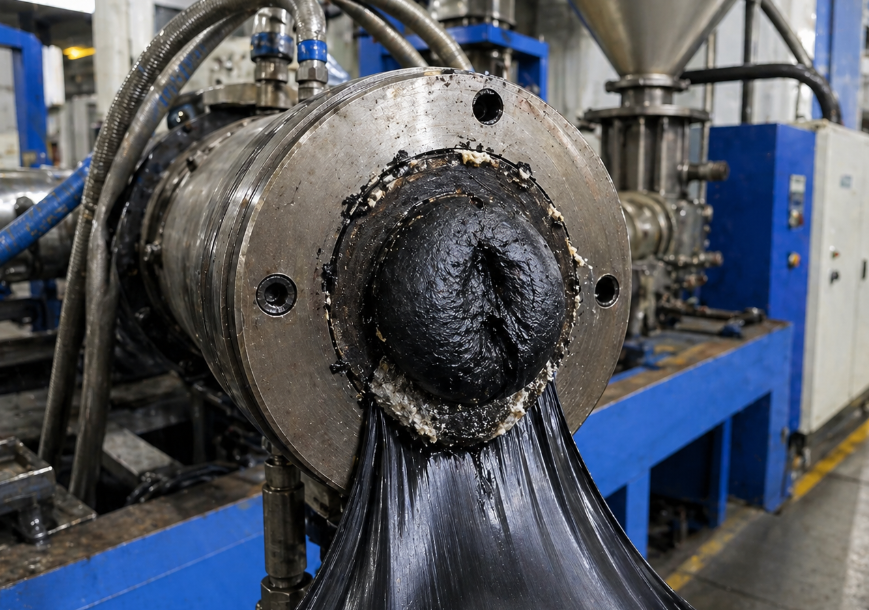
Solution 1: Optimize Die Temperature
Cost: Minimal
Implementation Time: 1 hour
Expected Improvement: 20-30% pressure reduction
Procedure:
- Consult material datasheet for optimal die temperature
- Increase die temperature by 5-10°C if below optimal
- Allow 30 minutes for system stabilization
- Monitor discharge pressure
- Adjust in 2-3°C increments until optimal
- Document final temperature
Temperature Adjustment Guide:
| Current Pressure | Temperature Adjustment | Expected Result |
| >50 bar | +10°C | Pressure drops 15-25% |
| 40-50 bar | +5°C | Pressure drops 10-15% |
| 30-40 bar | Optimal | Maintain |
| <30 bar | -5°C | Increase throughput |
Solution 2: Implement Regular Die Cleaning Schedule
Cost: $500-1,000 per cleaning
Frequency: Monthly or quarterly
Expected Improvement: 30-40% pressure reduction
Cleaning Schedule by Material:
| Material Type | Cleaning Frequency | Estimated Buildup |
| Unfilled PE/PP | Quarterly | Minimal |
| Glass-filled | Monthly | Moderate |
| Mineral-filled | Monthly | Moderate |
| Recycled plastic | Every 2 weeks | High |
| PVC | Monthly | Moderate |
Cost-Benefit Analysis:
| Scenario | Annual Cleaning Cost | Downtime Saved | Net Benefit |
| No cleaning | $0 | 0 hours | -$5,000 (lost production) |
| Quarterly | $2,000 | 40 hours | +$8,000 |
| Monthly | $6,000 | 80 hours | +$14,000 |
| Bi-weekly | $12,000 | 160 hours | +$28,000 |
Solution 3: Upgrade Die Design
Cost: $15,000-25,000
Implementation Time: 2-3 days
Expected Improvement: 50-70% pressure reduction
New Die Design Features:
- Optimized channel geometry
- Elimination of dead zones
- Improved flow distribution
- Enhanced thermal uniformity
- Reduced pressure drop
Performance Comparison:
| Metric | Original Die | New Die | Improvement |
| Pressure drop | 45 bar | 18 bar | -60% |
| Flow uniformity | ±18% | ±3% | +83% |
| Residence time | 55 seconds | 28 seconds | -49% |
| Throughput | Baseline | +15% | +15% |
| Blockage frequency | Monthly | Quarterly | -75% |
Solution 4: Install Material Filtration System
Cost: $5,000-8,000
Implementation Time: 1 day
Expected Improvement: 25-35% pressure reduction
Filtration Components:
- Magnetic separator – Removes ferrous particles
- Screen filter – Removes large contaminants (>100 microns)
- Melt filter – Removes fine particles (>40 microns)
Filtration Effectiveness:
| Contaminant Type | Removal Rate | Impact on Die |
| Metal particles | 95%+ | Prevents scratching |
| Dust/debris | 85%+ | Reduces blockages |
| Degraded material | 60%+ | Improves flow |
| Moisture | 40%+ | Reduces bubbles |
Real-World Case Study
Company: Plastic Pipe Manufacturer
Material: HDPE (high-density polyethylene)
Problem: Die blockages occurring every 3-4 weeks, causing 8-10 hours downtime per month
Original Conditions:
- Die temperature: 210°C (below optimal 220°C)
- No regular cleaning schedule
- Discharge pressure: 52 bar
- No filtration system
Implemented Solutions:
- Increased die temperature: 210°C → 225°C
- Established monthly cleaning schedule
- Installed magnetic separator + screen filter
- Optimized die design (new die ordered)
Results (Timeline):
- Month 1: Blockage frequency reduced by 40%
- Month 2: New die installed, blockage frequency reduced by 75%
- Month 3: Blockage frequency reduced by 85%
- Months 4-6: Stable operation, blockages reduced to quarterly
Financial Impact:
- Downtime reduction: 8 hours/month → 1 hour/month
- Production increase: 15%
- Quality improvement: Reject rate down 12%
- Total annual savings: $45,000
- Investment payback: 8 months
Die Blockage Decision Matrix
| Pressure Level | Frequency | Recommended Action | Timeline |
| 30-40 bar | Never | Monitor | Ongoing |
| 40-50 bar | Quarterly | Schedule cleaning | Next month |
| 50-60 bar | Monthly | Clean + optimize temp | This week |
| 60-70 bar | Every 2 weeks | Clean + upgrade die | Urgent |
| >70 bar | Weekly | Emergency action | Immediate |
Key Performance Indicators
| KPI | Measurement | Target | Action if Failed |
| Discharge pressure | Pressure gauge | 30-40 bar | Investigate cause |
| Blockage frequency | Maintenance log | <2 per year | Implement solutions |
| Cleaning interval | Calendar | 3 months | Increase frequency |
| Die temperature | Thermocouple | ±2°C | Calibrate/repair |
| Product uniformity | Thickness gauge | ±5% | Check die condition |