
Written by BLOOM Engineering Team
In modern plastics processing and specialty material manufacturing, choosing the right extruder isn’t just about the initial equipment budget—it is the lifeline that dictates your product yield and machine downtime. As material formulations become increasingly complex, many plant managers and factory owners face a critical dilemma: stick with the reliable, economical single-screw extruder, or invest heavily in the superior mixing capabilities of a twin-screw system?
To make an ROI-driven decision, we need to step away from the spec sheets and look at what actually happens on the production floor. Let’s break down the core differences and explore how targeted hardware upgrades can maximize your operational efficiency.
The Workhorse: Single-Screw Extruders
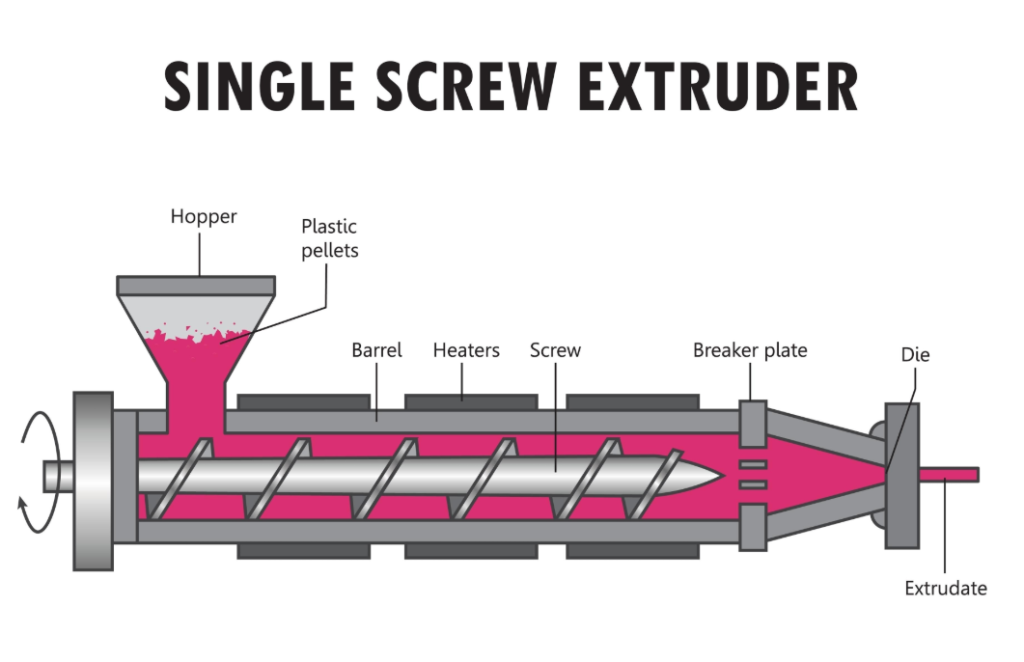
Single-screw extruders rely on friction drag to convey and melt materials. From a production floor perspective, these machines are the absolute workhorses for high-volume, continuous manufacturing of a single material. If your facility produces standard PVC pipes, basic profiles, or routine cable jacketing, a single-screw setup is usually your most profitable choice.
Operators favor them because the initial capital expenditure is low, they are relatively straightforward to integrate with standard PLC control systems, and maintenance costs are highly predictable.
However, the major drawback of a single-screw system is its poor dispersive mixing capability. If you are processing shear-sensitive materials or complex blends, standard off-the-shelf screws often cause localized overheating and inconsistent melting.
The Master Compounder: Twin-Screw Extruders
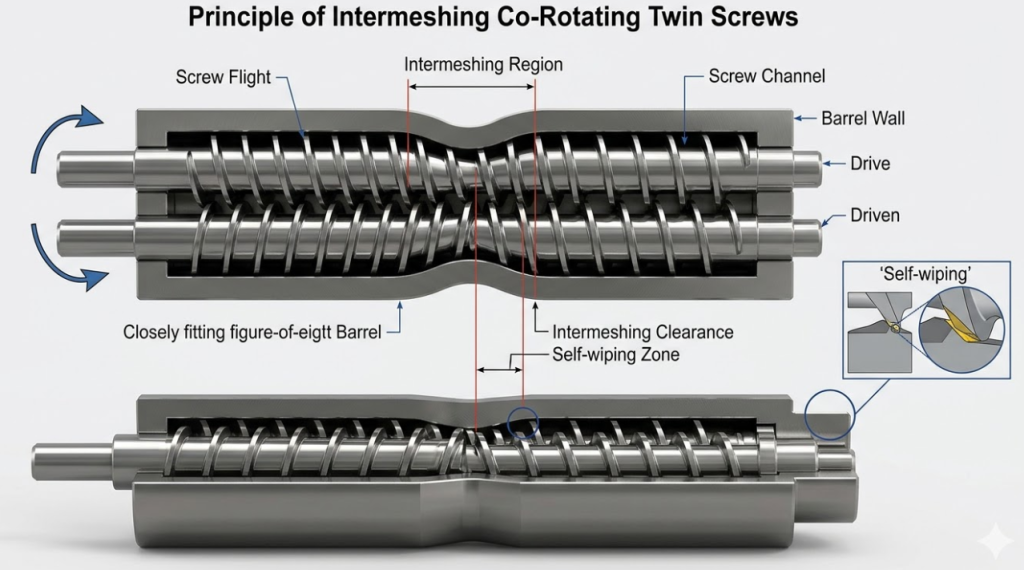
When your process involves complex compounding, high loadings of color masterbatches, or the incorporation of heat-sensitive additives, co-rotating twin-screw extruders are the undisputed masters.
According to established compounding engineering standards, the magic of the twin-screw lies in its intermeshing mechanism. The screws actively wipe each other clean as they rotate (self-wiping). This provides positive displacement conveying, meaning the residence time of the polymer inside the heated barrel is strictly controlled, eliminating dead zones where expensive materials could degrade.
Head-to-Head Technical Comparison
To give you a clearer picture of how these two systems stack up against each other on the factory floor, here is a breakdown of their core operational differences:
| Feature | Single-Screw Extruder | Twin-Screw Extruder (Co-rotating) |
| Conveying Mechanism | Friction drag (dependent on material friction) | Positive displacement (forced conveying) |
| Mixing Capability | Basic distributive mixing | Excellent dispersive and distributive mixing |
| Degassing / Venting | Poor to moderate | Highly efficient (ideal for removing volatiles) |
| Self-Cleaning | No (requires manual purging) | Yes (intermeshing profile wipes the screws) |
| Ideal Applications | Standard pipes, blown film, basic profiles | High-fill compounding, reactive extrusion, masterbatch |
Real-World Scenario: Compounding Flame-Retardant Plastics for Power Storage Enclosures
To understand the practical impact of equipment choice, let’s look at a high-stakes manufacturing scenario: producing power storage enclosures. With the boom in the energy storage industry, manufacturing the heavy-duty, flame-retardant plastic housings for battery systems has become a highly lucrative, yet technically demanding, market.
A facility initially attempted to produce these enclosures using a standard single-screw line. The formulation required high doses of inorganic flame retardants to meet stringent safety standards. The result? Severe agglomeration of the additives. The single screw simply could not distribute the abrasive powder evenly into the polymer matrix, leading to failed impact tests and an unacceptable scrap rate.
The solution wasn’t just buying a bigger machine; it was about precision compounding. By upgrading to a twin-screw compounding line equipped with BLOOM’s specialized custom extruder screws, the factory utilized targeted kneading blocks designed specifically for high-fill materials. This setup achieved nanoscale dispersion of the flame retardants. The enclosures easily passed UL safety certifications, and the facility reduced its material waste by over 40%.
Cost vs. ROI: Upgrading Your Setup with BLOOM Custom Extruder Screws
When evaluating the cost of single versus twin-screw systems, looking solely at the purchase price is a mistake. In the production of high-value engineered plastics, excessive downtime, rapid equipment wear, and wasted raw materials will quickly eclipse the cost of the machinery itself.
Whether you operate a single or twin-screw system, the geometry and metallurgy of the screw dictate the limits of your production. Processing abrasive materials (like glass fibers or flame retardants) will quickly destroy standard factory screws. This is why investing in custom extruder screws often yields the highest ROI in your plant.
Why Standard Screws Fail in Advanced Applications
| Evaluation Metric | Standard Off-the-Shelf Screws | BLOOM Custom Extruder Screws |
| Material Adaptability | One-size-fits-all approach | Tailored geometry for your specific polymer/filler mix |
| Wear Resistance | Basic nitriding (wears out quickly with abrasive fillers) | Specialized bimetallic/hard-facing alloys for max lifespan |
| Melt Temperature Control | Prone to shear heating and localized degradation | Optimized flight depths to prevent polymer burning |
| Long-Term ROI | Low (frequent replacements and higher scrap rates) | High (reduced machine downtime and perfect product yield) |
BLOOM leverages years of precision machining and process engineering to manufacture custom extruder screws tailored to your exact formulations—whether you need aggressive mixing for glass-fiber compounds or gentle melting for shear-sensitive resins.
There is no universally “better” extruder—only the one that perfectly matches your current polymer formulations and your future business trajectory. Getting the core hardware right is the first step toward reducing waste and scaling your output.If your production line is facing material mixing bottlenecks, or if you are looking to extend the capabilities of your current machinery with wear-resistant components, contact the engineering team at BLOOM today to discuss your custom extruder screws requirements.