
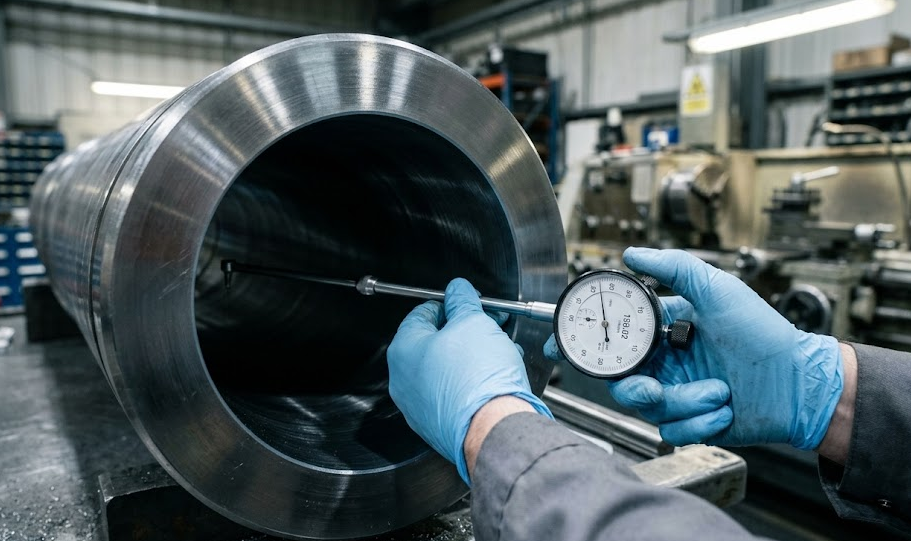
The extruder barrel is the beating heart of any plastic extrusion or injection molding line. It is the pressurized, heated crucible where raw polymers are transformed into high-value products. However, as the plastics industry shifts heavily toward high-performance modified plastics—incorporating aggressive additives like glass fibers, calcium carbonate, and halogen-free flame retardants—the demands placed on the extruder barrel have reached unprecedented levels.
In my years of walking the factory floor and consulting with global B2B clients at BLOOM, I frequently see the same expensive mistake: processors using standard equipment for highly abrasive compounds, leading to catastrophic wear, plummeting output, and severe downtime.
The purpose of this guide is to strip away the marketing fluff and provide you with actionable, technical insights. Whether you are a plant manager or a procurement director, this article will help you choose the right metallurgy for your specific compound, understand what happens inside a true source factory, and learn the proper maintenance protocols to maximize your barrel’s operational lifespan.
Deep Dive into Extruder Barrel Materials: Bimetallic vs. Nitrided
Choosing the right material for your extruder barrel is not about finding the cheapest option; it is about finding the optimal cost-per-hour of production. Let’s break down the metallurgical choices.
The Limitations of Standard Nitrided Barrels in Abrasive Environments
A standard nitrided barrel is typically machined from high-quality alloy steel (like 38CrMoAlA) and then subjected to a gas or ion nitriding process. This introduces nitrogen into the surface of the steel, creating a very hard casing (typically around 65-68 HRC).
For virgin commodity plastics like PP, PE, or ABS, nitrided barrels are highly cost-effective and perform beautifully. However, they have a critical structural limitation: the hardened layer is extremely shallow, usually measuring only 0.5mm to 0.8mm deep.
When you introduce abrasive fillers—such as in a 30% glass-fiber reinforced PA66 application—that thin nitrided layer acts like an eggshell. Once the glass fibers scour away that 0.8mm casing, the softer base steel underneath is exposed. From that moment, barrel wear accelerates exponentially, destroying the internal geometry.
What is a Bimetallic Extruder Barrel?
To combat severe wear, the industry standard is the bimetallic extruder barrel. Instead of just hardening the surface of the base steel, a completely different, highly wear-resistant alloy is fused to the inside of the barrel.
This is achieved through a process called centrifugal casting. A proprietary alloy powder is placed inside the bored steel blank. The barrel is then sealed and heated in a specialized furnace to temperatures exceeding 1,200°C (2,192°F), melting the powder. The barrel is simultaneously spun at incredibly high RPMs. The centrifugal force throws the molten alloy against the inner wall, where it cools and solidifies, creating a void-free, metallurgical bond with the backing steel.
The result? A dense, solid wear layer that is typically 1.5mm to 3.0mm thick—up to four times thicker than a nitrided layer.
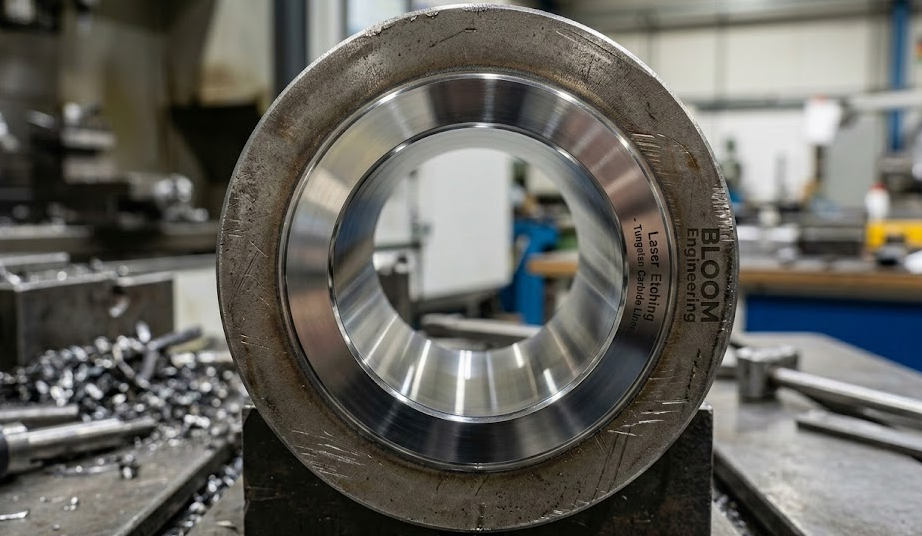
Comparing Bimetallic Alloys: Tungsten Carbide vs. Nickel-Cobalt Base
- Tungsten Carbide (Carbide-Based Alloys): The heavyweight champion of abrasion resistance. Formulations containing high percentages of Tungsten Carbide (up to 40-50%) feature metallic carbides dispersed in a matrix, offering extreme hardness. If you process high-percentage fiberglass or ceramics, this is your required metallurgy.
- Nickel-Cobalt Base Alloys: When processing materials like PVC or compounds with acidic flame retardants, the primary enemy is corrosion. Halogen gases released during melting will eat away standard steel. Nickel and Cobalt-rich alloys offer superior resistance to chemical attack while maintaining excellent hardness.
📊 BLOOM Case Study: Solving 30% GF PA66 Wear for an Automotive Parts Supplier
The Challenge: A European automotive tier-2 supplier was using standard nitrided barrels to process PA66 with 30% glass fiber. Their barrels were losing tolerance every 3 to 4 months due to severe abrasive wear. This caused a 12% drop in extrusion output and cost them an estimated $18,000 annually in replacement parts and unscheduled machine downtime per line.
The BLOOM Solution: We audited their process and upgraded their extrusion line to a Tungsten Carbide (40% WC) bimetallic barrel paired with a fully armored screw.
The Result: The operational lifespan of the barrel extended to 18 months (a 450% increase). While the initial procurement cost of the bimetallic unit was roughly 40% higher than the nitrided version, the client achieved full Return on Investment (ROI) in less than 4 months through uninterrupted production, stabilized melt pressure, and zero scrap rates caused by metal contamination.
Inside the Factory: Our Custom Extruder Barrel Manufacturing Process
Understanding how your barrel is made is the best way to verify the capability of your supplier. Here at BLOOM, we control every step of the manufacturing process in-house. This allows us to guarantee the tight tolerances required for high-end extrusion.
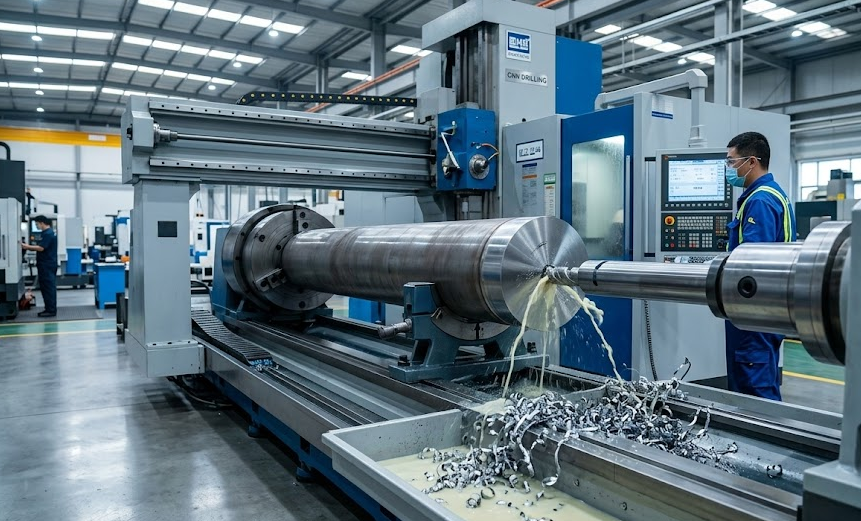
Engineering & Drawing Verification
Before any steel is cut, our engineering team meticulously reviews the client’s CAD drawings. We don’t just blindly copy; we analyze the application. If a client is experiencing premature wear in the compression zone, we might recommend adjusting the internal geometry. We finalize the L/D ratio, venting port designs, and sensor hole placements down to the millimeter.
Precision Deep Hole Drilling & Honing
The foundation of a great barrel is absolute straightness. If the inner hole curves even slightly, the screw will rub against the barrel wall, causing rapid, uneven wear. We utilize specialized CNC deep-hole drilling machines to bore out the solid steel blank. Following the centrifugal casting process, we move to honing. This abrasive machining process smooths the inner diameter (ID) to a mirror-like surface finish (typically Ra 0.4).
Strict Quality Control: Inspection and Testing
A barrel does not leave the BLOOM facility without passing a rigorous QC protocol:
- Dimensional Accuracy: We use precision dial bore gauges to map the inner diameter across the entire length of the barrel, ensuring adherence to strict straightness tolerances (typically 0.015mm/m).
- Bond Integrity: Ultrasonic testing ensures there are no hidden voids or delamination between the bimetallic layer and the backing steel.
- Hardness Verification: We test the Rockwell Hardness (HRC) to guarantee the alloy matches the requested technical specifications.
Maintenance Guide: How to Measure Extruder Barrel Wear
Even the best Tungsten Carbide bimetallic barrel will eventually wear. The key to maintaining profitability is knowing when that wear is impacting your bottom line.
Recognizing the Early Signs of Barrel Wear
Your production data will tell you when wear is occurring:
- Reduced Output: You have to increase the screw RPM to maintain the same throughput (kg/hr).
- Melt Temperature Spikes: The screw has to work harder, generating excessive shear heat.
- Surging and Pressure Drops: A worn barrel allows plasticized melt to flow backward over the screw flights (leakage flow), causing unstable die pressure.
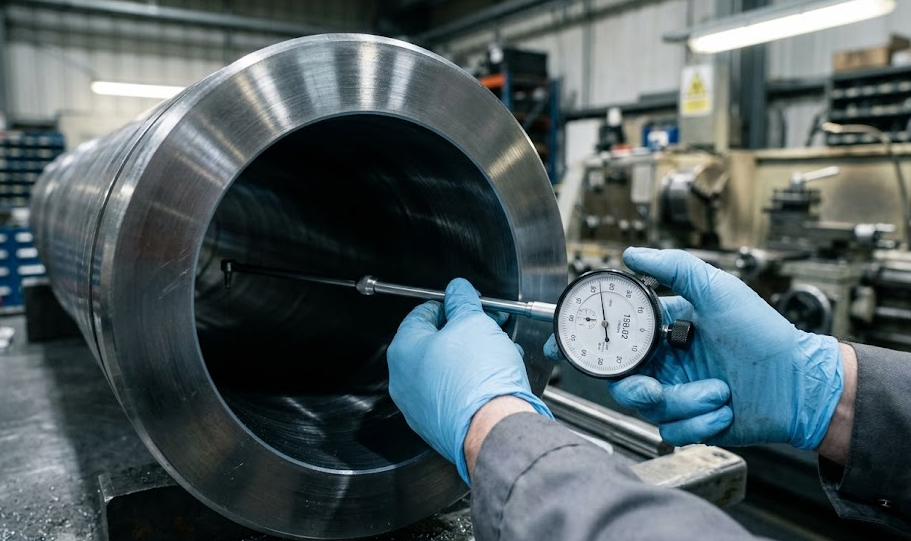
Step-by-Step: Measuring the Inside Diameter (ID) Properly
To truly assess the health of your barrel, physical measurement is required during a maintenance shutdown.
- Pull and Clean: Extract the screw and thoroughly clean the barrel while it is still warm using copper brushes. Do not use steel tools, as they can scratch the honed finish.
- Allow to Cool: You must allow the barrel to cool completely to ambient room temperature. Measuring a hot barrel will result in skewed data due to thermal expansion.
- Use the Right Tool: A standard caliper is useless here. You must use an inside micrometer or a precision dial bore gauge with a long extension rod.
- Measure Strategically: Measure the ID at multiple points, paying special attention to the transition/compression zone and the metering zone, as this is where internal pressure is highest. Take measurements in both the vertical and horizontal axes to check for ovality (egg-shaped wear).
Understanding Allowable Clearance: When is it time to replace?
According to industry polymer rheology studies, a precise radial clearance is vital.
- Standard New Clearance: The standard radial clearance for a new screw and barrel is roughly 0.001 inches per inch of diameter (or approx. 0.1mm per 100mm of diameter).
- The Danger Zone: Studies show that once radial clearance exceeds 0.2mm to 0.3mm (depending on the polymer viscosity), leakage flow can reduce overall throughput by up to 10% to 15%.
- The Replacement Threshold: Once your clearance doubles the original spec, the energy wasted and material degraded will quickly cost more than a new component. For highly abrasive applications, replacing the barrel with a new, high-quality bimetallic unit is the most reliable long-term solution.
In the demanding world of modified plastics and high-volume extrusion, the extruder barrel is not just a spare part; it is a critical asset that dictates your overall production efficiency. Relying on standard nitrided components for abrasive compounds will inevitably lead to downtime, wasted resin, and lost margins.
By partnering with a premier source factory like BLOOM, you eliminate the middlemen. You gain direct access to metallurgical expertise, rigorous manufacturing quality control, and components designed specifically for your unique polymer formulations.
Are you experiencing premature wear, unexplained pressure drops, or looking to upgrade your extrusion line for a new abrasive compound?
We are here to help. Send us your technical drawings, or simply tell us about your current operational challenges and the compounds you are processing. The BLOOM engineering team will review your application and provide a free, no-obligation consultation and competitive quote.

Pingback: How to Measure Twin Screw Barrel Wear: The Figure-8 Bore Method