In the high-stakes world of PVC manufacturing, the extruder screw is not merely a component; it is the heartbeat of your entire production line. However, because Polyvinyl Chloride (PVC) possesses a notoriously narrow thermal processing window, the margin for error is virtually non-existent. Selecting an incorrect screw geometry—whether it is a mismatched compression ratio, inappropriate shear elements, or an unsuitable L/D ratio—can lead to catastrophic operational consequences. Manufacturers utilizing suboptimal screws frequently face severe thermal degradation, resulting in yellowing, black specks, and brittle products that must be scrapped. Beyond the immediate quality issues, the financial toll is staggering: excessive shear heat causes frequent downtime for maintenance, accelerates wear on the barrel, and inflates energy consumption. In an industry where efficiency dictates profit, a wrongly specified screw is a hidden liability that bleeds your bottom line. This guide is designed to navigate these complexities, ensuring your machinery is optimized not just for operation, but for peak performance and maximum longevity.
At the heart of solving this problem is the extruder screw.
The geometry, material, and configuration of the screw dictate the success of your entire PVC extrusion line. In this guide, we will explore the critical relationship between extruder screws and PVC production, helping you make the right equipment choices to maximize yield and minimize downtime.
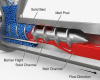
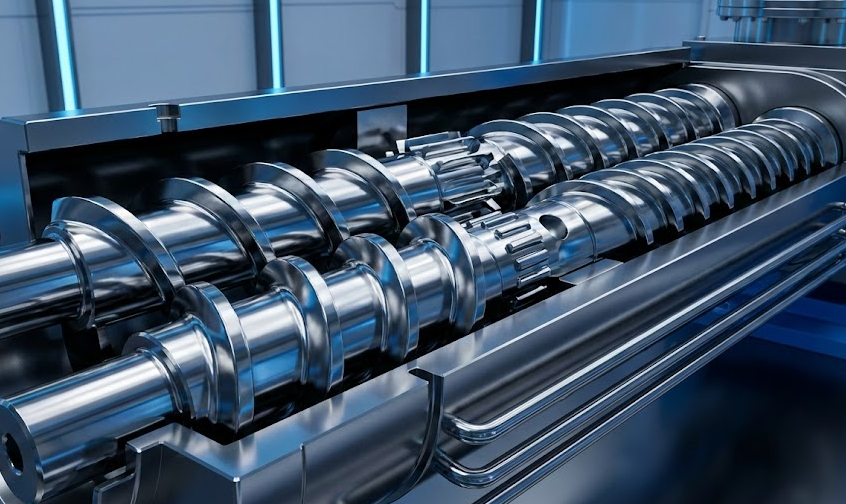
Caption: Precision-engineered extruder screws are critical for controlling shear stress and melt temperature during PVC processing.
1. The Processing Challenge: Why PVC Demands Specialized Extruder Screw
Unlike more forgiving polymers like PE or PP, PVC requires a narrow processing window. The extrusion process must carefully balance heat and pressure to melt the PVC powder (or pellets) uniformly without burning it.
Single-Screw vs. Twin-Screw Extruders for PVC
Historically, single-screw extruders were the standard. They feature a single rotating screw that conveys, melts, and pumps the polymer. While cost-effective and suitable for pre-compounded, flexible PVC pellets, single-screw machines struggle with rigid PVC powder.
- The Single-Screw Limitation: Processing raw PVC powder in a single-screw extruder often generates excessive friction. To prevent degradation, operators must run the machine at lower speeds, which severely limits output. Furthermore, single-screw designs lack the intensive mixing capabilities required to disperse additives like calcium carbonate ($CaCO_3$) evenly.
- The Twin-Screw Solution: Today, twin-screw extruders (intermeshing, counter-rotating) are the industry standard for rigid PVC. They act as positive displacement pumps. The interlocking screws pull the PVC powder forward, providing intense mixing, superior degassing, and gentle, uniform plasticization at lower screw speeds. This drastically reduces the risk of thermal degradation while maintaining high production rates.
2. Deep Dive: Conical vs. Parallel Twin-Screw Extruders
When producing rigid PVC products like pipes or profiles, you will typically choose between two twin-screw configurations: Conical and Parallel. Understanding the difference is crucial for matching the machine to your specific PVC formulation.
Conical Twin-Screw Extruders
Conical screws have a larger diameter at the feed zone that tapers down toward the discharge end.
- The Advantage: The large feed opening is phenomenal for pulling in light, fluffy PVC powder blends. The decreasing volume along the screw naturally builds high compression, forcing the air out through vacuum vents and ensuring excellent melt homogeneity.
- Best For: Standard rigid PVC pipes, window profiles, and medium-output applications. They offer an incredible balance of performance and cost-efficiency.
Parallel Twin-Extruder Screw
Parallel screws maintain a consistent diameter from the feed to the discharge and typically feature a much larger Length-to-Diameter (L/D) ratio (e.g., up to 30:1 or more).
- The Advantage: The longer barrel provides more time for the plasticization process. This is absolutely critical when working with high-filler formulations, such as PVC combined with 100 p.h.r (parts per hundred resin) or more of Calcium Carbonate. The extended mixing time ensures the polymer matrix fully coats the high volume of filler, preventing the final product from becoming brittle.
- Best For: High-output production, heavy sheets, and highly filled PVC compounds.
Quick Comparison Table
| Feature / Parameter | Conical Twin-Screw Extruder | Parallel Twin-Screw Extruder |
| Screw Geometry | Tapered (Large feed, small discharge) | Uniform diameter throughout |
| L/D Ratio | Typically lower (e.g., 22:1) | Higher (e.g., 28:1 to 36:1) |
| Feeding Capability | Excellent for low bulk-density powders | Good, often requires forced feeding |
| Plastification Time | Shorter, rapid compression | Longer, gradual and thorough mixing |
| Best Material Match | Standard rigid PVC, moderate fillers | Highly filled PVC (High $CaCO_3$), compounds |
| Core Strength/Torque | Limited by smaller discharge diameter | High torque capacity across the entire screw |
| Cost | Generally more economical | Higher initial investment |
3. Combating Wear and Tear: The Importance of Screw Metallurgy
In PVC extrusion, the mechanical design of the screw is only half the battle; the metallurgy is the other.
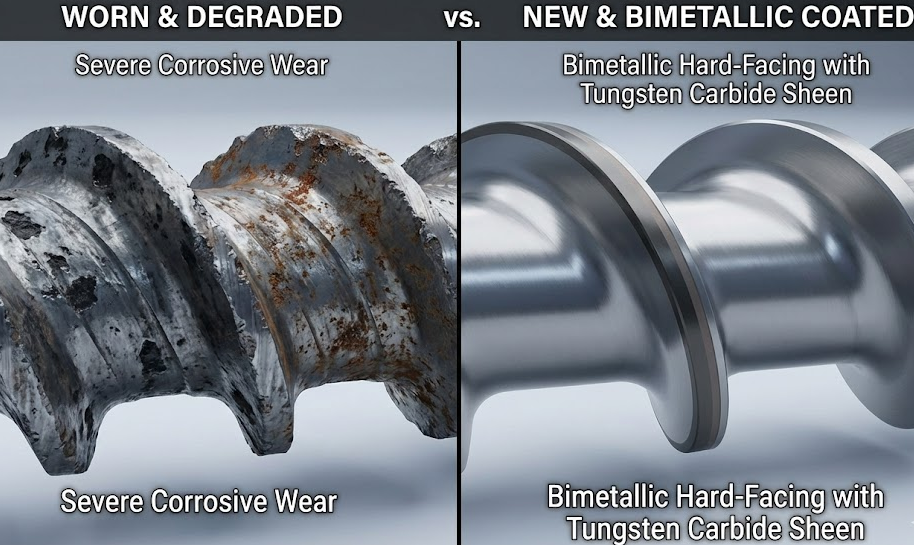
PVC formulations are notoriously harsh on machinery. Fillers like calcium carbonate and titanium dioxide are highly abrasive. Additionally, if the PVC overheats, it can release corrosive byproducts. Over time, this combined abrasive and corrosive wear degrades the screw flights and the inner barrel wall. As the clearance between the screw and barrel increases, output drops, melt temperature fluctuates, and product quality suffers.
How We Solve This:
For sustained, high-volume PVC production, standard steel is insufficient. High-performance screws and barrels must utilize advanced surface treatments:
- Nitriding: A heat-treating process that diffuses nitrogen into the surface of the steel, creating a hardened, wear-resistant case.
- Bimetallic Coating: For the most demanding high-filler applications, screws are coated with specialized wear-resistant alloys (often tungsten-carbide based), and barrels are centrifugally cast with bimetallic liners. This dramatically extends the lifespan of the components, reducing long-term maintenance costs and minimizing costly factory downtime.
4. Conclusion: Customization is Key
There is no “one-size-fits-all” solution in PVC extrusion. The optimal extruder screw depends entirely on your specific end-product, your target output, and, most importantly, your exact material formulation.
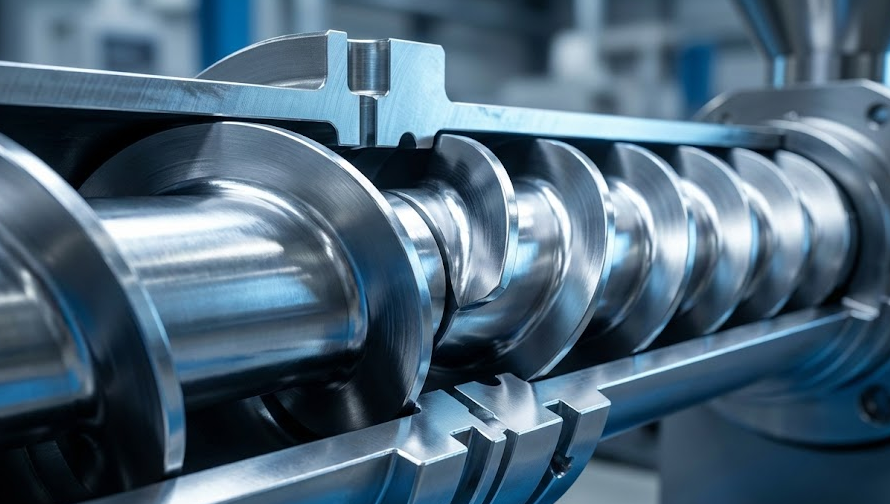
Whether you are extruding standard plumbing pipes with a conical twin-screw or tackling high-filler siding with a parallel twin-screw, the geometry—flight pitch, channel depth, and compression ratio—must be tailored to your process. Investing in high-quality, customized screw and barrel components is the most effective way to ensure consistent product quality, lower energy consumption, and a superior return on investment.