On the plastic extrusion floor, there is one sentence that instantly raises a plant manager’s blood pressure: “The main motor current is jumping all over the place again.”
Watching the digital needle on the control panel swing erratically, accompanied by melt back pressure that behaves like a roller coaster, usually triggers a frantic series of adjustments. Operators tweak temperatures or mess with the feeder. Yet, hours later, the output is still surging, pipe wall thickness is uneven, or pellet sizes are wildly inconsistent. This “extruder surging” phenomenon doesn’t just create mountains of scrap; it risks sudden motor overload and catastrophic line shutdowns.
At BLOOM, we design and manufacture custom extruder screws every day. We are skipping the textbook theories today to give you a field-tested, engineer-to-engineer breakdown of why your extruder is gasping for air and how to permanently stabilize it.

Don’t Tear the Barrel Apart Just Yet: Baseline Troubleshooting
When facing extruder main motor current fluctuation, you must first eliminate surface-level process variables. Based on hundreds of service calls we’ve handled at BLOOM, this rapid-check matrix will help you isolate 50% of the most common external culprits.
Table 1: Plastic Extruder Surging Causes & Parameter Checklist
| Observed Symptom | Likely “Surface” Cause | Key Parameter Check & Action |
| Rhythmic, sinusoidal wave fluctuations | Feeder bridging or inconsistent flow | Check hopper RPM fluctuation (should be < 1%). Clear blockages; consider installing a crammer feeder. |
| Specific barrel zone temperature dropping | Failed heater band or faulty thermocouple | Use an IR gun on the barrel exterior. If actual temp vs. gauge difference > 5°C, inspect the relay/wiring. |
| Back pressure steadily rising (> 20 MPa), current spiking | Severely clogged screen pack | Check pressure alarm thresholds. Initiate immediate screen change. Inspect melt for unmelted cold slugs. |
| Haul-off speed steady, but output surges | Excessive moisture in raw resin | Test resin moisture (PET/PA must be < 0.02%). Verify desiccant dryer dew point is functioning correctly. |
The Real Culprit: Hidden Leakage Flow Inside the Barrel
If you’ve cleared the baseline checks but the melt pressure keeps dropping and spiking, it’s time to face the mechanical reality: the clearance between your screw flights and the barrel wall has exceeded acceptable tolerances.
An extruder is essentially an Archimedes screw pump. According to classic polymer rheology, when the radial clearance at the flight tip increases due to wear, high-pressure melt is forced backward over the flights. This is known as “leakage flow.”
This unstable fluid dynamic means the screw periodically loses its “bite” on the material (current drops), only to suddenly grab a massive chunk of unmelted resin a second later (current spikes). Different manufacturing sectors destroy screws in entirely different ways:
Table 2: Wear Mechanisms by Industry & Hardness Requirements
| Industry Application | Typical Material/Formula | Wear Mechanism & BLOOM’s Defense Strategy |
| Engineering Plastics | PA66 + 30% Glass Fiber (GF) | Abrasive Wear: Glass fibers act like sandpaper. Standard nitrided screws (HV 900) lose flight edges in months. Requires tungsten carbide PTA welding. |
| Plastic Recycling | Post-consumer PE/PP films | Foreign Object & Corrosive Wear: Residual dirt/sand and acidic off-gassing demand extreme bimetallic alloy armor against mechanical and chemical degradation. |
| PVC Pipe/Profile | UPVC + High Calcium Carbonate | High Shear Friction: High-viscosity melts create massive frictional heat in the compression zone, leading to localized galling or chrome peeling. |
Field Data: How BLOOM Stabilizes the Unstable
Let’s look at how targeted geometry and metallurgy solve these issues in the real world:
Case 1: The “Heart Transplant” for a PA66+30% GF Pelletizing Plant
A compounding facility took on a high-glass-fiber order. Within two months, their new OEM equipment suffered violent current fluctuations and a 30% drop in throughput.
- The Diagnosis: Micrometer readings showed the metering section flight clearance had eroded from the factory 0.15mm to a massive 0.85mm.
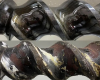
- The BLOOM Solution: We engineered a custom high glass fiber plastic extrusion screw, applying a Ni-WC (Nickel-Tungsten Carbide) bimetallic PTA welded coating to the compression and metering flights, pushing hardness to HRC 62-65.
- The Result: After 8 months of continuous running, clearance increased by only 0.05mm. Melt back pressure is locked at 12 MPa (fluctuating < ±0.3 MPa), and the current curve is flat.
Case 2: Cooling Down a PVC Pipe Extrusion Line
A PVC pipe manufacturer tried increasing RPM to boost capacity, resulting in immediate surging and yellow degradation streaks inside the pipe walls.
- The Diagnosis: They were running a generic, single-flighted screw (compression ratio 2.8:1). At high RPMs, shear heat spiraled out of control, pushing the melt temperature 14°C above the setpoint.
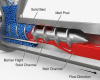
- The BLOOM Solution: We analyzed their high-calcium PVC formulation and designed a PVC pipe extrusion screw with a customized Barrier flight profile to efficiently separate solid and melt pools while optimizing the L/D ratio.
- The Result: Capacity jumped 22% without increasing motor load. Melt temperature now stays within ±2°C of the target, eliminating burning and pressure surging entirely.
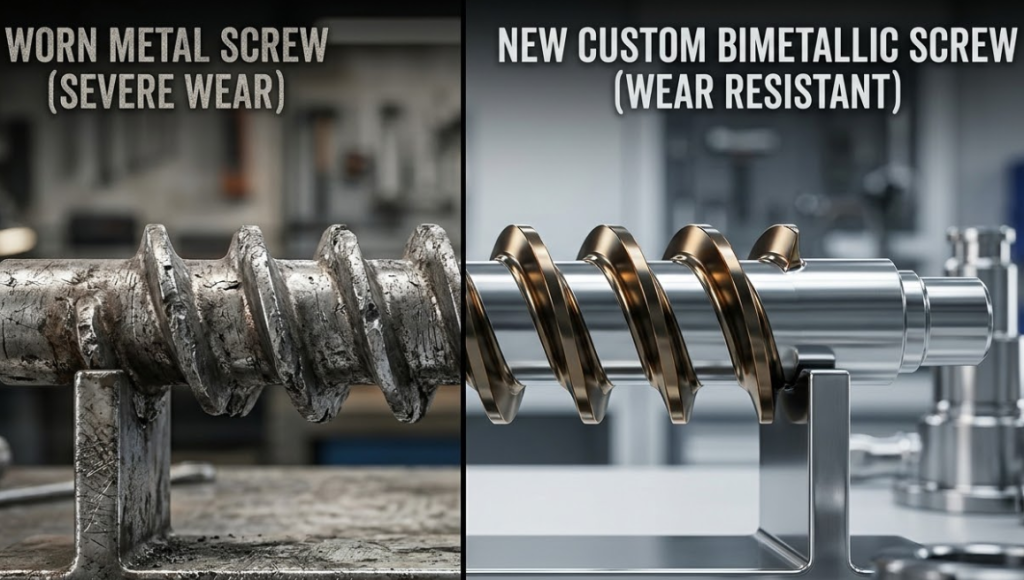
Fixing the Root Cause: Generic vs. Custom Bimetallic Extruder Screws
If you continually suffer from electrical and pressure fluctuations, buying identical, cheap replacement screws is just funding your own downtime. The permanent fix requires an upgrade in geometry and metallurgy.
Table 3: Generic OEM Screws vs. BLOOM Custom Solutions
| Core Metric | Generic Standard Screws (Band-Aid Fix) | BLOOM Custom Bimetallic Screws (Root Cure) |
| Geometry (L/D & CR) | Fixed, compromised parameters designed to “sort of” process everything. | Calculated specifically for your polymer’s Melt Flow Index (MFI) to lock in the perfect compression ratio. |
| Metallurgy & Coating | Basic gas nitriding (effective depth only 0.4-0.6mm). Once breached, wear accelerates exponentially. | Fully hardened tool steel (SKD11), powder metallurgy, or thick PTA bimetallic armor (wear layer > 2.0mm). Lifespan increases 3x-5x. |
| Efficiency & Yield | Rapid onset of leakage flow increases Specific Energy consumption and scrap rates. | Ultra-high plasticizing efficiency with dead-steady back pressure, enabling “lights-out” stable manufacturing. |
Stop Letting a Worn Screw Dictate Your Production Schedule
The heart of your extrusion line is that spinning shaft of steel. Wild current swings and erratic back pressures are distress signals. Ignoring them guarantees wasted resin, missed deadlines, and ruined machinery.
Stop the guesswork. Send BLOOM your current material formulations, machine symptoms, or photos of your worn screw. Our rheology engineers will provide a free, data-driven wear assessment and design the exact custom screw your production line needs to run flawlessly.
Frequently Asked Questions (FAQ)
1. What is the normal operating range for extruder melt pressure?
There is no universal number; it depends on your polymer, die resistance, and screen pack mesh. It typically ranges from 5 MPa to 25 MPa. The critical metric isn’t the absolute number, but the stability—normal fluctuation should not exceed ±5% of your setpoint.
2. I just installed a new screw, why is my extruder main motor current still fluctuating?
If a brand-new screw causes surging, it usually points to an improper geometric design. The compression ratio or transition zone of the new screw likely conflicts with your specific resin’s melting behavior, causing solid bed breakup. This requires a custom redesign by BLOOM.
3. What type of screw do I need for processing plastics with 30%+ glass fiber?
Never use standard nitrided screws for this application. You absolutely need custom bimetallic extruder screws featuring a PTA-welded Tungsten Carbide alloy flight coating (HRC 60+ minimum) to withstand the severe abrasive wear of the glass fibers.
4. Can extruder surging cause my main motor to burn out?
Yes. Severe leakage flow and sudden material grabbing create massive torque spikes. If your variable frequency drive (VFD) or overload relays fail to trip in time, these repetitive high-current surges will eventually fry the motor windings.
5. How do I accurately perform an extruder screw wear measurement?
The most reliable method during a teardown is using a feeler gauge to measure the radial clearance between the flight tip and the barrel wall. As a rule of thumb, if the gap exceeds 3 to 4 times the original factory clearance (e.g., growing from 0.2mm to 0.8mm+), or if you must drastically increase RPMs to maintain baseline output, it is time to contact BLOOM for a replacement.